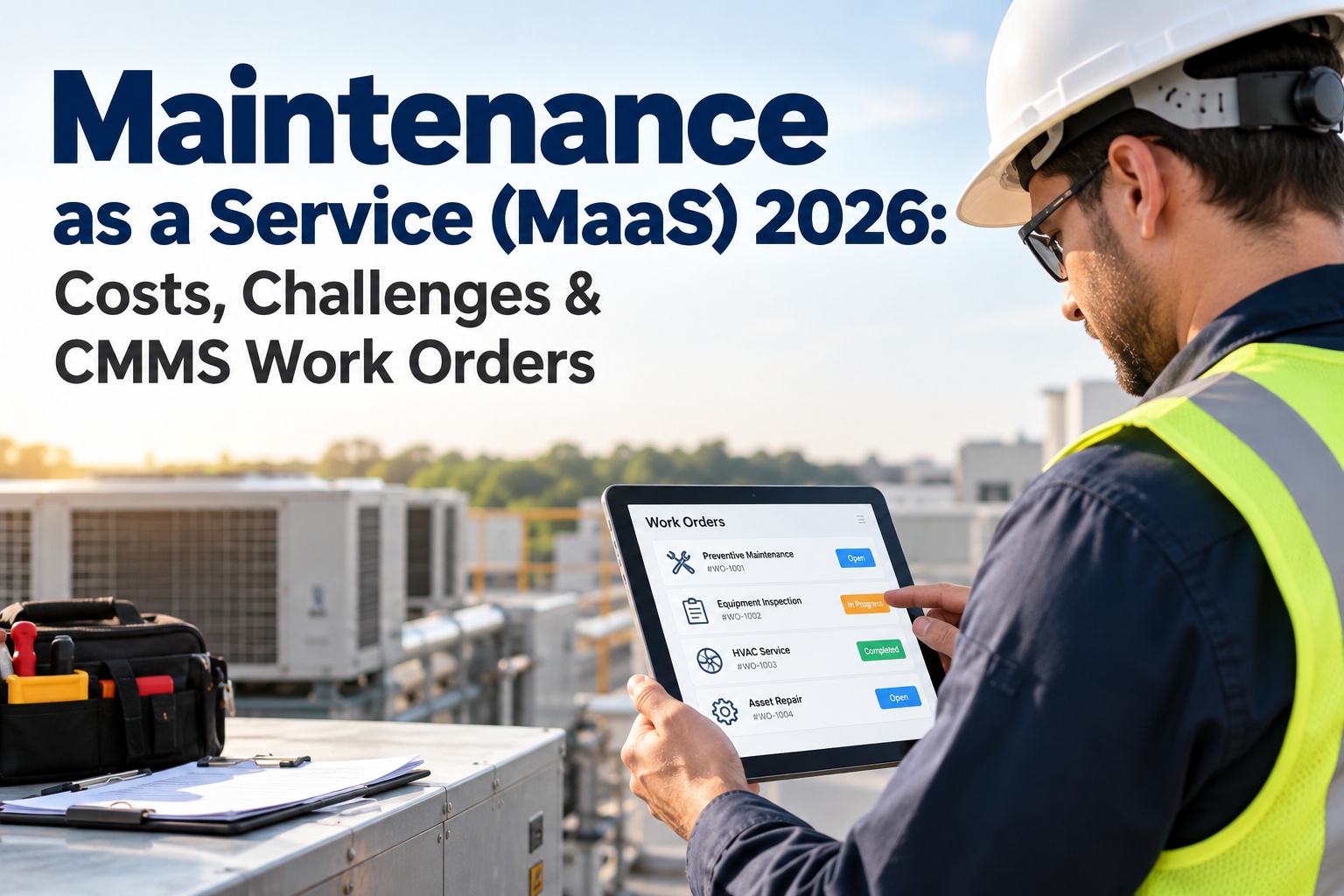
Hiring maintenance talent is hard, sensors and analytics are expensive, and a single unplanned breakdown can erase a quarter's savings. That's the pull behind Maintenance-as-a-Service: pay a subscription, and someone else brings the technicians, the predictive tech and the accountability. But the model has real trade-offs — who owns your data, who's on the hook for uptime, and what happens to your in-house knowledge. OXMAINT AI is the AI-powered maintenance management software (CMMS) that runs underneath any MaaS arrangement — the work orders, asset history and SLA evidence both sides depend on. Book a demo to see the system of record behind the service.
Maintenance as a Service: What It Costs, What It Solves, What to Watch
In-House vs Maintenance-as-a-Service
The choice isn't all-or-nothing, but it helps to see the two ends clearly. Most operations land somewhere in between — often keeping the CMMS in-house while buying the service around it. Start a free trial to keep the record layer yours.
- Capital spend on tools, sensors, software
- You recruit and retain the technicians
- Full control of data and decisions
- Cost spikes with every major failure
- Predictive tech often out of reach
- Predictable subscription — OpEx, not CapEx
- Provider brings the crew and expertise
- Predictive analytics included in the fee
- Often an uptime or performance guarantee
- Data ownership and SLAs must be negotiated
The Five MaaS Models
"Maintenance-as-a-Service" isn't one product — it's a spectrum from a monitoring add-on to a full pay-per-uptime arrangement. Knowing which model you're buying is half the negotiation. Book a demo to see which fits your assets.
Five-model framework per predictive-maintenance service guidance (Prometheus Group). Most commercial offers blend two or three of these. Source: Prometheus Group.
Whichever Model You Pick, Keep the System of Record
The Balance Sheet: Benefits and Challenges
A fair look at MaaS puts the upside and the risk side by side. The benefits are real; so are the trade-offs, and they're where the contract matters most. Start a free trial to protect your side of it.
Challenge set per MaaS analysis (Prometheus Group): data ownership, SLA complexity, ROI difficulty, and stakeholder alignment are the recurring hard parts. The common thread — every one is easier to manage when you keep your own maintenance record.
How MaaS Is Priced
The pricing structure decides who carries which risk. Match it to how predictable your assets are and how much control you want to keep. Book a demo to model the fit.
| Pricing model | How you pay | Best when |
|---|---|---|
| Fixed subscription | Flat monthly or annual fee covering labor, parts and tech | You want budget certainty above all |
| Per-asset | A rate per monitored machine or line | You're scaling coverage gradually |
| Pay-per-use / uptime | Per hour of operation; provider carries uptime risk | Utilization varies and you want risk shifted |
| Outcome / performance | Tied to a guaranteed uptime or availability target | The SLA can be clearly defined and measured |
Pricing structures are typical of the MaaS market; actual terms vary by provider and asset class. The one constant worth insisting on: a shared, auditable record of the work performed.
Why the CMMS Is the Backbone of Any MaaS Deal
A service is only as trustworthy as its records. The CMMS is where both sides see the same work orders, the same asset history and the same SLA evidence — so OXMAINT AI keeps you in the driver's seat whoever does the wrenching. Start a free trial to own the record.
-
1
One asset register
Every covered device, its history and its criticality on a record you own, not the provider's. -
2
Every task a work order
Provider and in-house work alike flow through the same ranked, tracked work-order system. -
3
SLA evidence
Timestamped completions and uptime data to hold a performance guarantee to account. -
4
Portable history
If you change providers or bring work back in-house, the asset record comes with you.

.jpg)

