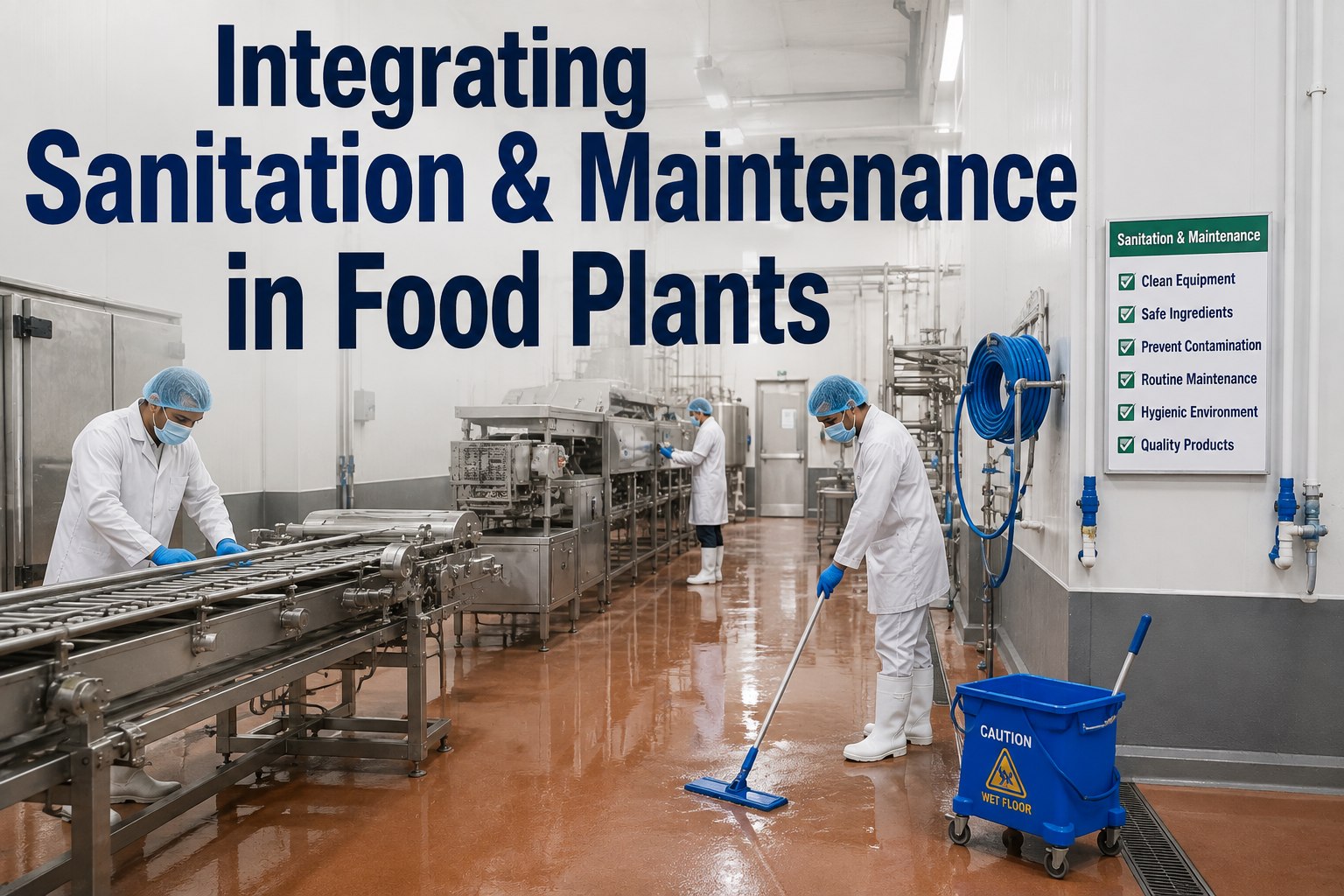
Food plant maintenance and sanitation integration is where food safety and equipment reliability either work as one system — or leave gaps that show up as recalls, failed audits, and unplanned downtime. When maintenance and sanitation teams operate on disconnected schedules, the result is missed preventive maintenance (PM) windows, CIP cycles that degrade equipment, and sanitation-critical assets that fail between shifts. OxMaint unifies both programs inside a single AI-powered CMMS, so food manufacturing teams can coordinate master sanitation schedules, hygienic design PMs, and work orders without compromising food safety or production targets. You can Start Free Trial today or book a guided demo to see the integration on your own asset register.
When sanitation and maintenance collide on the floor, who keeps the line running — and audit-ready?
A single missed sanitation-critical PM can trigger a recall event costing $10M on average. OxMaint aligns your master sanitation schedule with preventive maintenance so both programs run as one closed-loop system — no spreadsheet gaps, no audit surprises.
Why food plant sanitation and maintenance teams collide
In most food processing facilities, sanitation owns cleaning and maintenance owns repair — but their schedules, work orders, and data never connect. That split creates the exact gaps auditors and pathogens exploit.
Overlapping downtime windows
Sanitation needs 90–180 minutes of line access for CIP; maintenance needs the same window for PM. Without a shared schedule, one team waits on the other — burning 4–8 hours of weekly OEE.
Sanitation-critical PMs get skipped
Gaskets, seals, and spray balls degrade during cleaning cycles. If PMs on these components aren't tagged as sanitation-critical, they fail silently — turning a $15 gasket into a contamination event.
Hygienic design drift
Replacement parts that don't meet hygienic design specs get installed during emergency repairs. Once a non-sanitary weld or fitting enters the line, it becomes a harborage point that sanitation can't fully clean.
Audit evidence scattered across systems
Sanitation logs live in one spreadsheet, PM records in another, and corrective actions in email. During a FSMA or SQF audit, reconstructing who did what and when takes days instead of minutes.
Checklist: identifying sanitation-critical maintenance in food plants
Not every asset carries the same food safety risk. Use this tiered checklist to tag equipment that requires coordinated sanitation-maintenance attention, then mirror these tags inside your CMMS asset hierarchy.
Direct product contact
- Filler nozzles, seals, and O-rings on a CIP cycle
- Heat exchanger plates and gaskets
- Spray balls, CIP supply pumps, and return lines
- Conveyor belts and direct-contact guide rails
Indirect contact & environment
- HVAC and filtration serving high-care zones
- Drains, trench covers, and waste handling conveyors
- Overhead structures, catwalks, and utility lines
- Forklifts and pallet jacks moving between zones
Utility & CIP infrastructure
- CIP skid pumps, valves, and heat recovery units
- Compressed air dryers and filters in contact zones
- Water treatment and softener systems
- Boiler and steam distribution for sanitation cycles
How to integrate sanitation schedules with food plant maintenance
A coordinated program doesn't require reorganizing departments — it requires a shared data structure. Here's a six-step framework that plants can implement inside a CMMS within 30 days.
Map the master sanitation schedule into the CMMS
Import every daily, weekly, and master sanitation task as a scheduled work order linked to the asset it covers. This eliminates the parallel spreadsheet and makes sanitation tasks visible on the same calendar as PMs.
Tag sanitation-critical PMs
Flag any PM on a Tier 1 asset with a sanitation-critical designation. These PMs trigger automatically when the corresponding CIP or COP cycle completes, ensuring gaskets and seals are inspected right after cleaning — not weeks later.
Enforce hygienic design specs on spare parts
Attach hygienic design criteria (3-A, EHEDG) to each asset's BOM in the CMMS. When a technician pulls a replacement part, the system blocks non-compliant substitutes — preventing hygienic design drift during emergency repairs.
Merge downtime windows
Schedule sanitation and maintenance tasks into the same changeover or CIP window using a shared calendar. A 120-minute CIP cycle can absorb 20–40 minutes of concurrent PM if both teams see the same timeline.
Link corrective actions across both programs
When sanitation finds a cracked weld or worn belt, it becomes a maintenance work order instantly — not a note on a clipboard. Bi-directional triggers close the loop between detection and repair in hours, not shifts.
Generate unified audit trails
Every sanitation task, PM, parts replacement, and corrective action is time-stamped and attributable. For an SQF or FSMA audit, export the full history of any asset in under 60 seconds — no reconstruction required.
Disconnected vs integrated: what changes when programs align
The table below maps the operational difference between running sanitation and maintenance as separate silos versus integrating both inside a single CMMS platform.
| Dimension | Disconnected (spreadsheets + clipboards) | Integrated (OxMaint CMMS) |
|---|---|---|
| Scheduling | Separate calendars; conflicts discovered on the floor | Shared calendar; CIP and PM windows merged automatically |
| Sanitation-critical PMs | Not differentiated; inspected on generic intervals | Tagged and triggered post-CIP; zero missed inspections |
| Parts compliance | Technician grabs whatever fits; specs unchecked | BOM enforces 3-A / EHEDG spec; non-compliant parts blocked |
| Corrective action loop | Paper note handed off; 24–72 hour lag to repair | Sanitation finding auto-creates work order; 2–4 hour response |
| Audit readiness | 3–5 days reconstructing records per audit | Full asset history exportable in under 60 seconds |
| Weekly OEE loss to conflicts | 4–8 hours of idle time per line | Under 1 hour; windows stacked and sequenced |
OxMaint capabilities for integrated food plant maintenance
OxMaint was built to close the gap between sanitation and maintenance — not with another siloed tool, but with a unified CMMS that treats food safety and reliability as one program. Here are four concrete capabilities and the measurable outcomes they deliver.
Unified master sanitation + PM calendar
Import your master sanitation schedule as recurring work orders alongside PMs. OxMaint's shared calendar surfaces conflicts before they reach the floor, so CIP and maintenance windows stack — not collide. Plants recover 4–6 hours of weekly OEE per line.
Sanitation-critical PM triggers
Tag any asset as sanitation-critical and OxMaint auto-generates the inspection PM the moment its linked CIP cycle closes. Gaskets, seals, and spray balls get checked right after cleaning — every time, with no manual handoff.
Hygienic design parts enforcement
Attach 3-A, EHEDG, or internal hygienic specs to each asset's BOM. OxMaint blocks checkout of non-compliant spare parts during work order execution, preventing the slow drift that turns a quick fix into a harborage point.
One-click audit trail export
Every sanitation task, PM, parts swap, and corrective action is time-stamped, attributable, and searchable. For an SQF, BRC, or FSMA audit, export the complete maintenance-and-sanitation history of any asset in under 60 seconds.
A 180-asset dairy plant spending $42K/year on reactive repairs
A mid-size dairy processor ran sanitation on paper logs and PMs on a legacy CMMS that didn't talk to the sanitation calendar. Sanitation-critical gaskets on filler nozzles were inspected quarterly — but CIP ran daily. After integrating both programs in OxMaint, gasket inspections became CIP-triggered, non-spec replacements were blocked at the parts crib, and the shared calendar recovered 5 hours of weekly line time. Result: $18K in emergency repair costs avoided in year one, a 30% drop in unplanned filler downtime, and an SQF audit completed with zero non-conformances on equipment records.
What disconnected sanitation and maintenance really costs
When food plant hygiene and reliability programs don't share a system, the costs compound quietly — until a recall, a failed audit, or a multi-day line stoppage makes them visible.
See OxMaint integrate your sanitation and maintenance programs
Book a 30-minute demo and we'll map your master sanitation schedule and Tier 1 asset list into a live CMMS environment — so you can see CIP-triggered PMs, hygienic parts enforcement, and one-click audit exports on day one.
Food plant maintenance and sanitation integration — answered
What is sanitation-critical maintenance in a food plant?
Sanitation-critical maintenance refers to preventive maintenance tasks on assets that directly affect food safety — filler seals, CIP spray balls, heat exchanger gaskets, and any component where degradation creates a contamination risk. OxMaint lets you tag these assets so their PMs trigger automatically after each CIP or COP cycle, eliminating the gap between cleaning and inspection. You can Start Free Trial to test the tagging on your own asset register.
How does a CMMS integrate with a master sanitation schedule?
A CMMS imports every daily, weekly, and master sanitation task as a scheduled work order linked to the asset it covers, placing it on the same calendar as PMs. This eliminates parallel spreadsheets, surfaces scheduling conflicts before they hit the floor, and creates a unified audit trail. OxMaint supports direct import of existing sanitation schedules during onboarding.
What hygienic design standards should maintenance follow in food plants?
The most referenced standards are 3-A Sanitary Standards, EHEDG guidelines, and FDA FSMA preventive controls. Maintenance teams should enforce these specs at the parts level — every replacement gasket, weld, or fitting on a product-contact asset must meet the applicable standard. OxMaint enforces this by attaching hygienic design criteria to each asset's BOM and blocking non-compliant parts at checkout.
How often should CIP systems receive preventive maintenance?
CIP-critical components like spray balls, supply pumps, and heat exchanger gaskets should be inspected at least monthly, with full seal and gasket replacement quarterly on high-use lines. OxMaint automates these intervals and can trigger inspections immediately after each CIP cycle completes, so wear is caught before it affects cleaning efficacy.
Can OxMaint generate audit-ready records for SQF, BRC, or FSMA inspections?
Yes. Every sanitation task, PM, parts replacement, and corrective action logged in OxMaint is time-stamped and attributable to a specific technician. For an SQF, BRC, or FSMA audit, you can export the complete maintenance-and-sanitation history of any asset in under 60 seconds. Book a Demo to see a live audit export on sample data.
Stop running sanitation and maintenance on separate systems
Integrate both programs inside OxMaint — CIP-triggered PMs, hygienic parts enforcement, shared downtime calendars, and audit-ready records in one AI-powered CMMS. Free 14-day trial · No credit card.
Free 14-day trial · No credit card