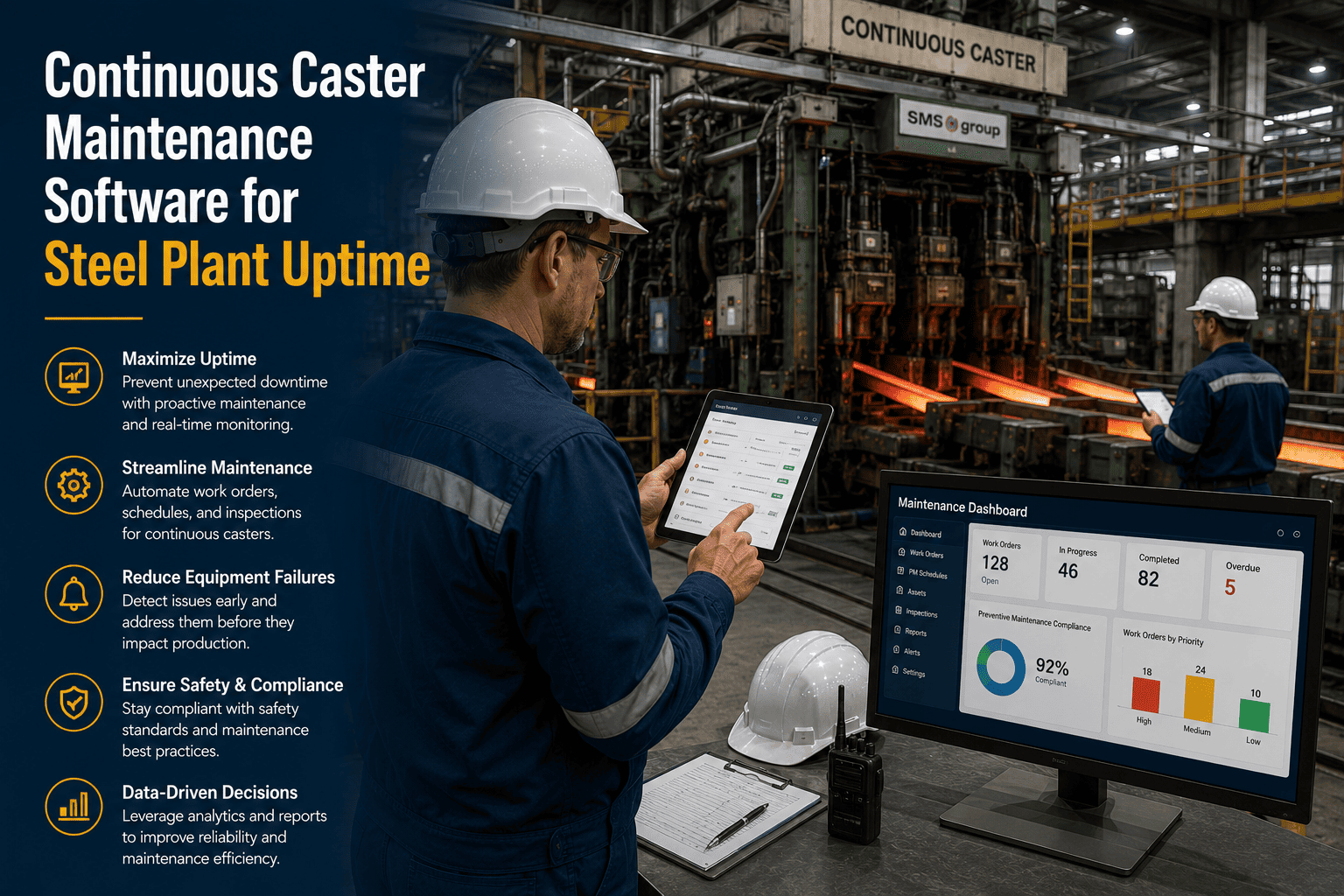
Steel plants live and die by furnace uptime. A single unplanned blast furnace or reheat furnace shutdown costs $150,000 to $500,000 per day in lost production — and the average integrated steel mill experiences 4 to 7 unplanned furnace outages annually. The problem isn't that furnaces fail without warning: refractory degradation, cooling system anomalies, and burner wear all follow predictable deterioration curves. The problem is that most steel plants are still running furnace maintenance on fixed schedules and manual inspections that miss 60% of early-stage failures. A CMMS built for furnace lifecycle management changes the equation — connecting sensor data, inspection records, and predictive alerts into a single workflow that converts emergency shutdowns into planned maintenance windows. Start a free trial on Oxmaint to see how furnace asset tracking works across your plant, or book a demo and we'll map your specific furnace asset structure.
Stop Fighting Fires. Start Preventing Them.
See how Oxmaint eliminates unplanned furnace shutdowns in steel plants — live, in 30 minutes.
Most steel maintenance teams eliminate their first unplanned shutdown within 90 days of deployment. See how.
- Real-time furnace asset visibility across all process lines
- Predictive failure alerts before refractory and burner breakdown
- 5–10 year CapEx forecasting for furnace major repairs
Used by operations teams managing 10,000+ assets — live in days, not months
What Is Furnace Shutdown Reduction CMMS?
Turning Reactive Furnace Shutdowns Into Planned Maintenance
A furnace shutdown reduction CMMS is a computerized maintenance management system specifically configured to monitor, track, and predict failures across steel plant furnace assets — blast furnaces, reheat furnaces, ladle furnaces, electric arc furnaces, and annealing lines. Unlike generic maintenance software, it integrates thermal monitoring, refractory inspection schedules, cooling water analytics, and burner performance data into a single asset lifecycle record.
The core principle is converting time-based maintenance into condition-based maintenance. Instead of scheduling furnace inspections every 90 days regardless of actual degradation, the CMMS monitors real-time health indicators and triggers work orders when thresholds are crossed — not when the calendar says so. Industry data confirms that condition-based furnace maintenance reduces emergency repair costs by 60–75% compared to reactive response. Start a free trial to see how Oxmaint structures furnace asset hierarchies for your specific plant configuration.
The most operationally damaging gap in steel plant maintenance is the interval between when a furnace problem becomes detectable and when it triggers a production halt. CMMS bridges that gap — giving maintenance teams 2 to 8 weeks of actionable lead time on the failures that matter most.
Core CMMS Capabilities
8 Furnace Maintenance Capabilities That Reduce Shutdown Risk
01
Refractory Health Tracking
Track lining thickness, hot spot location, and campaign length against historical benchmarks. Flag degradation trajectories before they reach critical thresholds.
02
Burner Condition Monitoring
Log burner performance data, fuel consumption ratios, and flame pattern anomalies. Auto-generate work orders when efficiency drops below target bands.
03
Cooling System Alerts
Monitor cooling panel flow rates, water temperature differentials, and pressure drops. Early cooling failure detection prevents catastrophic furnace shell damage.
04
Shutdown Planning Workflows
Pre-build shutdown task lists, parts requirements, contractor schedules, and safety permits. Execute planned shutdowns in 30–40% less time than reactive events.
05
Asset Condition Scoring
Each furnace component receives a live condition score aggregating inspection data, sensor readings, and repair history. Portfolio managers see risk across all furnaces at a glance.
06
PM Schedule Automation
Replace fixed-interval PMs with dynamic schedules triggered by operating hours, heat cycles, or condition thresholds. Reduce unnecessary PM work by 25–35%.
07
IoT and SCADA Integration
Pull real-time data from existing process control systems via OPC-UA and Modbus. No parallel data entry — furnace sensor data feeds directly into maintenance records.
08
CapEx Forecasting
Generate rolling 5–10 year major repair forecasts based on current asset conditions. Give finance teams investment-grade cost projections instead of emergency budget requests.
Industry Pain Points
Why Steel Plants Keep Experiencing Furnace Shutdowns
Steel plant maintenance leaders consistently identify the same failure patterns — and they all trace back to visibility gaps that a properly configured CMMS eliminates. Start a free trial to identify which gaps are costing your plant the most.
No Early Warning on Refractory Wear
Visual inspection catches refractory problems when they've already progressed to the point of risk. Infrared and thickness monitoring data exists but isn't integrated into work order triggers.
Siloed Maintenance Records
Inspection records in spreadsheets, work orders in paper logs, sensor data in the DCS, and parts history in ERP — no single view of furnace health means no one catches the converging failure signals.
Emergency Repairs at 4.8× Cost
Reactive furnace repairs cost 4.8 times more than the same work performed as planned maintenance. Emergency contractor rates, expedited parts freight, and secondary damage multiply cost rapidly.
CapEx Surprises Destroying Budgets
Major reline campaigns and furnace overhauls appear as budget shocks rather than planned investments. Without condition-based forecasting, CFOs have no visibility into furnace capital requirements 3–5 years out.
Shift Handover Failures
Critical furnace anomalies observed on one shift fail to transfer effectively to the next. Informal verbal handovers miss 30–40% of time-sensitive equipment observations that should trigger immediate action.
Compliance Documentation Gaps
Pressure vessel inspections, safety relief valve certifications, and environmental compliance records scattered across departments create audit risk and regulatory exposure during facility inspections.
Most steel plants lose 20–40% of their annual maintenance budget to unplanned furnace shutdowns that were preventable with 4 weeks of early warning.
How Oxmaint Solves It
How Oxmaint Eliminates Furnace Shutdown Risk
Unified Furnace Asset Registry
Every furnace component — refractory lining, burner assemblies, cooling panels, pressure vessels, instrumentation — lives in a single hierarchy with condition scores, maintenance history, and next-action triggers. Portfolio view covers all furnaces across all production lines.
Condition-Based Alert Engine
Set threshold rules on any sensor channel or inspection parameter. When cooling water differential exceeds target or refractory temperature profile shifts, work orders generate automatically with priority routing to the right technician on the right shift.
Shutdown Planning Toolkit
Pre-loaded task libraries for reline campaigns, burner overhauls, and major inspections. Drag-and-drop scheduling, parts reservation, permit-to-work integration, and contractor coordination — all from the same platform.
SCADA and IoT Data Bridge
Native OPC-UA, Modbus, and REST API connections pull furnace telemetry directly into maintenance records. No manual transcription. Sensor readings become maintenance evidence linked to asset condition history.
Rolling CapEx Forecasting
Oxmaint generates 5–10 year major repair cost projections from current asset condition scores and campaign history data. Finance teams get investment-grade CapEx models instead of reactive budget requests.
Mobile-First Field Operations
Technicians receive, execute, and close work orders from the furnace floor on mobile. Photo evidence, inspection readings, and failure notes attach directly to asset records — no paper, no transcription lag.
Reactive vs Planned Comparison
Reactive Furnace Maintenance vs Planned CMMS-Driven Approach
| Maintenance Dimension |
Reactive (No CMMS) |
Planned (Oxmaint CMMS) |
| Refractory failure detection |
Visual inspection only — problems detected at crisis stage |
Thermal and thickness monitoring — 4–8 weeks early warning |
| Unplanned shutdown frequency |
4–7 events per year, $150K–$500K per event |
Target: 1–2 events per year after 12 months deployment |
| Emergency repair cost premium |
4.8× planned maintenance cost — expedited parts and contractor rates |
Planned windows — standard parts pricing, scheduled contractors |
| Maintenance record quality |
Paper logs, spreadsheets, verbal handovers — 30–40% data loss |
Digital records with photos, readings, and technician sign-off |
| CapEx planning horizon |
Budget surprises — major repairs appear with 3–6 months notice |
5–10 year rolling forecast from current condition data |
| Compliance readiness |
Audit preparation takes weeks — records scattered across departments |
Instant audit trail — all records timestamped and asset-linked |
ROI and Results
What Steel Plants Report After CMMS Deployment
Steel operations teams using structured CMMS for furnace management consistently report measurable outcomes within the first year. Teams switching from reactive to planned maintenance see up to 40% lower breakdown costs — start a free trial to see how quickly these results appear on your furnace assets.
63%
Reduction in Emergency Repair Costs
Planned maintenance vs reactive response on equivalent furnace repairs
4–8 Wks
Early Warning Lead Time
Average advance notice on furnace failures using condition monitoring and CMMS alerts
35%
Faster Planned Shutdown Execution
Pre-built task libraries and parts reservation reduce planned outage duration
$2.1M
Average Annual Savings
Typical integrated steel mill with 3+ furnace assets after 12-month CMMS deployment
FAQ
Furnace CMMS: Common Questions
How long does it take to deploy Oxmaint for furnace maintenance?
Most steel plants complete initial deployment within 2–4 weeks. Oxmaint's asset import tools accept data from existing ERP systems, spreadsheets, or manual entry — no heavy implementation project required. Basic furnace asset hierarchies, PM schedules, and alert rules are typically live within the first week.
Start a free trial and see how quickly your team is operational.
Can Oxmaint connect to our existing blast furnace SCADA system?
Yes. Oxmaint supports OPC-UA, Modbus TCP, and REST API integrations for pulling sensor data from existing DCS and SCADA systems. For older systems without standard protocol support, flat file imports and manual sensor reading workflows provide a bridge path.
Book a demo to review your specific integration architecture.
How does Oxmaint handle furnace campaign tracking and reline scheduling?
Oxmaint tracks campaign heat counts, lining age, and thickness measurements against campaign targets. When projected remaining life crosses threshold, the system auto-generates reline planning tasks with configurable lead times — typically 8–12 weeks before required shutdown. This gives procurement, contractors, and production planning the notice they need to minimize production loss.
Does the CMMS support permit-to-work for furnace maintenance activities?
Oxmaint includes digital permit-to-work workflows with multi-level approval chains, LOTO procedure checklists, and energy isolation verification steps. All permit records link to the work order and asset record, creating a complete safety audit trail for every furnace maintenance event — meeting OSHA PSM requirements and ISO 45001 compliance frameworks.
Stop Losing Millions to Reactive Furnace Failures
Turn Every Furnace Into a Predictable, Trackable Asset with Oxmaint
See measurable results in the first 30 days. No heavy implementation. Works across multi-site portfolios. Live in days, not months.
- Real-time furnace asset visibility across all process lines
- Predictive failure alerts before refractory and burner breakdown
- 5–10 year CapEx forecasting for furnace major repairs
Used by operations teams managing 10,000+ assets — limited onboarding slots available this quarter