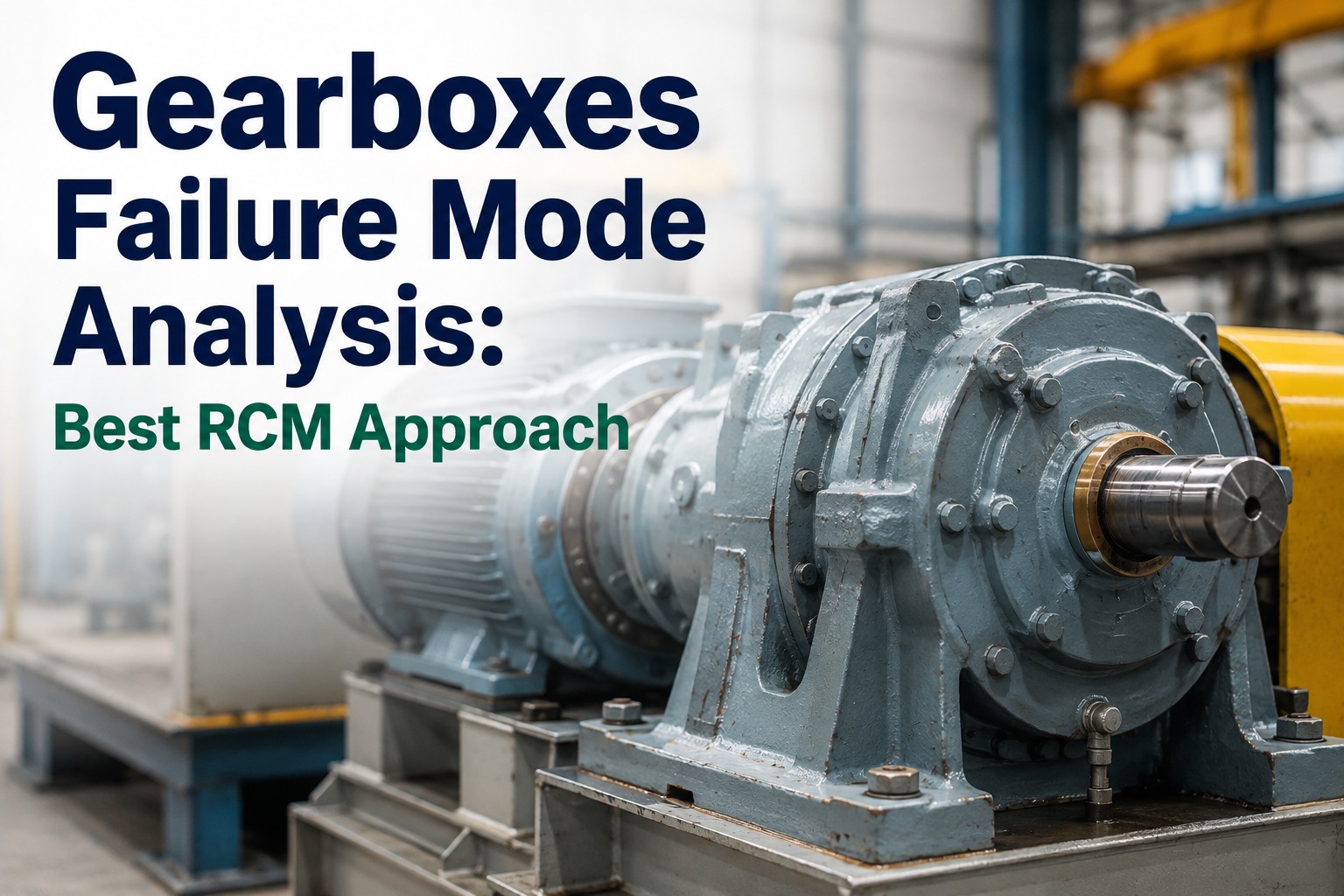
Industrial gearboxes fail in patterns that AGMA 1010, ISO 10825, and half a century of tribology literature have mapped in exhaustive detail — and yet the same failures keep surprising plants that skipped the FMEA step at commissioning. Gear tooth fractures alone account for roughly 38% of unplanned industrial gearbox replacements per Power Transmission Engineering benchmark data, and in open-pit mining that figure rises to 75%. Bearings are the second-largest failure driver, seals the third, lubrication the underlying accelerant across all of them. Every one of those failure modes is detectable weeks before functional failure with the right combination of vibration analysis, oil analysis, and thermal trending — but only if the FMEA analysis exists as living records inside the CMMS rather than as a consulting deliverable that died in a shared drive. This guide is the working FMEA reference for industrial gearboxes: every dominant failure mode per sub-system, root cause chain, severity/occurrence/detection scoring, vibration signature, and the RCM task that pre-empts it. Use it as the starting template for your gearbox FMEA library, and route the resulting tasks into scheduled work orders so the analysis becomes operational reality instead of paperwork. Book a free demo to see gearbox FMEA-driven WOs firing against a real asset register.
38%
Of unplanned industrial gearbox replacements caused by gear tooth failure alone
6–8 wks
Bearing wear detection lead time achievable with vibration spectroscopy in cement mill benchmarks
82%
Reduction in contamination-related failures from annual oil analysis + seal inspection cadence
73%
Downtime reduction reported in heavy-industry gearboxes with vibration + oil monitoring combined
The Six Sub-Systems · Where Gearboxes Actually Fail
A gearbox is not a single asset — it's six interacting sub-systems, each with its own dominant failure modes. Root cause analysis without sub-system decomposition confuses cause and effect. A bearing failure often shows up first in the vibration signature as a gear tooth issue; a seal failure quickly becomes a lubrication failure. Get the sub-system taxonomy right and the FMEA scoring becomes trivial.
S1
Gears & Teeth
~38% of failures
Bending fatigue · pitting · micropitting · scuffing · wear · spalling · tooth fracture
S2
Bearings
~30% of failures
Raceway pitting · spalling · brinelling · cage damage · false brinelling · fluting
S3
Shafts & Couplings
~10% of failures
Torsional fatigue · misalignment · fretting corrosion · coupling wear
S4
Seals
~10% of failures
Lip seal wear · shaft groove wear · ingress contamination · thermal cracking
S5
Lubrication System
Root of 70%+ chains
Contamination · degradation · viscosity loss · water ingress · foaming · additive depletion
S6
Housing & Breather
~2% of failures
Casting cracks · breather blockage · desiccant saturation · fastener loosening
The Five Gear Tooth Failure Modes · AGMA 1010 Reference
Machine Design and AGMA nomenclature both converge on the same five dominant tooth failure modes. Understanding what each one actually looks like — mechanism, contact zone, precipitating condition — is what separates a real FMEA from a copy-pasted template. Below is the working reference.
T1
Bending Fatigue
Mechanism: Cyclic bending stress at tooth root · crack initiation at fillet · propagation until fracture
Triggers: Overload · shock cycling · design margin exceeded · sub-surface material defect
Signature: Broad-spectrum energy burst · low-frequency impact at shaft rotation period
T2
Pitting (Macropitting)
Mechanism: Hertzian contact fatigue · sub-surface cracks propagate to surface · material breaks away in visible pits
Triggers: Surface fatigue at pitch line · overload · inadequate lubricant film thickness
Signature: GMF sidebands at shaft speed · elevated first three GMF harmonics
T3
Micropitting (Grey Staining)
Mechanism: Micro-scale surface cracks below 20 µm · matte grey appearance · precursor to macropitting
Triggers: Thin EHL film · rough tooth surfaces · low-viscosity lubricant · high sliding velocity
Signature: Subtle high-frequency vibration rise · oil debris shows fine ferrous particles
T4
Scuffing (Scoring / Galling)
Mechanism: Adhesive wear · lubricant film ruptures · metal welds and tears · material transfers between mating teeth
Triggers: Overload · high sliding velocity · high contact temperature · EP additive depletion
Signature: Rapid high-frequency energy rise · oil temperature spike · burnt smell in vent
T5
Abrasive Wear
Mechanism: Hard particles in the oil abrade tooth surfaces · gradual material removal · profile degradation
Triggers: Silica or metallic contamination · seal leakage · inadequate filtration · breather ingress
Signature: Broadband noise floor rise · ISO 4406 particle count elevation · viscosity drift
The Master FMEA Table · Every Dominant Mode Scored
This is the working reference — every gearbox failure mode any reliability team should have in the CMMS as a distinct FMEA record. Severity, occurrence, and detection scored on the standard 1–10 scale (higher is worse). RPN = S × O × D. Anything above 100 gets a dedicated RCM task; anything above 150 gets predictive monitoring plus a scheduled task.
Sub-System
Failure Mode
Root Cause
Effect
S
O
D
RPN
Gears
Tooth bending fatigue fracture
Overload · shock cycling · fatigue exhaustion
Catastrophic gearbox failure · driven machine damage
10
4
4
160
Bearings
Raceway spalling
Contamination · fatigue · inadequate lubrication
Loss of alignment · gear damage · shutdown
9
5
3
135
Gears
Macropitting / spalling
Surface fatigue · thin EHL film · overload
Increased noise · vibration · progressive tooth damage
8
6
3
144
Lubrication
Silica / metallic contamination
Seal failure · breather ingress · dirty top-up
Accelerated wear all components · downstream cascade
8
6
3
144
Gears
Scuffing (adhesive wear)
Lubricant film rupture · EP additive depletion · overload
Rapid tooth degradation · potential catastrophic failure
9
4
3
108
Bearings
Raceway pitting
Fatigue · contamination · misalignment loading
Progressive bearing degradation · vibration rise
7
6
3
126
Lubrication
Water ingress / emulsification
Seal degradation · breather failure · thermal cycling
Additive depletion · corrosion · foam formation
8
5
3
120
Gears
Micropitting (grey staining)
Thin lubricant film · rough surface · low viscosity
Progressive surface fatigue · precursor to macropitting
6
6
4
144
Bearings
Cage / roller damage
Vibration · thrust load · lubrication starvation
Uneven loading · secondary raceway damage
7
4
3
84
Shafts
Shaft-coupling misalignment
Assembly error · thermal growth · foundation shift
Bearing overload · seal wear · vibration transmission
7
5
3
105
Seals
Lip seal wear / oil leak
Shaft surface wear · misalignment · thermal cycling
Oil loss · contamination ingress · lubrication starvation
7
6
2
84
Lubrication
Viscosity degradation / oxidation
Thermal aging · oxidation · service life exceeded
Lost film strength · surface wear · scuffing risk
6
5
3
90
Housing
Breather blockage / desiccant saturation
Dust ingress · humidity · missed replacement
Pressure differential · seal stress · moisture ingress
5
6
3
90
S Severity 1 (no effect) to 10 (catastrophic / safety)
O Occurrence 1 (very rare) to 10 (constant)
D Detection 1 (certain) to 10 (undetectable)
RPN S × O × D · >100 = RCM task · >150 = task + monitoring
The Vibration Signature Reference · What Each Mode Looks Like
Vibration spectral analysis is the single most productive detection method for gearbox failures once you know what to look for. Gear Mesh Frequency (GMF = number of teeth × shaft speed) and its sidebands are the primary diagnostic anchor. Different failure modes leave different signatures in the spectrum — the map below is the working reference.
Failure Mode
Primary Signature
Sideband Pattern
Detection Method
Tooth crack / bending fatigue
High-energy impact at shaft rotation period
Broadband energy burst · noise floor rise
Time waveform analysis · envelope demodulation
Macropitting / spalling
Multiple GMF harmonics with large amplitude
Dense sidebands spaced at shaft speed
FFT spectrum · GMF harmonic tracking
Micropitting (early)
Subtle high-frequency band rise (5–10 kHz)
Weak sideband families forming
High-freq envelope · oil ferrous debris
Scuffing (developing)
Rapid rise across full spectrum
Broadband energy · sudden increase
Overall RMS trend · thermal correlation
Bearing outer race defect
BPFO fundamental + harmonics
Low sideband content · asynchronous
Envelope demodulation · high-freq acceleration
Bearing inner race defect
BPFI + shaft-speed modulation
Strong shaft-speed sidebands
Envelope demodulation
Misalignment (coupling)
Strong 2× shaft-speed peak
Axial component elevated
Standard FFT · axial direction reading
Unbalance
Dominant 1× shaft-speed peak
Radial dominance · no sidebands
Standard FFT · radial reading
The Oil Analysis Reference · What Each Result Means
Oil analysis complements vibration by catching failures via a different physical pathway — wear metal particulate, viscosity change, contamination signals. Together they provide 6–8 week lead times on the failure modes that dominate gearbox reliability. The parameter reference below is what to test and what values trigger action.
ISO 4406
Particle Count
Target: 19/16 or better · action: 21/18
Contamination indicator · signals filtration failure, seal ingress, or wear debris accumulation
Wear Metals
Spectroscopic Analysis
Iron, copper, chromium, aluminum · trend against baseline
Iron rise → gear or shaft wear · copper rise → bronze cage · chromium → bearing race · aluminum → housing seat
Viscosity
ASTM D445 @ 40°C & 100°C
±10% of new oil spec triggers alarm
Viscosity drop → oxidation, fuel dilution, shear breakdown · rise → oxidation products, contamination
Water (Karl Fischer)
ASTM D6304
<500 ppm target · >1000 ppm action
Seal or breather ingress · additive depletion · emulsification · corrosion risk
TAN
Total Acid Number
Rise of 2 mg KOH/g over baseline = action
Oxidation progression · additive depletion · lubricant service life exhausted
Ferrous Debris
PQ / Ferrogram Analysis
Trend PQ index · morphology inspection
Distinguishes wear mode: cutting = abrasion · rubbing = normal · fatigue chunks = pitting/spalling
Build Your Gearbox FMEA Library in 30 Minutes
Working session with our reliability team — bring your gearbox register and current PM cadence. We'll map the sub-system FMEA table onto your assets, flag RPN >150 gaps, and show how OxMaint converts each record into a scheduled RCM task without a consulting engagement.
The Recommended RCM Tasks · What Each FMEA Record Should Trigger
An FMEA is not the deliverable — the scheduled task it triggers is. For each of the top failure modes above, the table below defines the RCM-selected task type (predictive, condition-based, preventive) and the cadence. Deploy these against your gearbox asset register in the CMMS and 70%+ of the failure modes above become predictable weeks in advance.
Failure Mode
RCM Task Type
Cadence
Recommended Action
Tooth bending fatigue fracture
Predictive
Continuous
Vibration time-waveform monitoring · torque limiter · load trending
Macropitting / spalling
Predictive
Monthly FFT
GMF harmonic tracking · oil ferrous PQ · shutdown at pit threshold
Micropitting
Condition-Based
Quarterly
High-freq envelope · oil debris trending · lubricant review if progressing
Scuffing (adhesive wear)
Predictive
Continuous
Oil temperature alarm · vibration RMS trend · EP additive test
Bearing raceway spalling
Predictive
Monthly
Envelope demodulation at BPFO/BPFI · oil debris trend · thermal check
Silica / metallic contamination
Condition-Based
Quarterly
ISO 4406 particle count · wear metal spectroscopy · seal integrity check
Water ingress / emulsification
Condition-Based
Quarterly
Karl Fischer water test · breather desiccant replacement · seal inspection
Shaft-coupling misalignment
Preventive
Semi-annual
Laser alignment · 2× shaft-speed vibration check · coupling inspection
Lip seal wear / oil leak
Preventive
Monthly walk-down
Visual leak check · shaft surface inspection at seal service · replace on wear
Viscosity degradation
Condition-Based
Quarterly
Viscosity test at 40°C · TAN measurement · oil change if outside spec
Breather blockage / desiccant saturation
Preventive
Quarterly
Desiccant color check · breather replacement · vent inspection
Root Cause Chain · Why Gearboxes Actually Die
Individual failure modes rarely happen in isolation. They cascade — a seal fails, contamination enters, oil degrades, gears wear, bearings load unevenly, and eventually something catastrophic happens. Understanding the cascade is what turns RCM from reactive replacement into pre-emptive root-cause intervention.
Root Cause
Seal degradation · silica ingress
→
Cascade
Contamination spikes · abrasive wear · bearing raceway pitting
→
Final Failure
Bearing failure · gear mesh misalignment · tooth damage
Root Cause
Overload / shock cycling
→
Cascade
Tooth root stress cycles · fatigue crack initiation · propagation
→
Final Failure
Tooth fracture · catastrophic gearbox failure
Root Cause
EP additive depletion · thermal excursion
→
Cascade
Lubricant film ruptures · metal-metal contact · welding
→
Final Failure
Scuffing · rapid tooth degradation · potential catastrophic
Root Cause
Coupling misalignment
→
Cascade
Bearing side-load · uneven raceway wear · seal shaft groove wear
→
Final Failure
Bearing spalling · seal leak · gear tooth pitting
Expert Perspective · Why Most Gearbox FMEAs Never Reach the Floor
Gearbox failure analysis is one of the most mature disciplines in industrial reliability. AGMA has been publishing tooth failure nomenclature standards for decades, tribologists have mapped every micropitting mechanism, and vibration analysts can name every sideband pattern in their sleep. The knowledge exists in enormous depth. But the plants that get surprised by gearbox failures are not the plants that don't know this material. They're the plants where the FMEA analysis lives in a report from a five-year-old reliability audit, the vibration monitoring data streams to a dashboard nobody watches, the oil analysis lab results get emailed to whoever's inbox, and the actual PM schedule was set by the OEM at commissioning and never revised. The mismatch between what's technically possible and what actually gets executed is enormous. What breaks the pattern is unglamorous. Every FMEA record lives as a database row inside the CMMS, attached to the specific gearbox it describes. Every threshold — vibration RMS, ISO 4406 particle count, wear metal ppm, oil temperature — auto-generates a work order when crossed. Every predictive task fires a scheduled WO that a millwright sees on their phone, not an alert that dies in a Grafana dashboard. Every closeout logs what was actually found so the FMEA scoring recalibrates against reality. That's the gearbox reliability program that captures the 73% downtime reduction the benchmark studies promise. The one that stays in the PDF report never will.
FMEA Lives in the CMMS
Failure mode records as database rows linked to each gearbox · not a report from the reliability audit consultant three years ago.
Two Signals Beat One
Vibration + oil analysis catch different failure phases. Neither alone is sufficient · together they deliver the 6–8 week lead times.
Closeout Tunes the Cycle
Predicted vs actual MTBF gap is the learning signal · task cadence recalibrates every 12 months from real operational data.
How OxMaint Delivers Gearbox FMEA as Operational Reality
OxMaint runs the full RCM cycle for industrial gearboxes as one integrated cloud-native workflow — FMEA records linked to assets, RPN scoring, JA1011 task selection, vibration + oil monitoring ingest, threshold-triggered WOs, mobile execution, closeout feedback. Every sub-system gets its dedicated failure-mode library, and every RPN >100 record becomes a scheduled task.
FMEA
6-Sub-System Failure Library
Pre-populated library for gears, bearings, shafts, seals, lubrication, housing · RPN auto-scored · linked to gearbox asset records
Logic
JA1011 Task Selection
Every failure mode routed through the seven-question decision tree · task type selected · P-F interval sets cadence
Vibration
FFT & GMF Analysis
Accelerometer ingest up to 10 kHz · GMF harmonic tracking · envelope demodulation for bearing defect frequencies · threshold auto-fire WOs
Oil
Lab Result Integration
ISO 4406, wear metals, viscosity, water, TAN, PQ trended per gearbox · lab CSV/API ingest · threshold alarms per parameter
Schedule
RCM Task Auto-Generation
RPN >100 modes generate recurring WOs · predictive WOs fire on threshold cross · linked to the specific gearbox unit
Feedback
Predicted vs Actual Loop
Closeout data feeds back to FMEA · S/O/D auto-recalibrate · task intervals tune · RPN scores refresh from operational data
Turn the Gearbox FMEA Into Scheduled Repairs
Stop letting gearbox FMEA analyses die in binders. See how OxMaint runs the full RCM cycle — 6-sub-system library, JA1011 logic, vibration + oil monitoring, threshold WOs, mobile execution, closeout feedback — for industrial gearboxes. Free forever plan available.
Frequently Asked Questions
What are the most common failure modes in industrial gearboxes?
Gear tooth failures — bending fatigue, pitting, micropitting, scuffing, and abrasive wear — account for roughly 38% of unplanned gearbox replacements per Power Transmission Engineering benchmarks, rising to 75% in open-pit mining applications. Bearing failures (raceway pitting, spalling, cage damage) account for another 30%. Seal degradation drives about 10%, but is upstream of most contamination-driven failures. Lubrication degradation and contamination are the accelerant across 70%+ of all failure chains. Every one of these modes is detectable weeks in advance with vibration analysis and oil analysis combined.
How is the FMEA RPN calculated for gearboxes?
RPN (Risk Priority Number) = Severity × Occurrence × Detection, each scored on a 1–10 scale where higher is worse. Severity rates the consequence: 1 = no effect, 10 = catastrophic or safety-critical. Occurrence rates the frequency: 1 = very rare, 10 = constant. Detection rates how easily the failure would be caught before consequence: 1 = certain to detect, 10 = undetectable. Any RPN above 100 should trigger a dedicated RCM task in the CMMS. Any RPN above 150 should add continuous condition monitoring on top of the scheduled task. Tooth bending fatigue at RPN 160 qualifies for both — predictive vibration monitoring plus torque-limiter protection.
Book a free demo to see RPN-driven WO generation.
What's the difference between micropitting and macropitting in gears?
Micropitting produces microscopic surface cracks under 20 µm, appearing as a matte grey stain on the tooth surface. It's a precursor mode caused by thin elastohydrodynamic (EHL) lubricant film — often from low oil viscosity, rough tooth surfaces, or high sliding velocity. Macropitting is the advanced stage — Hertzian contact fatigue produces sub-surface cracks that propagate to the surface and break away as visible pits, typically at the pitch line. Spalling is the further advanced stage where material breaks away in larger fragments. Detection: micropitting shows up in oil analysis as fine ferrous debris and subtle high-freq vibration; macropitting produces distinct GMF sidebands at shaft speed in the FFT spectrum.
How often should I sample gearbox oil?
Quarterly is the standard cadence for stable service; monthly for critical duty or when wear metal trending shows an inflection. Sample from the same port using the same procedure every time — variance in sampling method is the largest source of noise in oil analysis. Test for ISO 4406 particle count (target 19/16 or better), wear metals via spectroscopy (iron, copper, chromium, aluminum), viscosity at 40°C and 100°C (±10% of new-oil spec triggers alarm), water content via Karl Fischer (<500 ppm target), TAN (rise of 2 mg KOH/g over baseline = action), and PQ ferrous debris index. Any sudden shift in wear metal trend is more diagnostic than the absolute value.
Sign up free to trend oil analysis per gearbox.
What vibration signatures indicate specific gearbox faults?
Different failure modes leave different signatures. Cracked tooth: high-energy impact in time waveform at shaft rotation period plus broadband energy burst. Macropitting/spalling: multiple GMF harmonics with dense sidebands spaced at shaft speed. Micropitting: subtle high-frequency band rise, best caught with envelope demodulation. Scuffing: rapid overall RMS rise plus oil temperature correlation. Bearing outer race defect: BPFO fundamental plus harmonics with weak sideband content. Bearing inner race: BPFI with strong shaft-speed sidebands. Misalignment: dominant 2× shaft-speed peak, elevated axial component. Unbalance: dominant 1× shaft-speed peak, radial dominance, no sidebands. Vibration bandwidth to 10 kHz is required to catch stage 1–2 bearing defects and early micropitting.
Does OxMaint have a pre-built FMEA library for industrial gearboxes?
Yes. OxMaint includes a pre-populated failure-mode library for the standard six-sub-system decomposition — gears, bearings, shafts, seals, lubrication, housing — with default severity, occurrence, and detection scores calibrated from published FMEA studies and AGMA nomenclature. When you add a gearbox to your asset register, the library attaches automatically with all RPN >100 modes converted to recurring RCM work orders via the JA1011 decision logic. Vibration data streams from accelerometers via MQTT or OPC UA; oil analysis lab results integrate via CSV upload or API. You customize the S/O/D scores against your specific unit's history, and closeout data auto-refines the scores over 12–18 months. The free forever plan is available to trial the full workflow.
Book a free demo to see the library.