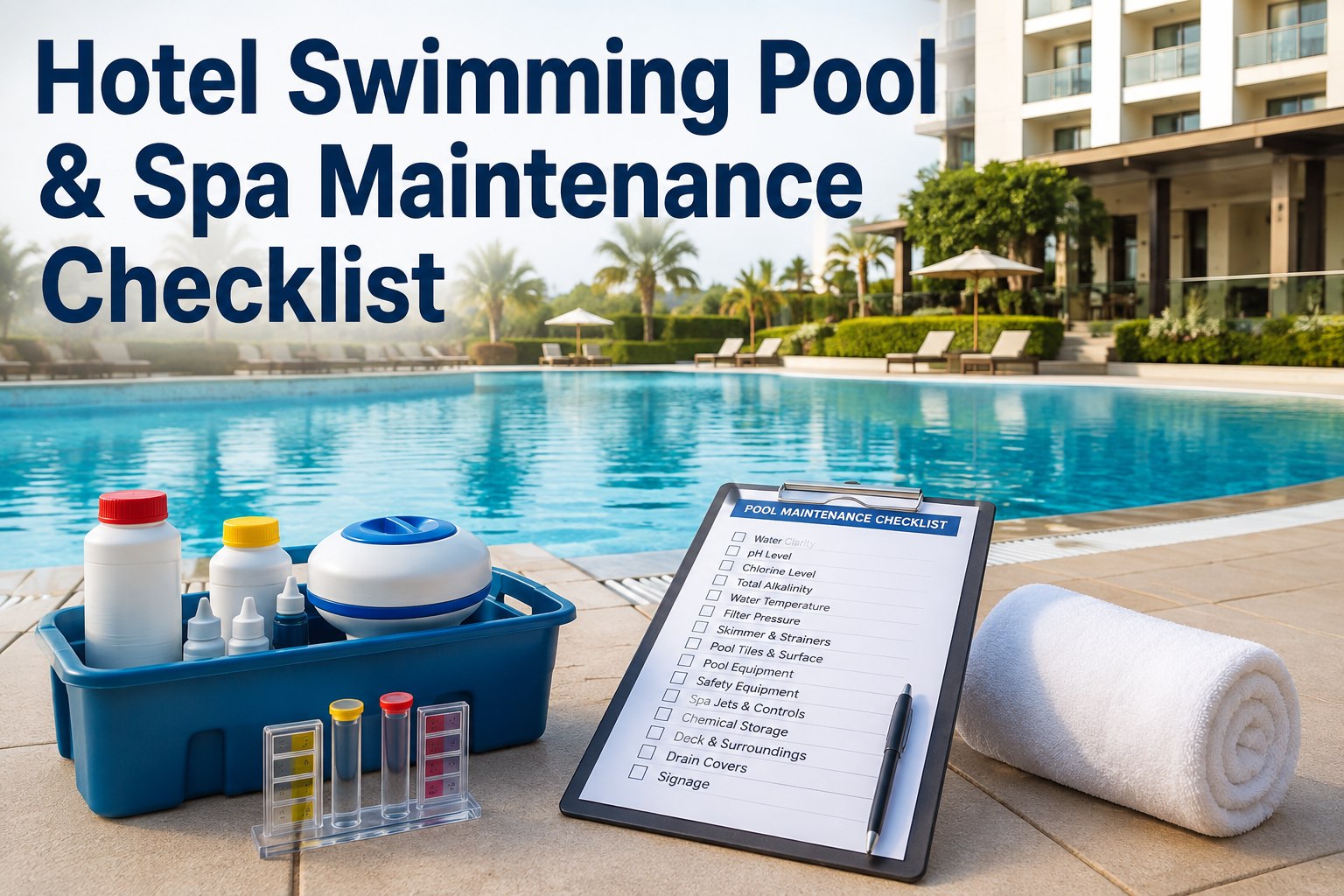
A hotel pool maintenance checklist is the backbone of safe, compliant aquatic operations — covering daily water chemistry, weekly equipment inspections, and monthly preventive maintenance (PM) for pumps, filters, and spa systems. Hotel engineering and facilities teams rely on a structured spa maintenance schedule to satisfy health department requirements, pass VGB Act and ADA compliance audits, and protect the guest experience. OxMaint brings every pool equipment maintenance task, inspection log, and compliance document into one AI-powered CMMS, so you can stop chasing paper checklists and Start Free Trial to digitize your entire hotel aquatic maintenance workflow today.
Hotel Pool & Spa Maintenance
Your complete hotel swimming pool maintenance checklist — daily, weekly, and monthly PM in one system
Track water chemistry, schedule pump and filter PM, and prove health-code compliance to any inspector — without spreadsheets, clipboards, or gaps in your logs.
pH, chlorine, alkalinity, temperature, turbidity
strainer baskets, pressure gauges, backwashing
anti-entrapment covers, pool lifts, signage
digital records ready for any auditor, anytime
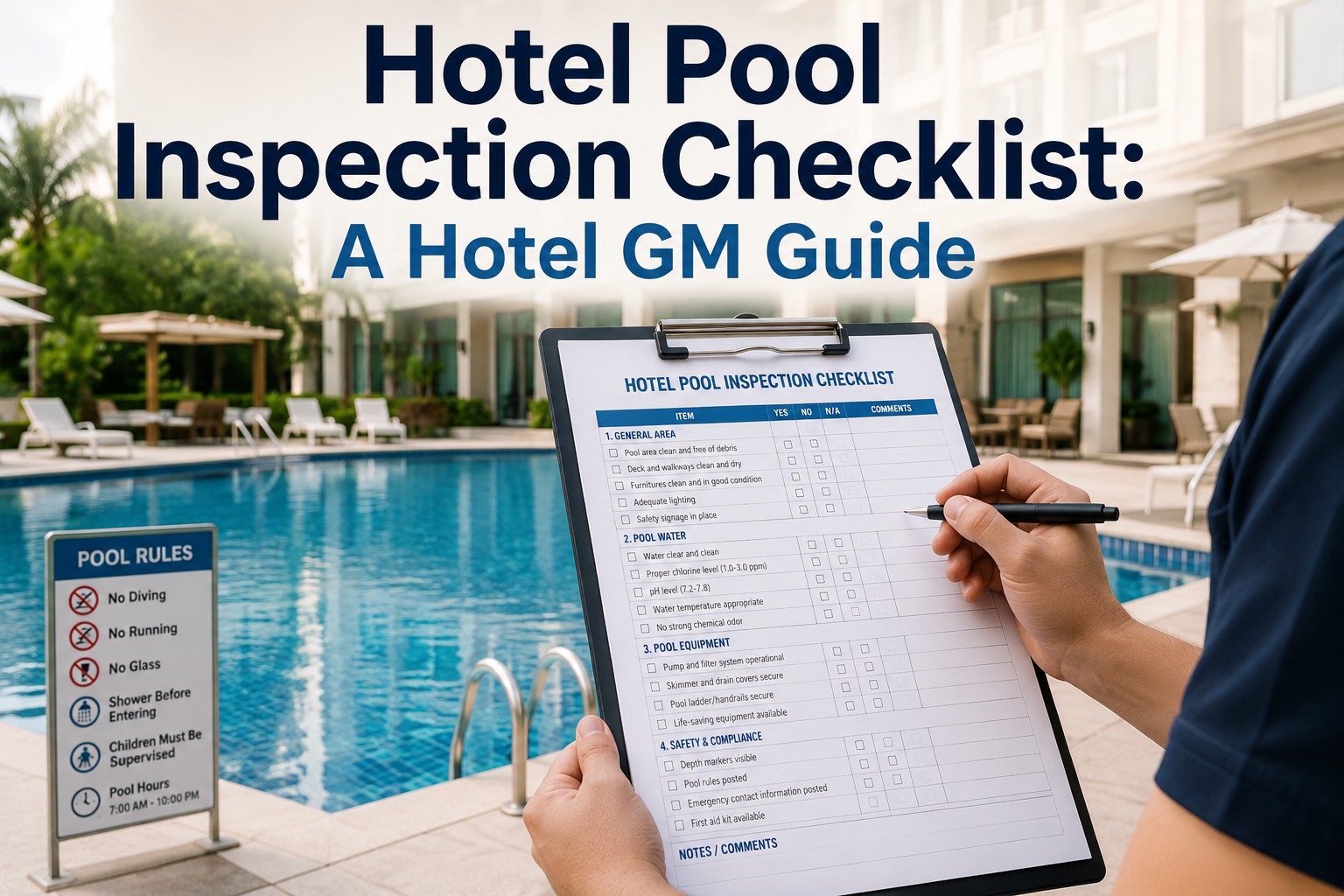
Daily Hotel Pool Maintenance Checklist
Daily water chemistry and pool inspection tasks
Health code violations and guest complaints overwhelmingly trace back to skipped daily checks. A single day of missed chlorine or pH adjustment can trigger a cloudy pool, a failed health inspection, or a guest injury — the daily hotel pool inspection is your first and most critical line of defense.
Water Chemistry Testing
- Test free chlorine (1–3 ppm) and bromine (3–5 ppm) before opening and every 4 hours
- Verify pH stays within 7.2–7.8; ideal target 7.4–7.6
- Check total alkalinity (80–120 ppm) and calcium hardness (200–400 ppm)
- Record cyanuric acid level if outdoor pool (30–50 ppm)
Pool & Spa Visual Inspection
- Inspect water clarity — a coin at the deepest point must be clearly visible
- Check for algae growth on walls, steps, and tile lines
- Verify pool deck is clean, free of slip hazards, and drains are clear
- Confirm spa temperature does not exceed 104°F (40°C) per health code
Equipment & Safety Check
- Inspect pump room for leaks, unusual noise, or vibration
- Verify flow rate and pressure gauges are within normal operating range
- Check that all safety equipment (ring buoy, hook, signage) is in place
- Confirm drain covers are intact and visibly secure (VGB compliance)
Documentation & Logging
- Record all chemistry readings in the daily pool log with timestamp and initials
- Note any chemical additions, backwash events, or equipment adjustments
- Flag any out-of-range reading for re-test and corrective action
- Store digital records for a minimum of 1–2 years per most state health codes
Weekly & Monthly PM Schedule
Weekly and monthly swimming pool PM checklist
Reactive pool equipment maintenance costs 3–5x more than scheduled preventive maintenance. A 150-room hotel with a pool and spa typically loses $8,000–$15,000 per closure event in guest refunds, rate reductions, and brand reputation damage. This tiered PM checklist prevents the pump failures, heater outages, and filter breakdowns that cause them.
Pool Water Chemistry & Health Code Standards
Hotel pool water chemistry ranges and health code compliance
Most state and local health departments mandate specific water chemistry ranges. Operating outside these ranges for even 24 hours can result in mandatory pool closure, fines ranging from $500 to $5,000, and failed brand-standard audits. Use this reference table to set automated threshold alerts in your CMMS.
| Parameter | Minimum | Ideal Range | Maximum | Health Code Risk |
|---|---|---|---|---|
| Free Chlorine (ppm) | 1.0 | 2.0 – 4.0 | 10.0 | Below 1.0: bacterial growth risk; mandatory closure |
| pH Level | 7.2 | 7.4 – 7.6 | 7.8 | Out-of-range: sanitizer inefficiency, skin/eye irritation |
| Total Alkalinity (ppm) | 80 | 100 – 120 | 150 | Low: pH bounce; High: cloudy water, scaling |
| Calcium Hardness (ppm) | 200 | 200 – 400 | 1,000 | Low: plaster etching; High: scale buildup in heaters |
| Cyanuric Acid (ppm) | 10 | 30 – 50 | 100 | Above 100: chlorine lock; health code violation in some states |
| Combined Chlorine (ppm) | 0 | 0 – 0.2 | 0.4 | Above 0.4: chloramine odor, irritation; superchlorinate required |
| Spa Temperature (°F) | — | 98 – 102 | 104 | Above 104°F: health code violation; Legionella risk increases |
| Turbidity (NTU) | 0 | 0 – 0.5 | 0.5 | Above 0.5: mandatory closure; main drain must be visible |
How OxMaint Helps
How OxMaint streamlines hotel aquatic maintenance and compliance
Spreadsheets and paper logs fail during audits — they get lost, they lack timestamps, and they cannot alert you when a pump is vibrating outside its baseline. OxMaint replaces clipboards with a structured, AI-powered CMMS built for hotel engineering teams managing pools, spas, and full property maintenance.
Automated PM Scheduling
Auto-generate daily, weekly, and monthly pool and spa maintenance work orders. OxMaint triggers tasks based on time, meter readings, or sensor data — ensuring no filter backwash or sensor calibration is ever missed. Hotels eliminate 90% of manual scheduling effort.
Digital Compliance Records
Every water chemistry reading, equipment inspection, and corrective action is timestamped and stored permanently. Generate a complete VGB Act, ADA, and health department audit report in seconds — not hours spent digging through paper binders.
Predictive Equipment Alerts
OxMaint's AI analyzes pump run-hours, pressure gauge trends, and vibration data to predict failures before they happen. Engineering teams catch a degrading pool pump seal 2–3 weeks before failure, avoiding a $4,000 emergency repair and 2-day pool closure.
Spare Parts & Chemical Inventory
Track chemical stock levels, filter cartridges, and pump seals with automated reorder points. Never shut down a pool because you ran out of muriatic acid or a replacement O-ring — OxMaint cuts inventory carrying costs by 20–30% while eliminating stockouts.
Stop managing your hotel pool with paper logs and spreadsheets
See how OxMaint digitizes your entire hotel swimming pool PM checklist, automates compliance tracking, and predicts equipment failures before they close your pool.
Frequently Asked Questions
Hotel pool and spa maintenance — your questions answered
How often should hotel pool water chemistry be tested?
Hotel pool water chemistry must be tested at least twice daily — once before the pool opens and once in the afternoon during peak usage. High-bather-load pools and spas should be tested every 2–4 hours. Most state health codes require a minimum of two documented tests per day for free chlorine and pH, with additional tests after any chemical adjustment or heavy rain. OxMaint lets engineers log readings from a mobile device and auto-flags any value outside the safe range. You can Book a Demo to see automated chemistry logging in action.
What is included in a hotel pool inspection checklist?
A complete hotel pool inspection checklist covers four areas: water chemistry (chlorine, pH, alkalinity, calcium hardness, cyanuric acid), water clarity and physical condition (turbidity, algae, debris), equipment operation (pumps, filters, heaters, gauges, chemical feeders), and safety compliance (VGB drain covers, ADA pool lifts, safety signage, rescue equipment, emergency phones). A health department inspector will verify all of these, plus review your daily logs for the past 12–24 months.
What are the VGB Act requirements for hotel pools?
The Virginia Graeme Baker Pool and Spa Safety Act requires all public pools and spas — including hotel pools — to have ASME/ANSI A112.19.8-certified anti-entrapment drain covers installed on every main drain and equalizer line. Pools with a single main drain must also have a secondary anti-entrapment system such as a safety vacuum release system (SVRS) or gravity drainage. Drain covers must be visually inspected monthly and replaced per the manufacturer's certified lifespan, typically 3–7 years.
How long must hotel pool maintenance records be kept?
Most state and local health codes require hotel pool maintenance and water chemistry records to be retained for a minimum of 1 to 2 years, and some jurisdictions require up to 5 years. Records must include daily chemistry readings, equipment maintenance logs, chemical inventory, corrective actions taken, and any inspector reports. Paper logs are easily lost or damaged — a CMMS like OxMaint stores all records digitally with timestamps and makes them instantly retrievable for any audit.
Can a CMMS help with hotel pool health code compliance?
Yes — a CMMS is the most effective way to maintain continuous health code compliance. OxMaint automates daily checklist generation, enforces task completion with mobile signatures, stores every record in a tamper-proof digital log, and generates compliance reports on demand. Engineering directors can see at a glance whether every pool and spa in their property has been tested, inspected, and maintained to code — eliminating the documentation gaps that cause 80% of failed health inspections.
Get Started with OxMaint
Put your hotel pool maintenance checklist on autopilot
Join engineering teams using OxMaint to cut unplanned pool closures by 75%, pass every health inspection, and reclaim 10+ hours per week in manual paperwork.
Free 14-day trial · No credit card