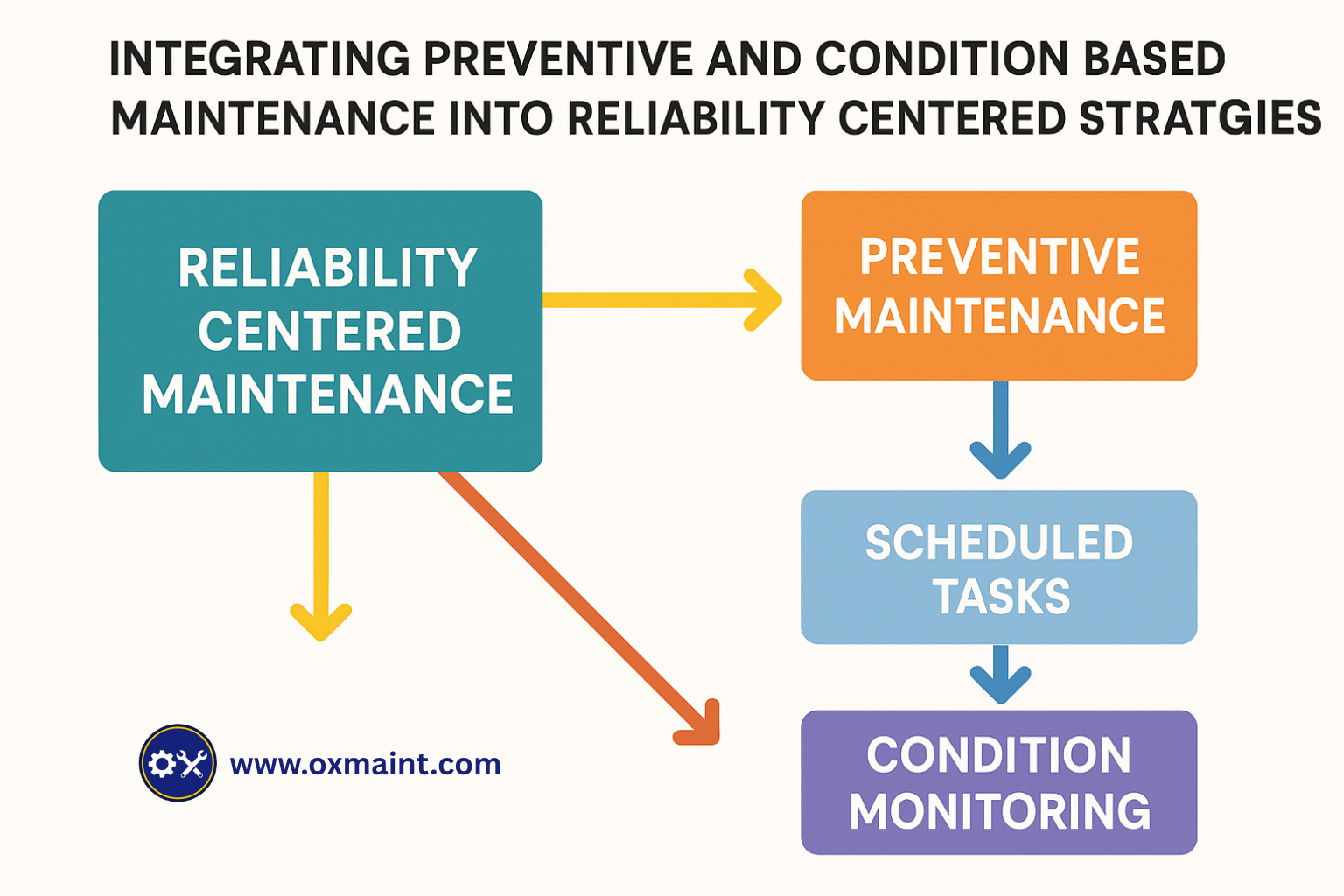
Reliability centered maintenance in marine & offshore operations is the systematic process of identifying the failure modes that matter most on critical vessels, rigs, and topside assets — then selecting the right maintenance strategy for each one so unplanned downtime drops, asset life extends, and total maintenance cost falls. Marine and offshore reliability programs built on RCM principles shift maintenance teams from reactive firefighting to engineered prevention, cutting unplanned downtime 30–50% within the first year. OxMaint's AI-powered CMMS gives you the asset hierarchies, failure-mode libraries, condition-based PM triggers, and analytics dashboards to operationalize RCM across your fleet. Start Free Trial to see how quickly you can move from spreadsheet chaos to a data-driven reliability program.
RCM IMPLEMENTATION GUIDE
Are unplanned equipment failures still driving 70% of your marine maintenance budget?
Reliability-Centered Maintenance for marine & offshore transforms breakdown-driven operations into engineered reliability. Identify critical failure modes, match each one to the right strategy, and prove the impact in weeks — not years.
Each critical asset must answer seven questions — from function to failure consequences — before you can select the optimal maintenance strategy.
RCM FOUNDATIONS
What is reliability centered maintenance in marine & offshore?
Reliability-Centered Maintenance (RCM) is a structured framework — formalized in SAE JA1011 and IEC 60300-3-14 — that determines the minimum level of maintenance required to keep each asset performing its intended function in its operating context. In marine & offshore environments, where a single propulsion failure can cost $80K–$150K per day in lost charter revenue and a blown separator on a production platform can halt 50,000 barrels of output, RCM is not academic theory — it is survival engineering.
Functions
What are the asset's primary and secondary functions in context? A ballast pump's primary function is moving 500 m³/hr; its secondary functions include containment and noise limits.
Functional Failures
How can the asset fail to perform each function? Total failure is obvious; partial failure — degraded flow rate — is the silent killer RCM forces you to name.
Failure Modes
What specific events cause each functional failure? Bearing wear, seal degradation, impeller cavitation — each mode gets documented at the component level.
Failure Effects
What happens when each failure mode occurs? Describe the physical evidence, operational impact, and safety/environmental consequences.
Failure Consequences
Does the failure matter? RCM classifies consequences as safety, environmental, operational, or non-operational — and only consequences justify maintenance tasks.
Proactive Tasks
What scheduled or condition-based task can prevent or detect the failure before consequences occur? On-condition, scheduled restoration, or scheduled discard.
Default Actions
If no proactive task is technically feasible and worth doing, the default is run-to-failure with a planned corrective response — or a one-time redesign.
STEP-BY-STEP
How to implement an RCM pilot project in marine & offshore
A full-plant RCM analysis can take 12–18 months. A focused RCM pilot on your most critical system delivers measurable downtime reduction in 8–12 weeks. Follow this five-month timeline to prove value before scaling.
Select Pilot System & Build Asset Hierarchy
Pick one critical system — typically main propulsion, topside gas compression, or crude export pumps. Map every asset, sub-assembly, and component into a hierarchical structure that mirrors how the plant actually operates. OxMaint's asset hierarchy builder lets you import existing data and drag-and-drop nodes into the correct parent-child relationships.
Conduct FMEA & Document Failure Modes
Facilitate 3–5 RCM working sessions with operators, maintainers, and engineers. For each asset, document functions, functional failures, failure modes, effects, and consequences. A typical 180-asset pilot surfaces 600–900 failure modes. OxMaint's failure-mode library auto-suggests common modes from 12,000+ marine equipment records, cutting analysis time by 40%.
Select Maintenance Strategy per Failure Mode
Apply RCM decision logic to each failure mode. Assign one of four strategies: run-to-failure (non-critical, low-cost), time-based PM (age-related failures), condition-based monitoring (degradation patterns detectable by sensors or inspection), or redesign (recurring failures with no feasible proactive task). OxMaint converts each decision into a scheduled work-order trigger automatically.
Execute, Monitor & Collect Data
Run the new maintenance plan for 4–6 weeks. Every work order generated, every inspection performed, and every failure event gets captured in OxMaint. Track leading indicators (PM compliance %, condition-monitoring alerts resolved) and lagging indicators (unplanned downtime hours, corrective work-order backlog).
Measure Impact & Scale
Compare pilot-system downtime, maintenance cost, and PM compliance against the pre-RCM baseline. A well-executed pilot typically delivers 20–35% downtime reduction and 10–15% maintenance-cost savings. Present results to leadership and roll out to the next two or three critical systems.
STRATEGY SELECTION
Choosing the right marine and offshore maintenance strategy per asset
Not every failure mode deserves the same response. RCM's power is in matching the strategy to the failure pattern and consequence — maximizing reliability per dollar spent. Use the comparison below to assign strategies during your RCM analysis.
| Strategy | Best For | Failure Pattern | Typical Marine & Offshore Application | OxMaint Trigger |
|---|---|---|---|---|
| Run-to-Failure | Low-criticality, low-cost assets where repair is cheaper than prevention | Random or age-related; consequences are non-operational | Lighting ballasts, non-essential HVAC fans, deck fittings | Corrective work order on failure report |
| Time-Based PM | Age-related failures with clear wear-out pattern | Increasing failure rate with operating age or runtime | Engine oil changes, filter replacements, valve overhauls, anode replacement | Scheduled work order by calendar or runtime hours |
| Condition Monitoring | Critical assets where degradation is detectable before failure | Random failures but with detectable PF interval | Propulsion bearings, gas turbine generators, cargo pump seals, switchboards | Automated work order when sensor threshold or inspection alert fires |
| Redesign / Modification | Recurring failures where no proactive task is technically feasible | Repeated modes with safety or environmental consequences | Recurring seal failures on sour-service pumps, fatigue cracking at known stress points | Engineering change request linked to failure history |
WORKED EXAMPLE
RCM in practice: cutting downtime on a 180-asset offshore platform
Reactive maintenance culture
- 180 critical assets across production, utilities, and safety systems
- Annual maintenance spend: $42K per asset ($7.56M total)
- Unplanned downtime: 340 hours/year — 2.1% production loss
- 70% of work orders were corrective; PM compliance below 55%
- Spare-parts stockouts caused 18-day average reactive-purchase delay
Engineered reliability program
- Same 180 assets — 620 failure modes documented and strategy-assigned
- Maintenance spend dropped to $33K/asset ($5.94M total) — 21% reduction
- Unplanned downtime fell to 165 hours/year — 51% reduction
- Corrective work orders dropped to 38%; PM compliance reached 92%
- Stockout delays eliminated via min/max auto-reorder in OxMaint
ANNUAL SAVINGS CALCULATION
($7.56M − $5.94M) + (175 hrs × $4,200/hr production recovery) = $2.43M / year
Payback period on RCM program + OxMaint deployment: 3.4 months
PRODUCT FIT
How OxMaint powers your marine and offshore reliability program
RCM analysis is only valuable if it gets executed — consistently, measurably, and at scale. OxMaint closes the gap between RCM theory and operational reality by turning every failure-mode decision into an automated, trackable maintenance action.
Asset Hierarchies That Mirror Your Plant
Build vessel-level, system-level, and component-level hierarchies that match your P&ID and equipment tag conventions. Every work order, failure record, and cost rolls up to the correct parent asset — giving you clean data for RCM analysis and ISO 55000 compliance audits.
Failure-Mode Libraries Linked to Work Orders
Pre-loaded with 12,000+ marine and offshore failure modes. When a technician closes a work order, they select the failure mode from a dropdown — building the failure history RCM needs to validate or revise your strategy decisions over time.
Condition-Based PM Triggers
OxMaint's AI engine ingests sensor data from vibration, temperature, pressure, and oil-analysis systems. When a deviation crosses your PF-interval threshold, a work order generates automatically — before the failure occurs. No manual monitoring, no missed alerts.
RCM Analytics That Prove ROI
Live dashboards track MTBF, MTTR, PM compliance, unplanned downtime hours, and maintenance cost per asset — all filterable by system, vessel, or platform. Export-ready reports prove your RCM program is working and justify scaling to the next critical system.
BEST PRACTICES
Marine and offshore maintenance best practices for RCM success
Start with the top 10% of assets by criticality
A full-plant RCM analysis is a 12–18 month effort that often loses momentum. Instead, rank assets by a criticality matrix (safety, environmental, production impact) and analyze the top 10% first. These 18 assets out of 180 will typically account for 60–70% of your unplanned downtime cost.
Cross-functional RCM working sessions beat solo analysis
The best failure-mode identification comes from a room with an operator who runs the equipment, a technician who repairs it, and an engineer who designs it. Schedule 90-minute sessions per system — longer sessions lose focus. OxMaint's collaborative FMEA workspace lets all three roles contribute and review in real time.
Review and revise strategy decisions every 12 months
RCM is not a one-time project — it is a living program. Failure patterns change as assets age, operating contexts shift, and new failure modes emerge. Schedule an annual RCM review where you compare predicted failure rates against actual failure history and adjust task intervals, add condition monitoring, or retire PMs that are not adding value.
Eliminate paper work orders before scaling RCM
RCM decisions depend on failure history data. If your team is still closing work orders on paper forms or spreadsheets, you will never have the data quality to validate or refine your strategy. OxMaint's mobile app lets technicians close digital work orders at the point of work — with photos, failure-mode dropdowns, and parts consumed — feeding clean data back to your RCM analysis.
See OxMaint on your assets — book a 30-minute demo
Watch how fast you can build an asset hierarchy, import failure modes, and generate your first RCM-driven PM schedule. We'll show you the exact workflow on marine and offshore equipment like yours.
FAQ
Marine & offshore RCM — your questions answered
What is reliability centered maintenance in marine & offshore?
RCM is a structured process that identifies the failure modes most likely to affect critical marine and offshore assets, then assigns the optimal maintenance strategy — run-to-failure, time-based PM, condition monitoring, or redesign — to each one based on its consequences and failure pattern. The goal is to do the right maintenance at the right time, eliminating both over-maintenance and unplanned breakdowns.
How long does an RCM pilot project take in marine and offshore operations?
A focused RCM pilot on one critical system — such as main propulsion or topside gas compression — typically takes 8–12 weeks from asset-hierarchy selection through measurable results. Full-plant RCM implementation across all systems spans 12–18 months, which is why most operators start with a pilot to prove ROI before scaling. You can Book a Demo to see how OxMaint compresses pilot timelines.
How much downtime reduction can an RCM program deliver?
Well-executed RCM programs in marine and offshore operations typically reduce unplanned downtime by 20–50% within the first year of implementation, with the largest gains coming from shifting critical assets from reactive maintenance to condition-based monitoring. A focused pilot on your top 10% of critical assets usually delivers the fastest measurable impact.
What standards govern RCM in marine and offshore environments?
The primary RCM standard is SAE JA1011 ("Evaluation Criteria for Reliability-Centered Maintenance Processes"), supplemented by IEC 60300-3-14 for dependability management. Marine operators also align with IMO resolutions, classification society rules (DNV, ABS, Lloyd's Register), and ISO 55000 for asset management systems. OxMaint's reporting structure maps to these standards for audit readiness.
Can OxMaint help implement RCM if we're starting from spreadsheets?
Yes — OxMaint is designed for teams transitioning from spreadsheet-based or reactive maintenance. You can import existing asset lists, PM schedules, and failure history, then build your asset hierarchy, launch condition-based PM triggers, and generate RCM analytics dashboards within days. Start with a Start Free Trial or schedule a guided walkthrough to see the migration path.
Build your RCM program on a platform engineered for reliability
Asset hierarchies. Failure-mode libraries. Condition-based PM triggers. RCM analytics. OxMaint gives your marine and offshore maintenance team everything needed to move from reactive to engineered reliability — and prove the ROI.
Free 14-day trial · No credit card