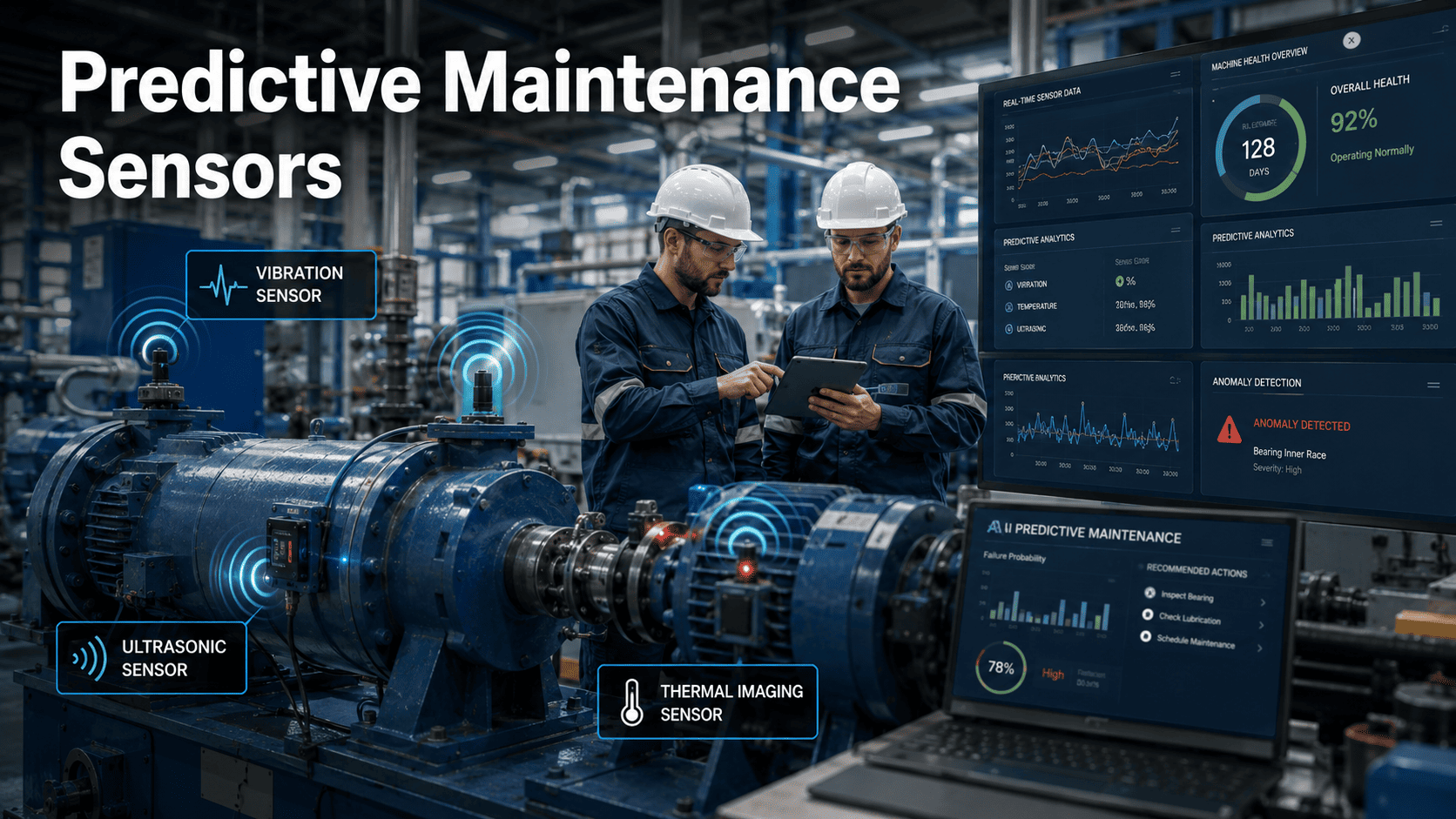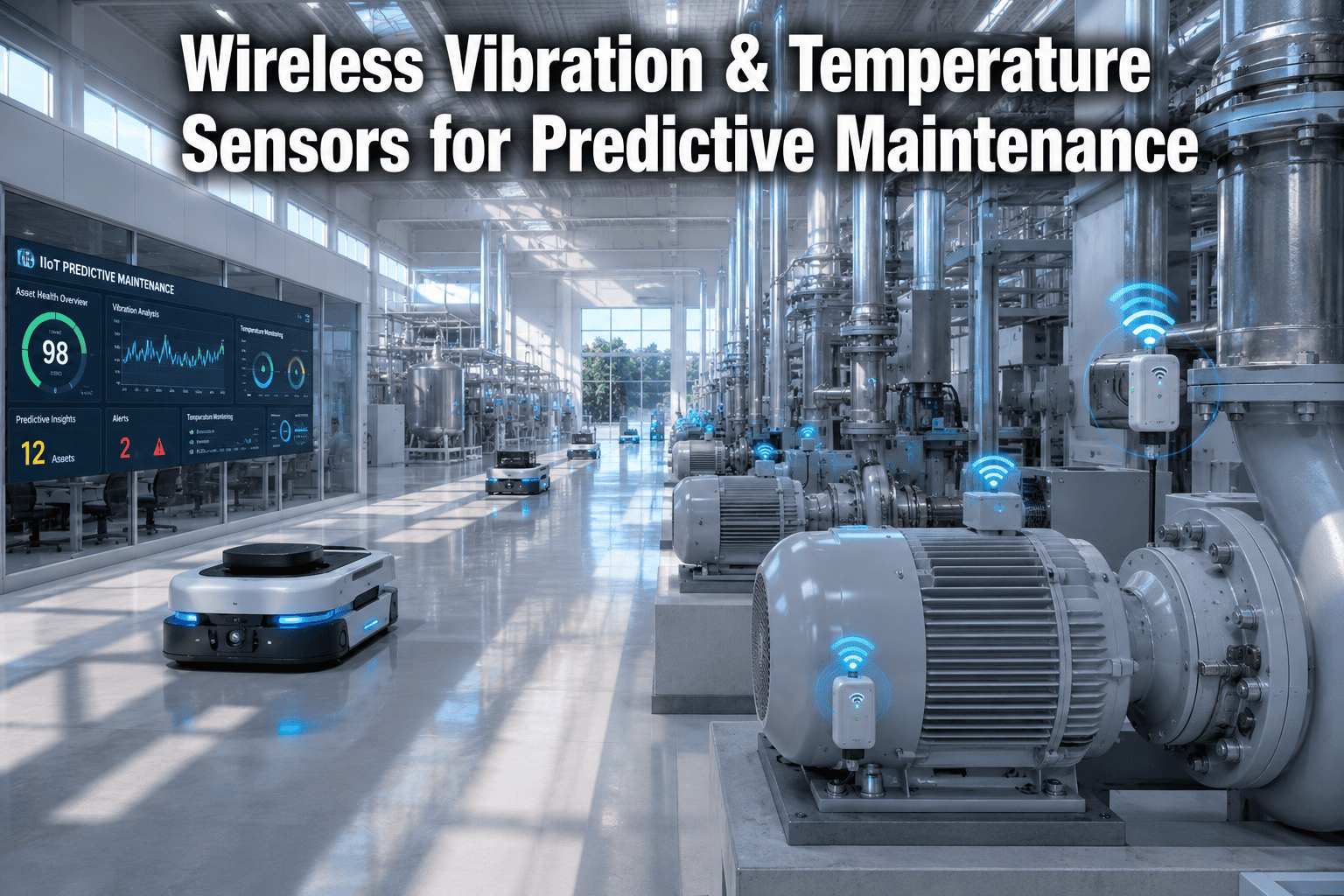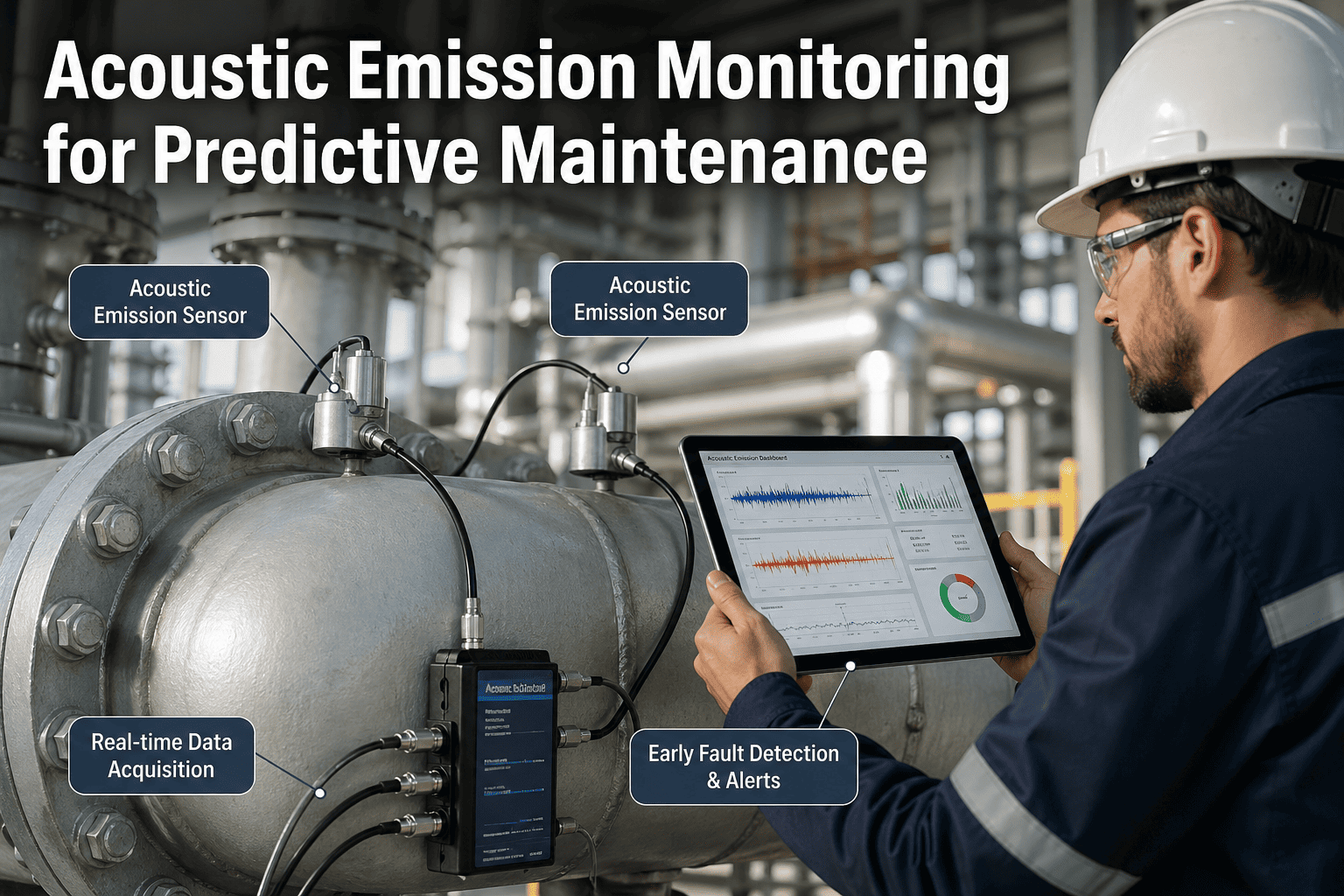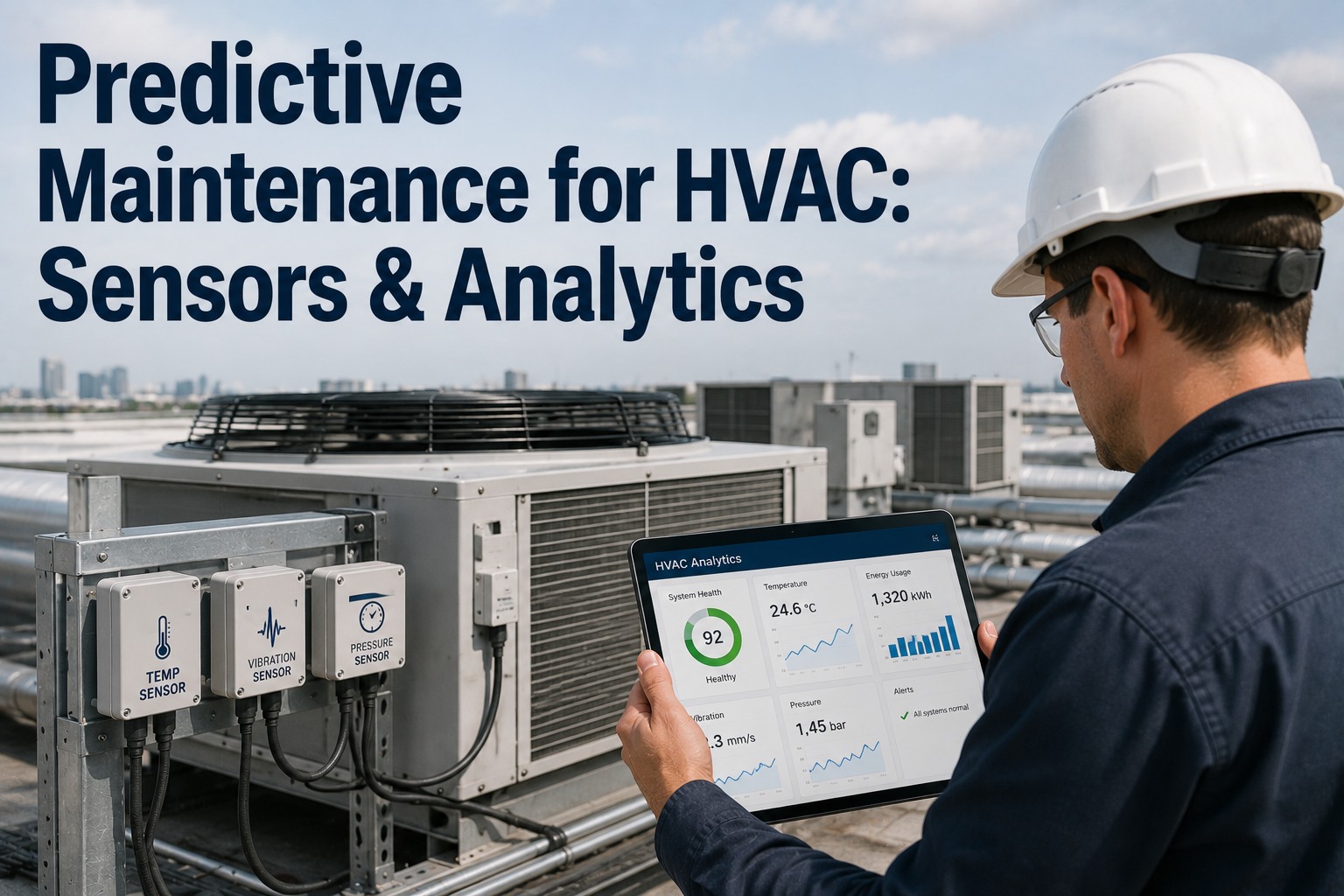
HVAC predictive maintenance uses IoT sensors and analytics to detect emerging equipment faults — refrigerant charge loss, motor bearing wear, compressor performance degradation — weeks before a failure occurs, cutting unplanned downtime by 30–50% and reducing energy waste. Modern HVAC condition monitoring platforms transform raw sensor data into actionable work orders, moving facility teams from reactive firefighting to predictable, data-driven reliability. This guide breaks down the sensors, fault detection diagnostics (FDD), and analytics workflow that make predictive HVAC a measurable ROI reality — and shows how OxMaint integrates these signals into a single CMMS so your team can act on them instantly. Ready to modernize your maintenance operation? Start Free Trial and connect your first asset today.
HVAC PREDICTIVE MAINTENANCE GUIDE
What if your HVAC system told you it was failing — three weeks before it did?
Modern HVAC sensors and machine-learning analytics catch refrigerant leaks, motor bearing wear, and compressor degradation in real time — turning run-to-failure into predictable, scheduled repairs. The result: 30–50% less unplanned downtime, 10–25% lower energy bills, and a maintenance budget that finally behaves.
THE BUSINESS CASE
Why HVAC predictive maintenance pays for itself in under 12 months
Commercial buildings waste up to 30% of their energy on underperforming HVAC equipment, and a single rooftop unit failure can cost $5K–$15K in emergency labor, spoiled inventory, or tenant credits. HVAC predictive maintenance attacks both sides of that equation.
WORKED EXAMPLE
A 180-asset commercial portfolio spending $42K/yr on reactive HVAC callouts deployed vibration + current sensors on 40 critical AHUs and chillers. In Year 1, analytics flagged 11 emerging faults — a chiller bearing, two contactor failures, and a gradual refrigerant leak among them. Scheduling the fixes during normal shifts saved an estimated $19K in emergency labor and avoided 3 weekend outages. The sensor + software investment paid back in Month 9.
SENSOR ARCHITECTURE
Essential HVAC sensors for condition monitoring
HVAC IoT maintenance starts with the right physical-layer data. Each sensor type below maps to a specific failure mode — together they form the baseline for predictive analytics.
Vibration & Accelerometer
Mounted on motor bearings, compressors and fans. Spike in high-frequency vibration predicts bearing race and ball defects 30–60 days before failure.
Catches: bearing wear, imbalance, misalignmentMotor Current Signature
A CT clamp on motor supply lines detects current harmonics — a non-invasive read of rotor health, stator faults, and mechanical overload.
Catches: rotor bar degradation, phase imbalancePressure & Refrigerant
Suction/discharge transducers track refrigerant charge and compressor performance. A 10% charge loss drops efficiency ~20% and signals a leak.
Catches: refrigerant leaks, coil fouling, expansion valve faultsTemperature & Humidity
Supply/return air and coil temps reveal stuck dampers, failed economizers, and degraded heat exchangers — the foundation of HVAC FDD rules.
Catches: damper actuator failure, economizer faultsANALYTICS WORKFLOW
From sensor data to work order: the HVAC FDD pipeline
Fault Detection and Diagnostics (FDD) is the engine of predictive HVAC. It applies physics-based rules and machine-learning models to sensor streams, then hands actionable alerts to your CMMS. Here's the six-stage pipeline that turns raw data into prevented failures.
Data Acquisition
Sensors sample at 1 Hz–1 kHz; a gateway normalizes and time-stamps the stream over BACnet, Modbus, or MQTT.
Baselining
The analytics platform learns each asset's "healthy" signature across load curves, ambient temps, and operating modes for 7–14 days.
Fault Detection
Rule-based and ML models flag deviations — e.g., compressor current 15% above baseline at matched load = emerging mechanical drag.
Diagnosis & Severity
The system isolates the likely fault (bearing vs. rotor vs. load) and assigns a remaining-useful-life (RUL) score from 1–100.
Work Order Generation
OxMaint auto-creates a prioritized work order with fault code, affected asset, recommended action, and parts list — routed to the right technician.
Verify & Close Loop
Post-repair sensor data confirms the fault cleared; the record feeds back into the ML model, sharpening future predictions.
ROI MATH
Calculating the payback of HVAC predictive analytics
Most HVAC PdM projects clear ROI in 8–14 months. The formula is straightforward — plug in your own numbers to see why reactive maintenance is the expensive option.
ANNUAL NET SAVINGS
= (Emergency labor avoided) + (Energy saved) + (Capital life extended) − (Sensor + software cost)
| Cost / Savings Category | Reactive Baseline | With HVAC PdM | Annual Delta |
|---|---|---|---|
| Emergency / after-hours callouts | $28,000 | $9,500 | +$18,500 |
| Energy waste (dirty coils, low charge) | $22,000 | $16,800 | +$5,200 |
| Premature equipment replacement | $15,000 | $7,000 | +$8,000 |
| Sensor hardware + OxMaint software | $0 | −$11,200 | −$11,200 |
| Net Annual Savings | +$20,500 |
In this 40-unit scenario, payback hits at Month 7. Beyond Year 1, the ML model improves, the sensor cost is sunk, and net savings compound — a typical 3-year IRR of 180–260%.
HOW OXMAINT HELPS
How OxMaint turns HVAC sensor data into prevented failures
Sensors and analytics only create value when they trigger the right action. OxMaint is the CMMS foundation that connects HVAC FDD output to a closed-loop maintenance workflow — so every alert becomes a completed, verified repair.
Sensor & FDD Integration
Ingest vibration, current, pressure, and temperature data via API or BACnet/MQTT gateways. OxMaint maps each data stream to an asset record and applies threshold + ML-based alerts automatically.
Outcome: 100% of critical assets monitored in one dashboard — no siloed vendor portals.
Analytics-Driven Work Orders
When FDD flags a fault, OxMaint auto-generates a prioritized work order with fault description, recommended fix, required parts, and technician assignment — no manual ticket creation.
Outcome: Cut alert-to-action time from hours to minutes; eliminate missed alerts.
Predictive PM Scheduling
Shift from calendar-based PMs to condition-based triggers. When RUL drops below a threshold, OxMaint schedules the intervention before failure — optimizing labor and parts inventory.
Outcome: 18% average reduction in unnecessary PMs; parts stocked just-in-time.
Maintenance Analytics & Audit Trail
Track MTBF, MTTR, energy-avoided, and fault-recurring rates by asset class. Every work order, sensor reading, and repair is timestamped for ISO 55000 and compliance audits.
Outcome: Prove ROI to leadership and pass audits with one-click reports.
See OxMaint predict failures on YOUR HVAC assets
Book a 30-minute demo and we'll map a predictive maintenance pilot to your top 10 critical units — sensors, analytics, work-order workflow, and ROI projection included.
FAQ
HVAC predictive maintenance: your questions answered
What is HVAC predictive maintenance?
HVAC predictive maintenance is a condition-based strategy that uses IoT sensors (vibration, motor current, pressure, temperature) and analytics to monitor equipment health in real time, detecting faults like bearing wear or refrigerant leaks weeks before failure. Unlike calendar-based PMs, interventions are triggered only when data shows degradation — reducing unnecessary work and catching real problems earlier.
How does HVAC fault detection and diagnostics (FDD) work?
HVAC FDD compares live sensor data against a learned baseline or physics-based model of healthy operation. When a deviation exceeds a threshold — say, compressor current 15% above baseline at a given load — the system flags a specific fault code and severity. Modern FDD combines rule-based logic with machine learning to improve accuracy over time and reduce false alarms.
Which HVAC sensors are needed for predictive maintenance?
The core set includes vibration accelerometers (motor/compressor bearings), motor current sensors (rotor and electrical faults), pressure transducers (refrigerant charge and compressor health), and temperature/humidity probes (damper and heat-exchanger faults). Start with the 10–20% of assets that cause 80% of downtime. You can pilot a sensor + OxMaint workflow in minutes — Start Free Trial to connect your first asset.
How much does HVAC predictive maintenance cost?
A typical mid-size deployment runs $200–$600 per asset per year for sensors, gateway, and analytics software, with CMMS platforms like OxMaint adding $30–$60 per user/month. Most projects reach payback in 8–14 months through avoided emergency labor (often $1,500–$4,000 per callout), energy savings of 10–25%, and extended equipment life.
Can OxMaint integrate with our existing HVAC sensors and BMS?
Yes. OxMaint ingests data via REST API, BACnet, Modbus, and MQTT, so it connects to most modern Building Management Systems and standalone IoT sensor gateways. Fault alerts from your FDD platform automatically generate prioritized work orders inside OxMaint — closing the loop between detection and repair without manual data entry.
Stop reacting. Start predicting.
Join the maintenance teams using OxMaint to cut unplanned HVAC downtime by up to 50%, lower energy bills, and prove ROI with one-click analytics.
Free 14-day trial · No credit card