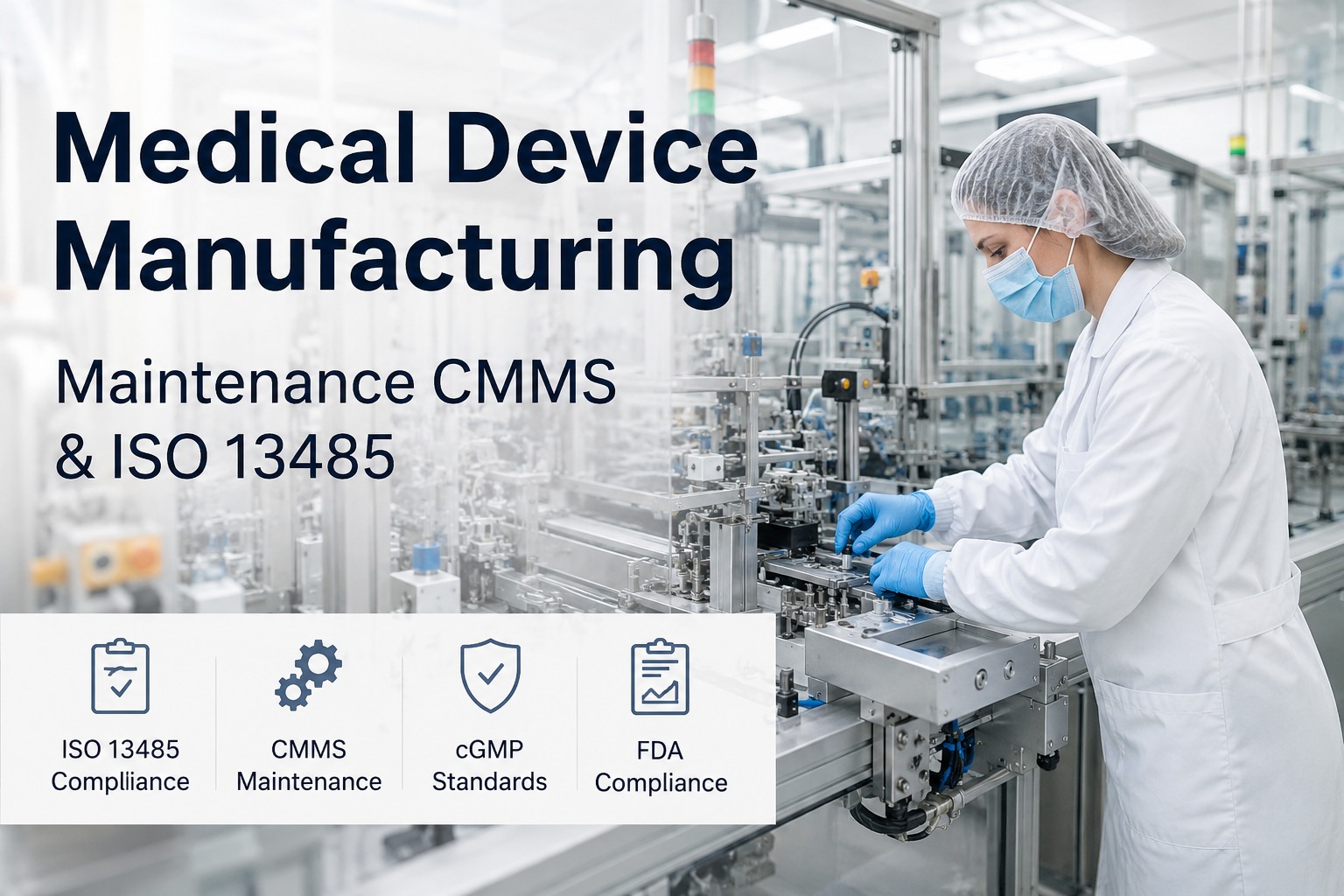
In medical device manufacturing, a preventive maintenance task that was performed but not documented did not happen — at least not as far as an FDA investigator is concerned. That is the hard truth a maintenance manager in this industry lives with: the wrench work is only half the job, and the record proving it is the other half. Equipment-maintenance documentation failures are among the most common findings in FDA 483 observations issued to device manufacturers, and the reason is structural. As of February 2, 2026, the FDA's Quality Management System Regulation (QMSR) replaced the old 21 CFR Part 820 quality system requirements and incorporated ISO 13485:2016 by reference — so the international standard is now the foundation of US device compliance, and its demand for documented, controlled equipment maintenance is enforceable federal law. On top of that, equipment that was qualified through IQ, OQ, and PQ has to stay qualified, and uncontrolled maintenance is exactly what breaks that qualified state. This guide covers how to run device-manufacturing maintenance as the documented quality activity it now has to be. Start a free Oxmaint trial with ISO 13485 PM documentation and audit trails built in, or book a demo to see qualification-linked PM and CAPA tracking live.
Medical Device · cGMP / QMSR · Maintenance Manager
Medical Device Manufacturing Maintenance: CMMS & ISO 13485
ISO 13485 PM documentation, equipment qualification, cGMP compliance, and a CMMS audit trail built for FDA scrutiny — how device manufacturers run maintenance as a controlled quality activity under the 2026 QMSR, not just an engineering task.
-
Feb 2026
QMSR replaced 21 CFR Part 820, adopting ISO 13485:2016
-
483s
equipment-maintenance documentation is a top FDA observation
-
IQ/OQ/PQ
qualified equipment must stay qualified through controlled PM
-
ALCOA+
data-integrity standard every maintenance record must meet
Maintenance Is a Quality Record
The PM Isn't Done Until the Record Proves It
In a regulated device plant, every maintenance activity produces a controlled document, and that document must satisfy the ALCOA+ data-integrity principles an investigator applies. A perfectly executed PM with a weak record is a finding waiting to happen. This is what a compliant maintenance record has to carry.
- A AttributableTied to the named technician who performed and signed the work.
- L Legible & LastingReadable and permanent for the full retention period, no lost entries.
- C ContemporaneousRecorded at the time of the work, timestamped, not backfilled later.
- O OriginalThe source record or a verified true copy, with the raw data intact.
- A Accurate + CompleteCorrect, whole, and consistent — with an audit trail of every change.
Under 21 CFR Part 11, electronic records need audit trails, controlled e-signatures, and validated systems (CSV per GAMP 5) to stand in for paper. Book a demo to see ALCOA+ maintenance records with a full audit trail.
Qualification Doesn't End at Go-Live
Qualified Equipment Must Stay Qualified
Process equipment enters production through a three-stage qualification, mandated because some outputs — sterilization, injection molding, welding, aseptic filling — cannot be fully verified by inspection alone. Maintenance is what keeps that validated state intact; a wrong part or an uncontrolled change can quietly invalidate it.
- IQ Installation Qualification Documents that the equipment was delivered, installed, and configured per manufacturer specifications — the baseline every future maintenance change is measured against.
- OQ Operational Qualification Confirms the equipment operates correctly across all defined parameters and conditions — the operating envelope that PM must preserve.
- PQ Performance Qualification Proves the process consistently produces conforming product — the qualified state that a controlled maintenance program exists to protect.
- RQ Requalification Trigger A major repair, part substitution, or relocation can break the qualified state — the CMMS must flag when maintenance work triggers a requalification review.
Mandated by ISO 13485:2016 clause 7.5.6 and the underlying 21 CFR 820.75 process-validation requirement, now unified under the QMSR. Sign up for Oxmaint to link PM tasks to equipment qualification status.
Where Control Is Required
Four Areas That Must Be Documented
Device-manufacturing maintenance compliance concentrates in four control areas. Each needs scheduled PM, calibration where applicable, and a defensible record — and each is a place investigators look first.
-
Production Equipment
Injection molding, assembly, and sterilization equipment on scheduled PM and calibration — the direct process controls behind product conformity. -
Cleanroom & HVAC
Environmental monitoring and HVAC qualification records per ISO 14644 — particle counts, pressure cascades, and filter integrity kept in spec. -
Calibration
Measurement and test instruments on a calibration schedule traceable to standards — overdue calibration invalidates every reading taken since. -
LOTO & Safety
Lockout/tagout and machine-safety controls documented on every maintenance intervention — protecting technicians and preserving the compliance record.
A gap in any one area is a documentation gap an investigator can pull — and one that a Class II recall linked to process-control failure can trace back to. Book a demo to see all four control areas scheduled and documented in one system.
CAPA Is Where Maintenance Meets Quality
A Recurring Failure Is a CAPA Waiting to Be Opened
Under the QMSR, corrective and preventive action (CAPA) requires manufacturers to eliminate the causes of nonconformities and verify the fix does not compromise device safety or performance. Maintenance is upstream of that: a recurring equipment failure, a repeated out-of-tolerance calibration, or a deviation on a qualified machine is exactly the kind of signal a CAPA must capture and close. When maintenance history, failure patterns, and calibration records live in one system, the link from a repeat fault to an opened, tracked, and closed CAPA is direct — and device facilities using digital maintenance management document materially higher CAPA closure rates than paper-based ones.
Oxmaint for Device Manufacturing
How Oxmaint Runs Compliant Maintenance
-
Documented PM
Every Task, an ALCOA+ Record
Each PM generates a controlled, timestamped record attributable to the named technician — contemporaneous, complete, and permanent — so the documentation is defensible the moment an investigator asks for it.
-
Audit Trail
Part 11 Electronic Records
A tamper-evident audit trail on every record, controlled electronic signatures, and validated-system operation — the 21 CFR Part 11 controls that let electronic maintenance records replace paper.
-
Qualification Link
PM Tied to IQ/OQ/PQ
Each asset carries its qualification status, and maintenance that could affect the validated state — a major repair or part change — flags a requalification review before the equipment returns to production.
-
Calibration Control
Schedules & Traceability
Instrument calibration on a traceable schedule with due-date alerts and certificate storage per instrument — so an overdue calibration is caught before it invalidates a batch of readings.
-
CAPA Linkage
Failure Patterns to Closure
Breakdown history and recurring-fault detection surface the signals a CAPA should capture, with each corrective and preventive action tracked to verified closure against the asset record.
-
Inspection-Ready
The Record on Demand
Any asset's full maintenance, calibration, and qualification history exported in minutes — the organized, complete evidence an FDA inspection under the updated compliance program expects.
Frequently Asked
Device Maintenance Compliance Questions
What changed for maintenance with the 2026 QMSR?
Effective February 2, 2026, the FDA's Quality Management System Regulation (QMSR) amended 21 CFR Part 820 and incorporated ISO 13485:2016 by reference, making the international standard the foundation of US device quality requirements. For maintenance, this reinforces that documented, controlled equipment maintenance, calibration, and process validation are federal requirements — and that audit trails, preventive action, and records are directly inspectable under the updated inspection program. Sign up for Oxmaint to align maintenance records with the QMSR.
Why does maintenance affect equipment qualification?
Equipment that passed IQ, OQ, and PQ is validated to produce conforming product within a defined configuration and operating envelope. Maintenance that substitutes a non-equivalent part, alters a setting, or relocates the equipment can move it outside that validated state — potentially invalidating the qualification. That is why maintenance work on qualified equipment must be controlled and, where significant, must trigger a requalification review before the machine goes back into production.
What is ALCOA+ and why does it apply to maintenance records?
ALCOA+ is the FDA's data-integrity framework: records must be Attributable, Legible, Contemporaneous, Original, and Accurate, plus complete, consistent, enduring, and available. It applies to maintenance because a PM or calibration record is quality evidence — if it cannot be tied to a named person, timestamped to when the work happened, and shown to be unaltered, it will not withstand an inspection, no matter how well the physical work was done. Book a demo to see ALCOA+ compliant maintenance records.
Can a paper maintenance system meet these requirements?
It can in principle, but it is fragile: paper records are easy to lose, hard to make contemporaneous and attributable, and slow to produce for an audit. Because equipment-maintenance documentation is a common source of FDA 483 observations, most device manufacturers move to a validated digital system with built-in audit trails and Part 11 controls — and report materially higher CAPA closure rates as a result. The record, not just the wrench work, is what an inspection judges. Sign up for Oxmaint to replace fragile paper records with defensible digital ones.
Document · Qualify · Calibrate · Prove
The Wrench Work Passes Inspection Only If the Record Does
Every undocumented PM, uncontrolled repair on a qualified machine, and overdue calibration is a 483 observation forming inside your quality system. Oxmaint gives device-manufacturing maintenance managers one platform to produce ALCOA+ maintenance records, hold a Part 11 audit trail, link PM to equipment qualification, control calibration, and drive recurring failures into tracked CAPA — so maintenance stands up to an FDA inspection as the controlled quality activity the QMSR now demands.