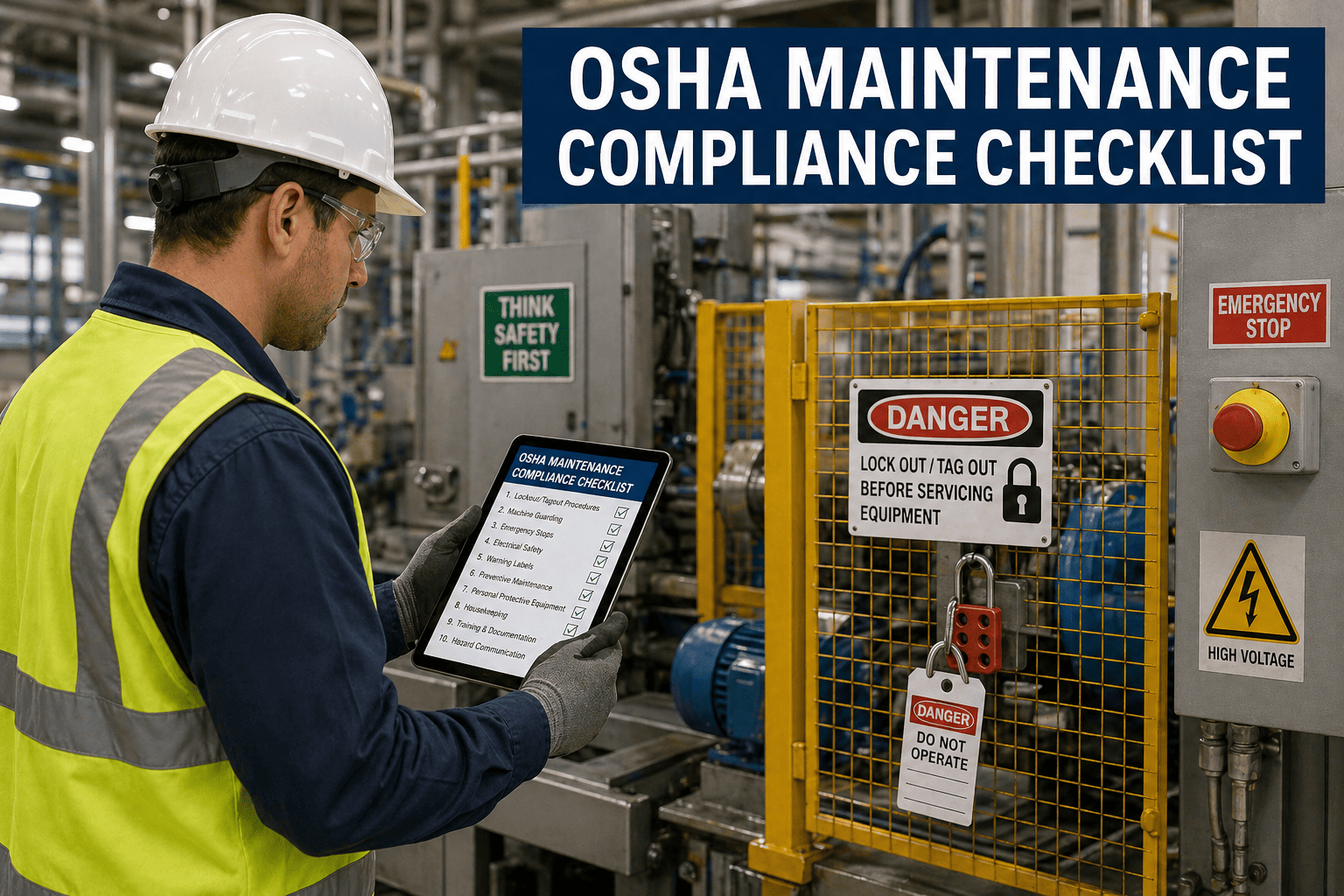
An OSHA self-inspection checklist for general industry is the structured procedure maintenance and reliability teams use to verify that facilities, equipment, and work environments meet OSHA 1910 compliance standards before a regulator ever steps on site. A robust OSHA self-inspection checklist template covers everything from machine guarding and lockout/tagout to walking surfaces, fire protection, and hazard communication, giving EHS leaders a defensible audit trail that proves every required check was performed, documented, and resolved. Teams that operationalize this procedure through a digital CMMS like OxMaint capture photo evidence, trigger automatic corrective work orders, and maintain an immutable compliance program record that satisfies both OSHA 1910 audits and ISO 45001 certification audit requirements. Instead of scrambling through paper binders the week before an inspection, you can Start Free Trial today and turn safety compliance into a continuous, automated workflow.
OSHA 1910 Compliance Procedure
Is your facility audit-ready right now, or just hoping the binder is current?
Over 32,000 OSHA inspections happen each year, and the average serious citation costs $1,284 — with willful violations reaching $145,027. A digital OSHA self-inspection checklist eliminates paper gaps and gives your team real-time, defensible proof of every safety check.
OSHA Self-Inspection Checklist SOP
What an OSHA 1910 compliant self-inspection checklist must cover
A defensible OSHA self-inspection checklist procedure goes far beyond a simple yes/no form. It maps every General Industry standard (29 CFR 1910) to specific pass/fail criteria, mandates photo evidence for identified hazards, and forces a closed-loop corrective action — the exact workflow an OSHA compliance officer or ISO 45001 auditor expects to see.
Lockout/Tagout (LOTO)
- Machine-specific LOTO procedures posted at the equipment
- Energy isolation devices verified and padlocks uniquely keyed
- Annual LOTO procedure inspection certified and documented
- Authorized employee training current within 12 months
Machine Guarding
- Point-of-operation guards intact and functional on all rotating equipment
- Light curtains and two-hand trips tested for correct response time
- No bypassed or defeated safety interlocks logged in shift reports
- Ancillary nip points and pinch hazards shielded with rigid covers
Hazard Communication
- Written HazCom program accessible to all employees on all shifts
- SDS library current, indexed, and digitally searchable by chemical name
- Primary and secondary containers labeled with GHS pictograms
- Annual employee training documented with sign-in rosters
Electrical Safety
- Arc flash boundary labels visible on all panels over 50V
- Ground fault circuit interrupters tested in damp/wet locations
- Cabinet clearances maintained at 36 inches minimum, front and sides
- Qualified worker training verified for energized work permits
Fire Protection & EAP
- Portable fire extinguishers inspected monthly, serviced annually
- Exit routes clear, illuminated, and minimum 28 inches wide
- Emergency Action Plan reviewed and updated within the last 12 months
- Sprinkler system valves locked open and tamper switches functional
PPE Assessment
- Workplace hazard assessment certified by a competent person
- PPE selected based on assessed risk levels and ANSI standards
- Respirator fit-test records current for all required employees
- Defective or damaged PPE immediately removed from service
Audit-Ready Documentation
OSHA self-inspection checklist example: building the audit trail
The difference between passing an OSHA 1910 audit and facing six-figure penalties usually comes down to the audit trail. A compliant OSHA self-inspection checklist form doesn't just capture deficiencies; it documents who inspected, when, what evidence was collected, and how the hazard was abated. Below is the standard workflow auditors look for.
| Inspection Stage | Required Documentation | Regulatory Reference | Corrective Action Trigger |
|---|---|---|---|
| Pre-Inspection Setup | Scope, facility map, assigned competent person, previous deficiency log | 1903.1 / 1903.2 | Open recurring items in CMMS as mandatory work orders |
| Field Walkdown | Timestamped checklist, digital pass/fail, geo-tagged photo evidence | 1910 General Industry | Auto-generate corrective work order on any "Fail" response |
| Hazard Abatement | Work order completion notes, secondary photo, e-signature of technician | 1903.14 | Route to EHS manager for final digital sign-off |
| Verification & Closeout | Audit report template export, asset-linked history, compliance dashboard | ISO 45001 Clause 9.2 | Trend recurring failures for predictive maintenance review |
OxMaint Compliance Platform
How OxMaint operationalizes your OSHA self-inspection program
OxMaint transforms your OSHA self-inspection checklist from a paper exercise into a live, automated compliance engine. By binding mandatory safety checks directly to work orders and asset records, OxMaint ensures no high-risk task proceeds without verified compliance — giving your EHS team real-time visibility and an audit trail that stands up to OSHA, ISO 45001, and corporate scrutiny.
Mandatory Safety Checks on Work Orders
Block high-risk work orders until LOTO verification, PPE confirmation, and permit-to-work steps are digitally signed. Ensures 100% procedure adherence before a technician ever touches a machine.
Digital LOTO & Permit Workflows
Replace paper lockout/tagout logs with mobile-validated digital permits. Energy sources are isolated, verified by photo, and released only after authorized e-signature — all timestamped to the second.
Inspection Records Linked to Assets
Every OSHA self-inspection checklist form is permanently attached to the asset's lifecycle record. Pull up any pump, conveyor, or panel and instantly see its full compliance history, deficiencies, and corrective actions.
Photo Evidence & Immutable Audit Trail
Capture geo-tagged, timestamped photo evidence directly from the mobile app. Every checklist submission, work order completion, and manager sign-off creates an immutable record regulators accept without question.
Implementation Procedure
How to deploy a digital OSHA self-inspection checklist in 30 days
Moving from paper binders to a digital OSHA self-inspection checklist SOP doesn't require a multi-month IT project. Maintenance teams that standardize on OxMaint typically roll out a fully compliant, audit-ready safety inspection program in four focused weeks.
Asset & Standard Mapping
Import your asset hierarchy into OxMaint and map each asset class to its applicable 29 CFR 1910 standards. Define pass/fail criteria and mandatory photo requirements for every inspection point.
Digital Checklist Build
Convert your existing OSHA self-inspection checklist template into OxMaint smart forms. Configure automatic corrective work order triggers for any failed item, assigning them to the right technician by skill and shift.
Pilot on High-Risk Assets
Run the digital checklist on your top 20% of high-risk assets — typically those requiring LOTO, machine guarding, or permit-to-work. Validate that photo evidence, e-signatures, and auto-generated work orders flow correctly.
Full Rollout & Dashboard Go-Live
Deploy to all shifts, activate the EHS compliance dashboard for real-time visibility, and export your first audit report template. Your facility is now continuously inspection-ready rather than cyclically scrambling.
See OxMaint on your assets — book a 30-minute demo
Watch how fast a failed safety check becomes a closed, documented corrective action with full photo evidence and an immutable audit trail.
Frequently Asked Questions
OSHA self-inspection checklist: common questions
How often should an OSHA self-inspection be performed?
OSHA does not mandate a single frequency for all self-inspections, but industry best practice and ISO 45001 Clause 9.1.2 require ongoing monitoring — typically daily pre-shift checks on high-risk equipment, weekly walkdowns of specific areas, and monthly comprehensive facility audits. High-hazard processes like LOTO and confined space entry require checks before every occurrence. OxMaint lets you schedule all these frequencies automatically and escalates any missed inspection to the EHS manager.
What is the difference between an OSHA self-inspection and an OSHA audit?
A self-inspection is an internal, proactive evaluation your team performs to identify and abate hazards before regulators arrive. An OSHA audit (or compliance inspection) is an official, external investigation conducted by an OSHA compliance officer — triggered by a complaint, referral, severe injury, or programmed scheduling. A rigorous self-inspection program using a digital OSHA self-inspection checklist form is the single best predictor of a clean external audit, because it surfaces and documents abatement before the inspector ever arrives.
Can a digital checklist satisfy OSHA documentation requirements?
Yes. OSHA accepts digital records as long as they are accurate, legible, accessible to employees, and retained for the required periods (typically 5 years for exposure records and 3 years for training records under 1910.1020). OxMaint's digital OSHA self-inspection checklist exceeds these requirements by providing timestamped, e-signed records with photo evidence and an immutable audit trail. You can Book a Demo to see the compliance export format.
What happens if a failed item is found during the self-inspection?
The failed item must be documented with a description, photo evidence, and an immediate corrective action plan. If the hazard poses an imminent danger, the affected equipment or area must be locked out or barricaded until abated. In OxMaint, any "Fail" response on the checklist automatically generates a high-priority corrective work order, assigns it to a qualified technician, and tracks it through completion with a secondary verification photo and manager e-signature — creating a fully closed-loop compliance record.
Does OxMaint support ISO 45001 audit requirements as well as OSHA 1910?
Absolutely. OxMaint's compliance workflows map to both OSHA 1910 standards and ISO 45001 clauses — particularly Clause 9.2 (internal audit), Clause 8.1.2 (hazard identification), and Clause 10.2 (incident and nonconformity corrective action). The same digital inspection records, asset-linked histories, and audit trail exports that satisfy an OSHA compliance officer also provide the documented evidence a certification body requires for an ISO 45001 certification audit, eliminating duplicate paperwork.
Make every shift inspection-ready
Stop relying on paper binders and hoping your last checklist is current. Deploy OxMaint's digital OSHA self-inspection checklist and walk into any audit with defensible, real-time evidence.
Free 14-day trial · No credit card