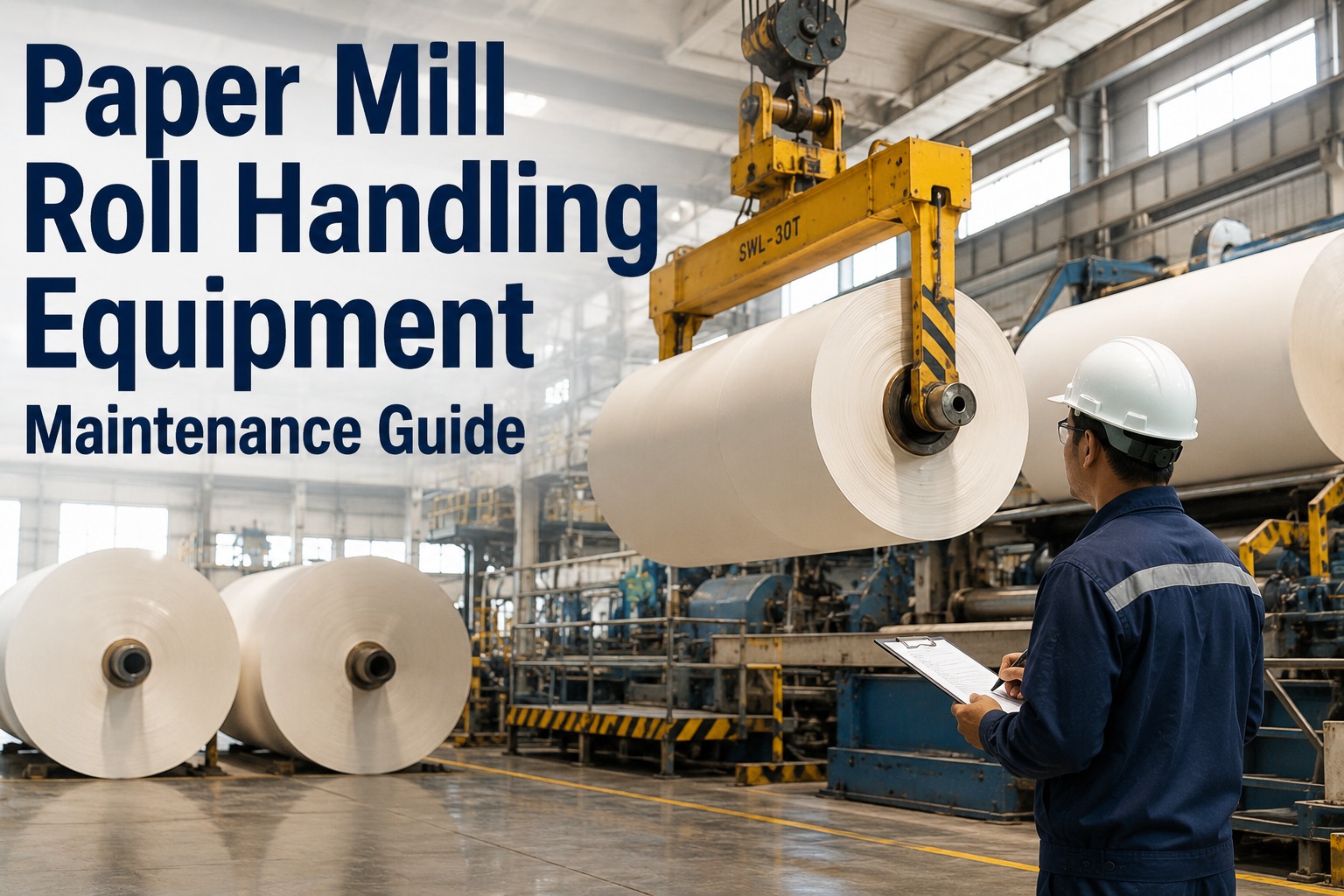
Paper mill roll handling maintenance is the decisive factor between consistent shipping availability and costly line stoppages — when a winder, reel drum, or roll grinder goes down, finished paper cannot ship, and revenue stalls within hours. This guide covers preventive maintenance schedules for paper mill roll handling equipment, including winder blade replacement, reel drum inspection, core chuck maintenance, and roll grinder PM, plus the CMMS work-order structure that keeps finishing operations reliable. Teams using a structured paper roll handling CMMS typically cut unplanned winder downtime by 30–50% and recover thousands of dollars per avoided stoppage. Ready to modernize your maintenance program? Start Free Trial and see how OxMaint streamlines every work order, PM trigger, and spare-parts lookup for your mill.
Paper Mill Roll Handling Maintenance Guide
One Winder Breakdown Stops Your Entire Mill From Shipping — Is Your Roll Handling Maintenance Ready?
Paper machine finishing equipment is the last line between production and revenue. Reactive maintenance on winders, reel drums, and roll grinders costs the average mid-size mill over $180K per year in lost output, scrap, and emergency labor. A structured PM program backed by OxMaint CMMS prevents 70–80% of those failures before they happen.
Critical Assets
Paper Mill Roll Handling Equipment That Demands Structured PM
Roll handling and finishing equipment operates at the intersection of production volume and product quality. A single misaligned core chuck or a worn winder blade can downgrade tons of finished paper per shift. Below are the five asset categories where paper mill equipment maintenance focus delivers the highest reliability return.
Paper Machine Reel Section
The reel is where the continuous web becomes a saleable roll. Reel drum maintenance, primary arm timing, and secondary arm handoff calibration directly affect roll density and edge quality. Mills without a formal reel section maintenance schedule report 4–6 unplanned reel stops per quarter.
Paper Winder & Slitter
The winder is the highest-speed rotating asset in the finishing line. Winder blade replacement frequency, drum balance, and tension-control roll condition determine whether rolls are shipped or scrapped. A missed winder PM cycle can cost $8K–$15K per incident in rejected product.
Roll Grinder & Superfinisher
Roll grinder PM preserves surface finish tolerances down to 0.2 micrometer Ra. Bearing lubrication, wheel dressing automation, and bedway alignment must follow OEM intervals. Skipping grinder maintenance degrades roll cover life by 20–35% across the campaign.
Core Chucks & Shaft Systems
Core chuck maintenance is frequently overlooked until a roll drops or telescopes. Pneumatic chuck seal wear, expansion-blade condition, and shaft runout should be inspected every 90 days. Chuck failure at speed is a safety event and a production stoppage simultaneously.
Roll Handling Cranes & Wrappers
Overhead roll-handling cranes, upenders, and wrapping lines carry finished inventory worth tens of thousands of dollars per roll. Hoist brake inspection, load-cell calibration, and wrapper film-tension PM protect both product and personnel.
Spare Roll Storage & Tracking
Spare rolls represent a massive working-capital investment. Tracking cover condition, grinding history, and storage environment per roll — without a CMMS — is nearly impossible. Paper roll equipment reliability starts with knowing which spare is ready and which is not.
Inspection Checklists
Paper Mill Winder PM and Reel Section Maintenance Checklist
These tiered checklists are drawn from OEM recommendations and TPM best practices at high-performing mills. Import them directly into OxMaint as recurring work-order templates — each task becomes a tracked, assignable, time-stamped record with parts and labor captured automatically.
Operator Walk-Down
- Inspect winder blade edges for nicks, chips, and uneven wear
- Check reel drum surface for scratches, buildup, and temperature rise
- Verify core chuck expansion and retraction cycle time
- Listen for abnormal vibration on unwinder and rewind shafts
- Confirm roll ejector and ramp safety interlocks function
- Log web-break frequency and tension-setpoint deviations
Maintenance Technician PM
- Torque-check winder blade holder fasteners to spec
- Lubricate reel section bearings per PM route lubrication chart
- Inspect pneumatic lines to core chuck for leaks and pressure drop
- Measure vibration on roll grinder drive motor and workhead
- Check roll grinder coolant concentration and filtration
- Calibrate tension-load cells on winder unwind stand
Reliability Engineering Audit
- Review vibration trend data on all critical roll-handling assets
- Analyze winder stop-log for top 5 failure modes and MTBF
- Inspect reel drum cover for hardness loss and profile deviation
- Audit spare-roll inventory: grinding due dates, cover life remaining
- Verify CMMS PM compliance rate — target above 95%
- Update FMEA if new failure modes appear in the work-order history
Deep Maintenance & Calibration
- Perform roll grinder geometry check — bedway, headstock, tailstock
- Replace winder blade set on scheduled interval or wear limit
- Strip and rebuild one core chuck assembly on rotation
- Laser-align reel section drive shafts and coupling
- Conduct infrared thermography on winder drive panels
- Review and update OEM service bulletins in the CMMS asset record
PM Schedule Table
Winder Maintenance Schedule and Roll Grinder PM Intervals
The table below consolidates recommended maintenance intervals for paper roll equipment. OxMaint auto-generates each task as a scheduled work order, assigns it to the right technician, and escalates overdue PMs — so nothing falls through the cracks during busy production runs.
| Asset | Maintenance Task | Interval | Downtime Window | Risk If Skipped |
|---|---|---|---|---|
| Paper Machine Reel | Reel drum surface inspection & cleaning | Weekly | 2 hr | Web breaks, roll density variation |
| Winder | Winder blade replacement & holder inspection | Bi-weekly or per tonnage | 3 hr | Slitter roughness, customer rejection |
| Winder | Drum bearing lubrication & vibration check | Monthly | 1.5 hr | Bearing seizure, 12+ hr unplanned stop |
| Roll Grinder | Roll grinder PM — geometry, coolant, wheel dress | Monthly | 4 hr | Roll finish out of spec, cover life reduced 25% |
| Core Chuck | Core chuck maintenance — seal & blade inspection | Quarterly | 2 hr per chuck | Roll drop event, safety incident |
| Reel Section | Reel section maintenance — drive alignment & arms | Quarterly | 6 hr | Transfer failure, full line stoppage |
| Spare Rolls | Spare-roll condition audit & grinding schedule | Monthly review | Planning only | No ready spare during roll change, extended downtime |
Real-World Scenario
The Cost of Reactive Maintenance on a Paper Mill Winder Line
A Southeastern coated-paper mill running a single winder line at 1,800 m/min was managing reel section maintenance and winder blade replacement on spreadsheets and tribal knowledge. Over a 12-month period, the mill recorded 14 unplanned winder stoppages — an average of 1.2 per month — each costing between $6,500 and $14,200 in lost production, scrap, and emergency labor.
The total annual impact: approximately $128,000 in direct downtime cost, plus an estimated $45,000 in accelerated wear on adjacent roll handling equipment caused by stop-start transient loads. After implementing OxMaint as their paper roll handling CMMS, the mill loaded 40 PM templates across the winder, reel section, roll grinder, and core chucks, set condition-based triggers on vibration and temperature data, and achieved 96% PM compliance within the first quarter.
Result: unplanned winder stoppages dropped from 14 per year to 4, recovering over $82,000 in avoided downtime cost in year one — a payback period under 3 months on the OxMaint subscription. The reliability team now spends its time analyzing trends instead of chasing paper work orders.
How OxMaint Helps
How OxMaint CMMS Transforms Paper Mill Roll Equipment Reliability
OxMaint is an AI-powered CMMS and EAM platform built for maintenance and reliability teams. Every feature maps directly to the challenges of paper mill finishing operations — from winder PM automation to spare-roll grinding history. Here is how OxMaint turns your roll handling maintenance from reactive firefighting into a controlled, data-driven program.
Automated PM Work Orders
Schedule winder maintenance, reel drum inspection, and roll grinder PM on time-based, meter-based, or condition-based triggers. OxMaint auto-generates and assigns work orders, sends notifications, and escalates overdue tasks — cutting PM compliance gaps by up to 40%.
Outcome: 30–50% reduction in unplanned winder and reel downtime
AI-Driven Predictive Maintenance
Connect vibration, temperature, and amperage sensors on roll handling equipment. OxMaint's AI models detect anomaly patterns in bearing wear and roll cover degradation 2–6 weeks before failure — giving you time to plan the repair during a scheduled outage.
Outcome: Predict up to 70% of critical failures before they happen
Full Asset & Roll Lifecycle Tracking
Track every roll by serial number: cover type, grinding history, total operating hours, current location, and remaining cover life. OxMaint maintains a complete asset registry for paper mill machinery — from the paper machine reel to every spare roll in storage.
Outcome: Eliminate "no ready spare" downtime events entirely
Spare-Parts Inventory & Blade Tracking
Maintain min-max stock levels for winder blades, core chuck seals, grinder wheels, and bearings. OxMaint links parts directly to work orders and auto-generates purchase requisitions when stock hits reorder points — so the right part is always on the shelf when a PM triggers.
Outcome: Cut emergency parts spend by 25–35%
ROI & Savings
Cost of Downtime vs. CMMS Investment for Paper Mill Maintenance
The math is straightforward. A single unplanned winder stoppage costs $8,000–$15,000. A mid-size mill averaging 10 stoppages per year faces $80K–$150K in avoidable annual downtime cost. OxMaint CMMS typically costs a fraction of one avoided stoppage — and pays for itself within the first quarter.
Annual Downtime Cost Formula
Avg. Stoppage Cost × Unplanned Stops per Year = Annual Downtime Exposure
Example: $11,000 × 12 stops = $132,000 / year
CMMS Payback Formula
Annual Savings (Avoided Stops) / Annual CMMS Cost = Payback Multiple
Example: $82,000 saved / $9,600 CMMS = 8.5x ROI in year one
See OxMaint on Your Paper Mill Assets — Book a 30-Minute Demo
Walk through a live OxMaint environment pre-loaded with winder PM templates, reel section maintenance routes, and roll-grinder work orders. See how AI-driven predictive maintenance and automated work-order management fit your mill's exact workflow.
Frequently Asked Questions
Paper Mill Roll Handling Maintenance FAQ
How often should winder blade replacement be performed?
Winder blade replacement frequency depends on line speed, tonnage, and paper grade, but most mills replace slitter blades every 2–4 weeks or after a set tonnage threshold (typically 1,500–3,000 tons). OxMaint tracks blade usage by meter reading and auto-generates a replacement work order when the threshold is reached, eliminating guesswork and preventing off-spec slitting.
What does a paper mill winder PM schedule include?
A comprehensive winder PM schedule includes daily blade-edge inspections, weekly lubrication and torque checks, monthly vibration analysis and tension-load-cell calibration, and quarterly deep maintenance on bearings, drums, and drive alignment. Using a winder CMMS like OxMaint ensures every task is assigned, tracked, and documented — maintaining compliance and audit readiness with minimal administrative overhead.
How does reel drum maintenance affect paper quality?
Reel drum surface condition directly impacts roll density, web tension consistency, and edge profile. Scratches, buildup, or uneven wear on the drum cause localized density variation that can lead to winder web breaks and customer complaints. Weekly cleaning, monthly surface inspection, and quarterly profile measurement are the minimum PM intervals recommended for reel drums.
Can a CMMS prevent core chuck failures?
Yes. Core chuck maintenance is highly predictable when tracked in a CMMS. OxMaint schedules quarterly seal inspections, expansion-blade checks, and pneumatic pressure tests for each chuck by serial number. Condition-based triggers on pressure-drop data can flag a failing chuck seal weeks before it causes a roll-drop event, converting a safety incident into a planned repair.
What is the ROI of implementing a CMMS for paper roll equipment?
Most mid-size paper mills see a payback period under 3 months. With unplanned winder stoppages costing $8K–$15K each and a typical mill experiencing 10–14 per year, reducing those by 50–70% through scheduled PM and predictive maintenance recovers $50K–$100K+ annually. OxMaint's automation also cuts maintenance admin time by 60%, freeing technicians for higher-value reliability work.
Start Your Maintenance Transformation
Stop Reacting to Winder Breakdowns — Start Preventing Them
OxMaint gives your paper mill maintenance team the CMMS tools to automate PM work orders, predict failures with AI, track every roll and spare part, and ship on time — every time. Join the mills that cut unplanned downtime by 40% in the first year.
Free 14-day trial · No credit card