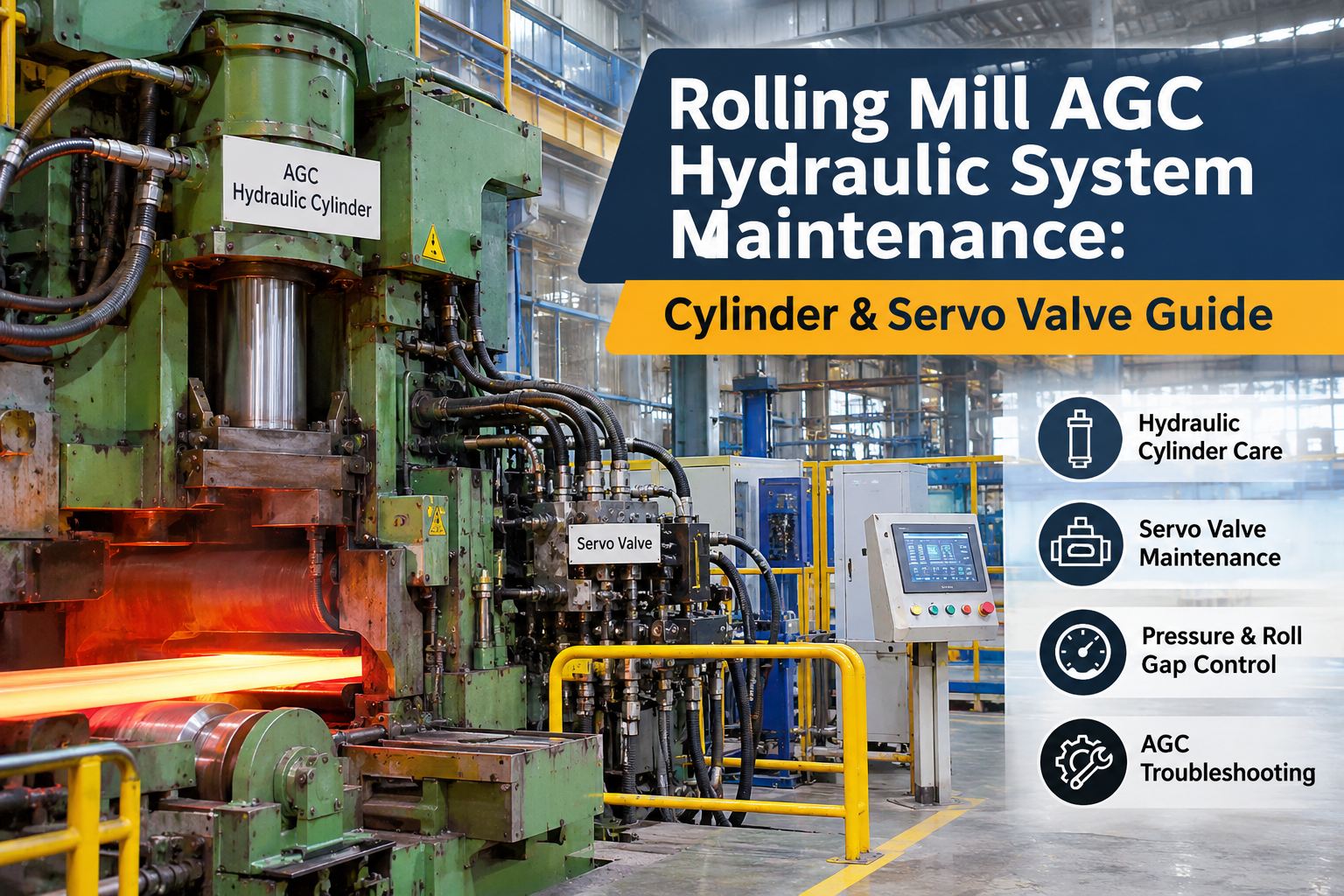
A rolling mill holds strip thickness to microns, and it does it by squeezing a hydraulic cylinder against the roll gap and correcting the position every few milliseconds. That is Automatic Gauge Control — and it is only ever as accurate as the servo valve, cylinder and oil behind it. A spool fouled by a few microns of contamination, a worn cylinder seal, a drifting position sensor, and the gauge wanders off spec. This guide covers AGC hydraulic maintenance from oil cleanliness to servo valve health, and shows how OxMaint AI maintenance management software keeps it on schedule. Book a demo to see it on your mill.
STEEL · ROLLING MILL · AGC HYDRAULIC SYSTEM
Rolling Mill AGC Hydraulic System Maintenance
Automatic Gauge Control keeps every metre of strip inside a tolerance band measured in microns — by trimming the roll gap in milliseconds. Keep the hydraulics clean and calibrated and the gauge holds; let them drift and the whole coil pays. OxMaint AI runs that maintenance on schedule.
STRIP THICKNESS · HELD BY AGC
− tolerancetarget+ tolerance
The servo valve corrects the roll gap every few milliseconds to hold the strip inside this band.
AGC Is Only as Good as Its Hydraulics
In a hydraulic AGC system, a controller reads rolling force from the load cells and cylinder position from the sensor, then drives a servo valve to move the screw-down cylinder and correct the roll gap — a closed loop that settles in roughly 30 to 100 milliseconds. Every element of that loop is a precision hydraulic component, so the accuracy a customer sees in the coil is really the health of the servo valve, the cylinder, the position sensor and the oil that connects them. Maintain the loop and you maintain the gauge.
THE #1 KILLER
Contamination Is How Gauge Control Dies
Servo valves are extraordinarily sensitive to dirt — micron-sized particles are enough to destabilize the loop. This is the chain a few microns of contamination sets off, and why oil cleanliness is the single most important thing you monitor.
1Contaminant EntersParticles or moisture in the oil
›
2Spool Stiction & WearSticky lands, worn edges
›
3Hysteresis & Null ShiftLoop drifts and oscillates
›
4Gauge ErrorStrip off-spec, coil rejected
Set a target cleanliness to an ISO 4406 / NAS 1638 class per your servo valve's spec, trend particle counts and moisture continuously, and treat a filtration or desiccant breach as a priority work order — not a monthly note.
Reading a Servo Valve's Health
A servo valve rarely fails outright — it drifts out of calibration first, and the loop hides it until the gauge suffers. Learn the signatures and act on the early ones.
A healthy valve tracks within a tight band — hysteresis under a couple of percent of rated current — so trending null current and hysteresis turns a surprise failure into a planned swap. Start free and trend servo valve readings per stand.
The Rest of the Loop
The servo valve gets the attention, but these components fail the gauge just as surely — and often get blamed on the valve.
Hydraulic Cylinder
Seal wear brings internal leakage and slow position drift; even minimal bypass compounds into gauge error. Watch seal condition and bore wear.
Position Sensor
The magnetostrictive sensor must be backlash-free; cold cylinder-versus-rod expansion can add phase lag and startup oscillation.
Load Cells
Gauge-meter AGC leans on accurate rolling-force measurement; a drifting or damaged load cell quietly corrupts the correction.
Accumulators
Bladder degradation and lost pre-charge soften the fast response AGC depends on. Check pre-charge on the OEM interval.
Filtration & Desiccant
The last line against the contamination cascade — monitor differential pressure and keep moisture out of the reservoir.
Cooling & Oil Temp
Viscosity shifts with temperature and changes loop dynamics; stable oil temperature keeps response predictable.
The AGC Maintenance Program
Precision hydraulics reward continuous monitoring over calendar guesswork. Run these together.
Continuous
Oil cleanliness, moisture, servo null current and oil temperature streamed and alarmed in real time.
Periodic
Servo valve null and hysteresis checks, filter differential pressure, accumulator pre-charge, sensor and load-cell verification.
Outage
Valve bench test or exchange, cylinder seal and bore inspection, full flush to target cleanliness before restart.
The Coil Doesn't Lie — But It Tells You Too Late.
By the time off-gauge strip reaches the inspection bench, the servo valve has been drifting for a while. OxMaint AI trends oil cleanliness, null current and hysteresis so the valve is swapped on evidence, and keeps every reading and repair tied to the stand.
How OxMaint AI Runs AGC Hydraulic PM
OxMaint AI is the AI-powered maintenance management software that carries the AGC hydraulic system from a cleanliness alert or a servo reading to a closed, recorded work order — with condition trends, PM routes and asset history built in. Book a demo and see an AGC hydraulic route run end to end.
Oil Cleanliness Tracking
Log ISO/NAS class, particle counts and moisture per system, with a limit that flags a trend before the servo valve suffers.
Servo Valve Trending
Null current and hysteresis tracked per valve, so a drifting unit is swapped on a plan, not after a scrap coil.
Condition-Based PM
Routes fire on readings and run-time — filters, accumulators, seals — instead of a blanket calendar.
Alert to Work Order
A cleanliness or null-current alarm opens a ranked work order routed to the hydraulics crew with the data attached.
Spares & Rebuild Log
Valve, seal kit and cartridge stock tracked, with rebuild history so a repeat failure on a stand stands out.
Per-Stand History
Every reading, repair and flush kept per stand and cylinder — the record a reliability review and an audit expect.
EXPERT REVIEW
Written for rolling mill maintenance, hydraulics and automation teams responsible for AGC screw-down systems on hot and cold mills. The components, symptoms and practices here are a general framework drawn from standard electrohydraulic and rolling-mill guidance — your authoritative cleanliness targets, hysteresis and null limits, response specs and service intervals come from the servo valve, cylinder and AGC OEM documentation for your mill. Servo valve testing, flushing and cylinder work are tasks for qualified hydraulic and controls technicians under your procedures. OxMaint AI structures and records the condition, PM and work order workflow; it does not replace your OEM specifications, your automation engineering, or your technicians' judgement.
Frequently Asked Questions
Why is oil cleanliness so critical in an AGC hydraulic system?
Because servo valves control the roll gap through tiny spool movements, and they are extremely sensitive to contamination — micron-sized particles cause sticky spools, higher hysteresis, null shift and loop instability, and debris wears seals into internal leakage. The result is a gauge that drifts off spec even though the control system looks healthy. Maintaining a target cleanliness class and trending particle counts and moisture is the foundation of AGC reliability.
Start free and trend oil cleanliness per AGC system in OxMaint AI.
What are the signs a servo valve is going out of calibration?
A servo valve doesn't have to fail to cause trouble — it just has to be off. Watch for hunting or oscillation, rising current needed to hold position at null, null shift with pressure or temperature, sluggish response, and hysteresis beyond a couple of percent of rated current. These drift in before the gauge visibly suffers, so trending null current and hysteresis lets you plan a swap instead of reacting to scrap.
Book a demo and see servo valve trending in OxMaint AI.
What causes AGC gauge drift if the servo valve looks fine?
Often the rest of the loop. Internal leakage past a worn cylinder seal bleeds position away at hold; a position sensor with backlash or cold-start thermal lag feeds bad feedback; a drifting load cell corrupts the force measurement that gauge-meter AGC relies on; and a soft accumulator slows the response. Each can masquerade as a valve problem, which is why the whole loop belongs in the maintenance program.
Start free and track the whole AGC loop per stand in OxMaint AI.
How does cold oil affect AGC performance?
Cold oil is more viscous, which slows servo response and changes the loop dynamics, and on a cold start the cylinder body and the sensor rod expand at different rates — adding phase lag that can show up as oscillation in the first half hour. Stable oil temperature through proper cooling and warm-up keeps response predictable, which is why oil temperature belongs on the continuous-monitoring list.
Book a demo and monitor oil temperature and response in OxMaint AI.
Can a CMMS support predictive maintenance on AGC hydraulics?
Yes. The whole point of AGC hydraulic PM is to act on condition, not the calendar, and OxMaint AI logs cleanliness class, null current, hysteresis and temperatures per system, trends them, and opens a ranked work order when a reading crosses its limit. Every reading, flush and valve rebuild stays tied to the stand, so the hydraulics crew works from evidence and the history is there for review.
Start free and build condition-based AGC maintenance in OxMaint AI.
Hold the Gauge at the Source — the Hydraulics.
Put oil cleanliness, servo valve trending, cylinder and accumulator PM on condition-based schedules in OxMaint AI maintenance management software — monitored live, raised as ranked work orders, and recorded per stand. One platform that keeps the AGC loop accurate and the coil on spec.