Power plant maintenance workers face the highest-energy sources anywhere — a hydroelectric generator can present 30-40 distinct isolation points, a utility boiler holds steam energy that will kill hours after shutdown, and a large steam turbine stores rotational energy that keeps the shaft turning long after grid separation. That's why LOTO is OSHA's most-cited standard in industry, why verification is the single most-frequently-skipped step, and why $156K willful-violation fines and criminal referrals sit at the top of the enforcement stack. This guide covers power plant Lockout/Tagout the way a compliance-mature utility actually runs it — the 8 energy types you must isolate, the 6-step procedure sequence under 29 CFR 1910.147, group LOTO for multi-craft and multi-shift work, and how OxMaint CMMS digitizes every step. Start free or book a demo to see digital LOTO workflows on turbines, boilers, and generators.
Power Generation · LOTO · OSHA 1910.147 · CMMS 2026
Power Plant Lockout Tagout (LOTO) Procedure & CMMS Guide
LOTO procedure guide for power plants: turbine de-energization, boiler lockout procedures, electrical isolation for generators, and CMMS-based digital LOTO — from written procedure through group lockout to zero-energy verification.
3M Workers
Covered by OSHA 1910.147 across US general industry annually
120 Lives
Fatalities prevented per year by proper LOTO compliance (OSHA)
$156K
Average OSHA willful LOTO violation penalty per instance
30-40 Points
Typical isolation points on a single hydroelectric generator
The 8 Hazardous Energy Types Every Power Plant Must Isolate
OSHA 1910.147 recognizes multiple forms of hazardous energy, and a power plant contains every single one — often several simultaneously on the same asset. A steam turbine alone can present electrical, mechanical, thermal, pressure, and stored rotational energy at the moment of maintenance. Below is the full energy taxonomy every LOTO procedure must account for. Sign up free and OxMaint's power plant asset library ships with energy-type templates for turbines, boilers, generators, and switchgear — energy sources pre-mapped so your first written procedure takes minutes, not weeks.
⚡
ELECTRICAL
Generators, motors, switchgear, MCCs
Racked-out breakers, disconnect switches
⚙
MECHANICAL
Turbine rotors, pumps, fans, conveyors
Blocking pins, turning gear disengage
◈
HYDRAULIC
Governor systems, MOV actuators, dampers
Isolation valves, pressure bleed-down
◊
PNEUMATIC
Instrument air, soot blowers, valve actuators
Air isolation + bleed to zero PSI verified
◉
THERMAL
Boiler tubes, superheater headers, HRSG
Cool-down time + temperature verification
◐
CHEMICAL
Water treatment, hydrogen cooling, fuel
Line blinds, LEL/toxic gas monitoring
☢
RADIATION
Level detectors, density gauges, NDT sources
Source shutter + RSO clearance
↓
GRAVITY / STORED
Coal chutes, dampers, elevated components
Blocking, cribbing, tag-and-secure
The 6-Step LOTO Sequence — Every Step Non-Negotiable
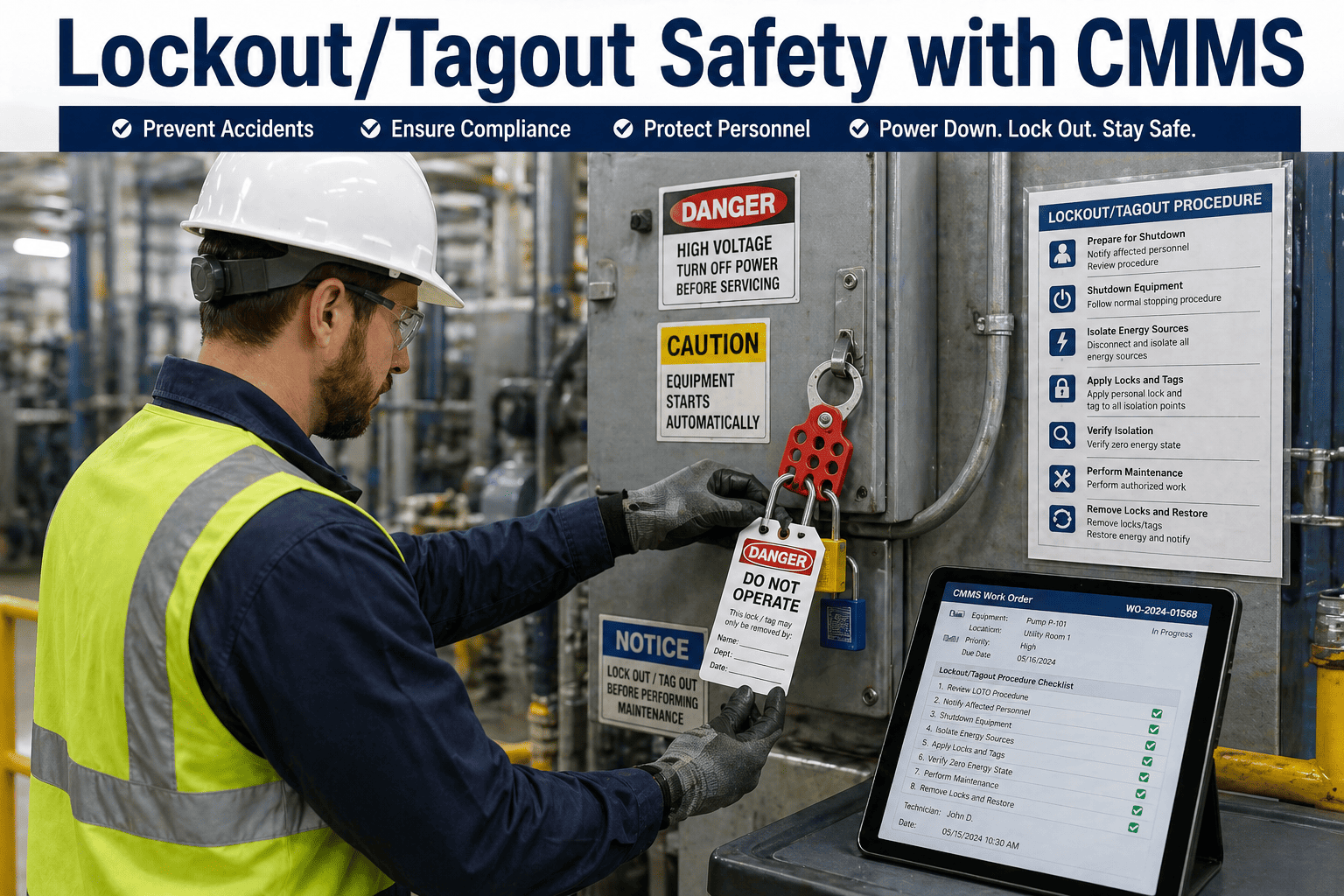
Under 29 CFR 1910.147, the six-step LOTO sequence must be followed in exact order. Every step has a specific safety purpose, and skipping any single one — most commonly verification (Step 6) — is where fatalities happen and where OSHA writes the biggest citations. Below is the sequence, with the specific power-plant considerations at each step. Book a 30-minute demo to see the 6-step digital sequence enforced inside OxMaint — mandatory sign-offs, timestamps, and zero-energy verification photos before any lock removal is even possible.
1
PREPARATION · Notify & Plan
Authorized employee reviews the written machine-specific procedure. Notify affected employees, control room, and adjacent work. Identify all energy sources — one missed source is the whole procedure invalid.
2
SHUTDOWN · Orderly Stop
Use normal stopping procedures — never emergency stop. On turbines, follow controlled roll-down. On boilers, follow purge and cool-down. Rushing this step creates its own hazards.
3
ISOLATION · Operate Every Isolating Device
Every energy-isolating device in the written procedure — breakers racked out, valves closed, line blinds installed. A hydroelectric generator may need 30-40 individual isolation actions.
4
LOCKOUT · Apply Locks and Tags
Each authorized worker applies their own personally-keyed lock to every isolation point. Tag identifies who, when, why. Default is lockout; tagout alone only if the device physically cannot accept a lock.
5
STORED ENERGY · Relieve & Restrain
Bleed pressure to zero. Discharge capacitors. Block or cribbing on elevated components. Wait for cool-down on thermal systems. Verify with instruments, not assumption.
6
VERIFICATION · Zero Energy State Test MOST-CITED STEP
Attempt to start equipment using normal controls. Confirm no motion, no voltage, no pressure response. If equipment responds — STOP. Do not proceed. Re-evaluate isolation. This is the single most commonly skipped step in citation records.
Power Plant Asset LOTO Profiles — Turbine, Boiler, Generator
The three highest-energy assets in any power plant — steam/gas turbine, boiler, and generator — each have their own LOTO character. The energy types dominate differently, the isolation-point counts differ by an order of magnitude, and the cool-down or bleed-down requirements shape the whole clearance timeline. Below is the profile map. Start free and OxMaint's power plant library pre-populates the isolation-point count and dominant energy type for each of these asset classes — your written procedures inherit the right hazard scope from day one.
TURBINE
Steam / Gas Turbine LOTO
Dominant EnergyMechanical (rotational) + Thermal + Electrical
Isolation Points15-25 typical (main steam, extraction, generator, lube oil, hydraulic)
Critical ConcernRotor coasts down for hours — turning gear must be locked out separately
Clearance Time4-12 hours to full zero-energy state
BOILER
Utility Boiler LOTO
Dominant EnergyThermal + Pressure + Chemical (fuel/flue gas)
Isolation Points20-40 typical (fuel, air, water, steam, drains, vents, ignitors)
Critical ConcernCool-down & LEL verification before internal entry — never bypass
Clearance Time24-72 hours for internal work depending on unit size
GENERATOR
Generator / Hydro Generator LOTO
Dominant EnergyElectrical (high voltage) + Hydrogen (cooling) + Mechanical
Isolation Points30-40 on hydro generator per OSHA example — highest in the plant
Critical ConcernH₂ purge to inert atmosphere + PT/CT secondaries + neutral grounding
Clearance Time6-24 hours depending on cooling system and grid isolation
The 30-40 Isolation Points on One Generator Won't Fit on a Paper Form.
A hydro generator, a boiler with 40 isolation points, a group LOTO with three crafts across two shifts — none of this survives a paper clipboard. Missed signoffs, illegible tags, verification steps skipped under time pressure. OxMaint digitizes every step: mandatory sequence, timestamped signoffs, verification photos, group lockbox transfers, and audit-ready records exportable in one click.
Group LOTO for Multi-Craft, Multi-Shift Power Plant Work
Most power plant outage work isn't one worker on one machine — it's several crafts (mechanical, electrical, I&C) working simultaneously across multiple shifts, sometimes for days. OSHA 1910.269(d)(8) governs this scenario with strict group LOTO and shift-transfer requirements that catch out plants running paper procedures. Below is the group LOTO discipline every outage coordinator needs. Book a scoping call and an OxMaint safety specialist will walk your specific outage scenarios — multi-shift boiler entry, generator rotor removal, turbine overhaul — before you open a trial.
01
Group Lockbox Assignment
Primary authorized employee applies the master lock to the isolation device, then places the isolation-device key inside the group lockbox. Every worker joining the job applies their own personal lock to the group lockbox.
02
Personal Lock Discipline
Each authorized worker's lock is personally keyed and stays with them. Nobody removes another worker's lock — not the supervisor, not the shift boss, not the plant manager. The lockbox cannot open until every personal lock is removed by its owner.
03
Shift-Transfer Protocol
Outgoing technician must NOT remove personal lock until incoming technician has applied their own lock to the hasp. Key transfer must be physical, not verbal or email. Incoming worker re-verifies zero-energy state at shift start.
04
Supervisor Sign-Off Log
Every lock addition, lock removal, and shift transfer requires signed and timestamped supervisor confirmation. Verbal transfer is not compliant. OSHA interpretation letters treat sign-off gaps as full-program failures.
Paper LOTO Program vs. OxMaint Digital LOTO Workflow
The gap between paper-based LOTO and digital LOTO isn't cosmetic — it's the difference between a program that passes audit and one that stacks up citations. Here's what changes when the whole workflow lives in OxMaint. Sign up free — no credit card, unlimited users so every authorized employee has an account from day one, and the power plant library ships with pre-built LOTO templates for turbines, boilers, generators, and switchgear.
Plants that move off paper stop losing days to audit prep and stop losing sleep over the verification step. Start your free forever workspace to digitize your first turbine or boiler LOTO this week, or book a demo to see a live digital LOTO clearance from a working utility customer before you commit.
"
We had a group LOTO on a 250MW steam turbine overhaul — three crafts, two shifts, twelve days. Under paper, the third shift transfer on day seven went verbal because the outgoing lead was already off-site. OSHA caught it in the next inspection cycle. After the citation we moved LOTO into OxMaint and set enforced dual-signoff on every shift transfer. The last two outages ran with zero transfer gaps, zero verification skips, and the annual periodic inspection wrote itself from the execution logs. The compliance discipline stopped being a memory test.
Plant Safety Manager · 500MW Combined-Cycle Facility · Southeast US Utility
Frequently Asked Questions
Which OSHA standard governs power plant LOTO?
Two standards apply. 29 CFR 1910.147 (Control of Hazardous Energy) is the general LOTO standard covering most maintenance work. 29 CFR 1910.269 (Electric Power Generation, Transmission, and Distribution) governs work on electric power generation equipment specifically, including group LOTO and shift-transfer provisions under (d)(8). Both are enforceable in a power plant and often apply simultaneously to different assets.
Why is verification the most-cited LOTO step?
Verification (Step 6) requires the authorized employee to actually attempt to start the equipment with normal controls after lockout. It's the step that proves isolation actually worked — but it's also the easiest to skip under time pressure, and it's the step most often left off written procedures entirely. OSHA writes citations both for skipped verification and for procedures that don't include it.
Sign up free to enforce verification as a mandatory step with photo and timestamp evidence.
Can OxMaint handle a hydroelectric generator with 30-40 isolation points?
Yes. OxMaint's isolation-point management supports unlimited points per asset, each with its own energy type, isolation method, verification requirement, and individual lock assignment. The written procedure lists every point in required sequence, and no procedure can be marked complete until every point is signed off. This is exactly the scenario paper clipboards fail on.
Does OxMaint integrate with our existing work-permit system?
Yes. OxMaint links LOTO clearances to work orders and can integrate with existing permit-to-work systems via API. The digital LOTO clearance becomes a required attachment on the work order, and the work order cannot be closed until the LOTO release sequence (Section 5 restoration) is complete and signed off.
How does the annual periodic inspection requirement (c)(6) work in OxMaint?
OSHA 1910.147(c)(6) requires an annual inspection of every energy control procedure by an authorized employee other than the one who normally performs it. In OxMaint, the inspection is generated automatically from live procedure execution logs — the inspector reviews actual clearances against the written procedure, flags any deviations, and signs off. The output is an audit-ready record with no reconstruction work.
Book a demo to see the periodic inspection workflow live.
What are the most common LOTO citations in power generation?
The top citation categories are: (1) inadequate or missing machine-specific written procedures, (2) failure to verify zero-energy state, (3) improper group LOTO — especially shift-transfer failures, (4) missing or expired annual periodic inspections, and (5) inadequate authorized-employee training records. Willful violations carry penalties up to $156K per instance, and repeat violations can trigger criminal referrals for a fatality.
Is a credit card or CAPEX approval required to start with OxMaint?
No. OxMaint's free forever plan requires no credit card, no CAPEX request, and no consulting engagement — you can
sign up in under 2 minutes, upload your first asset, and build your first digital LOTO procedure the same shift. The power plant asset library ships with pre-built templates for turbines, boilers, generators, and switchgear, so day-one configuration is minutes.
Every Verification Step Enforced. Every Sign-Off Timestamped. Every Audit Ready.
OxMaint digitizes the full 6-step LOTO sequence with mandatory verification evidence, digital group lockbox, enforced shift-transfer signoff, and auto-generated annual periodic inspections. Start free — no credit card, unlimited users, forever. Or book a demo to see digital LOTO on your specific turbine, boiler, or generator scenarios.