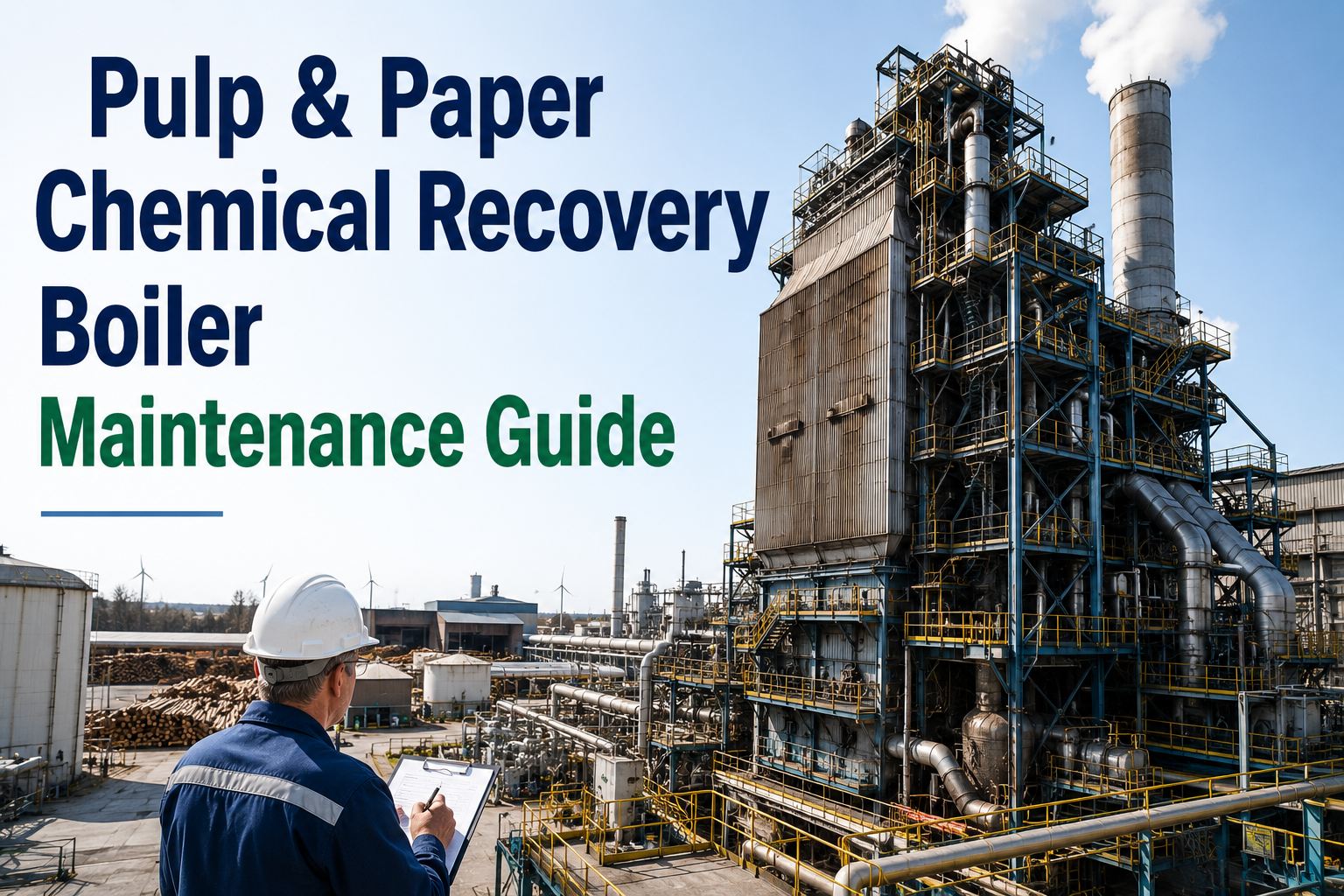
Recovery boiler maintenance is the highest-stakes reliability challenge in any kraft pulp mill — these units simultaneously recover pulping chemicals, generate steam, and manage molten smelt at 1,700°F, all while operating under strict BLRBAC compliance mandates. A single unplanned recovery boiler outage can cost a mill $200,000–$500,000 per day in lost production, and smelt-water incidents remain among the most catastrophic events in the chemical process industries. This guide covers the critical PM, inspection, and compliance workflows — from smelt spout and liquor gun maintenance to superheater cleaning and dissolving tank management — that keep recovery boilers safe and reliable, and shows how a purpose-built CMMS like OxMaint digitizes the entire schedule so nothing falls through the cracks. You can Start Free Trial today or book a personalized demo to see the platform configured for your mill.
PULP & PAPER · CHEMICAL RECOVERY
Is Your Recovery Boiler Maintenance Program Ready for the Next BLRBAC Audit?
Kraft recovery boilers combine the highest-consequence pressure vessel operations in the pulp and paper industry with unique smelt-handling hazards. One missed inspection or delayed spout replacement can trigger a costly outage — or worse, a smelt-water explosion. OxMaint structures every PM, inspection, and compliance record so your program is audit-ready every day.
CORE PM AREAS
Recovery Boiler Maintenance Checklist: Critical PM Tasks by Component
A kraft recovery boiler has six to eight major component systems, each with its own failure mode, inspection interval, and BLRBAC reporting requirement. Missing any one of them during a turnaround can extend outage duration by 3–7 days or force an unplanned shutdown mid-campaign.
Smelt Spouts & Spout Shutoff
- Visual spout condition & wash-water flow check — every shift
- Spout body ultrasonic thickness — weekly
- Spout replacement at 50% wall loss — 30–60 day cycle
- Shutoff device functional test — monthly
- Emergency dumping procedure drill — quarterly
Black Liquor Guns & Tips
- Spray pattern & tip wear inspection — daily
- Tip replacement or reface — 7–14 day cycle
- Liquor gun lance thickness check — monthly
- Gun oscillation mechanism lubrication — weekly
- Spare gun assembly readiness — continuous
Superheater & Generating Bank
- Ultrasonic tube thickness survey — annual outage
- Sootblower lance & valve inspection — monthly
- Pluggage & carryover deposit assessment — weekly
- Tube sample removal & analysis — annual
- Casing & ductwork expansion joint check — semi-annual
Dissolving Tank & Green Liquor
- Agitator motor & bearing condition — monthly
- Spout wash-water temperature & pressure — shift
- Tank wall & spout hood thickness — quarterly
- Green liquor density & temperature logging — continuous
- Level control & alarm functional test — weekly
Pressure Parts & Safety Valves
- Safety relief valve set-point test & certification — annual
- Drum & header NDE inspection — annual outage
- Water level gauge glass & alarms — shift
- Blowdown valve & piping inspection — monthly
- ASME code repair documentation — per repair
Refractory & Furnace Floor
- Furnace floor & smelt bed visual inspection — monthly
- Primary air port & char bed refractory — quarterly
- Tube wall refractory shield inspection — annual outage
- Thermocouple & temperature sensor calibration — monthly
- Critical spare refractory inventory check — weekly
INSPECTION TIMELINE
Recovery Boiler Inspection Schedule: What Gets Checked and When
BLRBAC recommended good practices and the ASME Boiler & Pressure Vessel Code (Section I) define a layered inspection cadence — from shift-level visual rounds to the full annual outage. A well-structured recovery boiler CMMS mirrors this cadence exactly so every inspector, operator, and manager sees the same due dates.
Operator Visual Rounds (Every 8 Hours)
Smelt spout flow verification, wash-water temperature logging, liquor gun spray pattern check, furnace floor visual, drum level gauge comparison, and smelt-bed condition assessment. These rounds feed directly into the CMMS as completed checklist records — no clipboards, no data entry lag.
Mechanical & NDE Spot Checks
Ultrasonic thickness on active smelt spouts, sootblower lance alignment, liquor gun oscillation mechanism lubrication, dissolving tank agitator bearing temperature, and safety device functional tests. OxMaint auto-generates work orders from trigger conditions — firing hours, liquor solids throughput, or calendar date.
Compliance & System Integrity
Spout shutoff device drill, emergency smelt dumping procedure, safety relief valve isolation valve check, thermocouple calibration, and green liquor system integrity. Every completed task is timestamped, signed, and stored for BLRBAC audit defensibility.
Full Outage Inspection (BLRBAC & ASME)
Complete boiler opening — pressure part NDE, tube sample removal, refractory assessment, superheater and generating bank thickness survey, safety valve bench testing, and casing/ductwork inspection. OxMaint manages the entire outage work-order package, critical path scheduling, and spare-parts reservation months in advance.
CONSEQUENCE & COST
The Real Cost of Reactive Recovery Boiler Maintenance
Recovery boiler reliability is not just a safety issue — it is a direct line to the mill's profitability. When a recovery boiler goes down, the entire fiberline, recausticizing plant, and power boiler cascade into disruption within hours.
WORKED EXAMPLE
A 1,200-tpd kraft mill running its recovery boiler on a spreadsheet-based PM system missed a scheduled smelt spout thickness check during a staffing transition. The spout developed a thin spot, leaked smelt into the shutoff device area, and forced an emergency dump and unplanned 4-day outage — total cost: $1.1M in lost production plus $85K in emergency repairs. With OxMaint's automated trigger-based PM, the thickness check would have auto-generated a work order with a escalating notification to the reliability manager at 3 days overdue.
SOFTWARE SOLUTION
How OxMaint CMMS Solves Recovery Boiler Maintenance Challenges
OxMaint is an AI-powered CMMS and EAM platform purpose-built for asset-intensive industries. For pulp mill recovery boiler teams, it replaces spreadsheets, paper work orders, and disconnected inspection logs with a single, audit-defensible system of record.
Trigger-Based PM Automation
OxMaint generates work orders automatically based on operating hours, liquor throughput, firing-rate changes, or calendar date — not just time. Recovery boiler PM for smelt spouts, liquor guns, and sootblowers fires exactly when conditions demand it, cutting missed PMs by up to 90% and reducing unplanned downtime 30–50%.
BLRBAC Audit Trail
Every inspection, thickness reading, torque value, and sign-off is captured digitally with timestamps and technician identity. When auditors arrive, OxMaint produces a complete compliance history in seconds — no scrambling through paper files or SharePoint folders. Mills report cutting audit prep time from weeks to hours.
Critical Spares Tracking
OxMaint's inventory module tracks spare spout assemblies, liquor gun tips, refractory materials, and safety valve spares with min/max triggers and automatic reorder alerts. During annual outage planning, the system reserves parts against work orders months in advance, eliminating the 3–7 day delays caused by missing critical spares.
AI-Driven Predictive Insights
OxMaint's AI engine analyzes thickness trends, vibration data, temperature logs, and historical failure patterns to predict component failure before it happens. A smelt spout approaching critical wall loss flags a replacement recommendation 10–20 days before failure, giving the team time to schedule the change during a planned window.
INSPECTION FRAMEWORK
Recovery Boiler Inspection & PM Tracking Table
A structured CMMS inspection schedule is the backbone of recovery boiler reliability. Below is the framework OxMaint deploys for kraft mill boiler PM — each row maps to a work-order template with assigned technicians, required spare parts, and BLRBAC documentation fields.
| Component | Inspection / PM Task | Frequency | Trigger Method | BLRBAC Ref. |
|---|---|---|---|---|
| Smelt Spout | Wall thickness ultrasonic inspection | Weekly | Operating hours + calendar | II.A.3 |
| Smelt Spout | Spout replacement at 50% wall loss | 30–60 days | Thickness trend threshold | II.A.3 |
| Liquor Gun | Tip wear inspection & replacement | 7–14 days | Liquor throughput tons | II.B.1 |
| Spout Shutoff | Functional test & emergency dump drill | Monthly | Calendar date | II.A.5 |
| Superheater | Tube thickness NDE survey | Annual outage | Outage schedule | III.C.2 |
| Sootblowers | Lance alignment & valve inspection | Monthly | Operating hours | III.D.1 |
| Dissolving Tank | Wall & spout hood thickness | Quarterly | Calendar date | II.D.4 |
| Safety Valves | Set-point test & certification | Annual | ASME code requirement | IV.B.1 |
| Refractory | Furnace floor & smelt bed inspection | Monthly | Calendar + visual trigger | III.A.1 |
| Pressure Parts | Drum & header NDE inspection | Annual outage | ASME Section I | IV.A.2 |
See OxMaint Configured for Your Recovery Boiler
Book a 30-minute demo and we'll walk you through a recovery boiler PM template, BLRBAC audit trail, and critical-spares workflow built specifically for your mill.
FREQUENTLY ASKED
Recovery Boiler Maintenance & CMMS FAQs
How often should smelt spouts be inspected on a kraft recovery boiler?
Smelt spouts require visual inspection every shift (8 hours) for flow condition and wash-water integrity, ultrasonic thickness measurement weekly, and replacement when wall loss reaches 50%. BLRBAC recommended good practices call for a documented spout thickness tracking program with records maintained for audit review. OxMaint automates these intervals with trigger-based work orders so no inspection is ever missed due to staffing changes or shift handover gaps.
What is BLRBAC compliance and how does a CMMS support it?
BLRBAC (Black Liquor Recovery Boiler Advisory Committee) publishes recommended good practices for recovery boiler design, operation, and maintenance — covering everything from smelt spout programs to emergency shutdown procedures. A CMMS like OxMaint supports BLRBAC compliance by maintaining a digital, timestamped audit trail of every inspection, test, and repair, so documentation is instantly retrievable during internal audits or insurance reviews. You can Start Free Trial to test the audit-trail workflow on your own asset hierarchy.
What are the most common causes of recovery boiler unplanned outages?
The leading causes are smelt spout failures (wall loss beyond critical), liquor gun tip plugging or wear causing poor spray patterns, superheater tube fouling and carryover, sootblower failures, and safety valve issues. Approximately 40% of these incidents are traceable to deferred or missed preventive maintenance tasks — exactly the gap that an automated CMMS like OxMaint is designed to close through trigger-based PM generation and escalation alerts.
How long does it take to implement a CMMS for a pulp mill recovery boiler?
A focused recovery boiler CMMS implementation in OxMaint typically takes 2–4 weeks: week one for asset hierarchy and criticality setup, week two for PM templates and inspection checklists, and weeks three to four for technician onboarding and go-live. Because OxMaint is cloud-based with pre-built pulp and paper templates, there is no on-premise server installation, and your team can be running recovery boiler PMs on the platform faster than a traditional enterprise CMMS deployment. Book a demo to see a sample implementation plan.
Can OxMaint track recovery boiler spare parts like spout assemblies and gun tips?
Yes. OxMaint's spare-parts inventory module tracks every critical recovery boiler component — smelt spout assemblies, liquor gun tips and lances, sootblower parts, refractory materials, and safety valve spares — with min/max reorder triggers and automatic reservation against planned outage work orders. This eliminates the 3–7 day outage extensions that occur when critical spares are discovered missing at the moment they are needed, and gives procurement teams visibility months in advance of annual outage windows.
Stop Managing Recovery Boiler PM on Spreadsheets
Join the pulp mills using OxMaint to automate recovery boiler maintenance, cut unplanned downtime 30–50%, and stay BLRBAC-audit-ready every day of the year.
Free 14-day trial · No credit card