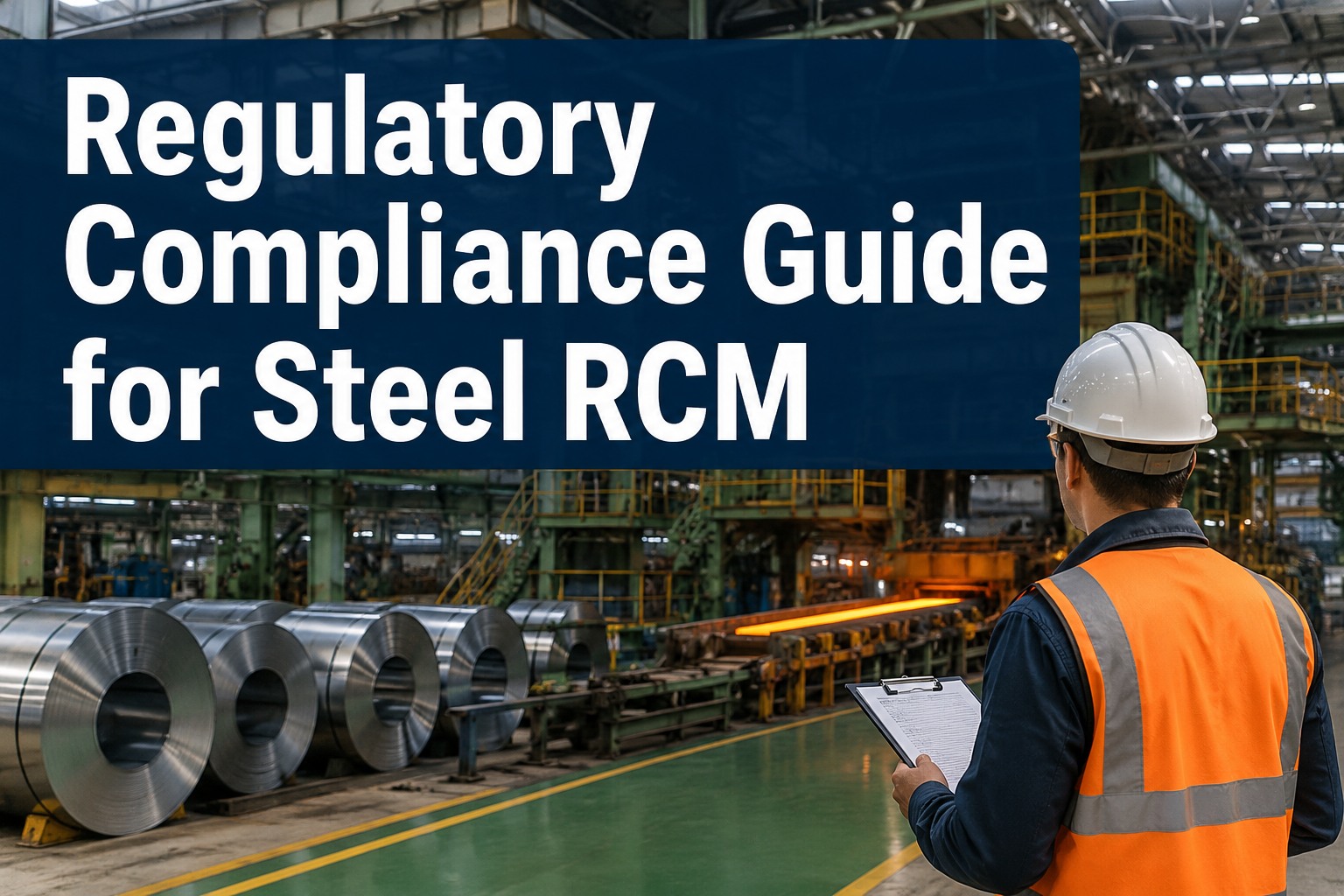
Regulatory compliance in steel manufacturing demands rigorous documentation of every maintenance decision, from ISO 55001 asset management frameworks to SAE JA1011 standards for Reliability-Centered Maintenance. Steel RCM compliance bridges the gap between operational reliability and audit readiness, ensuring that critical assets like blast furnaces, rolling mills, and continuous casters operate within strict safety and regulatory boundaries. By implementing structured failure-mode analysis and documented maintenance strategies, steel plants can reduce unplanned downtime by 30–50% while maintaining complete traceability for any regulatory audit. OxMaint's AI-powered CMMS platform automates compliance documentation, links failure modes directly to work orders, and generates audit-ready reports that prove your RCM program is engineering out failures rather than reacting to them. You can Start Free Trial today to see how OxMaint streamlines steel maintenance standards adherence across your entire plant.
Is your steel plant audit-ready — or one inspection away from a compliance finding?
Most steel maintenance teams run solid reliability programs on the floor but can't prove it on paper. OxMaint closes that gap by linking every RCM decision to documented, audit-ready evidence — so ISO 55001 and SAE JA1011 reviewers see a clean, defensible trail from failure mode to maintenance strategy to executed work order.
What RCM compliance in steel actually requires
Steel regulatory compliance extends far beyond keeping equipment running — it demands a documented, defensible maintenance strategy for every critical asset class, from coke ovens to finishing lines.
ISO 55001 Asset Management
Requires a documented asset management system where maintenance strategies are risk-based, regularly reviewed, and traceable to organizational objectives. Steel plants must show that RCM analyses drive the PM program — not the other way around.
Mandatory for certificationSAE JA1011 RCM Standard
Defines the seven minimum questions any RCM analysis must answer to be considered legitimate. If your failure-mode strategies can't trace back to these seven questions, auditors can reject your entire RCM program as non-compliant.
RCM process standardOSHA & Safety Compliance
Steel safety compliance under OSHA 29 CFR 1910 requires documented inspection and maintenance of critical safety systems — emergency shutdowns, interlocks, pressure relief devices. RCM must explicitly address safety and environmental failure modes.
Federal regulationEPA Environmental Standards
Environmental failure modes in steel — leaks, emissions, spills — must be identified in RCM analyses with documented mitigation strategies. Compliance tracking must show preventive actions taken before incidents, not just corrective responses.
Environmental regulationHow to map SAE JA1011 questions to steel maintenance standards
Every legitimate RCM analysis in a steel plant must answer seven questions in sequence — skipping any one invalidates the analysis under SAE JA1011 and weakens your ISO 55001 audit position.
What are the functions and performance standards of the asset?
Document what each critical steel asset must do — a rolling mill's throughput in tons/hour, a blast furnace's operating pressure range, a crane's load capacity — and at what performance level it must operate to meet production targets.
In what ways can it fail to perform those functions?
List every functional failure — the mill stops rolling, the furnace loses pressure, the crane cannot lift. Each failure mode must be specific enough to link to an observable degradation pattern or event.
What causes each functional failure?
Identify failure modes down to component level — bearing wear, refractory erosion, hydraulic seal degradation, electrical insulation breakdown. This is where OxMaint's failure-mode library links directly to work order history.
What happens when each failure occurs?
Document failure effects — production loss, safety hazards, environmental impact, secondary damage. This step determines whether a failure mode is safety-critical, operationally significant, or tolerable for run-to-failure.
In what way does each failure matter?
Classify failure consequences — safety, environmental, operational, or non-operational. Steel compliance documentation must show that safety and environmental failure modes received priority in strategy selection.
What can be done to predict or prevent each failure?
Assign proactive tasks — condition monitoring, time-based PMs, inspections, oil analysis, vibration analysis. Each task must be technically feasible and worth doing relative to the failure consequence.
What must be done if no proactive task is appropriate?
For failure modes where prediction and prevention aren't viable, document the default action — run-to-failure with a backup plan, or redesign/modification to eliminate the failure mode entirely. This decision must be recorded and justified.
Choosing the right maintenance strategy for steel critical assets
After the seven RCM questions are answered, each failure mode gets one of four strategies. The table below maps strategy selection to the failure consequence — a decision that must be documented for every critical asset in your steel plant.
| Failure Consequence | Strategy | Trigger Type | Steel Asset Example | Compliance Evidence Required |
|---|---|---|---|---|
| Safety / Environmental | Condition Monitoring | Sensor data threshold | Blast furnace pressure relief | Continuous sensor log + alert history |
| Operational — High Impact | Time-Based PM | Calendar or runtime hours | Rolling mill gearbox | PM schedule + completed work orders |
| Operational — Low Impact | Inspection-Based | Periodic inspection rounds | Conveyor belt rollers | Inspection checklist + defect log |
| Non-Operational | Run-to-Failure | Failure occurrence | Non-critical lighting circuits | RTF justification + repair time record |
| Safety — Recurring Failure | Redesign / Modification | Engineering change order | Crane brake system upgrade | Engineering review + post-mod validation |
How OxMaint drives steel RCM compliance and audit readiness
OxMaint turns RCM theory into a living, documented program — asset hierarchies that mirror your steel plant, failure-mode libraries linked to every work order, and audit-ready reports generated automatically from real maintenance activity.
Asset hierarchy mirroring your plant
Build a complete functional hierarchy — from plant to process to system to component — that matches how your steel operation actually runs. Every work order, PM, and failure record rolls up to the correct asset, giving auditors a clear line of sight from maintenance activity to asset strategy.
Outcome: 100% asset-level traceability for ISO 55001 auditsFailure-mode libraries linked to work orders
Every completed work order captures failure mode, cause, and remedy using standardized codes aligned with your RCM analysis. This creates a living dataset that proves your RCM strategies are being executed as documented — not just sitting on a shelf.
Outcome: Cut compliance documentation time by 70%Condition-based PM triggers
Trigger preventive maintenance automatically from runtime hours, cycle counts, or sensor thresholds — not just calendar dates. OxMaint's predictive analytics can flag deviation from baseline vibration, temperature, or oil quality before failure occurs, with every trigger logged for compliance.
Outcome: Reduce unplanned downtime 30–50% on critical assetsOne-click audit-ready compliance reports
Generate ISO 55001, SAE JA1011, and OSHA compliance reports in seconds — showing PM compliance rates, failure-mode analysis coverage, corrective action history, and strategy review dates. No more scrambling through spreadsheets and paper records when an audit notice arrives.
Outcome: Audit preparation from weeks to hoursRCM pilot on a steel plant's most critical asset — a real-world scenario
Consider a mid-sized steel plant running a 180-asset reliability program spending $42K per year on maintenance for its continuous caster alone — with 14 unplanned downtime events annually costing an average of $18,000 per hour in lost production.
Asset criticality ranking
OxMaint's asset hierarchy ranks the continuous caster, hot strip mill, and primary crusher as the top three critical assets by production impact and safety risk. The caster's 12 sub-systems are mapped to functional hierarchies in OxMaint, with performance standards documented for each.
12 sub-systems documentedFailure mode analysis (FMEA)
The RCM team identifies 47 failure modes across the caster's sub-systems — 6 safety-critical, 19 operationally significant, 22 non-operational. OxMaint's failure-mode library links each mode to historical work orders, revealing that 8 of the 14 downtime events traced back to just 3 recurring failure modes.
47 failure modes identifiedStrategy assignment and PM rebuild
Each failure mode receives a documented strategy: condition monitoring for the 6 safety-critical modes, time-based PMs for 14 operational modes, inspection rounds for 5, and run-to-failure for 22 non-operational modes. OxMaint auto-generates PM schedules and inspection checklists from the strategy assignments.
25 proactive tasks deployedMeasure and validate
After 4 weeks of execution, OxMaint reports show PM compliance at 94%, unplanned downtime events dropped from 14 to 6 annually, and the caster's availability improved from 87% to 93%. The full compliance report — covering ISO 55001 strategy documentation and SAE JA1011 process adherence — generates in under 60 seconds.
Downtime cut 57%Steel maintenance audit checklist — 12 items reviewers expect to see
When auditors arrive, they look for specific evidence that your RCM program is real, documented, and actively executed. Use this checklist to assess your steel compliance documentation before the next review.
Documentation Evidence
Execution Evidence
See OxMaint on your assets — book a 30-minute demo
Walk through a live RCM compliance setup on steel plant equipment, see audit-ready reports generate in real time, and learn how teams cut unplanned downtime 30–50% in the first 90 days.
Steel RCM compliance — common questions answered
What is RCM compliance in steel manufacturing?
RCM compliance in steel means your Reliability-Centered Maintenance program meets SAE JA1011 process standards, supports ISO 55001 asset management certification, and satisfies OSHA and EPA regulatory requirements for safety and environmental failure mode documentation. It requires that every critical asset has a documented RCM analysis, each failure mode has an assigned maintenance strategy, and all maintenance activity is traceable to that strategy through work order records and compliance reports.
How does ISO 55001 apply to steel maintenance programs?
ISO 55001 requires steel plants to maintain a documented asset management system where maintenance strategies are risk-based, aligned with business objectives, and regularly reviewed. For maintenance teams, this means RCM analyses must drive the PM program, asset criticality rankings must be documented and updated, and maintenance performance must be measured against defined KPIs. OxMaint generates the compliance reports that prove this alignment — you can Start Free Trial to see your assets set up in minutes.
What documents are needed for a steel maintenance audit?
Auditors typically expect an asset register with criticality rankings, RCM analyses covering all seven SAE JA1011 questions for critical assets, documented maintenance strategies per failure mode, PM schedules linked to those strategies, completed work orders with failure mode and remedy codes, condition monitoring logs for safety-critical systems, and KPI dashboards showing PM compliance, MTBF, and availability trends. OxMaint consolidates all of this into one-click compliance reports.
How long does it take to implement RCM in a steel plant?
A focused RCM pilot on one critical asset — like a continuous caster or rolling mill — typically takes 12 to 16 weeks: 4 weeks for asset criticality ranking and hierarchy setup, 4 weeks for failure mode analysis, 4 weeks for strategy assignment and PM schedule rebuild, and 4 weeks for execution and measurement. Scaling to a plant-wide program usually takes 12 to 18 months depending on asset count and team capacity, with OxMaint accelerating documentation by up to 70%.
Can OxMaint help with steel safety compliance documentation?
Yes — OxMaint specifically captures safety-critical and environmental failure modes within the RCM framework, links them to condition monitoring alerts and PM tasks, and documents every inspection and corrective action with timestamps and technician signatures. This creates the evidence trail that OSHA and EPA reviewers expect, showing that safety systems are actively maintained and monitored, not just listed on a compliance checklist. Book a Book a Demo to see the safety compliance workflow on your asset types.
Start your steel RCM compliance program today
Join steel maintenance teams using OxMaint to engineer out failures, cut unplanned downtime 30–50%, and walk into every audit with complete, defensible documentation.
Free 14-day trial · No credit card