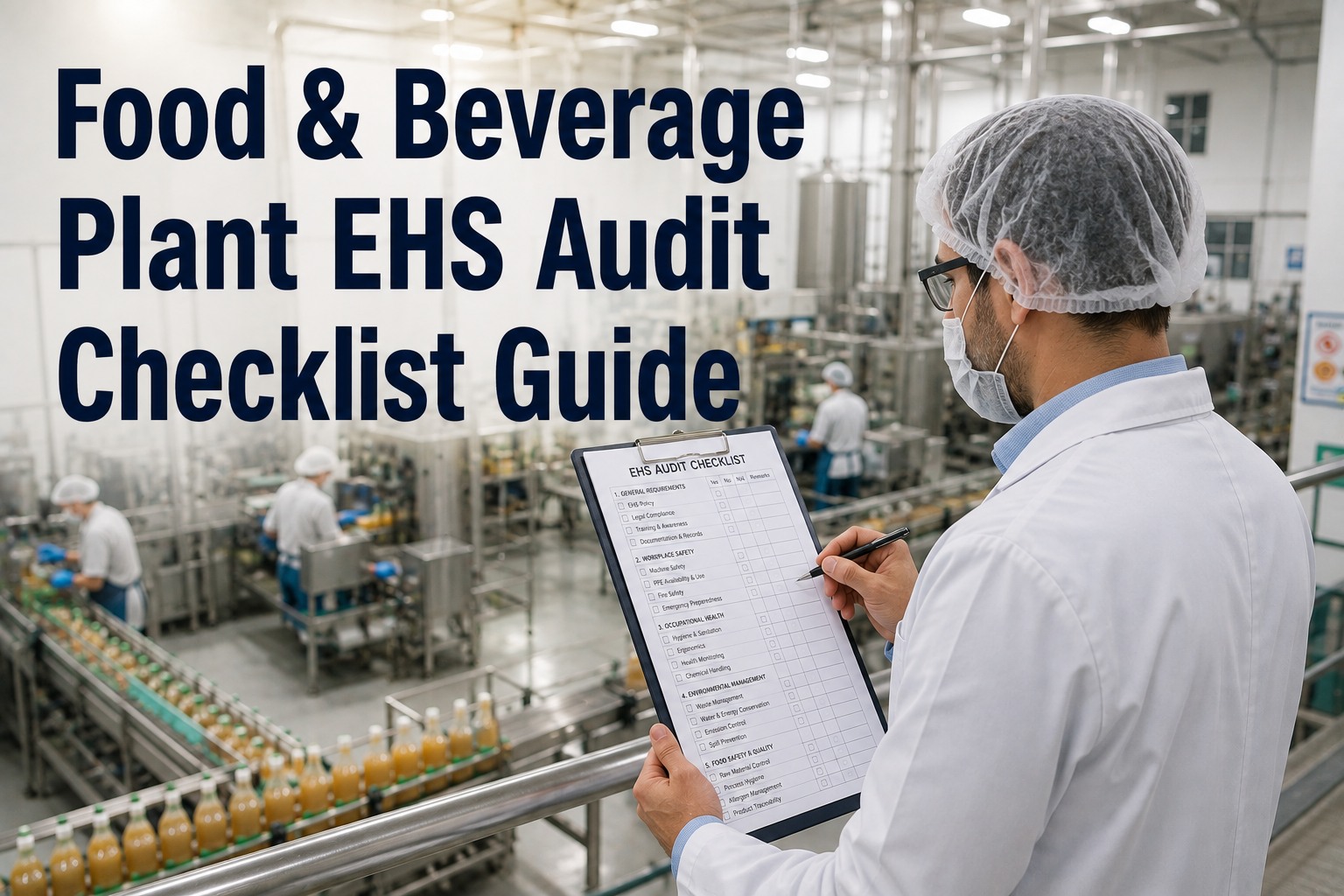
RCM compliance in food & beverage is the discipline of proving — with documented, auditable evidence — that every maintenance decision on your critical assets follows a defensible reliability logic, satisfies standards like ISO 55001 and SAE JA1011, and stands up to FDA, USDA, and GFSI audit scrutiny. Most plants fail audits not because their maintenance is wrong, but because their documentation can't prove it was right. This guide walks through the exact compliance framework food and beverage reliability teams need: the standards that apply, the seven RCM questions auditors expect answered, the documentation trail that closes findings, and how OxMaint's CMMS turns your RCM program into an always-audit-ready system instead of a binder you scramble to update. If you're ready to stop rebuilding compliance evidence before every audit, Start Free Trial and see how it works on your own assets.
Is your RCM program audit-ready — or just well-intentioned?
Auditors don't ask whether you maintain your equipment. They ask you to prove it: the failure-mode analysis, the task-selection logic, the completed work orders, the sign-offs. Here's the number that matters.
Which RCM compliance standards actually apply to food & beverage plants?
Four frameworks govern how food and beverage maintenance and reliability programs are judged — and auditors increasingly expect you to satisfy all of them at once. Knowing what each one demands is the first step to food and beverage standards adherence.
ISO 55001
Requires a documented asset management system with defined policies, objectives, and lifecycle plans. For food and beverage ISO 55001 compliance, you must show that maintenance decisions align to asset criticality — exactly what RCM analysis produces.
SAE JA1011 / JA1012
The defining standard for what qualifies as a true RCM process. JA1011 sets the seven-question minimum; JA1012 defines evaluation criteria. Auditors use it to check whether your "RCM program" is genuinely RCM or just renamed preventive maintenance.
FDA FSMA & USDA
FSMA's preventive controls rule makes equipment maintenance a food-safety control. A failed gasket on a pasteurizer isn't just downtime — it's a potential hazard. Food and beverage regulatory compliance now explicitly includes maintenance records as evidence.
SQF, BRC, FSSC 22000
Every GFSI-benchmarked scheme audits maintenance as a prerequisite program. SQF Edition 9, for example, scores your maintenance schedule, completion records, and corrective actions. Missed PMs with no documented justification are automatic findings.
The 7 RCM questions every food & beverage audit will test
SAE JA1011 says a maintenance program only qualifies as RCM if it answers all seven questions, in order, for every asset in scope. This is the backbone of food and beverage RCM compliance — and the exact sequence an experienced auditor will walk through.
What are the asset's functions and performance standards?
Define what the equipment must do and how well. A filler must run at 400 bottles/min with ±2ml accuracy — not just "fill bottles." Without quantified performance standards, every later decision is opinion, not analysis.
In what ways can it fail to fulfill those functions?
List functional failures: total failure (filler stops), partial failure (underfills), and over-performance (overfills causing giveaway). Food plants typically identify 3–7 functional failures per critical asset.
What causes each functional failure?
These are your failure modes — worn seals, contaminated lubricant, sensor drift, CIP chemical attack on elastomers. A thorough FMEA on a packaging line usually surfaces 30–60 failure modes; document every one.
What happens when each failure occurs?
Failure effects: Does it stop production? Compromise food safety? Damage downstream equipment? In food & beverage, any failure mode touching product contact surfaces automatically escalates to a safety consequence.
In what way does each failure matter?
Classify consequences: safety/environmental, operational (downtime cost), non-operational (repair cost only), or hidden. This classification drives the entire task-selection logic — and it's what auditors check first for rigor.
What proactive task can prevent or detect the failure?
Choose condition-based monitoring, scheduled restoration, or scheduled discard — only if technically feasible and worth doing. A vibration route on a homogenizer is defensible; a calendar-based rebuild "because we've always done it" is not.
What if no proactive task is suitable?
For hidden failures: failure-finding tasks (testing standby equipment). For safety consequences with no feasible task: redesign is mandatory. For everything else: documented run-to-failure is a legitimate, auditable decision — if you recorded the logic.
What food and beverage compliance documentation must your RCM program produce?
An RCM analysis that lives in a spreadsheet on one engineer's laptop fails the moment that engineer leaves. Food and beverage audit readiness requires six artifact types, linked and retrievable in under 5 minutes during an inspection.
| Documentation Artifact | What It Proves | Audit Standard | Retention |
|---|---|---|---|
| Asset criticality ranking | You know which equipment matters most and why | ISO 55001, SQF | Current + 2 revisions |
| FMEA / failure-mode library | Systematic analysis of how assets fail (RCM Q1–Q4) | SAE JA1011 | Life of asset |
| Task-selection logic records | Each PM task traces to a failure mode and consequence class | SAE JA1011, JA1012 | Life of asset |
| PM completion work orders | Scheduled tasks were actually executed, on time, by whom | FSMA, SQF, BRC | 2–3 years minimum |
| Corrective action records | Failures triggered root-cause analysis and program updates | ISO 55001, GFSI | 2–3 years minimum |
| Program review & KPI reports | The RCM program is living — reviewed, measured, improving | ISO 55001 Clause 9 | Current + 2 cycles |
Food and beverage compliance tracking fails when these six artifacts live in six different places. A CMMS that links failure modes to work orders to completion records closes the chain automatically.
How to choose the right maintenance strategy for each failure mode
RCM's power is that it matches the strategy to the failure mode — not the other way around. Plants that apply one blanket PM approach to everything typically overspend 30–40% on maintenance while still suffering avoidable breakdowns. Here's the decision logic auditors expect to see documented.
Predictive / Condition Monitoring
Vibration analysis on motors and gearboxes, oil analysis on hydraulics, thermography on electrical panels, temperature trending on pasteurizers. Best for failure modes with a detectable P-F interval — you see the failure developing weeks before it stops the line.
Example: bearing wear on a filler drive motor — vibration route every 2 weeks catches it 4–6 weeks before failure.
Scheduled Restoration / Discard
Replace or rebuild at a fixed interval when the failure mode is age-related and no practical condition check exists. Gaskets, seals, belts, and wear plates on product-contact equipment are classic candidates — especially where CIP chemical exposure accelerates degradation.
Example: homogenizer valve seals replaced every 2,000 operating hours regardless of apparent condition.
Functional Testing of Hidden Failures
Standby equipment, safety interlocks, backup refrigeration, emergency stop circuits — these fail silently. RCM mandates scheduled functional tests at intervals calculated from the required availability and the failure rate. This is the most commonly missed category in food plant audits.
Example: monthly test of the backup ammonia detection system — documented, signed, and traceable.
Deliberate No-Scheduled-Maintenance
For failure modes with no safety consequence, no production impact, and repair cost lower than any preventive task. The key word is deliberate — a documented decision with the consequence analysis on file, not neglect. Auditors accept run-to-failure; they don't accept "we never thought about it."
Example: a non-critical conveyor guide roller — $40 part, 5-minute swap, zero production impact.
What RCM compliance looks like on a real food & beverage line
A mid-size dairy processing plant — 180 maintainable assets, $42K/month in unplanned downtime, and a BRC audit 90 days out — ran an RCM pilot on their two most critical lines. Here's what the numbers did.
- PM schedule inherited from OEM manuals — never analyzed against actual failure modes
- 34% of PM tasks had no documented link to any failure mode
- Unplanned downtime: 18 hours/month across pasteurizer and filling lines
- Maintenance records in 3 systems: paper logs, a spreadsheet, and a legacy database
- Previous BRC audit: 2 minor findings on maintenance documentation gaps
- Full FMEA on 22 critical assets: 147 failure modes documented and classified
- PM tasks re-derived: 28% eliminated as non-value-adding, 12 new condition-based tasks added
- Unplanned downtime: 7 hours/month — a 61% reduction worth ~$25K/month
- All records in one CMMS: failure modes linked to work orders, completion auto-logged
- BRC audit result: zero maintenance findings; auditor cited documentation as a strength
How OxMaint makes food & beverage RCM compliance automatic
OxMaint is an AI-powered CMMS and EAM platform built for exactly this problem: turning RCM analysis into executed, documented, auditable maintenance — without the spreadsheet archaeology. Four capabilities do the heavy lifting for food and beverage maintenance audit readiness.
Asset Hierarchies That Mirror Your Plant
Build your plant structure — site, line, machine, component — exactly as an auditor expects to see it. Attach criticality rankings, nameplate data, and food-safety zone classifications to every node. ISO 55001's "documented asset information" requirement, satisfied by default.
Outcome: asset criticality review drops from 2 weeks to 2 daysFailure-Mode Libraries Linked to Work Orders
Store your FMEA directly in OxMaint. Every PM task links to the failure mode it addresses, the consequence class, and the RCM logic that selected it. When an auditor asks "why do you do this task every 500 hours?" — the answer is one click away, not one filing cabinet away.
Outcome: SAE JA1011 task-logic documentation always currentPM Triggers on Runtime, Cycles, or Sensor Data
Move beyond calendar PMs. OxMaint triggers work orders from meter readings, production counts, or IoT sensor thresholds — so condition-based tasks fire when the data says so, not when the calendar does. Missed PMs escalate automatically with a documented justification trail.
Outcome: PM compliance rates above 95%, with zero missed-task findingsAudit-Ready Reports on Demand
Generate PM completion histories, failure-mode coverage reports, downtime Pareto charts, and corrective-action logs in seconds. When a GFSI or FSMA auditor requests 12 months of maintenance records for your pasteurizer, you export a filtered report — not a weekend of paper-chasing.
Outcome: audit prep time cut from 3 weeks to under 1 daySee OxMaint running RCM compliance on your own assets
Book a 30-minute demo and we'll walk through a live food & beverage asset hierarchy, failure-mode library, and audit report — built around your equipment.
Frequently asked questions about RCM compliance in food & beverage
What is RCM compliance in food & beverage manufacturing?
RCM compliance means your maintenance program follows the SAE JA1011 standard — all seven RCM questions answered and documented for each critical asset — and that the resulting records satisfy food-safety and asset-management standards like ISO 55001, FSMA, and GFSI schemes. It's not enough to do reliability-centered maintenance; you must be able to prove the logic, the execution, and the outcomes to an auditor on demand.
Does ISO 55001 require RCM specifically?
No — ISO 55001 doesn't mandate RCM by name, but it requires a documented, risk-based approach to asset management decisions. RCM is the most widely accepted methodology that satisfies this requirement, which is why food and beverage ISO 55001 programs almost always use RCM as their analytical engine. The two standards complement each other: ISO 55001 sets the management system, SAE JA1011 defines the analysis rigor.
How long does an RCM analysis take for a food plant?
A focused pilot on 20–30 critical assets typically takes 8–12 weeks with a trained facilitator and a cross-functional team (operations, maintenance, quality, food safety). Full plant-wide coverage of 150–300 assets usually runs 6–12 months. The key is starting with your highest-criticality, highest-downtime equipment — book a demo to see how OxMaint structures a pilot scope.
What maintenance records do GFSI auditors actually ask for?
GFSI auditors (SQF, BRC, FSSC 22000) typically request: your preventive maintenance schedule, completion records for the past 12–24 months, records for food-safety-critical equipment specifically, corrective action logs for equipment failures, and evidence that temporary repairs were controlled and later permanent-fixed. They also check that your maintenance program covers calibration of food-safety instruments. Food and beverage safety compliance hinges on having all of this retrievable quickly.
Can a CMMS replace the RCM analysis process?
No — a CMMS doesn't perform the RCM analysis; it operationalizes and documents it. You still need the cross-functional team, the FMEA sessions, and the consequence classification. What OxMaint does is ensure the analysis doesn't die in a binder: failure modes link to live work orders, PM tasks carry their selection logic, and every completion auto-generates the audit trail. The analysis is human; the compliance documentation is automatic. Start Free Trial to see the difference.
Make RCM compliance a byproduct of how you already work
OxMaint links your failure-mode analysis to every work order, PM trigger, and completion record — so audit readiness isn't a project, it's just Tuesday. See it on your assets in a 30-minute walkthrough.
Free 14-day trial · No credit card · Set up in under an hour