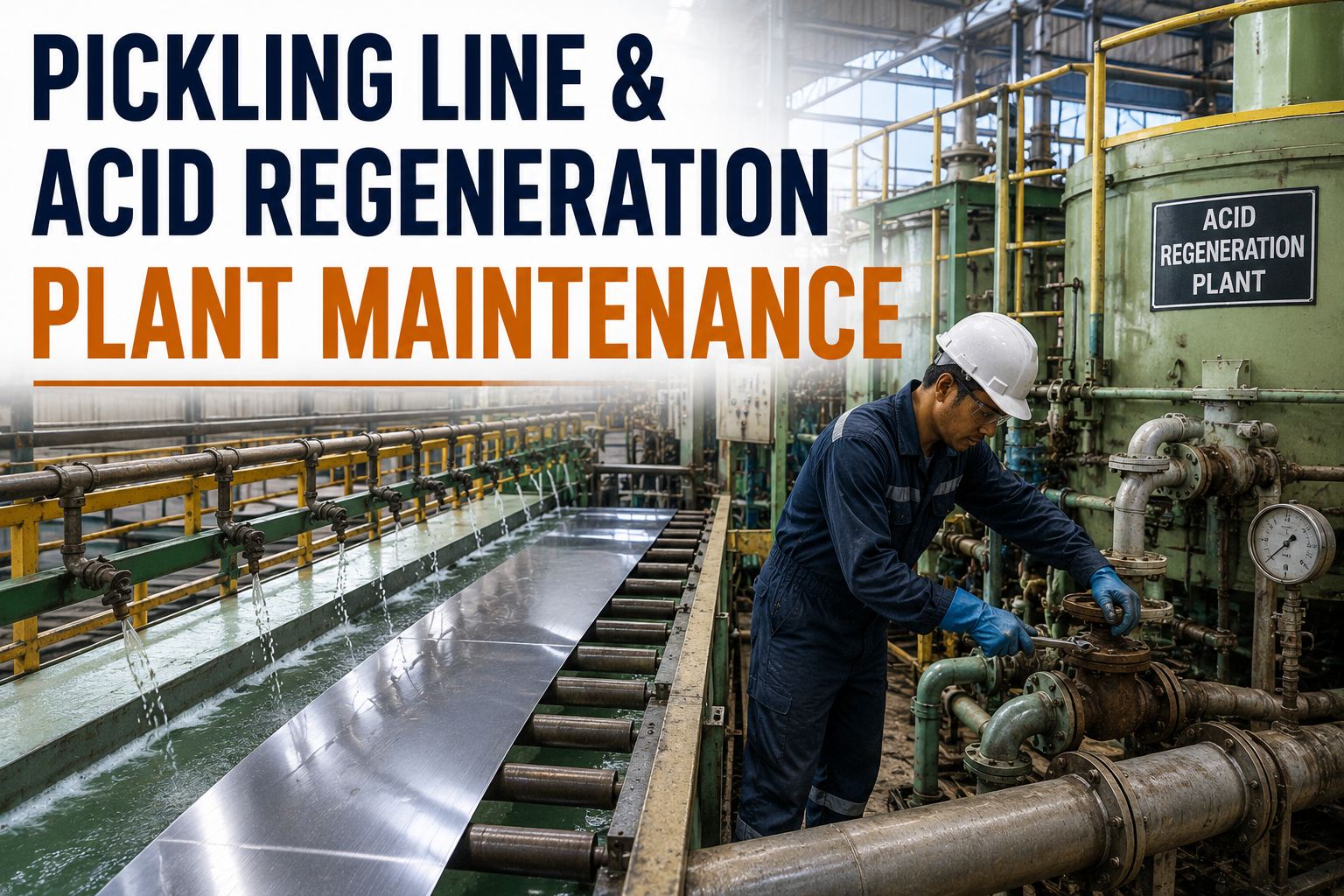
Pickling lines and acid regeneration plants sit at the most chemically hostile intersection of a steel mill — every minute of runtime is a controlled fight against hydrochloric acid, iron chloride carryover, and metallurgical fatigue in tanks, ducts, and heat exchangers. A single un-scheduled ARP outage can throttle the entire finishing line within hours, because pickled strip is the gateway to cold rolling, galvanizing, and coating. OxMaint maintenance management software gives steel finishing and chemical-handling teams the structure to keep acid-resistant assets defensible: PM scheduling, safety-critical inspection tracking, tank integrity logs, and the work-order discipline that corrosive service demands. Ready to harden your program? Start Free Trial and see the pickling-line template in your own environment.
One ARP outage can stall the entire finishing line within 6 hours.
Build a defensible maintenance program around acid-resistant assets, tank integrity cycles, and safety-critical inspections — before corrosion writes the schedule for you.
What poorly maintained pickling lines actually cost a mill
Corrosive service doesn't fail gracefully. It compounds — a thinned duct becomes a leak, a leak becomes an unplanned acid dump, and the dump becomes a multi-day ARP rebuild that idles the rolling line behind it.
Typical finishing-line OEE drag when pickling availability drops below 92% on a 1.2 Mt/yr line.
Reactive acid-resistant repair spend at a mid-size plant — over 60% of it traceable to skipped PMs.
Time from an ARP trip to a downstream cold-rolling or galvanizing line starving for pickled strip.
Reactive vs. planned maintenance cost on fiberglass-reinforced plastic tanks and graphite heat exchangers.
A 180-asset pickling & ARP operation spending $42K/yr on fragmented spreadsheets and reactive glass-lined tank repairs moved to OxMaint's corrosive-service PM engine. Within 9 months, unplanned acid-system downtime fell 41%, free-acid consumption dropped 7% through tighter regeneration tracking, and the plant recovered roughly $310K in avoided finishing-line stalls. The payback window was under 11 weeks.
Tiered PM & inspection checklist for pickling lines and ARPs
Every asset below sits in hydrochloric acid, iron-chloride, or spent-acid service. OxMaint lets you bind each one to a service class, an inspection code, and a closed corrective-action workflow.
Walk-down & chemical service checks
- Acid concentration & temperature log per pickling tank (HCl 5–15%, 70–85°C)
- Fume scrubber pH, flow, and pressure-drop verification
- FRP tank visual — blisters, weep stains, resin crazing
- Magnetic-drive pump seal-area walk for acid weepage
- Spent-acid & regenerated-acid tank level trending
- Emergency eyewash & deluge shower flow test
System performance & integrity tasks
- Ruthner/rotor spray nozzle inspection & descale cycle
- Graphite block heat-exchanger pressure test & fouling log
- Scrubber packing inspection, demister wash-down
- PTFE-lined spool & expansion joint thickness spot-check
- Acid dosing pump calibration against setpoint
- Pre-heater burner efficiency & flame stability audit
Safety-critical & regulatory inspections
- Tank integrity survey — NACE SP0304 / API 653 aligned
- FRP & rubber lining holiday spark-test and thickness map
- Acid relief & vacuum-breaker function test (PSM/RMP)
- Stack emission verification — HCl & Cl₂ limits
- Secondary containment & trench integrity walkthrough
- Acid unloading procedure & operator recertification
Pickling & ARP inspection and PM matrix
A consolidated view of the assets, codes, and frequencies OxMaint ships with its pickling-line template — editable per mill, per acid system.
| Asset / System | Service | Inspection / PM Code | Standard | Frequency | Criticality |
|---|---|---|---|---|---|
| Pickling tank (FRP / rubber-lined) | HCl 5–15% | TK-INT-01 | NACE SP0304 | Quarterly | High |
| Ruthner spray tower | Spent acid / FeCl₂ | ARP-NOZ-02 | OEM | Weekly | High |
| Graphite block heat exchanger | Regen acid | HE-PRES-03 | TEMA / API 660 | Monthly | High |
| Magnetic-drive acid pump | Concentrated HCl | PMP-SEAL-04 | API 682 | Shift | Critical |
| Fume scrubber (packed) | Acid vapor | SCR-PH-05 | EPA Method 5 | Shift | Critical |
| Acid storage tank | 33% HCl | TANK-653-06 | API 653 | Annual | Critical |
| PTFE-lined piping & spools | Process acid | PIPE-LN-07 | ASME B31.3 | Quarterly | Medium |
| Acid relief & vacuum breaker | Overpressure | REL-PSV-08 | API 510 / PSM | Annual | Critical |
How OxMaint compounds pickling-line availability
Reliability in corrosive service is arithmetic — every planned PM displaces a larger unplanned failure. This is the model a OxMaint program optimizes against.
A = availability · MTBF = mean time between failures · MDT = mean downtime. OxMaint drives MTBF up through scheduled PMs and drives MDT down through instant work-order routing — together lifting finishing-line availability.
S = annual savings · R = reactive cost/hr ($185) · P = planned cost/hr ($58) · H = acid-system hours saved · M = affected assets. A 180-asset plant recovering 1,400 hrs/yr ≈ $310K/yr.
Time to recover OxMaint subscription cost at a 180-asset pickling operation.
Reduction in unplanned acid-system outages within the first 9 months of deployment.
Free-acid consumption drop from tighter regeneration-cycle tracking and dosing control.
Combined avoided stall cost + reduced reactive spend at the reference plant.
What changes when corrosive-service assets get a system
The gap isn't effort — most pickling crews work hard. The gap is structure: a single source of truth for what's due, what's overdue, and what's safety-critical.
| Dimension | Reactive / Spreadsheet | OxMaint-managed |
|---|---|---|
| PM trigger | Calendar memory & operator call | Service-class + runtime + condition |
| Inspection evidence | Clipboards, lost in shift handover | Photo-attached digital records |
| Overdue safety PMs | Invisible until audit | Auto-escalation to plant manager |
| Spare parts for acid service | Stockout on PTFE seals, FRP resin | Bill-of-materials linked to work order |
| Regulatory readiness | Weeks of pre-audit scrambling | PSM/RMP/EPCRA records exportable on demand |
| Downtime cost visibility | Buried in monthly variance report | Live cost-of-failure per asset |
"We stopped chasing acid leaks and started preventing them. OxMaint turned our pickling PMs from a clipboard ritual into a defensible, audit-ready record — and gave us back 14 hours of finishing-line availability a month."
Stop letting corrosion set your maintenance schedule.
Deploy OxMaint's pickling-line & ARP template in days — pre-loaded PM codes, NACE/API inspection cycles, and PSM-ready records.
Answers maintenance and reliability leaders ask before deploying
How does OxMaint handle acid-resistant asset PMs differently from a generic CMMS?
OxMaint ships a corrosive-service asset class with pre-built PM templates for FRP tanks, graphite heat exchangers, PTFE-lined piping, and magnetic-drive pumps. Each asset carries its own inspection code, criticality rating, and service-life model — so PMs trigger on runtime, acid concentration exposure, or condition data, not just a calendar date. You can Book a Demo to see the pickling-line template populated with your asset names.
Can the system track safety-critical inspections for PSM, RMP, and EPCRA compliance?
Yes. Safety-critical PMs — acid relief valves, scrubber integrity, secondary containment, emergency deluge — are tagged as PSM-critical. Overdue ones auto-escalate to the plant manager and generate an auditable trail with photo evidence, inspector sign-off, and timestamps exportable for OSHA PSM and EPA RMP submissions.
How long does it take to deploy OxMaint on a pickling line and ARP?
Most steel finishing operations go live in 2–4 weeks. The pickling template pre-loads ~60 standard assets, PM codes, and inspection cycles; your team imports the asset register, adjusts frequencies to your OEM and NACE standards, and assigns technicians. A 180-asset plant typically sees full adoption inside one quarterly PM cycle.
What does the free trial include, and do I need a credit card?
The 14-day trial includes the full pickling-line & ARP template, unlimited assets, work-order creation, inspection logging, and the mobile app — no credit card required. You can Start Free Trial and have your first tank inspection scheduled inside an hour.
How does OxMaint prove ROI on a pickling-line maintenance program?
OxMaint tracks cost-of-failure per asset, unplanned downtime hours, and free-acid consumption trends before and after deployment. The reference 180-asset plant recovered $310K in year one through a 41% downtime cut and 7% acid savings — payback inside 11 weeks. The dashboard surfaces these figures live, so the business case renews itself every quarter.
Your pickling line deserves a defensible maintenance record.
Join the steel finishing teams using OxMaint to keep acid systems reliable, compliant, and audit-ready — every shift, every tank, every inspection.
Free 14-day trial · No credit card