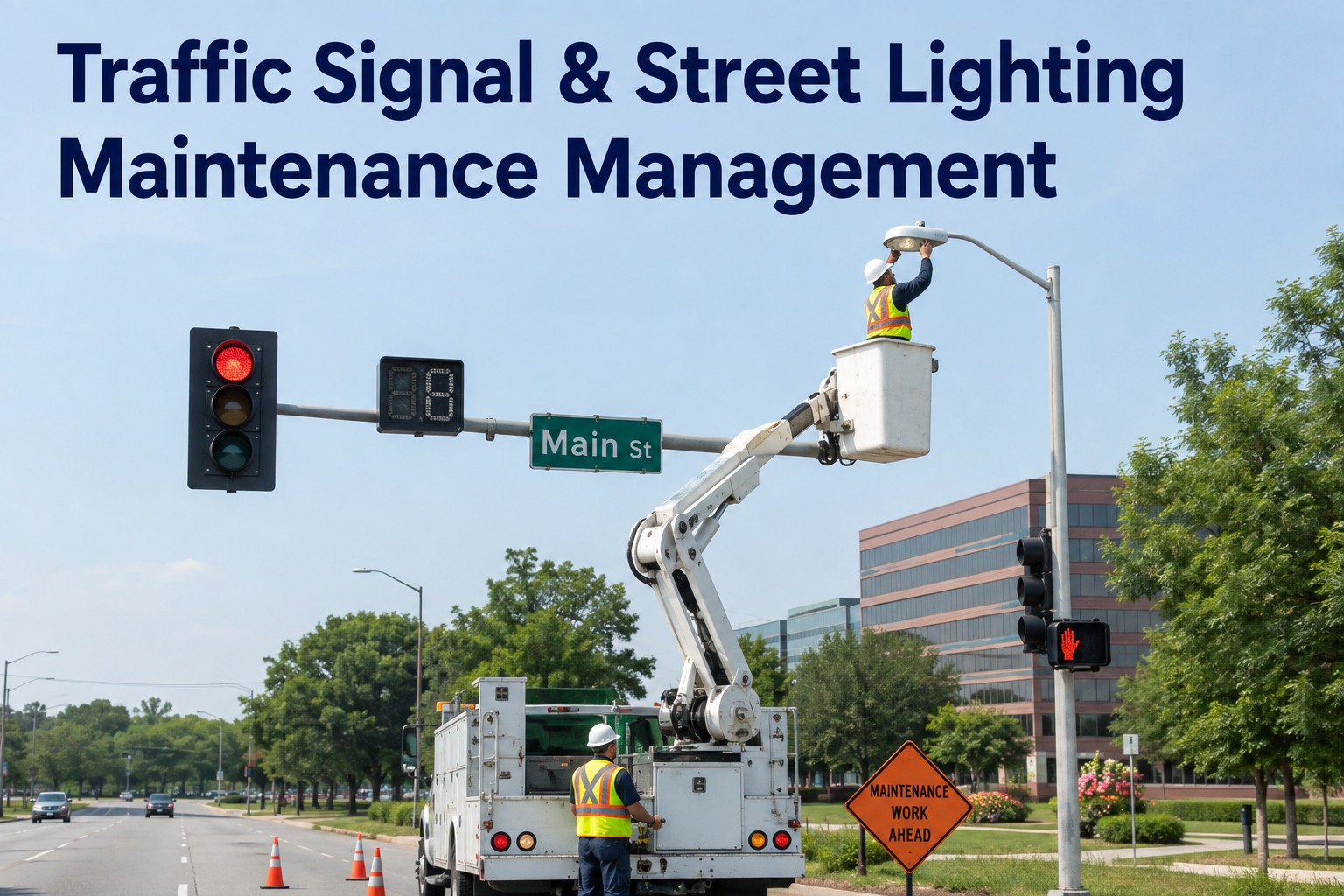
Traffic signal maintenance and street lighting maintenance are the backbone of safe, reliable municipal transportation networks—yet most public works teams still rely on disconnected spreadsheets, paper work orders, and reactive citizen complaints to manage thousands of critical assets. When a single dark intersection or malfunctioning signal can cost lives and trigger millions in liability, a modern traffic management CMMS becomes essential for tracking LED retrofits, scheduling signal cabinet inspections, and automating outage response. OxMaint brings AI-powered computerized maintenance management to municipal traffic and street lighting operations, unifying asset tracking, preventive scheduling, and real-time analytics into one platform. Stop chasing outages and start predicting them—launch your Start Free Trial or book a personalized demo today.
Every Signal Online. Every Streetlight Lit. Every Asset Tracked.
Municipal traffic operations lose $50B annually to unplanned outages, reactive repairs, and manual asset blind spots. OxMaint replaces paper-based signal maintenance programs with a predictive, GIS-enabled CMMS built for traffic signal and street lighting infrastructure.
Why Traffic Signal Maintenance Demands a CMMS, Not Spreadsheets
A mid-sized city operating 850 traffic signals and 12,000 streetlights typically fields 30–50 outage calls per week—each requiring manual dispatch, paper documentation, and post-repair data entry that wastes 6+ hours weekly.
Reactive Repair Chaos
Without a traffic signal CMMS, crews wait for citizen 311 calls before acting. A single dark signal averages 4.5 hours of downtime before a technician arrives—risking collisions, red-light running, and federal MUTCD non-compliance.
Blind Asset Registers
LED streetlight maintenance fails when install dates, wattage, and warranty end-dates live in separate Excel files. Teams over-order replacements by 20% and miss warranty claims worth $15K–$40K annually.
No Inspection Defensibility
MUTCD and agency audits demand documented signal inspection cadence. Paper logs get lost, misfiled, or never digitized—exposing municipalities to tort liability when crashes occur at un-inspected intersections.
Spare Parts Stockouts
Signal cabinet maintenance halts when controller boards, conflict monitors, or LED drivers aren't in stock. Reactive purchasing adds 3–7 days to outage duration and forces premium overnight shipping fees.
Traffic Signal Inspection Checklist & Preventive Cadence
A defensible signal maintenance program follows documented inspection intervals aligned to MUTCD Part 4 and local agency standards—typically 6-month visual checks and 12-month detailed electrical and alignment inspections.
Quarterly & Semi-Annual Tasks
Annual & Biennial Tasks
| Asset Type | Inspection Interval | Key CMMS Trigger | Risk if Skipped |
|---|---|---|---|
| Traffic Signal Head | 6 months | Auto-generated PM work order | Misalignment, LED outage, collision risk |
| Signal Cabinet | 12 months | Seasonal PM + post-storm check | Controller failure, intersection blackout |
| Pedestrian Signal | 6 months | Linked to signal head PM | ADA non-compliance, pedestrian injury |
| LED Streetlight | 12 months (sample) | Grouped batch inspection | Dark spots, warranty loss, citizen complaints |
| Detection System | 12 months | Performance-based trigger | Increased delay, signal cycle inefficiency |
Street Lighting Management System: Calculating Retrofit Payback
A city retrofitting 12,000 HPS fixtures to LED saves roughly $480K annually in energy—but without streetlight replacement tracking software, 15% of warranty claims are missed and dark fixture response times average 11 days.
Scenario: A public works department managing 850 signals and 12,000 streetlights spends $420K/year on reactive maintenance, premium part shipping, and manual documentation. After implementing OxMaint as their street lighting management system, preventive maintenance compliance hits 94%, outage response drops from 4.5 hours to under 90 minutes, and warranty recovery captures $28K previously lost to poor record-keeping. Total first-year savings: $135K with a 3.2-month payback period.
How OxMaint Powers Your Traffic Signal & Street Lighting CMMS
OxMaint maps directly to the workflows that municipal traffic and public works teams use daily—transforming reactive, paper-driven operations into predictive, audit-ready asset management.
GIS-Integrated Asset Tracking
Map every signal, cabinet, and streetlight to exact GPS coordinates. Filter by ward, subdivision, or installation year. Field crews navigate directly to assets via mobile app—eliminating wrong-location dispatch.
Automated PM Scheduling
Auto-generate preventive maintenance work orders for 6-month and 12-month inspection cycles. OxMaint assigns tasks by crew zone, sends reminders, and escalates overdue items—ensuring 100% MUTCD inspection defensibility.
Spare Parts & Warranty Engine
Track LED driver serial numbers, install dates, and manufacturer warranty periods. OxMaint flags parts approaching end-of-life and auto-generates warranty claim work orders—recovering revenue you currently lose.
Predictive Analytics Dashboard
AI-driven failure prediction analyzes outage patterns, age, and environmental factors to flag signals and lights at risk before they fail. Shift from reactive 311-driven calls to proactive, data-led replacement scheduling.
What Changes When Public Works Teams Adopt OxMaint
Municipalities that migrate from spreadsheets and paper logs to OxMaint see measurable improvements within the first 90 days—faster response, lower costs, and full audit readiness.
| Operational Metric | Before OxMaint (Manual) | After OxMaint (CMMS) |
|---|---|---|
| Average outage response time | 4.5 hours | Under 90 minutes |
| PM inspection compliance rate | 58% | 94%+ |
| Annual warranty claims recovered | $0–$3,000 | $15,000–$40,000 |
| Hours/week on manual documentation | 22+ hours | 3 hours |
| Audit preparation time | 2–3 weeks | Same-day export |
"OxMaint cut our signal outage response from 4 hours to under 90 minutes. The GIS map lets dispatchers send the closest crew instantly—no more calling around to find who's available."
"We recovered $31K in LED warranty claims the first year alone—money we didn't even know we were losing. The install-date tracking alone justifies the platform cost."
See OxMaint on Your Traffic & Lighting Assets
Book a 30-minute demo and we'll map your signal inventory, inspection cadence, and outage workflow inside OxMaint—live, on your real asset data.
Traffic Signal & Street Lighting CMMS Questions Answered
What does a traffic signal CMMS do that a spreadsheet can't?
A traffic signal CMMS like OxMaint automates work order generation based on inspection intervals, tracks every asset by GPS location, manages spare parts inventory with auto-reorder points, and provides audit-ready compliance records. Spreadsheets require manual entry, lack real-time field access, and cannot trigger preventive maintenance or predict failures—leaving teams reactive and exposed to liability. You can Start Free Trial to see the difference immediately.
How often should traffic signals be inspected?
MUTCD Part 4 and most state DOTs require visual inspections of traffic signal heads at least every 6 months, with detailed electrical, timing, and cabinet inspections annually. High-volume corridors or locations with documented crash patterns may warrant quarterly checks. OxMaint auto-schedules these intervals and generates PM work orders so no inspection is ever missed or undocumented.
Can OxMaint track LED streetlight retrofits and warranty claims?
Yes. OxMaint's asset register captures install date, manufacturer, wattage, serial number, and warranty end date for every LED fixture. When a driver fails within warranty, the system auto-generates a claim work order with all supporting documentation attached. Municipalities typically recover $15K–$40K annually in warranty costs that manual tracking misses.
How long does it take to implement a street lighting management system?
Most municipal teams are live on OxMaint within 2–4 weeks. The platform imports existing asset spreadsheets, integrates GIS coordinates, and configures inspection templates during onboarding. Field crews adopt the mobile app in a single training session. Book a Book a Demo session and we'll outline a migration plan tailored to your asset count and current data format.
Does OxMaint support signal cabinet maintenance and spare parts tracking?
Absolutely. OxMaint tracks controller boards, conflict monitors, surge protectors, and battery backups as individual assets inside each cabinet. The spare parts inventory module maintains real-time stock levels, sets reorder thresholds, and links parts consumption directly to work orders—so you always know what failed, when, and what replacement is on the shelf.
Ready to Modernize Your Traffic Signal & Street Lighting Maintenance?
Join the public works teams using OxMaint to cut outage response by 40%, recover $30K+ in warranty claims, and achieve 94% PM compliance—powered by AI-driven asset management.
Free 14-day trial · No credit card