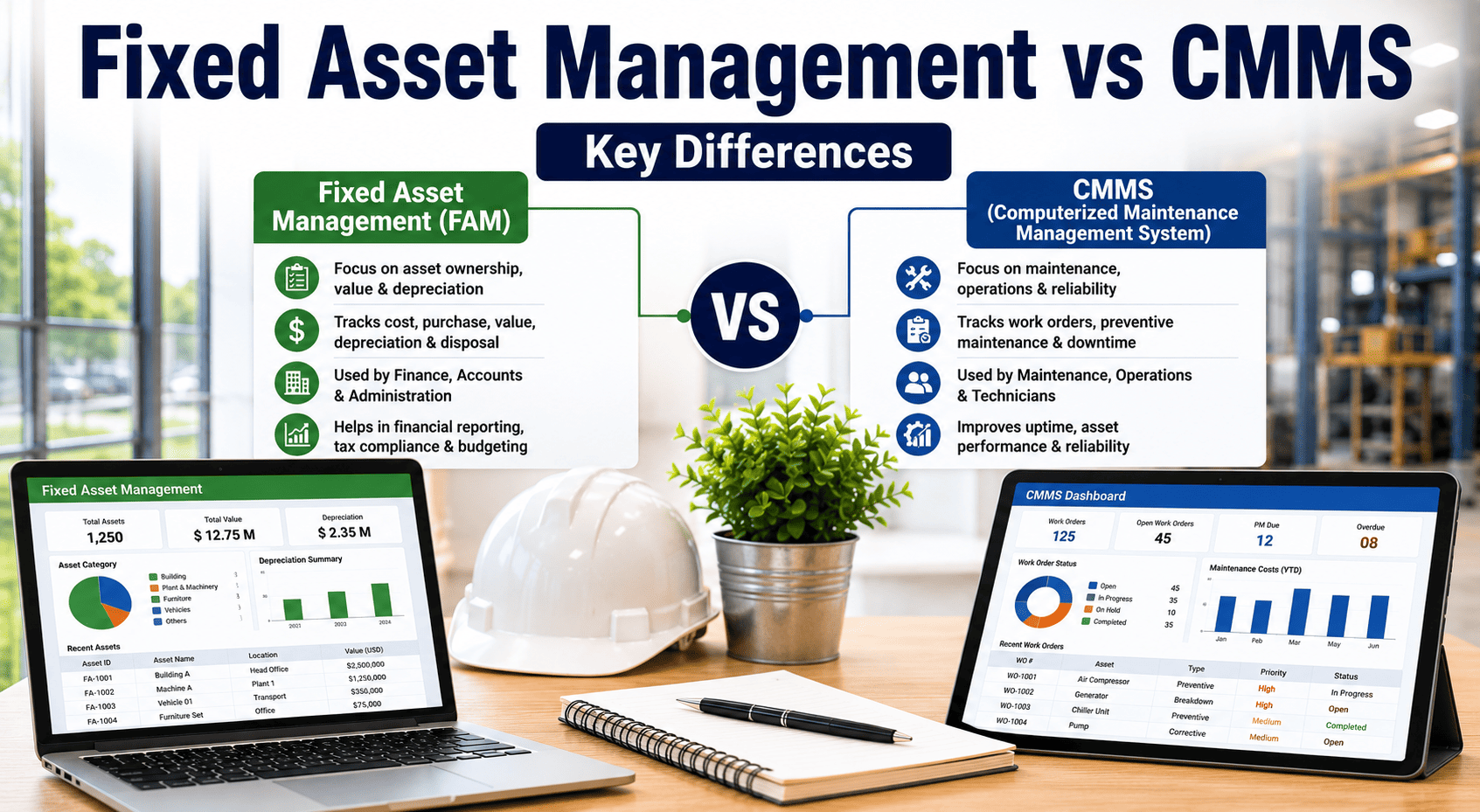
Fixed asset management and CMMS are two distinct systems that many operations teams confuse — and that confusion costs both finance departments and maintenance teams real money. Fixed asset management software tracks asset value, depreciation, and financial classification for accounting purposes. A CMMS (Computerized Maintenance Management System) tracks asset health, maintenance history, work orders, and operational uptime. Both work with assets, but they serve completely different masters: finance vs. maintenance. Understanding the difference — and knowing when you need one, the other, or both integrated — is one of the most consequential decisions in enterprise asset lifecycle management.
See how Oxmaint bridges the gap — AI-native CMMS with asset lifecycle visibility your finance team can use too.
- Full asset history: maintenance, cost, downtime, and replacement forecasting
- SAP integration connecting maintenance data to financial asset records
- AI-driven asset health scoring alongside financial depreciation visibility
Trusted by 1,000+ teams across manufacturing, facilities, and fleet · Live in days, not months
What Is Fixed Asset Management Software?
Fixed asset management software is a financial and accounting tool that tracks the monetary value of long-term physical assets on the balance sheet. It calculates depreciation (straight-line, declining balance, sum-of-years), assigns asset classifications per accounting standards (GAAP, IFRS), manages capitalization thresholds, and produces the asset register and depreciation schedules that auditors and CFOs rely on. The system's core questions are: what is this asset worth, how is its value declining, and when should we write it down or dispose of it?
Fixed asset management systems are owned by the finance or accounting department. They care about cost centers, asset IDs for tax purposes, book value vs. market value, insurance replacement costs, and asset disposal processes. They typically do not track maintenance history, work orders, inspection records, or operational availability. An asset can be fully depreciated on the books and still running reliably in the plant — fixed asset software doesn't know or care.
What Is a CMMS?
A Computerized Maintenance Management System (CMMS) is an operational tool owned by maintenance, facilities, and operations teams. It tracks asset health, maintenance history, work order workflows, preventive maintenance schedules, inspection compliance, parts inventory, and technician productivity. The core questions a CMMS answers are: what condition is this asset in, what maintenance has been performed, what's scheduled next, and who's responsible? Platforms like Oxmaint add AI vision, predictive analytics, and sensor integration to this baseline — making the CMMS the operational brain of the entire maintenance function, not just a scheduling calendar. Explore Oxmaint's asset management and predictive maintenance capabilities.
Eight Key Differences: Fixed Asset Management vs CMMS
Four Operational Pain Points When the Two Systems Don't Talk
Finance approves asset replacement based on depreciation schedules. Maintenance knows the asset was rebuilt six months ago and has 5 years of useful life left. Without integrated systems, capital is misallocated — replacing assets that don't need it and keeping assets that are costing a fortune in reactive repairs.
Fixed asset software captures acquisition cost and depreciation. It doesn't capture the $47,000 spent maintaining a pump over 8 years. Without CMMS data, total cost of ownership calculations are structurally incomplete — making future procurement decisions systematically wrong.
An asset fully depreciated to zero on the books might be your most reliable piece of equipment. A fully-valued new asset might be generating constant work orders. Fixed asset software can't surface this — only CMMS maintenance history, MTBF data, and downtime records reveal operational reality. Start a free trial to see both dimensions on every asset.
Insurance claims, compliance audits, and warranty disputes require demonstrating both financial ownership and operational history. When those records live in separate systems with no connection, assembling the documentation is slow, error-prone, and sometimes impossible. Integrated platforms eliminate this risk entirely — book a demo to see how Oxmaint handles audit documentation.
How Oxmaint Bridges Operational and Financial Asset Intelligence
Every asset in Oxmaint carries acquisition date, purchase cost, warranty terms, and maintenance cost-to-date alongside full operational history — giving finance and operations a single source of truth. Asset management module supports custom financial fields and document attachment.
Oxmaint integrates with SAP PM/MM/EAM/FI — connecting work order costs, parts consumption, and labor time directly to financial asset records. SAP integration means maintenance cost data flows to the ERP without double entry.
Oxmaint's predictive maintenance AI analyzes maintenance frequency, failure rates, and repair costs to flag when an asset is approaching the point where replacement is more economical than continued repair — giving finance actionable data, not just gut feel.
OEE analytics translate operational uptime into financial output — connecting asset availability and throughput data to the production value at stake. Finance finally understands what each percentage point of downtime costs in real revenue terms.
Insurance claims, safety audits, and warranty disputes require both financial ownership records and operational history. Analytics and reporting generates unified documentation in minutes — covering inspection logs, work order history, and financial cost records in one export.
For operations managing assets across multiple locations, Oxmaint provides a consolidated asset health and cost dashboard — the operational equivalent of the financial asset register, updated in real time from the field rather than the accounting system.
Fixed Asset Management vs CMMS: Side-by-Side Comparison
| Feature / Function | Fixed Asset Management | CMMS (Oxmaint) |
|---|---|---|
| Asset register / asset hierarchy | Financial classification only | Full operational hierarchy + financial fields |
| Depreciation calculation | Core function (straight-line, declining balance) | Not primary (SAP/ERP integration passes data) |
| Work order management | Not supported | Core function with AI prioritization |
| Preventive maintenance scheduling | Not supported | AI-driven condition-based scheduling |
| Failure prediction | Not supported | 94% accuracy AI predictive maintenance |
| Inspection & compliance records | Not supported | OSHA/ISO/GMP audit trail automation |
| Total cost of ownership | Acquisition cost only | Acquisition + full maintenance cost history |
| ERP integration | Native (GL, tax, audit) | SAP PM/MM/EAM/FI integration available |
| Mobile / field access | Accounting team use only | Mobile-first, QR scan to work order |
| AI / IoT integration | Not supported | NVIDIA AI vision + sensor/PLC integration |
ROI When CMMS and Financial Asset Data Work Together
Teams that integrate CMMS analytics with their financial asset processes see 20–30% improvements in CapEx accuracy and recover 15–25% of annual maintenance spend through better repair-vs-replace decision making. Use the Oxmaint ROI calculator to quantify this for your asset base — or book a demo for a guided walkthrough.
Frequently Asked Questions
What is the difference between fixed asset management and a CMMS?
Can a CMMS replace fixed asset management software?
What is EAM and how is it different from a CMMS?
How does CMMS data improve financial asset management decisions?
Stop Managing Half Your Asset Picture
Oxmaint gives maintenance and operations teams the AI-native CMMS they need to manage asset health, work orders, and downtime — with SAP integration that connects operational data to the financial asset record. Finance gets better CapEx intelligence. Maintenance gets AI-driven reliability. Both teams get one source of truth.
- AI predictive maintenance with 94% failure prediction accuracy
- SAP PM/MM/EAM/FI integration — maintenance costs flow to the ERP
- Full asset lifecycle records: operational history plus financial cost data
Trusted by 1,000+ teams managing 10,000+ assets · Live in days, not months