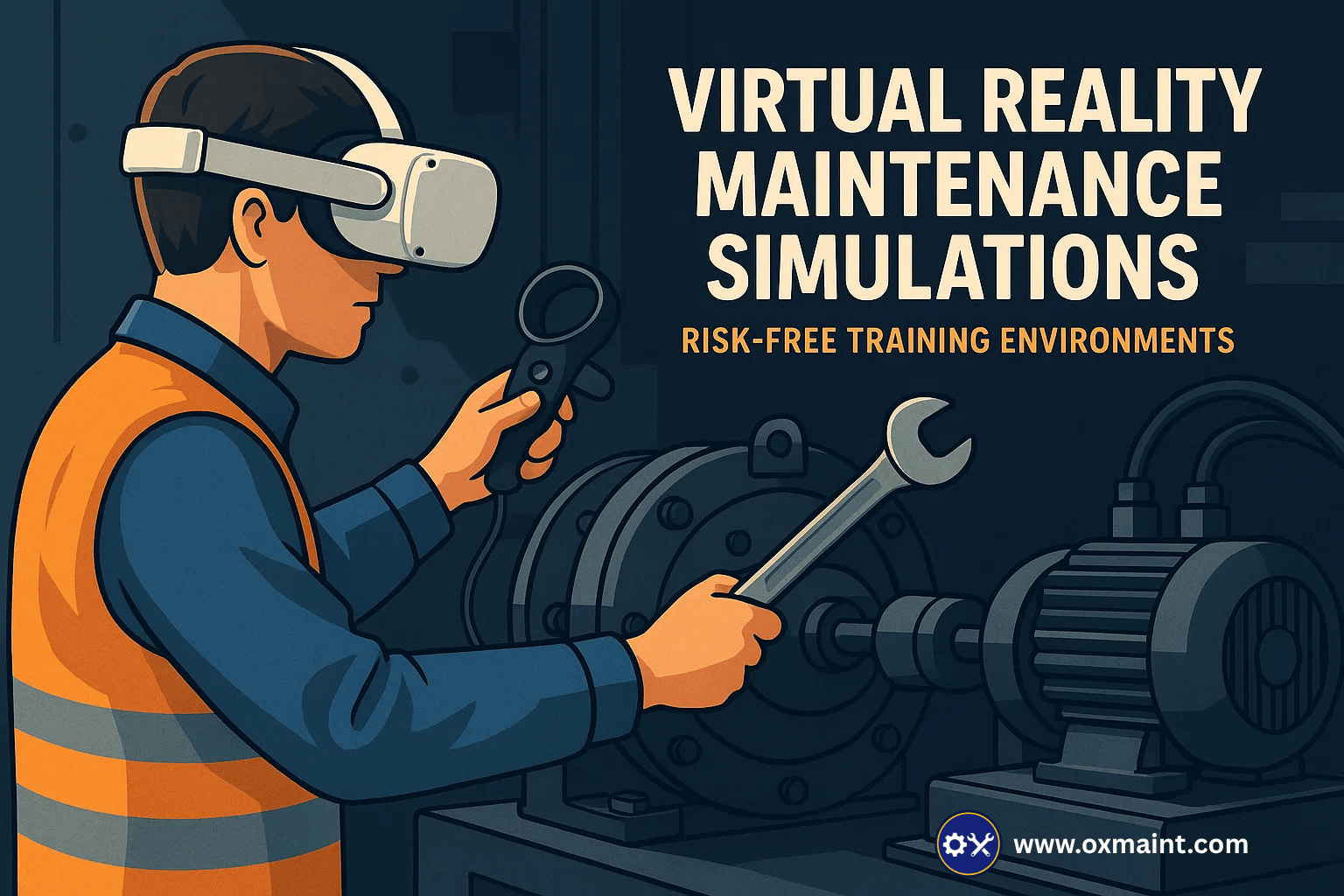
Manufacturing operations face a critical challenge: how do you train maintenance technicians on complex, expensive equipment without risking costly downtime, safety incidents, or equipment damage? Traditional training methods often fall short, requiring real equipment to be taken offline or exposing new technicians to potentially dangerous scenarios during their learning phase.
Virtual Reality (VR) maintenance simulations are emerging as a game-changing solution, offering manufacturing companies the ability to provide comprehensive, hands-on training in completely risk-free environments. This technology is transforming how industrial organizations approach maintenance training, delivering measurable improvements in safety, efficiency, and cost-effectiveness.
The Hidden Costs of Traditional Maintenance Training
Traditional maintenance training methods carry significant hidden costs that many manufacturing operations struggle to quantify. When experienced technicians must take time away from productive work to train newcomers, you're essentially paying double labor costs while reducing overall productivity. Equipment downtime for training purposes can cost thousands of dollars per hour, depending on your operation scale.
Safety incidents during training periods are another costly concern. According to industry data, new maintenance workers are 40% more likely to experience workplace injuries during their first six months. These incidents not only impact worker well-being but also result in workers' compensation claims, regulatory scrutiny, and potential production delays.
How VR Maintenance Simulations Transform Training
VR maintenance simulations create immersive, three-dimensional environments where technicians can practice complex procedures on virtual representations of actual equipment. These simulations replicate real-world scenarios with remarkable accuracy, including equipment specifications, operating procedures, safety protocols, and even potential failure modes.
Modern VR training platforms allow technicians to disassemble complex machinery, practice diagnostic procedures, and learn proper safety protocols without any risk to actual equipment or personnel. The technology tracks performance metrics, identifies knowledge gaps, and provides immediate feedback to accelerate learning.
What sets VR apart from traditional training methods is its ability to simulate rare but critical scenarios. Emergency shutdowns, equipment failures, and hazardous situations can be practiced repeatedly until technicians achieve mastery, something impossible to accomplish safely with real equipment.
Measurable Benefits for Manufacturing Operations
Manufacturing companies implementing VR maintenance training report significant improvements across multiple operational metrics. Training time reduction is typically the first benefit organizations notice, with many reporting 30-50% faster certification times for new maintenance personnel.
Safety improvements are equally impressive. Companies using VR training have documented 60-70% reductions in training-related incidents and 25-40% decreases in maintenance-related safety events overall. This improvement stems from technicians gaining experience with proper procedures and safety protocols in risk-free environments before working on actual equipment.
Cost savings extend beyond training efficiency. Reduced equipment downtime for training purposes, fewer training-related incidents, and improved maintenance quality all contribute to substantial ROI. Most organizations see positive returns within 12-18 months of implementation.
Implementation Strategy and ROI Considerations
Successful VR training implementation requires careful planning and phased rollout. Start by identifying your most critical training needs and equipment types that would benefit most from risk-free practice environments. High-value, complex equipment with significant downtime costs typically provides the strongest ROI case for VR training.
Technology requirements are more accessible than many organizations expect. Modern VR training solutions run on standard business computers with VR headsets costing between $300-800 per unit. Cloud-based platforms eliminate the need for significant IT infrastructure investments while providing scalable training capabilities.
Calculate your ROI by considering reduced training time, decreased equipment downtime, lower incident rates, and improved maintenance quality. Factor in the cost of VR hardware, software licensing, and initial content development. Most manufacturing operations find that VR training pays for itself through reduced downtime alone within the first year.
Building Your VR Training Program
Developing an effective VR maintenance training program begins with content creation that accurately reflects your specific equipment and procedures. Work with VR solution providers who understand manufacturing environments and can create custom simulations based on your actual equipment specifications and maintenance protocols.
Integration with existing training programs is crucial for success. VR should complement, not replace, all aspects of traditional training. Combine VR simulations with hands-on experience, classroom instruction, and mentorship programs to create comprehensive learning experiences.
Measuring training effectiveness becomes more precise with VR platforms that provide detailed analytics. Track completion rates, performance scores, time-to-competency, and post-training performance metrics to continuously improve your training programs and demonstrate ROI to stakeholders.
The Future of Manufacturing Training
VR maintenance simulations represent more than just a training tool—they're a strategic investment in operational excellence. As manufacturing becomes increasingly complex and the skilled labor shortage continues to challenge the industry, organizations that embrace innovative training technologies will maintain competitive advantages in safety, efficiency, and workforce development.
The technology continues to evolve rapidly, with improvements in haptic feedback, artificial intelligence integration, and collaborative training environments. Early adopters position themselves to leverage these advances while building internal expertise in VR training methodologies.
For manufacturing professionals responsible for maintenance operations, workforce development, or safety programs, VR training simulations offer a proven path to measurable improvements in training effectiveness, safety performance, and operational efficiency. The question isn't whether VR will become standard in industrial training—it's whether your organization will be an early adopter or play catch-up.
Frequently Asked Questions
VR training is most effective for complex, high-risk, or expensive-to-practice procedures. This includes equipment teardowns, emergency response protocols, hazardous material handling, precision assembly operations, and troubleshooting sequences on critical machinery. Any procedure that requires significant practice time or poses safety risks during learning is an excellent candidate for VR simulation.
Initial VR implementation costs typically range from $50,000-200,000 depending on program scope, including hardware, software, and content development. However, most manufacturing operations see ROI within 12-18 months through reduced equipment downtime, fewer training-related incidents, and faster technician certification. The cost per trained technician often decreases significantly over time as the system scales.
VR training should complement, not completely replace, hands-on experience. The most effective programs combine VR simulations for initial learning and risk-free practice with supervised hands-on training on actual equipment. This hybrid approach maximizes safety while ensuring technicians gain real-world experience before working independently.
Modern VR training requires standard business computers with dedicated graphics cards, VR headsets ($300-800 each), and reliable internet connectivity for cloud-based platforms. Most solutions are designed to work with existing IT infrastructure without requiring significant hardware upgrades. Training spaces need adequate room for safe movement while wearing VR equipment.
VR training platforms provide detailed analytics including completion rates, performance scores, time-to-competency, and skill retention metrics. Post-training KPIs include reduced maintenance errors, decreased safety incidents, faster problem resolution times, and improved equipment uptime. Many organizations also track cost-per-training-hour and overall maintenance efficiency improvements to demonstrate ROI.


.jpg)
.jpg)
