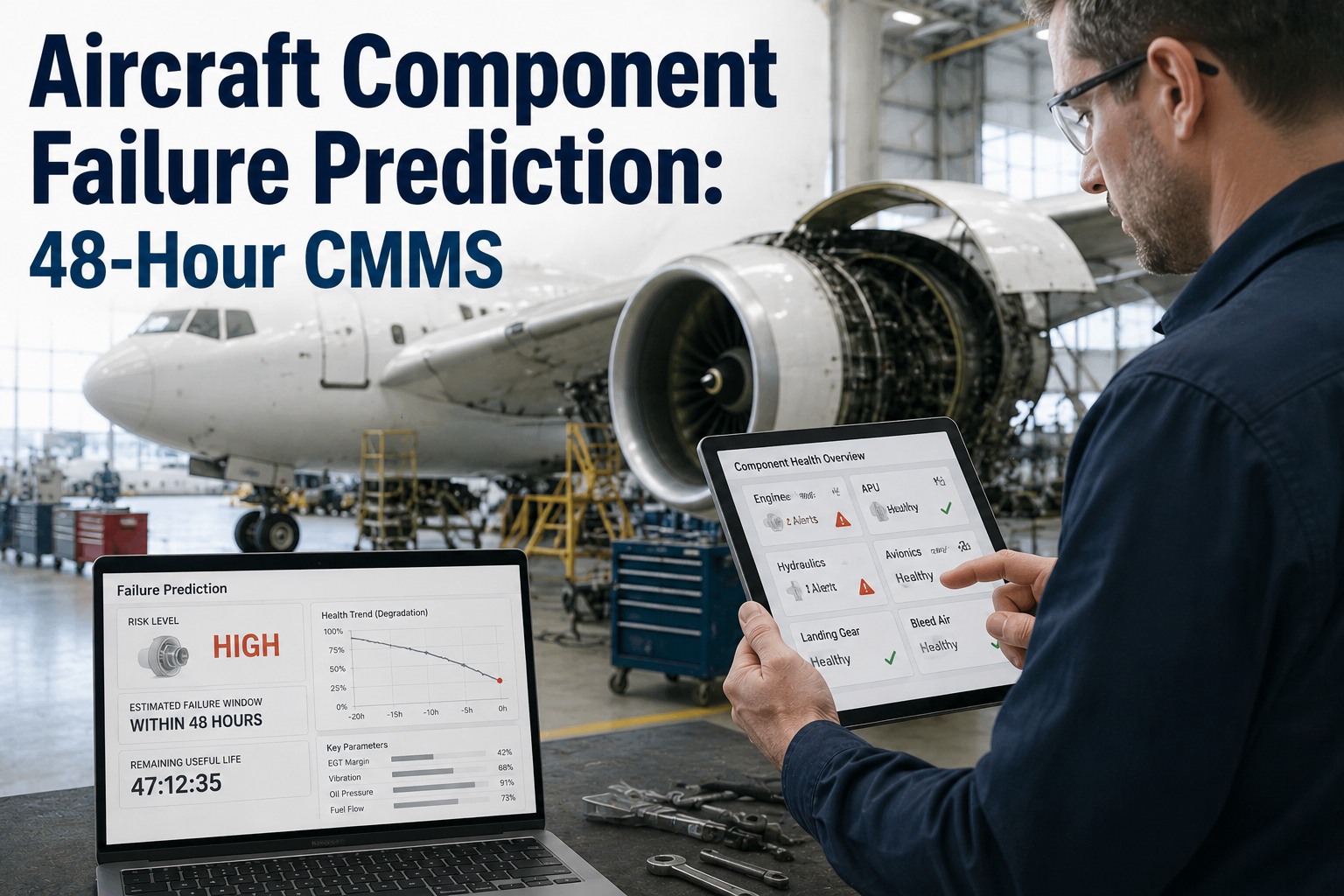
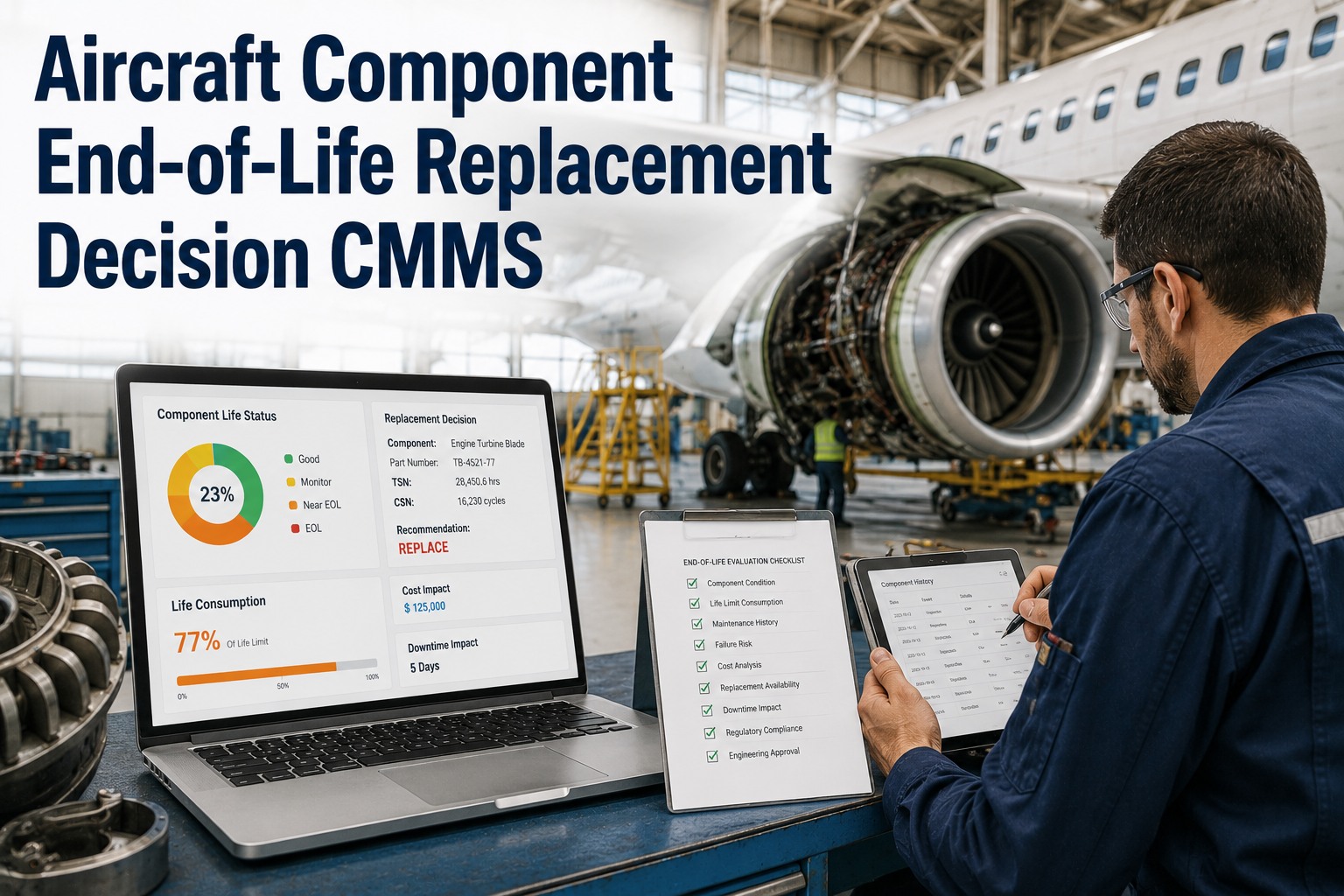
Every aircraft component carries a hidden number — the hours, cycles, and stress events standing between its current condition and its next failure. For decades, aviation maintenance teams have been guessing that number using calendar schedules, hard-time limits, and inspections that catch faults only after degradation has already taken hold. In 2026, that guesswork is over. IoT sensor networks combined with AI-driven Remaining Useful Life estimation now calculate that number precisely — in real time, for every monitored component across your entire fleet. MRO organisations deploying condition-based RUL prediction are reporting 38% fewer unscheduled component removals, 27% reductions in total maintenance spend, and AOG events averted hundreds of flight hours before they become operational crises. This guide breaks down exactly how the technology works, where it delivers the most measurable value, and why the performance gap between sensor-driven and reactive MRO operations compounds every single quarter.
$74B
Global MRO market by 2026
Oliver Wyman Aviation Forecast
38%
Fewer unscheduled removals with RUL prediction
Deloitte Aviation AI Study 2025
4.8x
Cost premium of emergency vs. planned repair
IATA MRO Cost Benchmarks
72%
MRO operators accelerating IoT sensor adoption
AeroDynamic Advisory 2025
AVIATION MRO INTELLIGENCE
Stop Flying Blind on Component Health
OxMaint connects to your IoT sensor feeds, builds a live condition score for every monitored component, and generates maintenance interventions before failures reach the runway. Full RUL prediction, automated work orders, and audit-ready compliance documentation — active within 30 days of onboarding, with no enterprise price tag and no six-month implementation.
What Is Remaining Useful Life (RUL) in Aviation?
Remaining Useful Life is the calculated time, cycles, or operational hours a component can continue functioning reliably before reaching a failure state or mandatory maintenance threshold. In traditional aviation maintenance, RUL estimates were based on OEM hard-time limits — fixed intervals that do not account for actual operating stress, environmental exposure, or the specific degradation trajectory of each individual component. IoT sensors change the equation entirely. By continuously measuring vibration signatures, temperature gradients, pressure differentials, and electrical characteristics across monitored components, AI models calculate a dynamic, asset-specific RUL that updates after every flight. The result is a maintenance programme that is neither too early nor too late — just precisely right, every time. Ready to see RUL prediction running against your own asset register? Start a free trial for 30 days and connect your first sensor feed in under 15 minutes, or book a demo with our aviation team for a live walkthrough.
RUL
Remaining Useful Life
The predicted operational time remaining before a component requires intervention — calculated continuously from live sensor data, not fixed OEM calendar limits.
CBM
Condition-Based Maintenance
A maintenance strategy where service intervals are determined by actual measured component condition — eliminating the guesswork of fixed-interval schedules and reactive call-outs.
PHM
Prognostics and Health Management
The full discipline of monitoring component health state, detecting anomalies before threshold alerts fire, and forecasting remaining useful life with statistically measurable confidence intervals.
AOG
Aircraft-on-Ground Prevention
The operational outcome RUL prediction is designed to eliminate — unplanned groundings that cost between $10,000 and $150,000 per hour in lost revenue and emergency MRO premiums.
Why RUL Estimation Is Critical for Aviation MRO
Operational Risk
Hard-Time Limits Leave Value on the Table
OEM hard-time limits are set conservatively — meaning 30–45% of removed components still have significant usable life remaining at replacement. Without RUL data, MRO operations systematically over-maintain and discard serviceable components that contribute directly to parts costs.
AOG Cost
Undetected Degradation Grounds Aircraft
Faults developing between scheduled inspection intervals are invisible to calendar-based systems. A bearing showing vibration anomalies 400 hours before failure never appears on a PM schedule — it appears as an AOG event at the worst possible moment, costing operators $10,000–$150,000 per hour.
Compliance
Regulatory Traceability Gaps
FAA 14 CFR Part 43, EASA Part M, and GCAA CAR M require complete, traceable maintenance histories for every life-limited component. Manual and siloed record systems create the documentation gaps that trigger CAA audit findings and ground certificates — with consequences that last years.
Budget Waste
CapEx Decisions Based on Age, Not Condition
Without condition data, aircraft component replacement decisions are driven by elapsed time and OEM limits — not actual asset state. This inflates CapEx by 15–25% through early replacements of components with significant remaining life, while occasionally running genuinely degraded parts too long.
How IoT Sensors Drive AI-Powered RUL Prediction
IoT-enabled RUL prediction is not a single technology — it is a four-stage intelligence pipeline that converts raw sensor signals into precise maintenance decisions. Each stage builds on the last, producing a continuously updated picture of component health that becomes more accurate as operational data accumulates. Aviation MRO organisations deploying this pipeline report fault detection leads of 200–600 hours before failure — enough time to plan, schedule, source parts, and intervene without an AOG event in sight. See how OxMaint structures the full pipeline for your fleet — start a free trial and explore the condition scoring engine yourself, or book a demo and walk through a live RUL model with our team.
01
Sensor Data Ingestion
IoT sensors across engines, APUs, landing gear, hydraulics, and avionics stream vibration, temperature, pressure, and electrical parameters continuously. ACARS, QAR downloads, and ground IoT networks feed the same pipeline — creating a unified, time-stamped data record for every monitored component after every single flight cycle.
Up to 100,000 data points per flight hour per aircraft
02
Anomaly Detection and Baseline Deviation
ML models trained on failure event histories and normal operating envelopes identify deviations from established baseline curves. Early-stage degradation signatures — a bearing vibration shift of 0.3 mm/s, a 4°C trend in oil temperature — are flagged 300–600 hours before conventional threshold alerts would fire, giving maintenance teams maximum lead time to respond.
Anomalies detected 300–600 hrs before threshold alert
03
RUL Model Calculation
Degradation rates extracted from sensor trend data feed physics-based and data-driven ML models — including LSTM networks, gradient boosting, and hybrid ensemble models — that calculate a statistically grounded RUL estimate with confidence intervals. Models update dynamically after every flight, continuously refining the prediction as more operational data flows in from that specific component's usage history.
RUL accuracy of 85–93% within a 10% confidence band
04
Automated Maintenance Action
When RUL reaches the configurable intervention threshold, a fully-populated work order generates automatically — with the component flagged, technician routed, parts pre-staged from inventory, and compliance documentation pre-built. The 4–6 hours of manual administration that follow a fault finding collapse to under 5 minutes. Every intervention is planned, not reactive.
4–6 hrs admin reduced to under 5 minutes per event
Aircraft Component Categories With the Highest RUL Impact
PROPULSION
Engine and Turbine Components
Hot section components, fan blades, and compressor stages monitored via EGT trend, vibration, and oil spectrometry analysis. AI detects erosion patterns and tip clearance degradation 400+ hours before a shop visit is mandatory — saving $2M–$8M per avoided unplanned removal.
LANDING
Landing Gear Assemblies
Actuator stroke performance, shock strut pressure, and bearing load signatures tracked across every landing cycle. Fatigue accumulation models calculate remaining structural life dynamically — preventing the hard-time removal of assemblies with 1,500+ cycles of remaining useful life.
HYDRAULICS
Hydraulic and Actuation Systems
Pump flow rates, accumulator pre-charge pressures, and fluid contamination levels monitored continuously. AI identifies the slow pressure decay signatures that precede actuator seal failure 200 hours before a flight control anomaly manifests, keeping every hydraulic system in its operating envelope.
APU
Auxiliary Power Units
Start cycle counts, EGT margin trends, and load shed events processed through degradation models that calculate the exact APU operating hours remaining before shop intervention — eliminating the 60–80% of forced AOG groundings that originate from unmonitored APU failures.
AVIONICS
Avionics and Electrical Systems
Intermittent fault code frequency trends, bus voltage stability, and component operating temperature profiles monitored for the early-stage patterns that precede avionics failures — which account for 18% of all unscheduled maintenance events but rarely appear on sensor dashboards in legacy MRO systems.
STRUCTURES
Structural Health Monitoring
Strain gauge networks, accelerometers, and acoustic emission sensors on primary and secondary structure track fatigue crack initiation zones. AI integrates g-loading event histories with flight cycle data to produce component-level fatigue life assessments far more accurate than fleet-average structural calculations.
WHEELS
Wheels, Brakes, and Tyres
Brake energy absorption per landing, tyre pressure decay rates, and heat sink wear index tracked per aircraft per cycle. Predictive replacement scheduling eliminates the common failure mode of brake stack over-wear discovered during turnaround inspections — the single largest contributor to short-notice AOG groundings at line stations.
GSE
Ground Support Equipment
Airport GSE fleets — GPU units, belt loaders, pushback tractors, and fuelling rigs — monitored with the same IoT-driven RUL methodology applied to aircraft. Unplanned GSE failures delay 12% of departures industry-wide. AI-predicted service intervals at airports using OxMaint cut that figure by over half.
How OxMaint Enables RUL Prediction Across Your Fleet
OxMaint is a modern CMMS and asset management platform engineered for the multi-site, multi-asset complexity of aviation MRO — connecting IoT sensor feeds, condition scoring, RUL modelling, and compliance automation into a single operational view. Unlike legacy MRO software requiring 12–18 month implementation projects, OxMaint is live within days. Every capability listed below is active and available in your first 30-day free trial. Get a live walkthrough of OxMaint's full RUL prediction pipeline built around your operation — start your free trial today, or book a demo with our aviation specialists.
Condition Scoring
Full Asset Registry with Live Health Scores
Complete component hierarchy from portfolio to part number. Condition scores updated in real time by sensor data, inspection findings, and maintenance history — at every level of your fleet structure.
Predictive Engine
AI-Driven RUL Calculation Module
ML models trained on degradation patterns calculate dynamic RUL estimates per component, updating after every flight cycle. Configurable intervention thresholds trigger work orders automatically when risk windows open.
IoT and SCADA
Real-Time Sensor Feed Integration
Native integration with aircraft sensor networks, ACARS streams, QAR downloads, and airport IoT infrastructure. Anomaly detection and escalation triggered in real time — not at the next shift handover.
Work Orders
Automated Work Order Generation
When RUL thresholds trigger, fully-populated work orders generate automatically — technician routing, parts allocation, and compliance documentation pre-built. 4–6 hours of manual admin in under 5 minutes.
Compliance
Audit-Ready Regulatory Documentation
Digital signatures, complete maintenance trails, and automated tracking for EASA Part M, FAA 14 CFR Part 43, and GCAA CAR M requirements. Every CAA audit becomes a non-event.
Inventory Intelligence
AI Parts Forecasting and MRO Procurement
Demand-driven inventory forecasting using RUL predictions as the signal — parts are staged before intervention windows open, eliminating the 30–60% emergency procurement premium that reactive MRO teams pay.
CapEx Forecasting
Rolling 5–10 Year Lifecycle Cost Models
Asset lifecycle modelling integrating RUL trajectories, condition scores, and cost data to generate investor-grade CapEx forecasts. Replace components at the optimal lifecycle point — driven by data, not OEM default intervals.
Multi-Site
Portfolio-Level Fleet Reporting
Unified RUL status, maintenance performance, and CapEx forecasts across every base and line station in your network. Built for airline technical operations, MRO providers, and airport operators managing assets across multiple jurisdictions.
Time-Based MRO vs. IoT-Driven RUL Prediction — The Performance Gap
The gap between time-based maintenance and IoT-driven RUL prediction is measurable, auditable, and growing every quarter. The data below represents operational benchmarks from MRO organisations that have made the transition — and the compounding cost of staying on calendar-based programmes.
Quantified ROI of IoT-Driven RUL Prediction
38%
Fewer unscheduled component removals
Across airlines and MRO providers deploying IoT-driven RUL prediction at fleet scale in 2024–25
27%
Reduction in total maintenance spend
Average within 12 months of deploying AI condition monitoring and automated parts forecasting
30%
Extension of component useful life utilisation
Through optimised replacement timing replacing conservative OEM hard-time limits with condition-based models
3.8x
Average ROI within 24 months of deployment
Measured across mid-size MRO providers and regional airline technical operations deploying IoT-driven RUL platforms
Frequently Asked Questions
How accurate is AI-driven RUL prediction for aircraft components?
AI RUL prediction models operating on mature sensor datasets — typically 6–18 months of operational history for the specific component type — achieve accuracy rates of 85–93% within a 10% confidence band. Early deployments on limited data still deliver 70–80% accuracy, which is significantly better than the zero lead time provided by time-based systems that miss developing faults entirely. Model accuracy improves continuously as more flight cycles accumulate, making the investment more valuable over time. OxMaint's platform begins generating actionable RUL estimates from day one and progressively tightens prediction confidence intervals as fleet data accumulates.
Which IoT sensors are most critical for aircraft RUL prediction?
The highest-value sensor types for RUL prediction in aviation are vibration sensors (MEMS accelerometers detecting bearing and rotor degradation), temperature sensors (EGT trends and oil temperature monitoring for engine and APU health), pressure transducers (hydraulic system and oil pressure decay patterns), and oil analysis sensors (particle count and spectrometry for metal contamination indicating wear). For structural components, strain gauges and acoustic emission sensors are most effective. OxMaint integrates with all standard aviation IoT sensor protocols and can ingest data from ACARS, QAR downloads, and third-party sensor management platforms — meaning you use what you already have rather than replacing your sensor infrastructure.
How does OxMaint handle multi-fleet and multi-site RUL prediction?
OxMaint is built specifically for multi-site, multi-fleet, and multi-regulatory environments. The platform manages an asset hierarchy from portfolio level down to individual component — meaning a technical operations team managing 40 aircraft across 6 line stations sees a unified condition score dashboard, with RUL predictions grouped by fleet type, base, and component category. Each site maintains its own regulatory compliance documentation and maintenance history, while group-level reporting consolidates asset health, CapEx forecasts, and RUL risk flags across the entire operation. This architecture suits airline technical operations, MRO networks, and airport operators managing ground support equipment across multiple jurisdictions simultaneously.
What does implementation look like and how long before RUL predictions are live?
Most aviation MRO operations are live with OxMaint's core condition monitoring and RUL features within 2–4 weeks. The platform connects to existing data sources — sensor feeds, ERP systems, existing CMMS records — without requiring a full data migration or infrastructure replacement. Basic condition scoring and anomaly detection can be operational within the first week for teams using the standard asset registry setup. RUL model training begins immediately as historical data is imported and live sensor feeds connect. There is no heavy implementation fee, no requirement for external integration consultants, and no minimum fleet size threshold — making the platform equally accessible to regional carriers and large international MRO providers.
BUILT FOR AVIATION MRO OPERATIONS
Every Component Has a Number. Know Yours.
OxMaint gives airlines, MRO providers, and airport operators the IoT-connected, AI-powered RUL intelligence to predict every component failure before it happens — automating maintenance workflows, protecting compliance records, and turning CapEx guesswork into data-driven decisions. Live in your operation within 30 days, with no enterprise price tag and no six-month implementation project standing between you and measurable results.