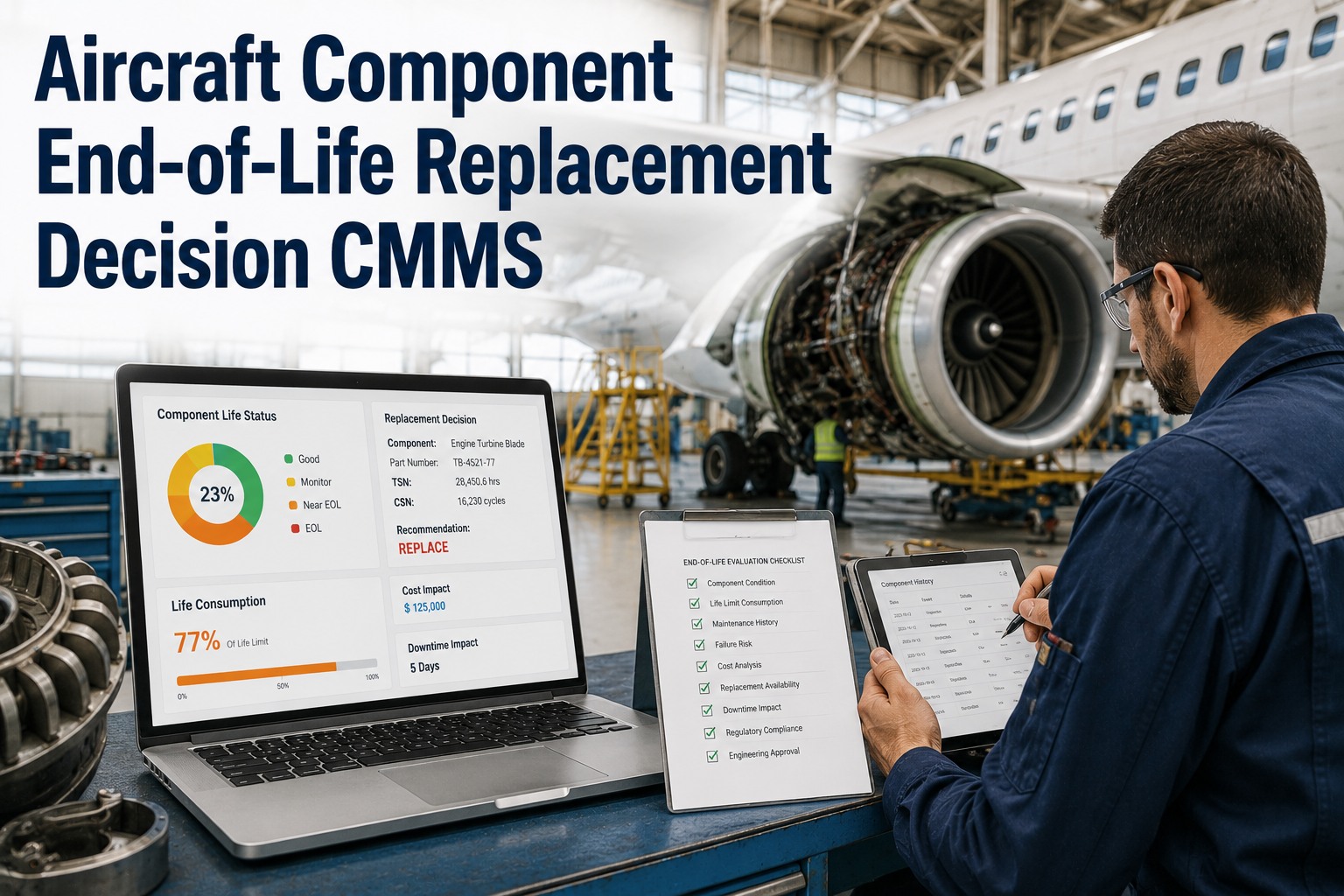
Deciding whether to repair, replace, exchange, or retire an aircraft component at its end of life is the single most consequential economic choice a reliability team makes — a single misjudged landing gear actuator or engine module can swing lifecycle costs by hundreds of thousands of dollars. An aircraft component end of life replacement decision CMMS gives maintenance and reliability engineers the data architecture to track repair cost trending, estimate remaining useful life (RUL), and execute exchange pool strategies without relying on tribal knowledge. This 2026 guide covers the repair vs replace economics for aviation assets, retirement documentation, and how AI-powered EAM platforms like OxMaint transform component-level decisions into auditable, predictive workflows. Stop losing margin to premature replacements and AOG delays — Start Free Trial to see how data-driven lifecycle management works on your fleet.
Component EOL Decision Guide 2026
Repair vs Replace Aviation Components with Confidence
Are you retiring high-value aircraft components too early — or flying them past their economic limit? Quantify repair cost trending, remaining useful life, and exchange pool economics with a CMMS built for reliability-driven aviation teams.
Lifecycle Economics
When to repair vs replace aviation components
The break-even point for any aircraft component occurs when cumulative repair costs exceed the depreciated value of a replacement unit. Tracking this threshold manually across thousands of rotable and repairable parts is virtually impossible without a CMMS.
Mid-Life Component Economics
For components in their first or second operational cycle, repairing makes economic sense if the repair cost is under 60% of the replacement unit's current market value. A CMMS tracks labor hours and material costs against this dynamic threshold automatically.
End-of-Life Economics
As parts approach their life limits, repair costs scale exponentially. When a repair exceeds 75% of replacement value, or requires extensive NDT testing, retiring the component and triggering an exchange pool request is the mathematically sound decision.
Cannibalization & Harvesting
Stripping serviceable parts from retired airframes can reduce AOG inventory costs by up to 40%. An EAM system documents remaining life credits and certification trails for harvested components to maintain strict regulatory compliance.
The EOL Decision Formula
How to calculate aircraft component replacement decisions
Data-driven replacement decisions rely on comparing the total cost of continued repairs against the amortized cost of a new or exchanged component. Use this formula to benchmark your fleet's lifecycle economics.
Component Economic Break-Even Formula
If ( Cnext_repair + L downtime_risk ) > ( Creplacement / Eremaining_cycles ) → REPLACE
Where C = direct costs, L = probability-weighted AOG delay cost, and E = estimated remaining useful life (RUL) cycles based on CMMS historical degradation data.
Lifecycle Strategy
Aviation component replacement guide: decision pathways
Every component reaching its end-of-life threshold follows one of four documented pathways. Reliability engineers must evaluate each route using historical failure data and real-time inventory visibility.
Repair & Return to Service
The component is sent to an approved MRO facility. CMMS tracks turnaround time (TAT) against historical baselines to prevent costly AOG delays. If TAT exceeds the loaner pool capacity, the decision triggers a replacement alert.
Exchange Pool Utilization
Swap the worn component for an overhauled unit from an exchange pool (e.g., standard engine LRUs). This cuts lead time from 45+ days to under 48 hours, drastically reducing fleet ground time.
New Replacement Purchase
If the part is beyond economic repair (BER) or faces obsolescence, a new unit is procured. The CMMS automatically links the purchase order to the parent asset's hierarchy and updates the baseline lifecycle tracker.
Retirement & Documentation
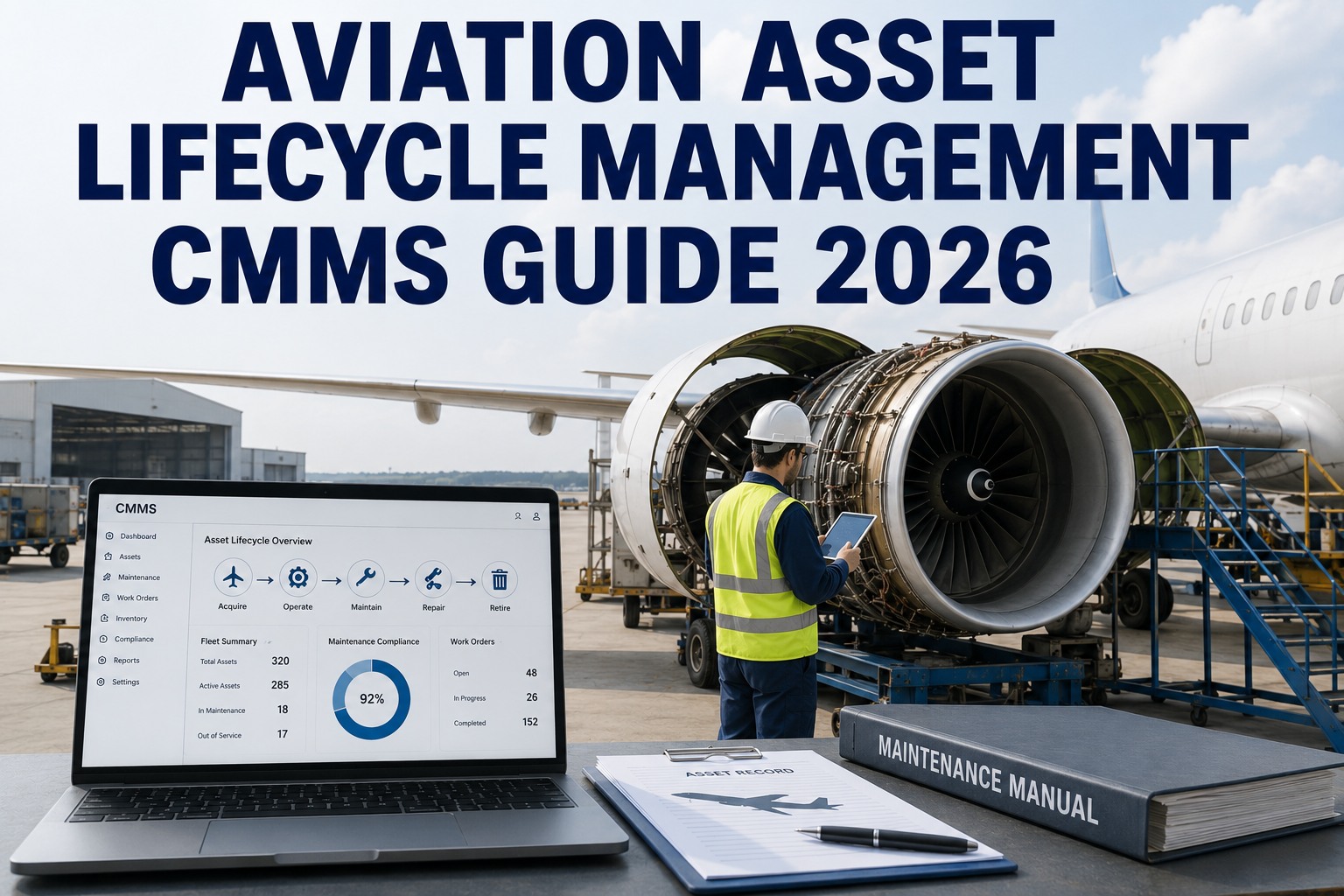
The component is permanently removed from service and scrapped or cannibalized. Rigorous retirement documentation (FAA Form 8130-3 / EASA Form 1 traceability) is archived within the EAM for permanent audit readiness.
CMMS vs Spreadsheets
CMMS end of life aviation: data-driven vs manual tracking
Transitioning from spreadsheet-based lifecycle tracking to a CMMS component EOL system fundamentally changes how reliability teams manage costs and compliance. Here is how the approaches compare.
| Decision Factor | Manual / Spreadsheets | CMMS (OxMaint EAM) |
|---|---|---|
| Repair Cost Trending | Laboriously compiled; often missing indirect costs. | Auto-tracked per component with predictive cost forecasting. |
| Remaining Useful Life (RUL) | Static TBO limits; no real-time condition data. | AI-driven RUL estimation based on usage and sensor data. |
| Exchange Pool Visibility | Manual inventory counts; high risk of stockouts. | Real-time rotable pool availability across all bases. |
| Retirement Documentation | Paper forms prone to loss and compliance audit failures. | Digital, permanent audit trails linked to asset hierarchy. |
How OxMaint Helps
How OxMaint powers CMMS component replacement decisions
OxMaint translates raw maintenance data into clear, actionable component end-of-life signals. Reliability teams gain the exact tools needed to optimize repair vs replace aviation economics without leaving the platform.
Predictive RUL Estimation
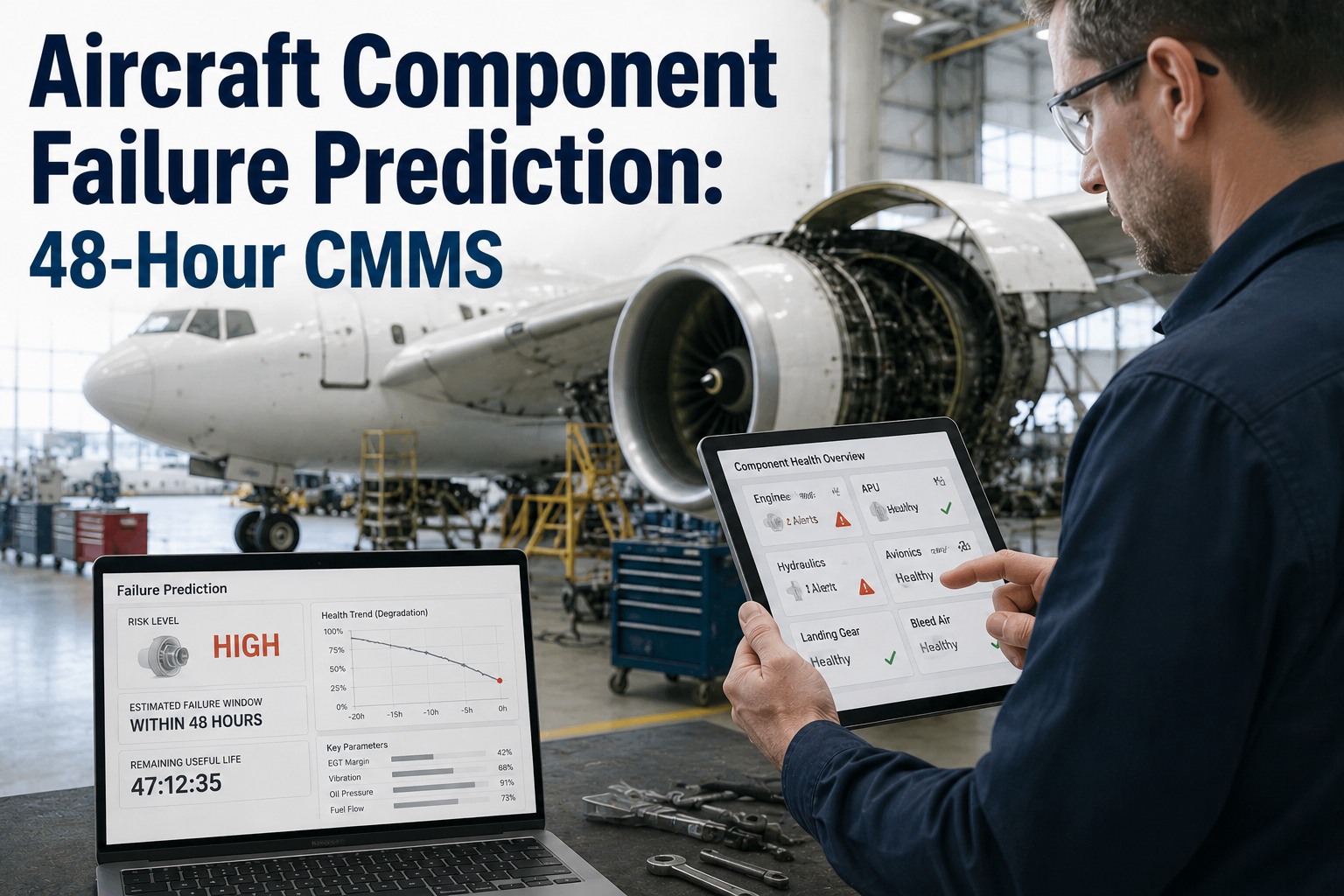
AI models analyze flight hours, cycles, and condition monitoring data to predict component failure before it happens — cutting unplanned AOG events by 30 to 50%.
Automated Spare Parts Inventory
Trigger automatic exchange pool requests and purchase orders the moment a component is flagged for replacement, reducing inventory carrying costs by up to 25%.
Digital Retirement Documentation
Auto-generate FAA and EASA compliant retirement and cannibalization records directly within the EAM, eliminating paper processes and ensuring 100% audit readiness.
Unified Asset Cost Tracking
Roll up labor, material, and AOG delay costs into a single dashboard view, giving asset managers real-time visibility into the total lifecycle economics of every tail number.
Integrated Work Order Execution
Convert EOL decisions into actionable work orders instantly, ensuring technicians have the correct exchange unit and tooling ready the moment the aircraft enters the hangar.
Reliability Analytics Dashboard
Visualize mean time between failures (MTBF) and repair cost trends across the fleet to identify systemic fatigue issues before they impact operational availability.
Stop guessing. Start optimizing your component lifecycle.
See exactly how OxMaint consolidates maintenance data, predicts end-of-life thresholds, and cuts your AOG costs. Book a 30-minute demo with our aviation reliability experts today.
Frequently Asked Questions
Aircraft component end of life & CMMS
What is an aircraft component end of life replacement decision CMMS?
It is a specialized maintenance management system that uses real-time data, repair cost trending, and predictive analytics to help reliability engineers decide whether to repair, replace, or retire aviation components. Instead of relying on static time-between-overhauls (TBO), a CMMS evaluates the actual economic and operational condition of each part. You can Start Free Trial to see this workflow in action.
How do you calculate repair vs replace economics for aviation components?
The general rule is to replace a component when the cost of the next repair, plus the risk-weighted cost of potential AOG downtime, exceeds the amortized cost of a new unit over its expected remaining life. CMMS software automates this math by continuously tracking labor, material, and delay costs against historical baselines.
What is remaining useful life (RUL) estimation in aviation maintenance?
RUL estimation predicts how many flight hours or cycles a component can safely operate before failing or requiring overhaul. AI-powered CMMS platforms calculate RUL by analyzing condition monitoring data, historical failure rates, and operational severity, moving maintenance from reactive to predictive.
How does a CMMS manage exchange pools for rotable components?
A CMMS maintains real-time visibility of available serviceable units in exchange pools across all maintenance bases. When a component is flagged for replacement, the system automatically reserves a replacement unit and generates the logistics work orders, reducing ground time from weeks to days.
Why is retirement documentation critical for aircraft components?
Regulatory bodies require strict traceability when components are permanently removed from service, scrapped, or cannibalized for parts. A CMMS securely archives digital retirement records, linking life credits and certification forms (like FAA 8130-3) directly to the asset hierarchy to ensure 100% audit compliance. To streamline your compliance processes, Book a Demo with our team.
Ready to modernize your component EOL strategy?
Join the reliability teams using OxMaint to eliminate reactive maintenance, reduce lifecycle costs, and maintain flawless audit trails.
Free 14-day trial · No credit card required