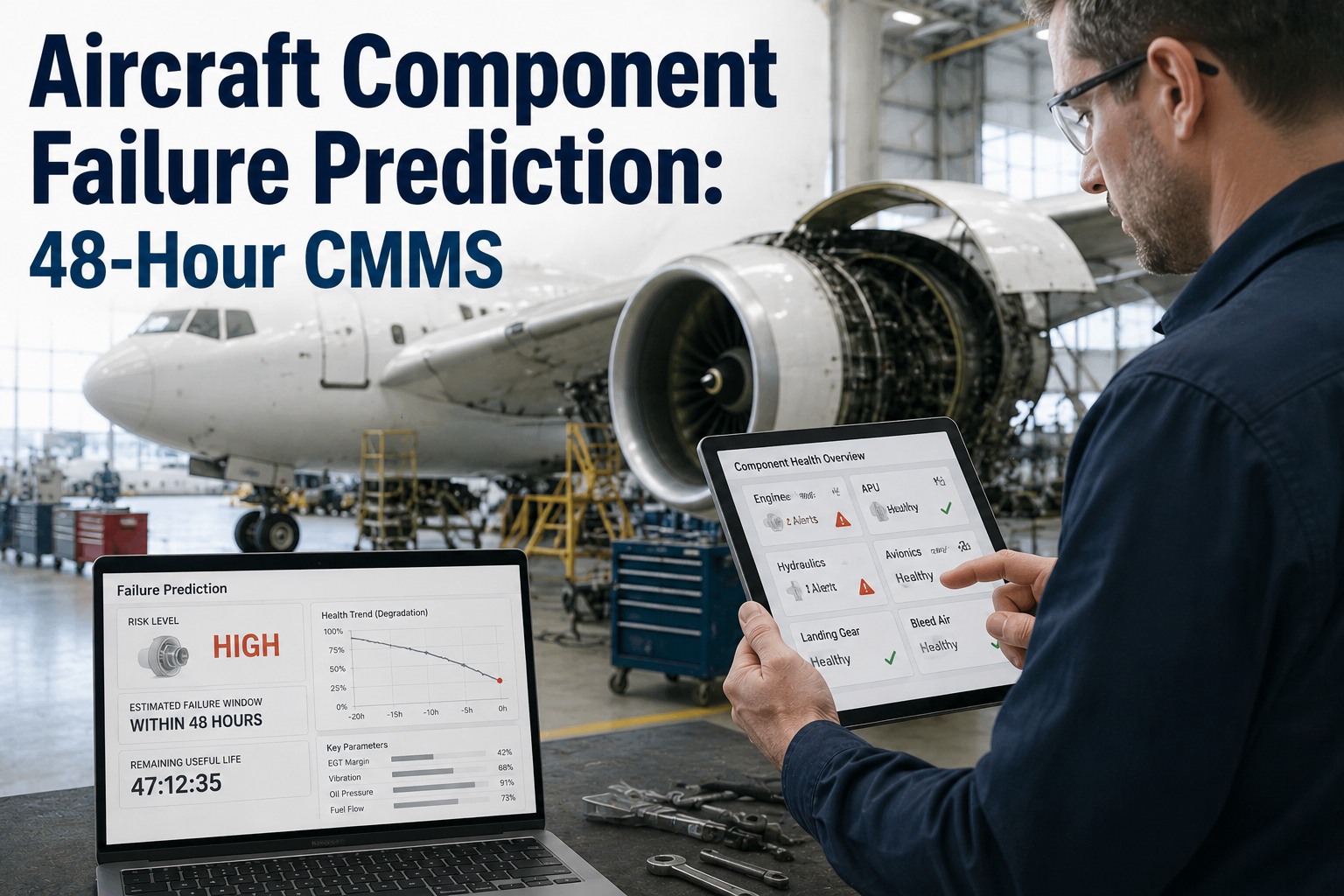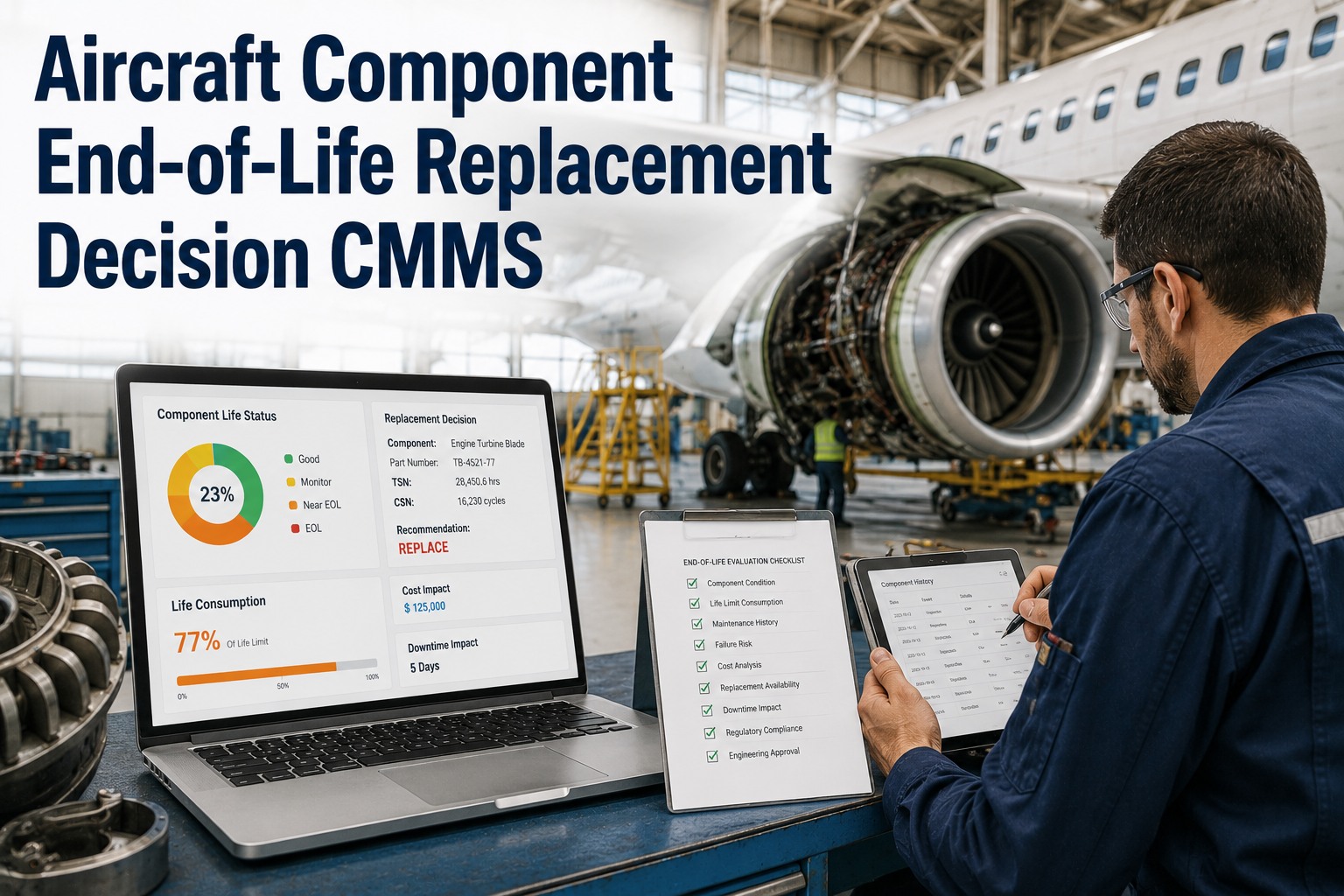
Predicting component remaining useful life in aviation means estimating how many flight hours, cycles or calendar days a part can safely deliver before failure risk rises — so you replace it at the optimal point, not too early and never too late. For reliability engineers, RUL prediction turns maintenance from calendar-based guesswork into condition-based precision, unlocking significant fleet economics: fewer premature removals, fewer unplanned AOG events and tighter spare-parts inventory. This guide covers how to design RUL models for aircraft components, engineer the right features, manage prediction confidence, and integrate remaining-life forecasts into your CMMS so predictions become scheduled work orders. Whether you're tracking turbine blades, landing gear actuators or avionics LRUs, the principles are the same — and platforms like OxMaint make it practical to operationalize RUL at fleet scale. If you're ready to move from reactive swaps to predictive component life management, Start Free Trial and see how OxMaint connects condition data to maintenance decisions.
What if every aircraft component told you exactly when to replace it?
Remaining useful life prediction estimates the safe operating window left in a part — so you stop wasting 20–40% of component life on premature removals and stop risking unplanned failures that ground aircraft and cost $10K–$150K per hour in AOG downtime.
Why calendar-based component replacement wastes millions in aviation
Most aircraft components are removed on fixed intervals — flight hours, cycles or calendar time — set conservatively to avoid in-service failures. But conservative means wasteful: studies show 30–40% of useful component life is discarded when parts are pulled too early, while 15–25% of unplanned removals still occur because fixed intervals can't account for actual operating stress, environment or manufacturing variance.
A mid-size carrier operating 50 aircraft and spending $8M annually on rotable component replacement can recover $1.6M–$3.2M per year by extending component life just 20–30% through condition-based RUL prediction — while simultaneously cutting AOG events by half. The economics are compelling, but only if predictions are accurate, confident and integrated into maintenance planning workflows.
How to build a remaining useful life prediction model for aircraft components
An effective aircraft RUL model combines physics-based degradation understanding with data-driven pattern recognition. The goal: estimate the probability distribution of remaining life (not just a point estimate) so you can schedule replacement with quantified confidence.
Start with FMEA (Failure Modes and Effects Analysis) for the component. Is it fatigue cracking, thermal degradation, wear, corrosion or seal leakage? Each mechanism has different measurable precursors — vibration signatures for bearing wear, EGT margin erosion for turbine blades, cycle counts for fatigue-limited structures.
Capture sensor streams (vibration, temperature, pressure, oil debris), operational parameters (flight cycles, hours, throttle settings, environmental exposure) and maintenance history (prior removals, findings, repairs). Minimum viable dataset: 50–100 failure examples with full run-to-failure histories, or 500+ censored (non-failed) units for survival-analysis approaches.
Raw sensor data rarely predicts RUL directly. Extract trend features (rate of vibration increase, EGT margin slope), statistical features (RMS, kurtosis, crest factor), frequency-domain features (bearing fault frequencies, blade-pass harmonics) and usage-accumulation features (equivalent cycles adjusted for severity). Feature engineering often contributes 60–70% of model accuracy.
Physics-based models (Paris law for crack growth, Arrhenius for thermal aging) work when degradation mechanisms are well understood. Data-driven models (survival analysis, Weibull, random forests, LSTM neural networks) excel when you have rich historical data. Hybrid approaches — physics-informed machine learning — often deliver the best accuracy and interpretability for aviation RUL.
A point estimate ("247 cycles remaining") is dangerous without confidence bounds. Output a probability distribution: "90% confidence RUL is between 180–320 cycles." Use prediction intervals to set conservative replacement triggers — e.g., schedule removal when the 10th percentile of RUL falls below the next maintenance opportunity window.
Validate on held-out fleets or time periods. Track prediction accuracy (MAE, RMSE, coverage of confidence intervals) in production. Retrain quarterly or when new failure modes emerge. Models degrade as fleets age, operating profiles shift and maintenance practices evolve — plan for lifecycle management.
Which data features best predict aircraft component remaining life?
The right features make or break RUL accuracy. For rotating components (bearings, gears, pumps), vibration-derived features dominate. For hot-section turbine parts, temperature margins and cycle accumulation matter most. For structures and fatigue-limited parts, usage severity and environmental exposure drive life consumption.
| Component Type | Top Predictive Features | Typical RUL Accuracy |
|---|---|---|
| Turbine blades & vanes | EGT margin trend, cycle count, time-at-temperature, creep strain models | ±15–25% at 200 cycles ahead |
| Main shaft bearings | Vibration RMS trend, bearing fault frequency amplitude, oil debris count, temperature | ±10–20% at 500 hours ahead |
| Landing gear actuators | Cycle count, seal leakage rate, hydraulic pressure decay, temperature cycles | ±20–30% at 1,000 cycles ahead |
| Avionics LRUs | Operating hours, thermal cycles, power-on hours, BIT (built-in test) fault history | ±25–40% (high variance) |
| APU (auxiliary power unit) | EGT margin, start cycles, oil consumption rate, vibration trends | ±15–25% at 300 cycles ahead |
| Structural components | Flight hours, cycles, gust/load exceedance history, corrosion inspections, crack growth models | ±10–20% (physics-based models) |
Best practice: start with 10–20 candidate features, use feature-importance ranking (random forest Gini importance, SHAP values) to identify the top 5–8, and iterate. More features don't always help — noisy or redundant features degrade model generalization. OxMaint's asset-tracking module automatically logs operational parameters and maintenance history, creating the structured dataset RUL models need.
How to turn RUL predictions into confident maintenance decisions
A prediction is only useful if you know how much to trust it. Aviation maintenance decisions require quantified confidence — you can't ground an aircraft on a hunch, and you can't ignore a credible failure risk.
Example: RUL = 250 cycles, 90% CI = [220, 280]. Action: schedule replacement at next planned maintenance visit within the lower bound. Use for work-order planning and parts provisioning.
Example: RUL = 250 cycles, 90% CI = [150, 350]. Action: increase monitoring frequency, order parts, flag for opportunistic replacement if aircraft comes in for other work. Re-inspect or re-test to narrow uncertainty.
Example: RUL = 250 cycles, 90% CI = [50, 450]. Action: do NOT use for replacement timing. Collect more data, improve sensors, refine features or revert to conservative time-based intervals until model matures.
Using the 10th percentile (not the median) ensures 90% confidence the component won't fail before the scheduled replacement. Safety buffer accounts for unplanned schedule changes — typically 10–20% of remaining interval.
Case example: regional carrier cuts AOG events 45% with RUL-guided replacement
A regional airline operating 32 turboprops was experiencing 18–22 unplanned component removals per month — mostly starter-generators, fuel pumps and actuators — causing 6–8 AOG events and $180K–$240K in monthly disruption costs. Components were replaced on fixed intervals per OEM recommendations.
- Fixed-interval replacement at OEM conservative limits
- 22 unplanned removals/month (avg)
- 7 AOG events/month, avg 14 hours each
- $210K/month in AOG + expedited shipping + overtime
- 35% of removed components had >30% life remaining (tear-down analysis)
- Condition-based replacement using vibration + usage + oil analysis
- 12 unplanned removals/month (45% reduction)
- 3 AOG events/month (57% reduction)
- $95K/month in disruption costs (55% savings)
- Average component life extended 22% without increased failures
Annual impact: $1.38M saved in AOG and disruption costs, plus $620K in extended component life and reduced spares consumption. Total ROI: $2M per year on a $180K investment in sensors, data infrastructure and model development — payback in under 4 months. The carrier integrated RUL predictions into OxMaint, which auto-generates work orders when predicted remaining life crosses the replacement threshold and reserves parts from inventory.
Turn RUL predictions into scheduled maintenance with OxMaint
Predicting remaining useful life is only half the battle — you need a CMMS that ingests predictions, triggers work orders, reserves parts and tracks execution. OxMaint closes the loop from condition monitoring to maintenance action.
Set RUL replacement triggers (e.g., "generate work order when 10th-percentile RUL < 150 cycles"). OxMaint monitors incoming predictions and auto-creates work orders with parts lists, labor estimates and priority scores — eliminating manual tracking and ensuring no component slips through.
OxMaint forecasts parts demand based on fleet-wide RUL distributions, auto-reserves components when work orders trigger, and optimizes reorder points — cutting spares inventory 15–25% while improving availability. No more AOG expediting or excess stock.
Track every component's installation date, flight hours, cycles, removals and findings. OxMaint's analytics dashboard shows life-extension trends, prediction accuracy and cost savings — proving ROI to leadership and refining RUL models with real-world outcomes.
OxMaint's scheduling engine aligns RUL-driven component replacements with planned maintenance visits, minimizing aircraft downtime. Bundle multiple RUL-triggered tasks into one hangar visit, coordinate parts and labor, and avoid opportunistic failures between checks.
Whether you're running physics-based models, machine-learning algorithms or hybrid approaches, OxMaint's open API ingests RUL predictions from any source and turns them into executable maintenance plans. Book a Demo to see how OxMaint operationalizes predictive component life management for aviation fleets.
See how OxMaint turns RUL predictions into scheduled maintenance
Book a 30-minute demo and we'll show you how to integrate remaining-life forecasts, automate work orders and cut unplanned removals 30–50% — using your fleet's real data.
Remaining useful life prediction in aviation: your questions answered
Remaining useful life prediction estimates how much longer an aircraft component can operate safely before failure risk becomes unacceptable — typically expressed in flight hours, cycles or calendar time. RUL models use condition-monitoring data (vibration, temperature, oil analysis), operational history and degradation physics to forecast the optimal replacement point, replacing conservative fixed-interval schedules.
Accuracy varies by component type and data quality. Well-instrumented rotating components (bearings, pumps) achieve ±10–20% error at 500+ hours ahead; turbine hot-section parts ±15–25% at 200 cycles ahead; avionics ±25–40% due to higher variance. Accuracy improves with more failure examples, better sensors and hybrid physics-plus-ML models. Always use prediction intervals, not point estimates, for maintenance decisions.
Typical ROI: 3–6 month payback, then $1M–$3M annual savings per 50-aircraft fleet. Benefits come from 20–40% component life extension (fewer premature removals), 30–50% reduction in unplanned failures and AOG events, 15–25% lower spares inventory, and reduced expedited shipping and overtime. A regional carrier case study showed $2M annual savings on a $180K investment. Start Free Trial to calculate your fleet's specific ROI.
No. Start with data you already have: maintenance history, removal records, flight hours, cycles and existing condition-monitoring (ACARS, FOQA, engine trend data). Many operators achieve 70–80% of RUL benefits using existing data sources. Add targeted sensors (wireless vibration, oil debris monitors) only for high-value or high-failure-rate components where incremental accuracy justifies the cost — typically $5K–$15K per aircraft for retrofit sensor packages.
RUL models output predictions (remaining life + confidence intervals) via API or file export. A modern CMMS like OxMaint ingests these predictions, compares them to replacement thresholds, auto-generates work orders when limits are crossed, reserves parts from inventory and schedules labor — all without manual intervention. Integration typically takes 2–4 weeks for API-based systems. OxMaint's open architecture works with any RUL modeling platform or in-house data science team.
Turn component remaining useful life into scheduled, confident maintenance
OxMaint connects RUL predictions to work orders, parts provisioning and maintenance execution — so you replace components at the optimal point, every time. See it on your fleet in a 30-minute demo.