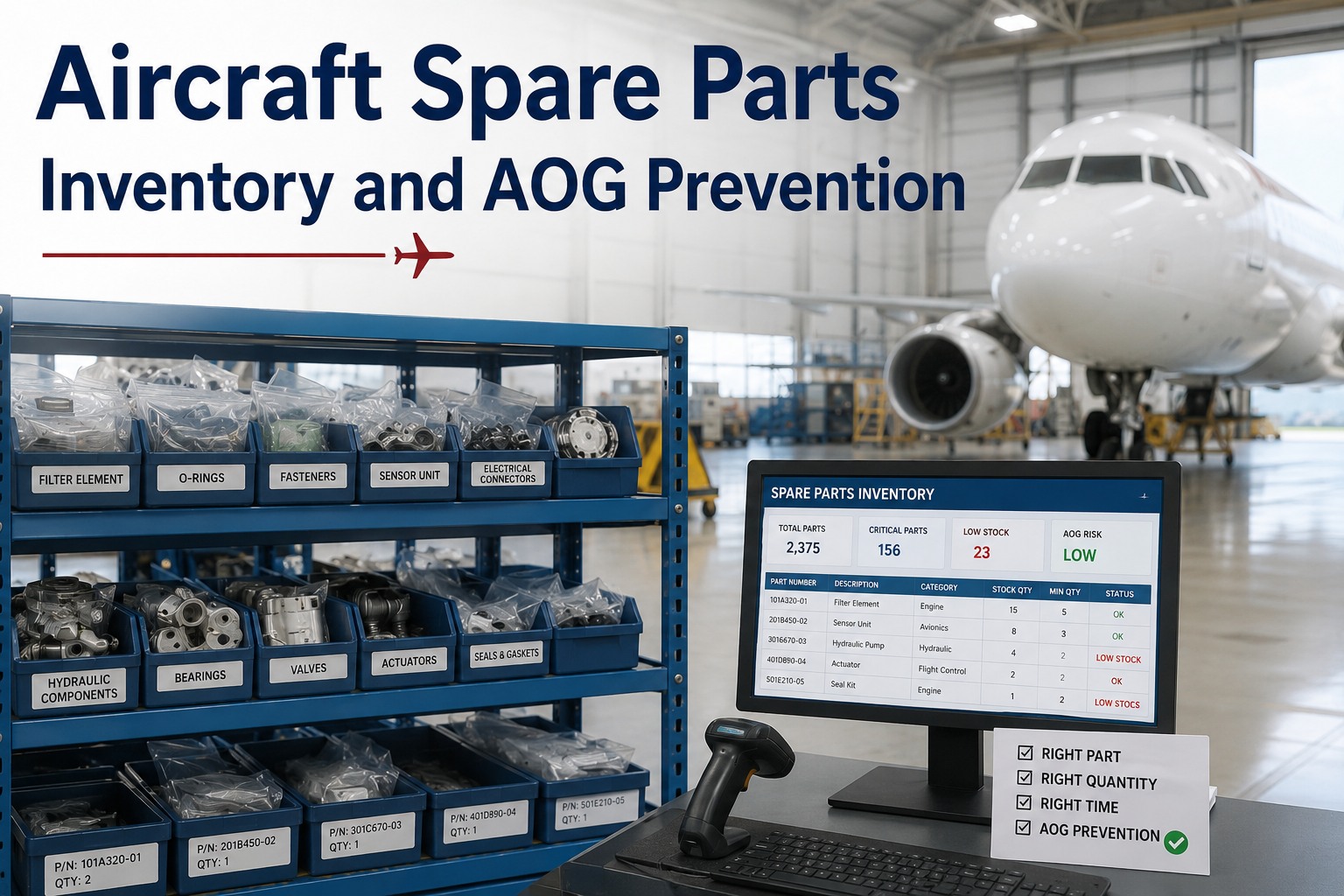
Aviation MRO operations are built on precision — yet the supply chain powering them often runs on anything but. Across fleets of fifty aircraft or five hundred, maintenance planners deal with the same fundamental tension: holding enough critical spares to prevent AOG events without tying up capital in parts that sit idle for months. Traditional inventory methods — static min/max levels, annual consumption averages, manual reorder triggers — were designed for a simpler era. In today's high-utilization, multi-fleet, multi-base operating environment, those methods produce chronic overstocking in low-demand categories while leaving high-criticality components at perpetual risk of stockout. AI-powered demand forecasting breaks this trade-off entirely — using machine learning to model parts demand at the component level, months in advance, with accuracy rates that fixed replenishment logic cannot approach. The result is a leaner inventory, fewer emergency procurements, and measurably lower AOG risk across your entire operation. To see what AI forecasting delivers in practice, start a free 30-day trial with Oxmaint or book a live demo with our aviation inventory analytics team and walk through a demand forecast built on your own fleet data.
AI-Powered Spare Parts Demand Forecasting for Aviation MRO
Reduce AOG events. Cut excess inventory by up to 31%. Predict what parts you need — before the demand event occurs.
Predict Parts Demand Months Ahead — Not Days After a Stockout
Oxmaint's AI inventory forecasting engine processes your fleet's historical consumption data, scheduled maintenance events, and supplier lead times — generating rolling demand predictions that position the right parts in the right location before the work order is even raised. Want to see what your inventory looks like with AI-driven demand intelligence? Start a free 30-day trial today and connect your existing data, or book a personalized demo with our MRO inventory team and walk through a live forecasting session.
What Is AI-Powered Spare Parts Demand Forecasting?
AI-powered spare parts demand forecasting applies machine learning models to historical parts consumption data, fleet utilization records, scheduled maintenance programs, and external variables — generating probabilistic demand predictions for every SKU across every location in your MRO network. Unlike traditional min/max replenishment, which reacts to depletion events, AI forecasting anticipates demand before it materializes — enabling procurement and inventory positioning to happen days or weeks ahead of actual consumption.
The core mechanism is supervised learning on consumption time-series data, enriched with contextual signals: aircraft utilization hours, fleet age profiles, seasonal maintenance patterns, component mean time between failures, and supplier lead time variability. The result is a demand model that adapts continuously — recalibrating as fleet configuration changes, as maintenance programs evolve, and as new consumption events refine the underlying patterns.
According to IATA's 2025 MRO forecast, global aviation MRO spend is projected to reach $119 billion by 2034 — with inventory inefficiency accounting for an estimated 18–23% of total MRO cost at the average commercial operator. AI forecasting targets that inefficiency directly: reducing capital locked in slow-moving stock while improving service levels for high-criticality, AOG-risk components. The operational and financial case is clear. Ready to act on it? Start your free Oxmaint trial or book a session with our aviation inventory specialists to see AI forecasting applied to your specific fleet and parts profile.
6 Core AI Forecasting Capabilities That Drive MRO Inventory Intelligence
Each capability targets a specific failure mode in conventional spare parts management — from chronic AOG-risk stockouts to capital-inefficient overstock accumulation across multi-base MRO networks.
4 Inventory Failures That Are Costing Your MRO Operation Right Now
These are not theoretical risks. They are the measurable, documented costs of operating aviation spare parts inventory without AI-powered demand intelligence — and they compound across every aircraft in your fleet.
How Oxmaint Delivers AI Spare Parts Demand Forecasting
Oxmaint connects to your existing MRO data infrastructure, processes historical consumption records, and generates rolling AI-powered demand forecasts that integrate directly with your procurement and inventory workflows — without a lengthy implementation project or expensive data migration. Ready to eliminate your next AOG stockout? Start a free 30-day trial today or book a personalized demo with our aviation inventory team and see AI forecasting running on your actual parts data within 48 hours.
Traditional Inventory Management vs AI-Powered Demand Forecasting
The gap between traditional replenishment methods and AI-powered forecasting is not measured in marginal efficiency gains — it is a structural shift in how inventory risk is managed across your entire MRO operation. The numbers tell the story.
| Capability Area | Traditional Approach | Oxmaint AI Forecasting |
|---|---|---|
| Forecast Accuracy | 55–65% on average with moving average methods | Up to 94% accuracy with ML demand modeling |
| Demand Horizon | 1–4 week reactive reorder lag | 3–12 month rolling forward demand visibility |
| AOG Stockout Risk | Discovered only when technician raises a job card against empty bin | Flagged weeks or months before demand event occurs |
| Maintenance Schedule Integration | Not integrated — C/D-check demand creates emergency buys | Fully integrated — planned maintenance drives pre-positioned stock |
| Excess Inventory Detection | Annual or ad-hoc review — slow-movers accumulate for years | Continuous AI-driven detection — disposal flags generated automatically |
| Multi-Base Visibility | Siloed per-base stock levels — no network redistribution intelligence | Network-wide demand modeling with lateral transfer recommendations |
| Procurement Cost | Frequent emergency buys at 4.8x standard procurement cost | Planned procurement at standard rates — emergency buys structurally reduced |
| Planner Time Investment | Significant manual review time per reorder cycle | Automated recommendations — planners review exceptions, not every SKU |
The Numbers MRO Directors Use to Build the Internal Business Case
Quantified outcomes from AI-powered demand forecasting deployments — the data points that close the conversation with finance teams and ownership groups about investment in inventory intelligence technology.
Frequently Asked Questions
How much historical parts consumption data does Oxmaint need to build an accurate forecast model? +
Oxmaint can generate useful initial forecasts with as little as 12 months of historical consumption data — though models trained on 24–36 months of history deliver meaningfully higher accuracy, particularly for low-frequency, high-criticality components with sporadic demand patterns. For operators with limited clean historical data, Oxmaint's data preparation process includes gap-filling, anomaly detection, and external demand signal integration to improve baseline model quality before initial deployment. Most aviation MRO operations see their first actionable AI-driven procurement recommendation within 48–72 hours of initial data connection. Start a free trial and connect your data today or book a session with our data team to assess your historical record quality before committing.
Does Oxmaint integrate with existing MRO management platforms like AMOS, TRAX, or SAP PM? +
Oxmaint is designed for integration with existing MRO ecosystems rather than replacement. It supports data ingestion from AMOS, TRAX, Quantum MX, SAP Plant Maintenance, and IFS — via API connection, scheduled data export, or flat-file import depending on the source system's capabilities. Forecast outputs and procurement recommendations can be pushed back into your existing procurement workflow or ERP system, meaning planners continue working in familiar interfaces while benefiting from AI demand intelligence in the background. The typical integration scope for a mid-size operator connects to Oxmaint's forecasting layer within two to three weeks — without a heavy implementation project or dedicated technical resource from the operator side.
How does AI demand forecasting handle low-frequency, high-criticality spares that have limited consumption history? +
Low-frequency, high-criticality spares — landing gear components, engine accessories, avionics line-replaceable units — are precisely where conventional replenishment methods fail most expensively. Oxmaint addresses these items through a combination of intermittent demand modeling techniques (Croston's method and Syntetos-Boylan Approximation), fleet-wide MTBF analysis from OEM data and industry reliability databases, and AOG-risk weighting that adjusts safety stock targets based on consequence rather than pure historical frequency. For truly new part introductions with zero consumption history, Oxmaint uses fleet-type demand analogues from its broader database — providing a starting model that improves as actual consumption data accumulates over the first operating year.
How does AI forecasting support FAA and EASA regulatory compliance in aviation inventory management? +
Oxmaint maintains full traceability and audit documentation across all AI-generated inventory decisions — which is essential for FAA Part 145 and EASA Part M regulatory compliance. Every procurement recommendation links back to the specific demand signals and model logic that generated it, with timestamps, confidence scores, and source data references preserved throughout. This supports regulatory audit readiness without added administrative burden on planning teams. Additionally, Oxmaint's parts management module maintains certificate of conformity tracking, shelf-life monitoring, and quarantine status management — ensuring that inventory controlled by AI forecasting remains airworthy-documented at every point in the supply chain from receipt through issue.
Your Next AOG Event Is Already Visible in Your Data — Oxmaint Surfaces It Before It Grounds Your Aircraft
Every day your MRO operation runs on static reorder points and manual inventory reviews, the cost gap between reactive and predictive inventory management compounds. Oxmaint's AI forecasting engine turns your historical consumption data into a live, self-updating demand intelligence asset — automatically positioning the right parts in the right locations before your maintenance teams raise a single job card against an empty bin.
Trusted by MRO operations across the USA, UK, UAE, Australia, and Germany. No lengthy implementation. Initial demand forecasts delivered within 48 hours of data connection. Full ROI typically achieved within the first year of deployment.