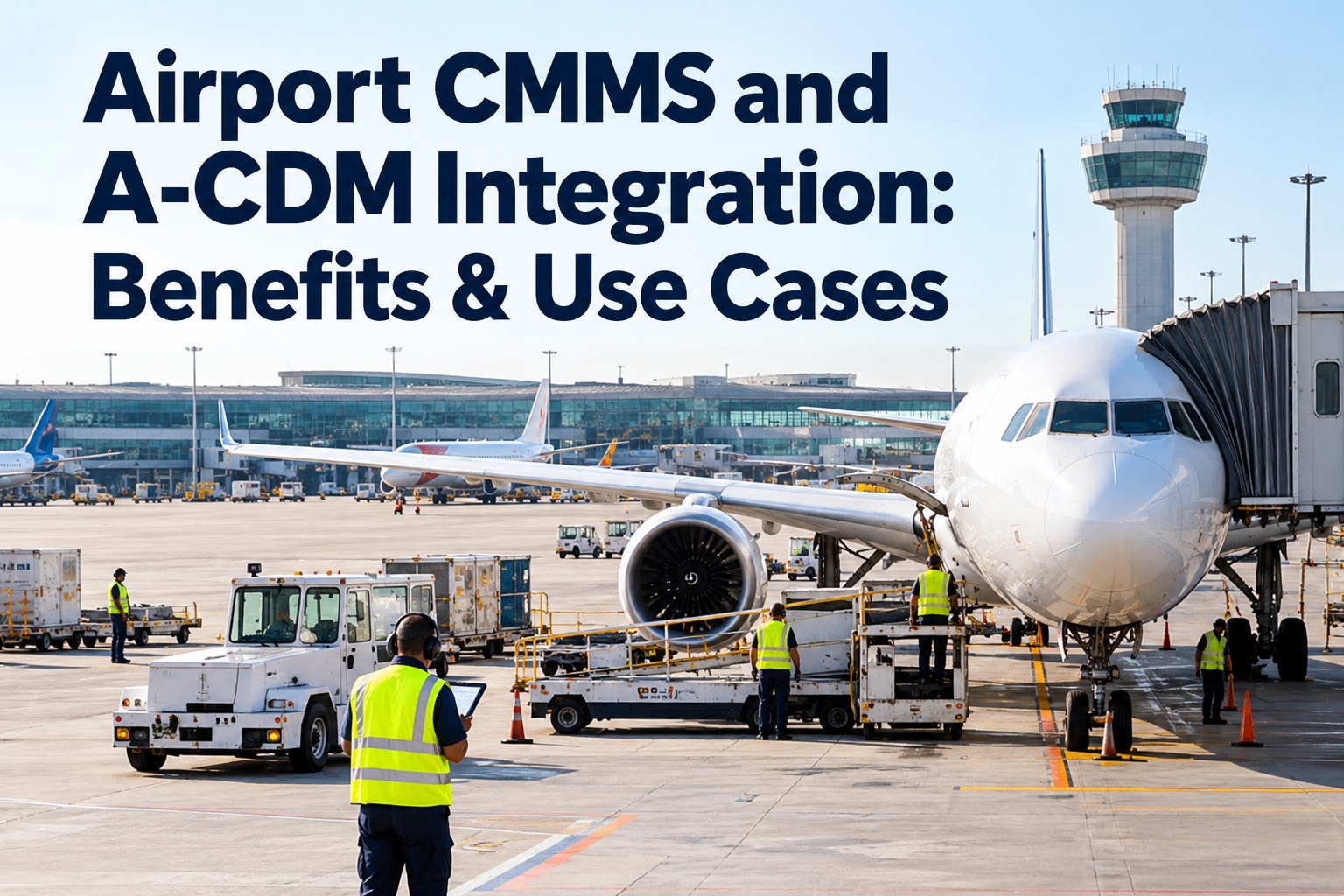
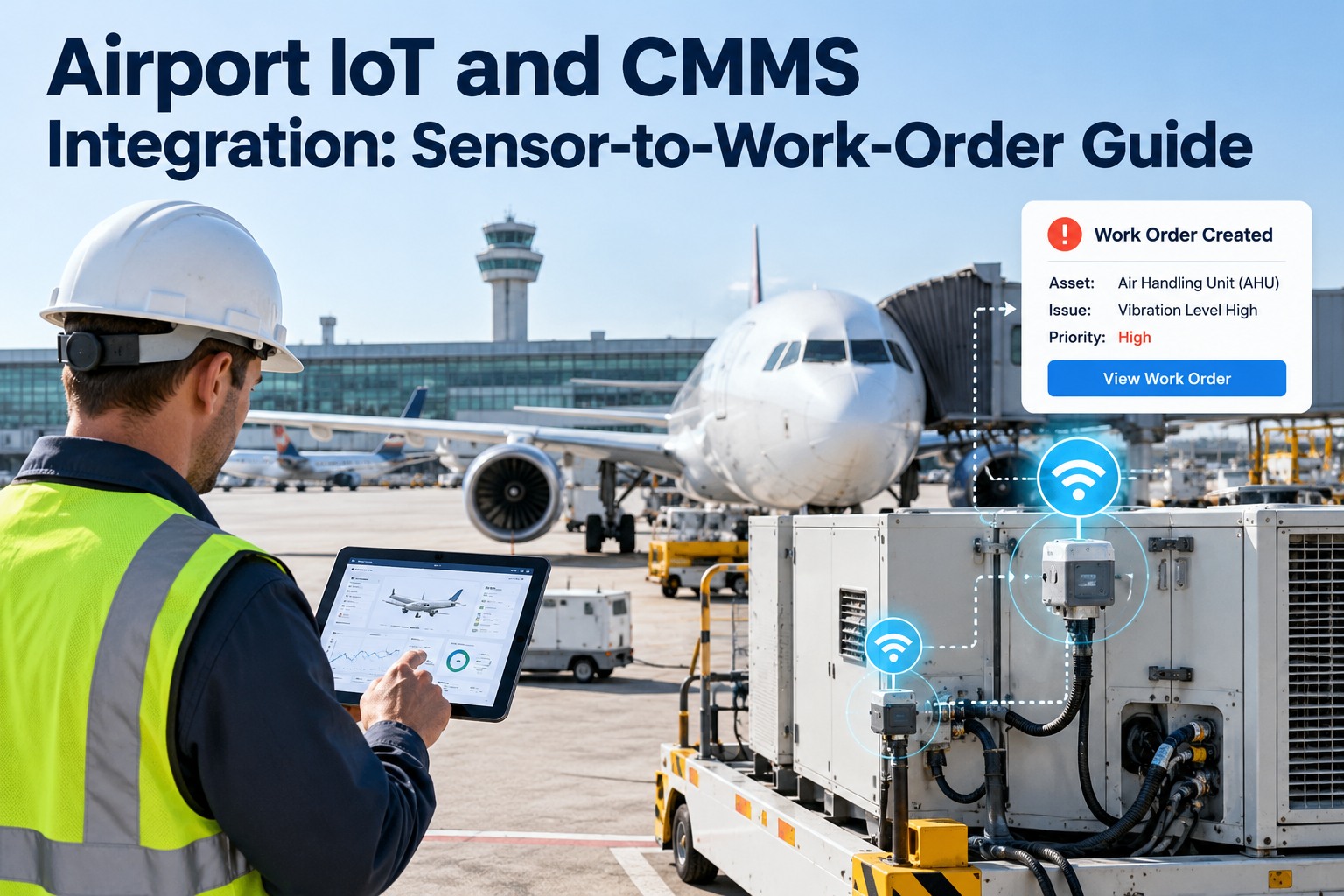
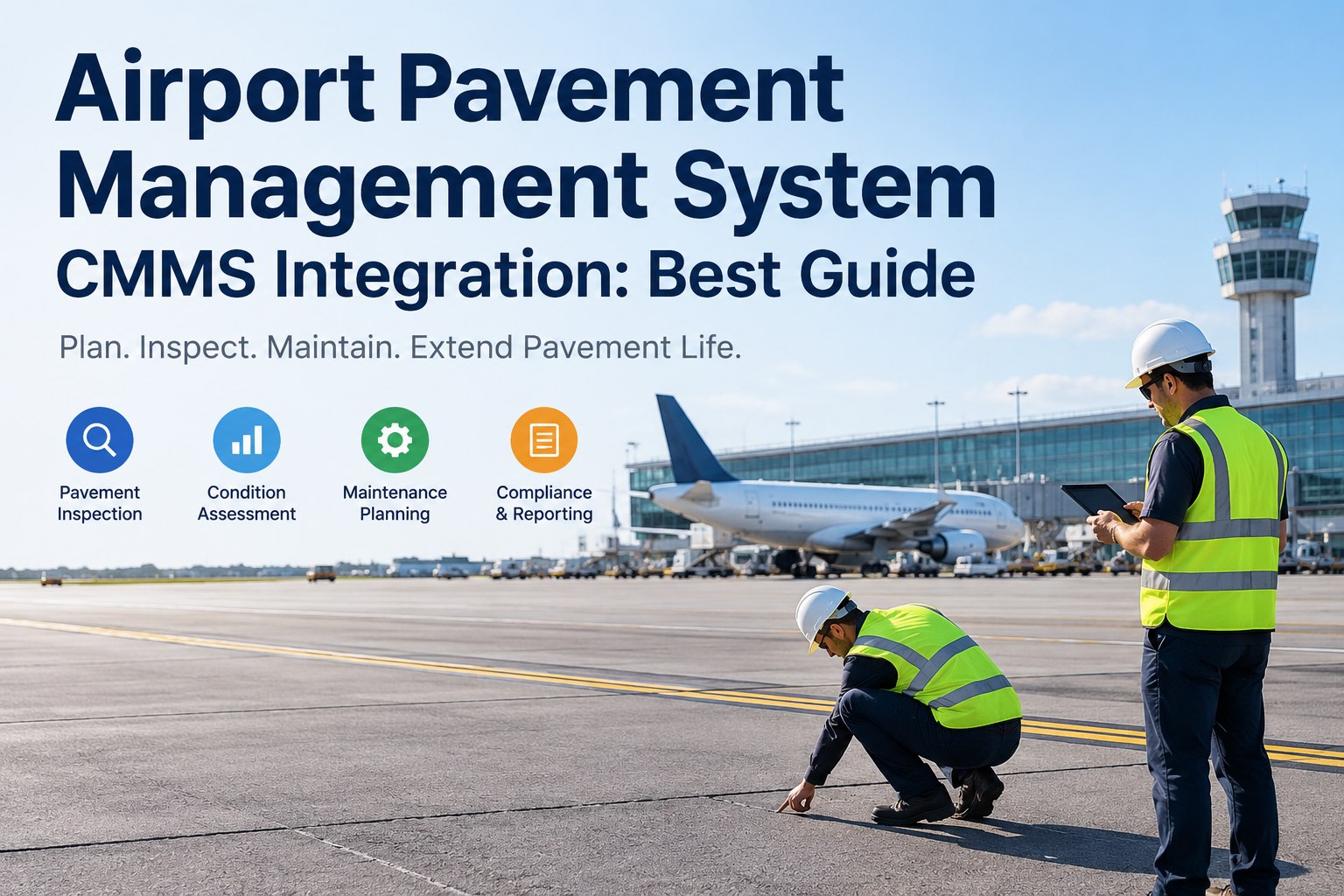
Airport Collaborative Decision Making (A-CDM) works because everyone shares one picture of each turnaround: when the aircraft will be ready, when the stand will be free and when pushback is expected. But that picture has a blind spot. A passenger boarding bridge that will not dock, a ground power unit that trips, a baggage line that jams: these are maintenance events, and they often reach the operations centre as a phone call rather than a data update. Connecting your airport CMMS to your A-CDM environment closes that gap, so equipment status and repair estimates sit alongside flight milestones. This guide explains where the two meet, which use cases matter most, and how to approach integration with OXMAINT AI, the AI-powered CMMS for airport and aviation maintenance teams.
Airport Operations · A-CDM Coordination · OXMAINT AI-Powered CMMS
Airport CMMS and A-CDM Integration: Benefits & Use Cases
Faults reported by phone, repair times nobody shares, stands assigned to broken equipment: this is where turnarounds slip. OXMAINT AI connects requests, inspections, work orders and PM in one platform, giving your integration a clean, structured source of maintenance status.
1
Request & Inspect
Faults raised from the apron
→
2
Issue or Defect
Tied to stand, gate or asset
→
3
Work Order
Status and repair estimate
→
4
PM & Predictive
Fewer repeat disruptions
A-CDM in 60 Seconds
A-CDM is a way for airport operators, airlines, ground handlers, air traffic control and the network manager to share data and agree on milestones for each flight. Instead of every party working from its own estimate, they work from shared times. The best known of these are the Target Off-Block Time (TOBT), the Target Start-up Approval Time (TSAT) and the actual in-block, off-block and take-off times. Sign up free and see how maintenance events are recorded in OXMAINT AI.
Airport Operator
Airlines
Ground Handlers
Air Traffic Control
Network Manager
Where Maintenance Touches the Turnaround
Every stage of a turnaround depends on equipment that someone maintains. Here is a simplified timeline, with the maintained assets that can affect each stage. Book a demo to map these assets to your stands.
In-blockAircraft arrives at stand
Ground handlingUnload, service, load
TOBTAircraft ready to push
BoardingPassengers on board
Off-blockPushback and taxi
Stand & bridgeDocking guidance, boarding bridge
ServicesGround power, pre-conditioned air, baggage system
ReadinessFuel hydrant, stairs, loaders, de-icing
BoardingBridge, gate systems, lifts
DeparturePushback tugs, apron lighting
Simplified illustration. Your airport's milestones and equipment will differ.
The Blind Spot: Maintenance Events That Disrupt Milestones
Bridge out of service
The stand was assigned with a working bridge. Passengers now need buses, and the turnaround plan changes.
Ground power unit failure
The aircraft must run its auxiliary power unit or wait for a replacement unit, which affects readiness.
Baggage system fault
Bags are delayed, and a ready aircraft cannot leave without them.
Two-Way Data: What Should Flow Between the Systems?
Integration is not only about sending alerts. The most useful setups exchange information in both directions. The exact fields depend on your operations platform and agreements with partners. Start free and structure your asset and work order data.
CMMS ➜ A-CDM / Operations
Asset availability by stand, gate and system
Fault reported, with time and location
Estimated time to repair and current work status
Planned maintenance windows
⇄
A-CDM / Operations ➜ CMMS
Stand allocation and occupancy
Peak periods and no-work windows
Urgency by flight priority or stand importance
Turnaround milestones for time-critical repairs
6 Use Cases That Pay Off First
1
Bridge and stand equipment status
Faulty equipment flagged against the stand, so planners avoid it.
2
GPU and PCA availability
Ground services readiness visible to handlers and operations.
3
Baggage system incidents
Fault status and estimated recovery shared with handlers.
4
De-icing equipment readiness
Pre-season checks and status ahead of winter operations.
5
Apron lighting and safety assets
Night-time stand usability reflected in planning.
6
Planned work scheduled around peaks
Maintenance windows chosen with the operational picture in view.
Integration Starts With Structured Maintenance Data.
OXMAINT AI records every fault, status change and repair against the right asset, so what you share with operations is accurate and timely.
A Simple Integration Architecture
Most integrations follow the same layered pattern. The CMMS remains the system of record for maintenance, and an integration layer carries selected events to the operations platform. Book a demo to discuss your systems.
Assets & Sensors Bridges, GPUs, baggage lines, lighting, equipment status signals
▼
CMMS Requests, work orders, asset register, repair status and history
▼
Integration Layer API or middleware, event rules, standard status codes
▼
Operations Platform AODB, A-CDM platform, stand and resource planning
▼
Partner Views Airport operations, airlines, ground handlers, control centre
A 4-Phase Approach
PHASE 1
Map
Link assets to stand and gate IDs. Clean the asset register.
PHASE 2
Define
Agree status codes, events and who owns each data field.
PHASE 3
Pilot
Integrate one use case, such as bridge availability, and measure.
PHASE 4
Expand
Add more systems and use cases using what the pilot taught you.
5 Integration Pitfalls to Avoid
Unclear asset-to-stand mapping. If a bridge isn't tied to a stand, status can't reach planners.
Free-text statuses. Operations needs standard codes it can act on automatically.
No data ownership. Nobody is responsible when an estimate is stale.
Sharing everything. Too many alerts get ignored. Start with events that change decisions.
Skipping a pilot. A big-bang rollout hides problems until they affect live operations.
How OXMAINT AI Supports Airport Operations Coordination
OXMAINT AI is an AI-powered CMMS and EAM platform with airport and aviation workflows. It provides the structured maintenance data behind integration and offers an open API for connecting other systems. It is not an A-CDM platform. Specific connection options should be scoped with your team in a demo. Start free and load your airport assets into OXMAINT AI.
Request Maintenance
Apron and gate staff raise faults quickly, creating a timed record from the first minute.
Asset Register
Hold bridges, GPUs, baggage lines and other equipment with their location and history.
Work Order Management
Assign, track and close repairs with status that operations can rely on.
Open API
Connect maintenance data to other airport systems through the developer API.
Predictive Maintenance
Use sensor data to flag developing faults on supported equipment before they disrupt turnarounds.
Offline-First Mobile
Technicians update status from the apron, even where connectivity is patchy.
Frequently Asked Questions
What is A-CDM at an airport?
Why connect a CMMS to A-CDM?
Equipment faults affect stands, ground services and baggage handling. Sharing asset status and repair estimates lets operations plan around problems rather than discover them late.
Book a demo to see the data you could share.
Is OXMAINT AI an A-CDM platform?
No. OXMAINT AI is a maintenance management system. It supplies structured maintenance and asset data, and its API can help connect that data to operations platforms.
Start free and explore the platform.
What is the best first integration use case?
Choose a high-impact, well-defined one, such as boarding bridge or ground power availability. It has clear owners, clear status and a visible effect on operations.
Book a demo and pick your pilot.
What do we need before integrating?
Give Operations the Maintenance Picture They Are Missing.
Capture faults, status and repairs on one platform, then share what matters with the systems that run your turnarounds. OXMAINT AI provides the maintenance foundation.