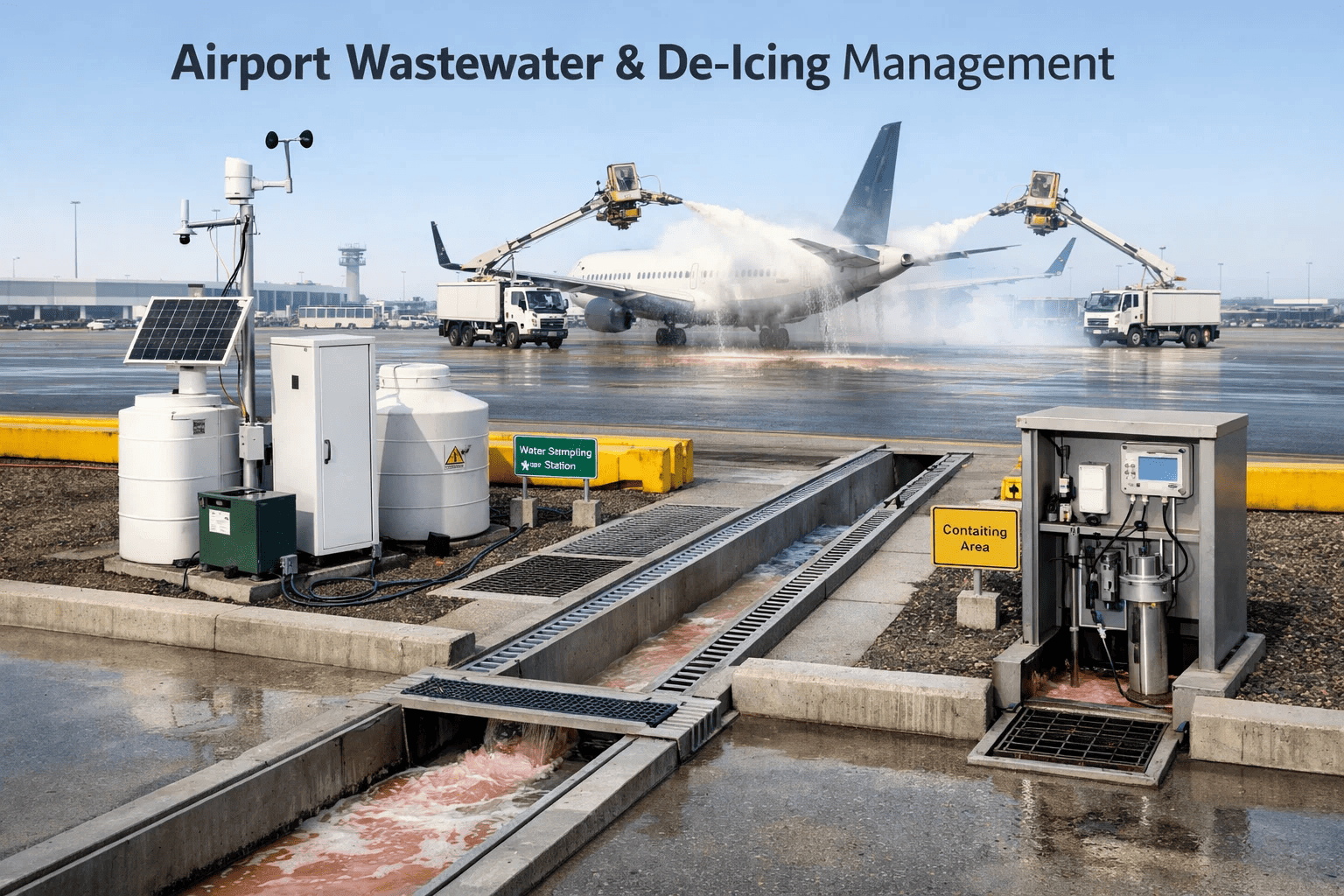
An airport de-icing operation runs seven months in preparation and five months in survival mode. Every truck must be ready before the first freeze, every fluid batch traceable to the tail number it was sprayed on, every holdover time defensible if a runway incursion review lands three weeks later. The teams that make it through the season without an aircraft delay from a broken proportioner or a mis-calibrated tank are the teams that treated PM and fluid records as one connected discipline all summer. This guide walks that discipline using OXMAINT AI, the AI-powered CMMS for airport winter operations.
Airport Operations · Winter Ops · De-Icing Vehicle PM + Fluid Records
Pre-Season Ready. Every Batch Traceable. Every Boom Cycle Logged.
OXMAINT AI, the AI-powered CMMS/maintenance management software, holds the full de-icing fleet programme on one platform — pre-season readiness gates, pump curve verification, boom hydraulic PMs, tank calibration records, Type I and Type IV batch traceability, and every spray event tied to the aircraft it was sprayed on.
Pre-Season Readiness Gate
Fluid Batch Traceability
Tank Calibration Records
2 Fluids
Type I (heated de-icing) + Type IV (anti-icing) tracked separately
4 Subsystems
pump · boom hydraulics · tanks · heating — all PM'd
5 Gates
pre-season readiness checkpoints before first freeze
1 Batch ID
links every spray event to the fluid drum it came from
The 4 Subsystems — What A De-Icing Truck Actually Is
A de-icing truck isn't one asset — it's a chassis plus four production systems that each fail differently and need different PM. Treating the whole truck as "a truck" is why fleets discover a bad proportioner at 04:30 on the first freeze. OXMAINT AI holds each subsystem as its own PM stream. Sign up free and build your subsystem library.
01
Pump & Proportioner
Fails at: Impeller wear, seal leaks, proportioner drift on Type I/IV blend ratio
Watch: Pump curve verification against baseline, flow-meter accuracy, proportioner blend test
PM: Pump curve annually + before season · proportioner calibration quarterly
02
Boom Hydraulics
Fails at: Hydraulic hose cracking, cylinder seal weeping, boom slew bearing wear, nozzle blockage
Watch: Hose cold-flex condition, boom cycle count, nozzle pattern uniformity test
PM: Hose inspection quarterly · nozzle pattern test pre-season · boom cycle log continuous
03
Tanks & Calibration
Fails at: Level sensor drift, sight glass fouling, insulation degradation, heater element failure
Watch: Volume calibration against reference, insulation integrity, heater draw against baseline
PM: Volume calibration pre-season and mid-season · heater test monthly in season
04
Fluid Heating System
Fails at: Burner failure, temperature sensor drift, heat-exchanger fouling, glycol degradation from overheating
Watch: Outlet temperature stability, burner cycling frequency, fluid pH drift
PM: Burner service pre-season · temp sensor cal quarterly · pH sample monthly
Pre-Season Readiness Gates — The 5 Checkpoints Before First Freeze
Every truck must clear five gates before it's marked ready-for-season. Any failed gate holds the truck off the ready line — no exceptions. OXMAINT AI blocks the ready-for-season status until every gate is signed. Book a demo to see the readiness gate workflow.
G1
Chassis & Powertrain Base PM
Engine service, transmission, brakes, tires, lights, cab heat — full DOT-equivalent condition inspection
Sign-off: Fleet mechanic
G2
Tank Calibration & Insulation
Volume calibration against reference meter · insulation continuity check · sight glass cleaned and calibrated
Sign-off: Tank technician + calibration record attached
G3
Pump Curve & Proportioner Test
Pump curve verified against baseline · proportioner blend ratio tested at 3 concentration points · flow meter accuracy verified
Sign-off: Fluid systems specialist + test data attached
G4
Boom, Nozzle & Spray Pattern
Boom articulation tested through full range · every nozzle inspected · spray pattern uniformity tested against test target
Sign-off: Boom technician + pattern photo attached
G5
Heating System & Fluid Load
Burner serviced · outlet temperature verified · Type I loaded to correct concentration · Type IV loaded and pH tested
Sign-off: Fluid quality technician + fluid record linked
Type I vs Type IV Fluid — What The Records Actually Track
Type I and Type IV are two different fluids serving two different purposes — track them separately or lose the audit trail. OXMAINT AI holds each fluid stream with its own batch chain, tank record, and spray event log. Start free and set up fluid tracking in OXMAINT AI.
TYPE I
Heated De-Icing Fluid
Purpose: Remove existing frozen contamination — snow, ice, frost — from aircraft surfaces
Applied: Heated (typically 60°C+ at nozzle)
Colour: Typically orange dye for visibility
Concentration: Blended with hot water — ratio per OAT and fluid type
Holdover: Short — clean-aircraft protection minutes only
Records to hold:
Batch ID · concentrate lot · dilution ratio · outlet temperature at spray · gallons applied per aircraft
TYPE IV
Anti-Icing Fluid
Purpose: Prevent re-freezing on cleaned aircraft — thickened film adheres, shears off at rotation
Applied: Cold or ambient — typically not heated
Colour: Typically green dye for visibility
Concentration: Applied undiluted (100/0) or per manufacturer specification
Holdover: Extended — per OAT and precipitation type per HOT table
Records to hold:
Batch ID · manufacturer lot · viscosity check date · application concentration · gallons applied per aircraft
The Fluid Batch Traceability Chain — From Drum to Wing
Every drop of fluid that hits an aircraft must trace back to the batch it came from. If a fluid quality incident surfaces three weeks later, the audit needs to name every aircraft that was sprayed from the suspect batch. OXMAINT AI walks the chain automatically. Book a demo to see the batch chain live.
Delivery
Fluid Batch Received
Manufacturer lot, delivery date, quality cert, storage bay
▼
Storage
Storage Tank / Drum
Fluid transferred, sample pulled, storage tank record updated
▼
Loading
Truck Tank Loaded
Volume loaded, storage-to-truck batch link established, truck ID stamped
▼
Spray Event
Applied to Aircraft
Tail number, gate, OAT, fluid type, gallons — logged live at spray
▼
Audit
Reverse Query
"Which aircraft received fluid from batch X?" answered in seconds, not days
First Freeze at 04:30. Every Truck Ready. Every Batch Traced.
OXMAINT AI holds the full winter-ops discipline on one platform — pre-season gates, subsystem PMs, fluid batches, spray events and holdover records — so the season starts ready and ends defensible.
The Seasonal PM Calendar — What Happens When
A de-icing fleet's PM calendar is unlike any other — heavy in the shoulder months, minimal during peak season, then equipment tear-down at spring melt. OXMAINT AI holds the calendar per truck with season-phase tags. Sign up free and build your seasonal calendar.
Season-End Audit — What the Records Must Answer
The season doesn't end when the last flight leaves — it ends when the audit closes. Every audit asks the same six questions, and the fleets that answer in minutes have the records to prove it. OXMAINT AI holds every answer on the same platform. Book a demo to see the season-end audit view.
Q1
Fluid Consumption Reconciliation
Total Type I and Type IV received vs applied vs disposed — closed to within tolerance per fluid stream
Q2
Per-Aircraft Spray History
Every tail number sprayed in the season, with fluid type, gallons, OAT and holdover start time
Q3
Batch Reverse Traceability
Any fluid batch queried returns the full list of aircraft that received fluid from it
Q4
Calibration Record Continuity
Pre-season, mid-season and post-season calibration records retained per truck per subsystem
Q5
Reliability KPI Performance
Vehicle availability, breakdown-during-event count, mean time between failures per truck class
Q6
Regulatory Filing Package
Season summary, incident log, environmental discharge reconciliation — packaged for regulator on demand
What OXMAINT AI Gives an Airport Winter Operations Team
Purpose-built for airport winter ops — one platform behind the pre-season gates, the subsystem PMs, the fluid batch ledger, the spray event log and the season-end audit. Start free and load your de-icing fleet.
Subsystem-Level PM
Pump, boom, tank, and heater held as separate PM streams — nothing overlooked because "the truck was serviced".
Readiness Gate Enforcement
Ready-for-season status blocked until all 5 gates are signed — a partly-ready truck cannot join the ready line.
Fluid Batch Ledger
Every delivery, every tank transfer, every truck load, every spray event linked — reverse queries return in seconds.
Live Spray Event Log
Tail number, gate, OAT, fluid type and gallons captured at the truck — the record is created at the wing.
Calibration Record Retention
Every calibration retained for the life of the truck — mid-season drift visible against pre-season baseline.
Season-Phase Calendar
PM calendar tagged by season phase — tear-down, overhaul, build-up, ready, active — so schedules match the reality of winter ops.
"
Our audit finding one season came down to a single question: which aircraft received fluid from a batch flagged for viscosity drift? On the old spreadsheet system it took three people two days to piece together an answer we weren't fully confident in. After we consolidated onto one platform, the same query returned twenty-eight tail numbers in under a minute, with gallons applied and OAT at spray for every one. The audit closed the same afternoon.
De-Icing Operations Manager · International Hub Airport
Frequently Asked Questions
Can OXMAINT AI capture spray events from the truck itself, not just after the shift?
Yes — spray events are captured at the truck via ruggedised tablet or in-cab interface. Tail number, OAT, fluid type and gallons are logged live, and events sync when the truck comes back into WiFi range.
Sign up free and see the mobile spray capture.
How does the platform handle fluid batches split across multiple storage tanks?
Each transfer records source batch, destination tank, volume and date — the batch ID follows the fluid into every tank it enters, so a batch spanning three tanks is still queryable as one batch record.
Book a demo to see split-batch tracking.
Can we integrate with fluid quality lab reports for viscosity and pH results?
Yes — lab reports attach to the batch record as structured fields where labs export CSV or JSON, or as PDF attachments where they don't. Out-of-spec results trigger a quarantine flag on the batch.
Start free and set up lab integration.
Does the platform track vehicle telemetry from OEM systems on the trucks?
Yes — for de-icing trucks with OEM telemetry (pump pressures, boom hydraulic pressure, fluid temperatures), the data streams into the truck's asset record with alert thresholds configurable per subsystem.
Book a demo to discuss telemetry.
How long does typical implementation take before a winter season?
Most winter ops teams go live on the fleet PM programme and fluid ledger 8-10 weeks before first freeze. Historical PM records back-load to give trend context, and the readiness gates are configured to match the operation's own checklist.
Sign up free and start ahead of the season.
Pre-Season Ready. Every Spray Traced. Every Season Audited.
Move your de-icing fleet programme onto OXMAINT AI — readiness gate enforcement, subsystem PM streams, fluid batch traceability, live spray event capture and calibration records retained for the life of every truck.