"We have records — somewhere." That single sentence, spoken to an FAA inspector standing in the ops office, is the moment an audit shifts from a routine surveillance visit into a documentation finding. It is not a maintenance failure. It is a records failure. And FAA data is unambiguous about how expensive that distinction is: civil penalty assessments for documentation deficiencies at Part 139 airports average $34,000 per finding — independent of whether any actual safety lapse occurred. Across the broader aviation compliance picture, 68% of all audit findings trace back to incomplete or illegible sign-off records, not to work that was never done. Under 14 CFR §139.327, airport operators must retain self-inspection records for a minimum of 24 months, and FAA inspectors routinely request records spanning the full prior inspection cycle. Under 14 CFR 91.417, airframe total time, life-limited parts status, and AD compliance evidence must be retained for the operational life of the aircraft. The FAA's 2026 Part 145 Digital Records Amendment now accepts electronic records without paper backup — but only if the system meets AC 120-78B for data integrity, access control, backup verification, and retrievability. Paper logs get wet on the airfield. Spreadsheets miss update cycles. Department-specific filing systems become unavailable when auditors arrive without advance notice. And "somewhere" is where audit findings live. Below is the working guide to why airport records fail audits, the five specific auditor questions where paper systems break down, and the digital CMMS approach that produces defensible records in seconds instead of hours or days. Start free and stand up audit-ready digital records on your airport's next self-inspection cycle, or book a demo to see the 30-second retrieval workflow mapped to your Part 139 documentation programme.
Aviation · FAA 14 CFR 139/145/91 · AC 120-78B · Digital Records 2026
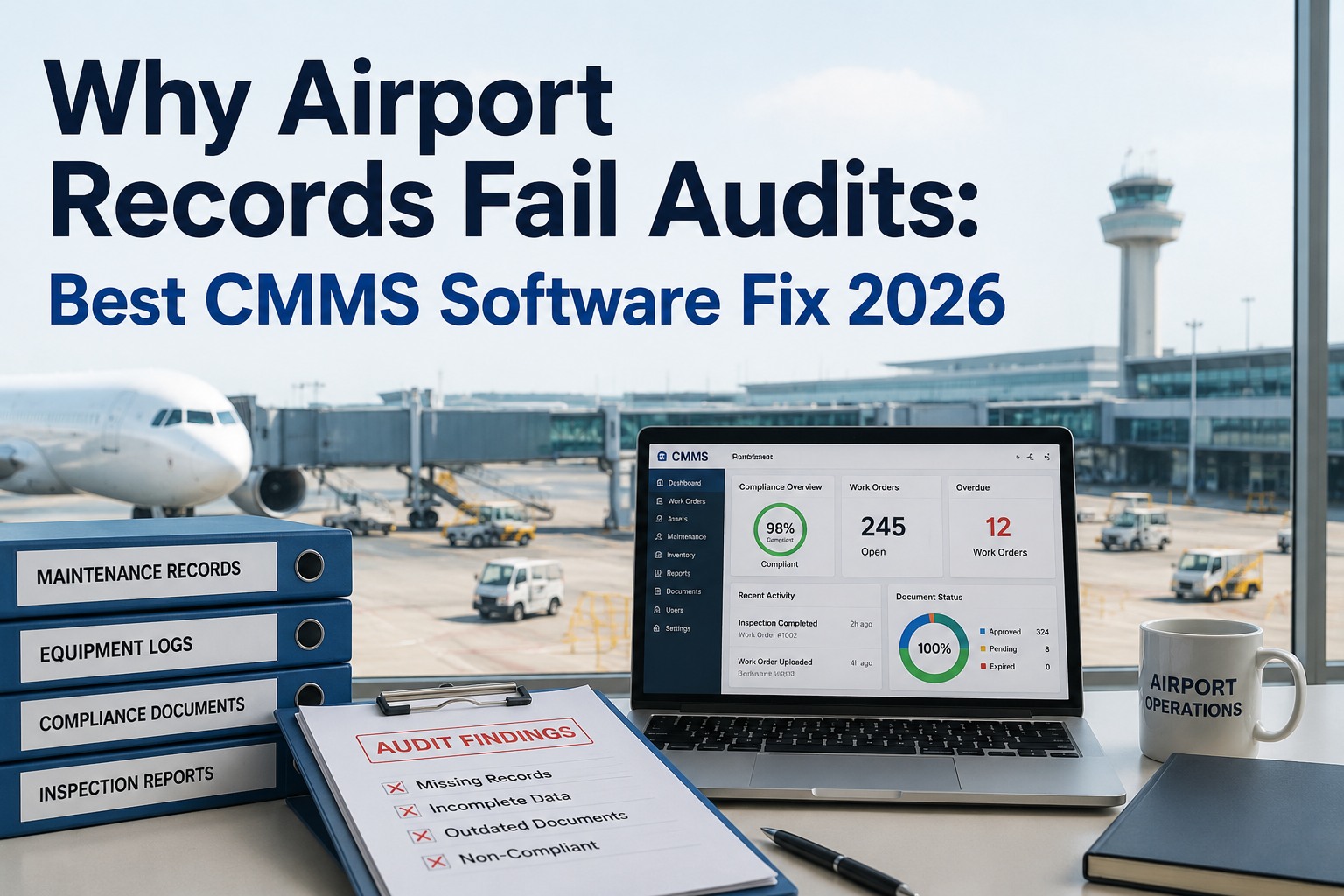
Why Airport Records Fail Audits: Best CMMS Software Fix 2026
The five specific auditor questions where paper and spreadsheet systems fail, the retention-period reference by record type, and the digital CMMS approach that turns "we have records — somewhere" into 30-second retrieval by asset, work order, or date. Aligned to FAA 2026 Part 145 Digital Records Amendment and AC 120-78B.
-
$34K
average FAA civil penalty per Part 139 documentation finding
-
68%
of aviation audit findings trace to incomplete or illegible sign-off records
-
24 mo
minimum retention for §139.327 self-inspection records
-
30 sec
FAA 2026 digital records retrieval standard by asset, WO, or date
The Working Reality
Audits Do Not Fail Because Work Was Not Done
The pattern is remarkably consistent across FAA Part 139 airports, Part 145 repair stations, and CAMO organisations. The maintenance actually happened. The inspection was actually performed. The corrective action was actually completed. But the record of it is illegible, incomplete, misfiled, or sitting in a binder in a locked filing cabinet whose keyholder is off-shift. The finding gets written. The penalty gets assessed. The audit closes with a Letter of Correction and a compliance plan. And none of it had anything to do with the underlying safety work. This is what "records fail audits" actually looks like at ground level — and it is the failure mode a modern CMMS is purpose-built to eliminate.
The Five Auditor Questions
Where "We Have Records — Somewhere" Actually Breaks Down
FAA inspectors ask a predictable set of questions. Paper and spreadsheet systems fail each of them in a different but recognisable way. Below is the working map — the five most common auditor questions, the paper failure mode each triggers, and the digital CMMS answer that produces the record in seconds.
-
Q1
"Show me every self-inspection on runway 27L in the last 90 days."
Paper FailsBinders sorted by date, not by asset. Someone re-reads 90 days of logs looking for entries mentioning 27L. Takes hours; misses entries where the runway was implied but not explicitly named.
CMMS DeliversFilter by asset ID + date range. Every inspection tagged to 27L in 30 seconds, with inspector name, findings, photos, and corrective actions on each.
-
Q2
"Prove this corrective action was actually completed on the date claimed."
Paper FailsHandwritten "completed 3/15" with a signature. No timestamp, no photo, no way to verify that the ink was applied on 3/15 or on the day the auditor arrived. Erasures and later-added notes visible.
CMMS DeliversServer-set closure timestamp — client clock never trusted. Photo evidence with GPS + EXIF timestamp baked in. Technician e-signature bound to individual credential. Full audit trail of any edits with reason logged.
-
Q3
"Show me the calibration record for the torque wrench used on this work order."
Paper FailsCalibration records in one binder, work orders in another, no link between them. Finding: calibrated tooling past due date used on live work — 1 in 4 Part 145 routine audits show this exact pattern, triggering review of every WO that tool touched.
CMMS DeliversTool calibration status linked to every WO that uses the tool. Expired-calibration tool automatically blocked from WO assignment. Full record chain from tool ID to WO to sign-off.
-
Q4
"Prove the technician who signed off this task held current certification."
Paper FailsPersonnel files in HR, sign-off signatures on WO in ops binders. No link between the two. Expired Part 66 licence found in 1 in 4 Part 145 audits — triggers review of every WO signed by that individual during the lapse.
CMMS DeliversCertification status linked to user credential. Expired certification blocks the individual from signing off restricted work. Automatic pre-expiry alerts drive proactive renewal.
-
Q5
"Show me the retention history for this record — no gaps, no edits without audit trail."
Paper FailsErasures, whiteout, later-added notes. Cannot prove a Tuesday entry was written on Tuesday. 14 CFR Part 3 Subpart D falsification rule specifically tightens this exposure — an ambiguous edit becomes a compliance finding.
CMMS DeliversAppend-only immutable record. Every edit preserved as a new annotated entry with user, timestamp, and reason. Full retention chain from creation to current state — no silent edits possible.
The Financial Case
$34,000 Per Finding — Independent of Whether Any Safety Lapse Actually Occurred
FAA civil penalty assessments for documentation deficiencies at Part 139 airports average $34,000 per finding. Part 145 citations run $25,000 to $400,000 per event plus 200 to 600 hours of rework labour. And each finding cascades — an expired calibration triggers review of every work order that used the tool; an expired licence triggers review of every WO signed by that individual. The math is unambiguous. Oxmaint operationalises the entire audit-ready records programme: append-only immutable audit trail, credential-bound e-signatures, tool-and-cert linked to WO, and 30-second retrieval by asset, WO, or date range.
The Retention Reference
How Long Every Record Must Actually Be Kept
Retention periods vary by record type — from one year for routine maintenance to the operational life of the aircraft for airframe total time and AD compliance. Getting retention wrong is a citable finding on its own. Below is the working reference for the record classes airport and aviation maintenance teams most commonly hold.
| Record Type | Governing Reference | Minimum Retention | Why It Matters |
|---|---|---|---|
| §139.327 self-inspection records | 14 CFR §139.327 | 24 months | Full prior inspection cycle — FAA routinely requests |
| Airframe / engine / propeller total time | 14 CFR §91.417 | Life of aircraft | Airworthiness spine — missing = grounding |
| Life-limited parts back-to-birth history | 14 CFR §91.417 | Life of aircraft | Every hour, cycle, landing since manufacture |
| Major repair & alteration (Form 337) | 14 CFR §91.417 | Life of aircraft | Single missing 337 grounds airframe |
| AD compliance evidence | 14 CFR §91.417 | Life of aircraft | Continuing airworthiness demonstration |
| Part 145 repair station records | 14 CFR §145.219 | 2 years | English-language, FAA-acceptable format |
| Routine maintenance records | 14 CFR §91.417 | 1 year or until superseded | Whichever comes later |
| AIP grant financial records (airport sponsor) | 49 CFR §18.42(c) | 3 years | From final reimbursement date; longer if under investigation |
| Personnel qualification & certification | 14 CFR §145.155 / §65.71 | Duration of employment + 2 yr | Every WO signed by lapsed cert triggers review |
| Tool calibration records | 14 CFR §145.109 / AC 43.13-1B | 2 years past retire date | Every WO the tool touched must trace to valid cal |
The Retrieval Timeline
Same Auditor Request. Three Very Different Response Times.
An FAA inspector says: "I need every corrective action closed against the north apron in the last 12 months, with sign-off, photos, and any related work orders." Below is what happens next under three different records systems — the pattern that produces or prevents findings.
2–5 Days
Reconstruction Project
Someone pulls twelve months of daily logs from the ops binder. Cross-references against WO binder in the maintenance office. Photos live on inspector personal phones — call each one, request they text photos. Manually associate photos with WOs by date and location. Two to five business days of engineering time per audit request.
4–8 Hours
Manual Reconciliation
Filter the WO spreadsheet by location + date range. Find the photo folder structure (assuming naming convention was followed). Missing entries where spreadsheet was not updated same-day. Sign-off column is a text field — no verification the person who typed the name was the person who did the work.
30 Seconds
Filter Query
Filter by asset (north apron) + status (closed) + date range (last 12 months). Every WO returned with GPS-tagged photos, immutable server-set timestamps, credential-bound e-signatures, and full audit trail per record. Print-to-PDF for the auditor. Done before the inspector opens their laptop.
Built for Airport Records Compliance
How Oxmaint Runs the Audit-Ready Programme End to End
-
Immutable Audit Trail
Append-Only Records, Every Edit Preserved
Every WO action logged to an append-only database record that cannot be edited or deleted. Corrections made via new annotated entry preserving full history. Satisfies 14 CFR Part 3 Subpart D falsification rule by design.
-
30-Second Retrieval
Filter by Asset, WO, Date, or Standard
FAA 2026 digital records retrieval standard met by configuration. Full history against any asset, work order, date range, or cited standard produced in seconds — the auditor visit becomes a filter query.
-
Credential-Bound E-Signature
Unique Individual Login, Bound to Certification
Unique credential per individual — no shared logins. E-signature captures intent, timestamp, and meaning of action. Expired certification blocks sign-off on restricted work. FAA AC 120-78B and Part 11 compliant.
-
Tool & Cert Linkage
Calibration and Licence Tied to Every WO
Tool calibration status linked to WO assignment — expired tool cannot be selected. Personnel certification linked to sign-off role — expired individual cannot sign off. The two most common Part 145 audit findings closed by design.
-
Retention Rules per Record Type
1 yr / 24 mo / 3 yr / Life of Aircraft
Retention rules configured per record class — routine maintenance 1 year, §139.327 self-inspection 24 months, AIP financials 3 years, airframe/engine total time and Form 337 for the operational life of the aircraft.
-
Photo Evidence with GPS + EXIF
Auditor Cannot Challenge When or Where
Every photo captured through the app carries GPS location, timestamp, and inspector identity in metadata. The "was this photo actually taken on the date claimed" auditor challenge becomes a non-event.
Measured Outcomes
What Airports Retiring Paper Records Report
-
30 sec
Auditor Document Request Answered
Filter by asset, WO, or date range and produce the full record — every check, every photo, every signature — in the time it takes to type the query. FAA 2026 standard met.
-
-90%
Audit Preparation Effort
Aviation operators report up to 90% reduction in audit preparation hours after moving from paper reconstruction to a searchable digital records system. The prep becomes a query, not a project.
-
$34K
Per-Finding Exposure Prevented
Average Part 139 documentation penalty. A single clean audit pays for the digital records programme for years — and each cascade finding (expired cal, expired cert) is closed by design.
-
$0
Free Forever Plan to Start
Cloud-based, mobile-first. Stand up audit-ready records on your next Part 139 self-inspection cycle, prove the 30-second retrieval, and scale to full airport coverage when validated.
Frequently Asked
Airport Records Questions
Are digital records legally acceptable to the FAA for airport compliance?
Yes. The FAA's 2026 Part 145 Digital Records Amendment accepts electronic records without requiring a paper backup — provided the system meets AC 120-78B for data integrity, access control, backup verification, retention configuration, and retrievability. For Part 139 airport records, the same principles apply: electronic records are acceptable if the system can demonstrate tamper-evidence, credential-bound sign-off, and audit-trail preservation. Start free and stand up an AC 120-78B compliant records system this week.
Where does the "68% of audit findings trace to records" number come from?
Aviation compliance research on FAA and EASA audit findings consistently shows that the majority of citations trace back to incomplete, illegible, or missing sign-off records — not to work that was never done. The exact percentage varies by study, but 68% is the commonly-cited figure across recent 2026 industry research. The implication is straightforward: better records prevent more findings than better maintenance does.
How long do we have to retain airport self-inspection records?
Under 14 CFR §139.327, minimum retention is 24 months from the date of the inspection. FAA inspectors routinely request records covering the full prior inspection cycle — which may span more than two years for facilities on longer inspection intervals. Airframe and engine total time, life-limited parts history, Form 337s, and AD compliance evidence must be retained for the operational life of the aircraft under 14 CFR §91.417. Book a demo to see retention rules configured per record type.
What is the difference between paper and digital under Part 145.219?
14 CFR §145.219 requires records "in a format acceptable to the FAA." Both paper and digital are acceptable formats, but digital carries advantages paper cannot match — server-set timestamps (client clock never trusted), credential-bound signatures, immutable append-only history, and 30-second retrieval by any filter. Paper meets the format requirement while systematically failing at retrieval, integrity, and traceability — the areas where audits actually get written up.
Is there a free plan to prove audit-ready records on one inspection cycle?
Yes. Oxmaint offers a free forever plan — enough to stand up digital records on one Part 139 self-inspection cycle, capture GPS-tagged photo evidence, collect credential-bound e-signatures, and prove the 30-second retrieval workflow. Cloud-based, mobile-first — no server procurement or infrastructure commitment. Sign up for the free plan and stand up your first digital inspection cycle today.
Immutable · Credential-Bound · Retrievable in 30 Seconds
"Somewhere" Is Where Audits Fail. "Filter by Asset" Is Where They Pass.
The audit finding is not written because the work was not done. It is written because the record cannot be produced fast, cannot be defended cleanly, or cannot be proven un-edited. FAA penalties average $34,000 per Part 139 documentation finding. Every day of paper-driven reconstruction is a day the "somewhere" answer is still being given. Oxmaint operationalises the entire audit-ready records programme — immutable audit trail, credential-bound e-signatures, tool-and-cert linked to WO, GPS-tagged photo evidence, and 30-second retrieval — so the next audit becomes a filter query, not a scramble.