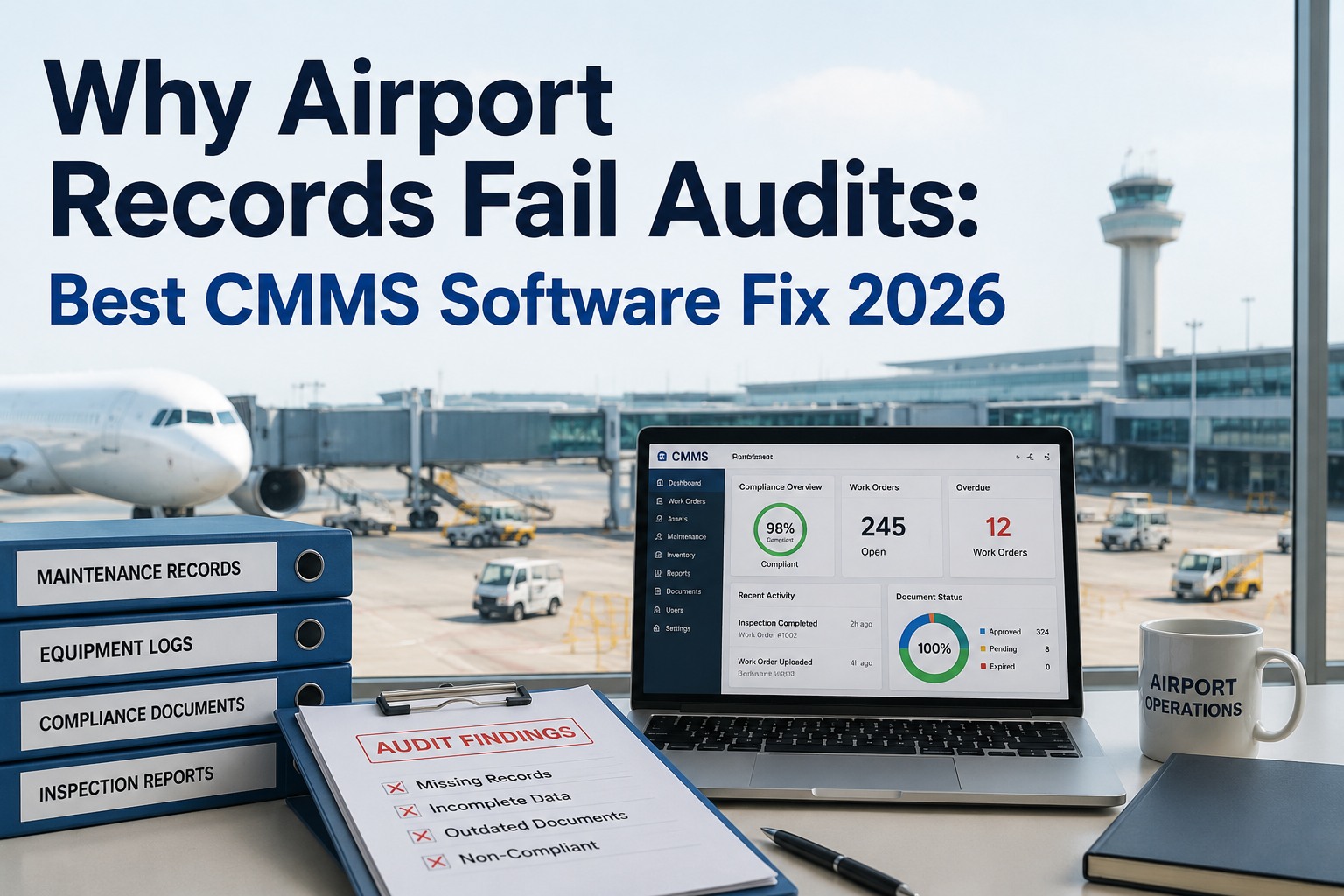
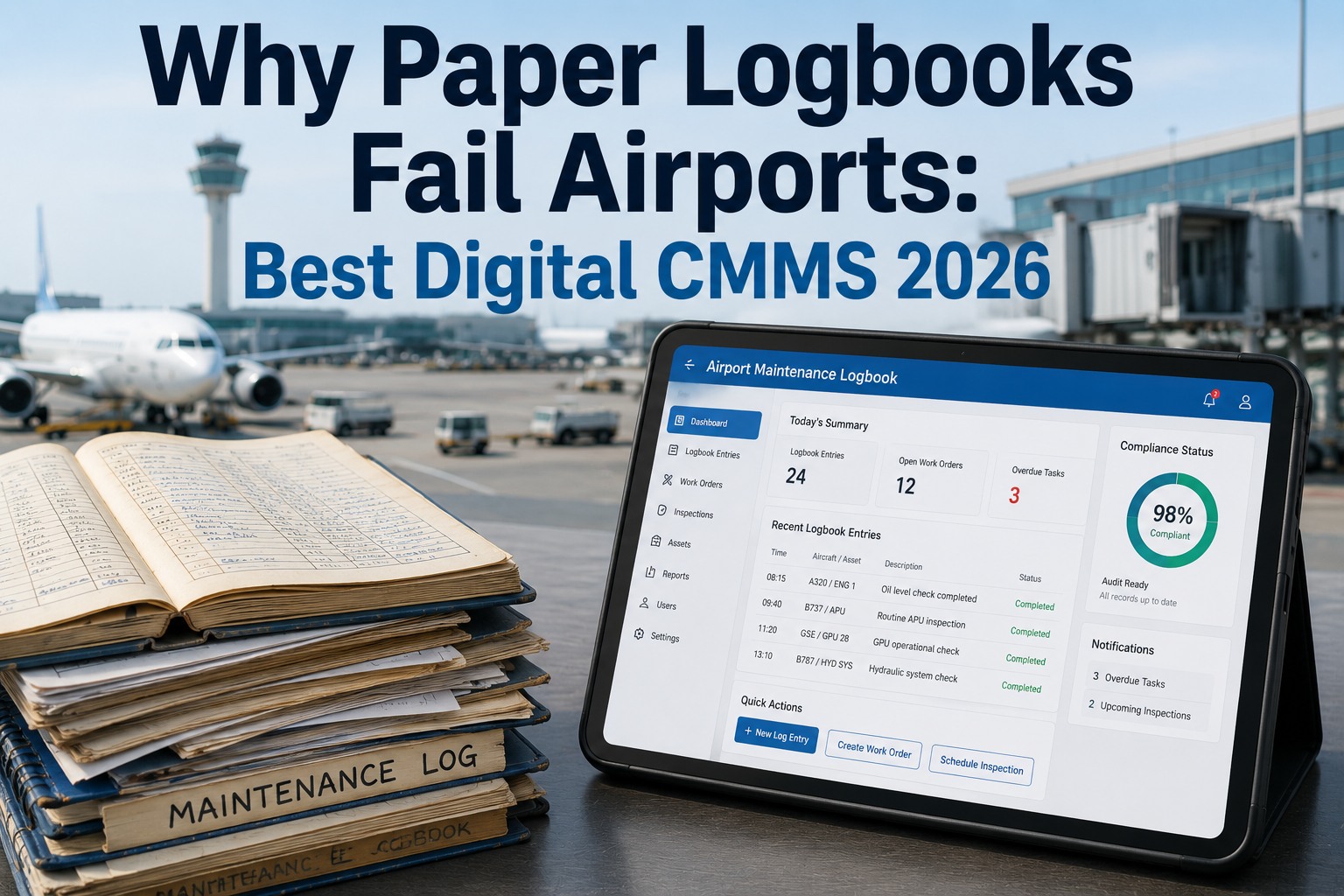
Every FAA Part 139 airport in the United States carries the same operational reality: an inspector can arrive tomorrow and ask to see 12 to 24 months of records covering self-inspections, training, NOTAMs, ARFF drills, fueling audits, and wildlife strike reports — and the response cannot be "give us two days to pull the binders." Under 14 CFR §139.327 self-inspection records must be maintained for at least 12 consecutive calendar months, training records for 24 months, ARFF documentation for 24 months, and the Airport Certification Manual current at all times. Documentation gaps against §139.327 are the single most cited deficiency in FAA Part 139 inspections year after year. Meanwhile the 2023 SMS final rule adds a whole additional documentation surface most Part 139 airports are still building their evidence workflow around. In 2026 the airports handling this well are running a CMMS platform built specifically for the retention, audit-trail, and evidence-package obligations of Part 139 — not a general maintenance tool with a folder called "Compliance" bolted on the side. This guide walks the actual retention rules, the record categories that generate the most compliance risk, the criteria for choosing airport records retention software, and how a purpose-built platform makes the audit trail assemble itself as work happens. Book a free Part 139 readiness audit against your current records stack.
§139.327
Single most cited deficiency in FAA Part 139 inspections — self-inspection documentation gaps
12 mo
Regulatory minimum retention for self-inspection records · attorneys recommend 24–60 months
24 mo
Training records retention minimum · applies to all Part 139-designated personnel roles
2026 SMS
New FAA Airport Safety Management System rule adds documentation surface for Class I airports
The Retention Clock · Every Record Category & How Long It Runs
Part 139 defines retention windows per record category, not as a single blanket rule. Getting the clock right on each category is the foundation of compliance — under-retain and you fail the audit; over-retain aggressively and you accumulate paper (or files) that becomes hard to search when the inspector actually arrives. The reference below is the working retention map every airport records program should encode.
TIER A · 12-MONTH MINIMUM
Baseline retention under §139.327 and adjacent sections
§139.327
Daily self-inspection records
Daily movement area inspections · conditions found · corrective actions taken · closure documentation
§139.339
NOTAM history
NOTAM issue and cancellation timestamps · conditions triggering issuance · corrective actions closing
§139.317
ARFF equipment inspection logs
Vehicle preventive maintenance · quarterly pump tests · hose inspection · foam proportioner verification
§139.321
Fueling facility inspection records
Quarterly tenant fueling agent inspections · fuel farm audits · mobile fueler records
Part 139
Incident & accident reports
Aircraft incidents · ground vehicle incidents · injury reports · investigation documentation
§139.337
Wildlife strike reports
Strike documentation · attractant surveys · mitigation action records · WHMP compliance evidence
TIER B · 24-MONTH MINIMUM
Training and personnel qualification records under §139.303 and §139.327
§139.327
Self-inspection personnel training
Initial training + 12-month recurrent · ACM familiarity · NOTAM procedures · discrepancy reporting
§139.319
ARFF personnel training
Annual live-fire drill · basic emergency medical care · equipment operation · protective clothing certification
§139.321
Fuel handler training
Fire safety training certification for every employee fueling aircraft or receiving shipments
§139.303
Airport personnel qualifications
Movement area vehicle operators · pedestrian access controls · radio communications procedures
TIER C · CURRENT / EVERGREEN
Documents maintained current at all times — not "retained" but perpetually authoritative
§139.203
Airport Certification Manual (ACM)
FAA-approved current version · full revision history · every revision reviewed and signed
§139.401
Safety Management System (SMS) Manual
2023 final rule · Implementation Plan within 12 months · SMS Manual within 12 months of plan approval · full deploy 36 months
FAA Form 5010
Airport Master Record
Kept current with all runway, taxiway, apron, and facility data · updated as conditions change
§139.325
Airport Emergency Plan (AEP)
Current AEP for Class II, III, IV certificate holders · triennial full-scale exercise documentation
Attorney Recommendation
While §139.327 sets the regulatory floor at 12 months, most airport compliance attorneys recommend retaining self-inspection records for 24 months minimum — and 36 to 60 months for litigation-risk buffer against delayed claims from operators or the public. AC 150/5200-18C guidance historically referenced 24-month retention. Purpose-built retention software makes the longer retention essentially free while regulatory minimums stay honored.
The Ten Record Categories · What Actually Goes in the Archive
The record categories below are what an FAA inspector will ask for during a certification or unannounced inspection. Any one missing produces a Letter of Correction; systematic gaps produce financial penalties or worse. The 2026 records retention program tracks every category with per-record timestamp, source technician, corrective-action linkage, and closure evidence.
01
Daily Self-Inspection Records
Complete inspection form per §139.327 · pavement · markings · lighting · signage · FOD · timestamped with e-signature
02
Personnel Training Records
Initial + 12-month recurrent for every designated role · certifications with expiration alerts · training completion evidence
03
Airport Certification Manual (ACM)
Current FAA-approved version · complete revision log · signed pages · procedures for every Part 139 element
04
NOTAM Issue & Closure History
Every NOTAM issued and cancelled · triggering condition · corrective action tying closure · timestamp continuity
05
ARFF Records
Vehicle PM per §139.317 · quarterly pump tests · hose inspection · foam proportioner · annual live-fire drill
06
Fueling Facility Inspection Logs
Quarterly tenant fueling agent inspections · fuel farm audits · mobile fueler records · fire safety training certifications
07
Wildlife Hazard Management
Strike reports · attractant surveys · WHMP compliance evidence · depredation and habitat control documentation
08
SMS Documentation
2023 rule · SMS Manual or ACM-integrated · Implementation Plan · hazard reports · safety risk assessments
09
Incident & Accident Reports
Aircraft events · ground vehicle incidents · injury reports · investigation and root-cause documentation
10
Corrective Action Closures
Every discrepancy tracked from open to closed · linked to originating inspection · signed evidence attached
The Software Evaluation Framework · What "Best" Actually Means for Part 139
Generic CMMS platforms have a "compliance" tab. Part 139-purpose-built platforms have compliance as the architecture. The distinction matters at audit time, and it should be the primary evaluation criteria when scoping records retention software for a certificated airport.
Capability
Generic CMMS
Part 139 Purpose-Built
Retention windows per record category
Manual configuration required
Preset per §139 category · auto-enforced
Timestamped mobile inspection capture
Basic form entry
Photo evidence · e-signature · GPS location · mandatory fields
ACM revision log with signed pages
Document folder
Complete revision history · signature tracking · change alerts
Training certification expiration alerts
Manual calendar entries
Auto-tracked per role · alerts before lapse · re-cert workflow
Corrective action closure linkage
Separate work order module
Every discrepancy links inspection → WO → closure evidence
On-demand audit package export
Ad-hoc report queries
Complete inspection package as PDF · filtered by date · ready for inspector
NOTAM history integration
External system
Integrated timeline · condition-to-NOTAM-to-closure linkage
2023 SMS documentation surface
Add via custom fields
Built-in hazard reporting · safety risk assessment · SMS Manual authoring
Compliance evidence & audit trail
Manual export & formatting
Auto-assembled from live data · always current · always exportable
Get a Part 139 Readiness Audit in 30 Minutes
Working session with our aviation compliance team — we'll walk your current retention setup against the §139.327 records catalog, flag documentation gaps, and show how OxMaint's audit-package export assembles a complete inspection archive on demand.
The Documentation Failure Modes · How Airports Actually Fail Part 139 Audits
The single most cited deficiency in Part 139 inspections year after year is §139.327 documentation gap. Understanding the specific failure modes below is the fastest path to closing exposure — because each one is a discrete, addressable software workflow problem, not a training or culture issue.
F1
Missing Daily Inspection Records
A daily inspection was performed but never captured · or captured on paper never scanned · or scanned but not indexed. Inspector requests date X and the record is gone.
F2
Unsigned or Uncertified Checklists
Inspection completed but signature line blank · or signed by unqualified staff · or completed after the fact with no timestamped audit trail proving when the work was actually done.
F3
Verbal Closures Without Written Record
A pavement deficiency was fixed but the closure was reported verbally to shift supervisor and never entered into the record system. The inspection log shows the finding open indefinitely.
F4
Expired Training Certifications
Self-inspection personnel or ARFF staff performed duties after their 12-month recurrent training lapsed · certification records show the gap but nobody watched for it.
F5
ACM Not Reflecting Current Operations
Airport Certification Manual describes procedures that were superseded 18 months ago without an approved revision. Actual operations don't match FAA-approved documentation.
F6
Corrective Action Not Traceable to Finding
A repair was performed but the work order can't be linked back to the specific inspection finding that generated it. Inspector can't trace the closure chain end to end.
The 2023 SMS Final Rule · The New Documentation Surface
The FAA Airport Safety Management System final rule published in February 2023 adds a new compliance surface every certificated airport meeting the trigger criteria has to build documentation around. For Class I hub airports the implementation timeline started immediately; for others it's staggered by trigger — but every affected airport is inside the compliance clock in 2026.
Trigger 1
Large Hub Airports
Implementation Plan due within 12 months of effective date
All Part 139 airports serving large hub operations were first-wave · Implementation Plan filed with FAA, SMS Manual within 12 months of plan approval, full deploy within 36 months
Trigger 2
Annual Operations Threshold
Implementation Plan due within 18 months of effective date
Airports meeting the operations count threshold have 18 months to Implementation Plan, then the same 12/36 month SMS Manual and deploy timeline
Trigger 3
International Operations
Implementation Plan due within 24 months of effective date
Airports qualifying under international operations trigger have 24 months to Implementation Plan · standard 12/36 downstream
Newly Qualified
Post-Effective-Date Qualification
Implementation Plan within 18 months of notification
Airports crossing the qualifying threshold after the rule takes effect get 18 months from FAA notification · same downstream deployment schedule
SMS Manual authoring & revision control · integrated with ACM per §139.401(f)
Hazard reporting workflow · anyone-can-report · triage assignment · closure evidence
Safety risk assessment records · risk matrix scoring · mitigation tracking
Safety performance indicators · trending · management review cadence
Personnel SMS training records · same 12-month recurrent cadence as §139.327
Continuous improvement documentation · corrective action linkage · effectiveness tracking
Expert Perspective · Why the Best Records Retention Software Assembles the Audit as You Work
The Part 139 airports that we see handle inspections cleanly all share one operational habit — they don't have an audit-prep season. There's no two-week scramble in the days before the inspector arrives. There's no all-hands weekend pulling binders, scanning missing forms, hunting for signature pages on inspections done six months ago. The reason isn't that these airports are more disciplined than others. The reason is that the software they use to run the daily work is the same software that assembles the audit evidence. Every self-inspection performed on a mobile device creates a timestamped record with photo evidence and e-signature at the moment of completion. Every discrepancy found generates a corrective work order automatically linked back to the inspection that found it. Every training completion updates the personnel record and starts the 12-month recurrent clock. Every ACM revision is captured in a change log with the reviewer's signature. When the inspector arrives and asks for the last 12 months of §139.327 records, someone clicks Export and hands over a complete indexed PDF package in five minutes. That's the difference between the airports that spend $10,000 in overtime prepping for inspections and the airports that treat inspections as a routine visit. The best 2026 airport records retention software isn't a place you save records. It's a workflow that makes the audit trail assemble itself as the work happens, because the audit trail is a byproduct of the operational data model, not a separate output someone has to build.
Audit as Byproduct, Not Output
The audit trail is a query against operational data · not a separate documentation exercise · not built the week before the inspector arrives.
Evidence at the Moment of Work
Photo, e-signature, GPS timestamp captured on the mobile device when the inspection is completed · not reconstructed later.
Traceable Closure Chains
Every finding links to its corrective WO to its closure evidence · inspector can trace any discrepancy end-to-end without asking for supporting documents.
How OxMaint Delivers Part 139 Records Retention as Operational Reality
OxMaint is architected for the specific records retention obligations of Part 139. Every §139 record category has its own workflow, retention window auto-enforced, evidence captured at the moment of work, and the complete audit package assembles itself on demand as a PDF ready for the inspector.
Retention
§139 Windows Preset & Enforced
12-month self-inspection · 24-month training · evergreen ACM · SMS surface · each record category retained per rule automatically
Capture
Mobile Inspection with Evidence
Timestamped record · photo evidence at defined checkpoints · e-signature at completion · GPS location · offline sync for airside dead zones
Training
Certification Expiration Tracking
Per-employee training records · 12-month recurrent alerts · re-cert workflow · records exportable per §139.327 request
ACM
Manual with Revision Log
Current ACM online · complete revision history · every change tracked with signature · integrated with SMS Manual per §139.401(f)
Closure
Discrepancy → WO → Evidence Chain
Every finding auto-generates corrective WO · linked back to inspection · closure signed with photo evidence · inspector can trace any chain
Export
On-Demand Audit Package
Filter by date range and record category · complete PDF package with inspections, photos, WOs, signatures · ready to hand to inspector in minutes
Turn Part 139 Retention from Scramble Into Byproduct
Stop reconstructing the audit trail the week before an inspector arrives. See how OxMaint delivers §139.327 retention, mobile evidence capture, training expiration alerts, ACM revision control, and on-demand audit packages — all assembling themselves as work happens. Free forever plan available.
Frequently Asked Questions
How long must airport records be retained under FAA Part 139?
Under 14 CFR §139.327 the regulatory minimums are 12 consecutive calendar months for self-inspection records (daily inspections, discrepancies, corrective actions, closures) and 24 consecutive calendar months for training records. NOTAM history, ARFF equipment inspection logs, fueling facility inspections, incident/accident reports, and wildlife strike documentation all follow the 12-month floor per §139.339 and adjacent sections. ARFF personnel training and airport personnel qualifications follow the 24-month floor. The Airport Certification Manual, SMS Manual, and Airport Emergency Plan are maintained current at all times rather than retained on a rolling window. Most airport compliance attorneys recommend extending self-inspection retention to 24–60 months for litigation-risk buffer, and purpose-built retention software makes the longer window essentially free.
What's the most common Part 139 compliance failure?
§139.327 self-inspection documentation gaps are the single most cited deficiency in FAA Part 139 inspections year after year. The specific failure modes include missing daily inspection records, unsigned or uncertified checklists, verbal closures of pavement or lighting deficiencies without written record, expired training certifications on personnel performing designated duties, ACM procedures that don't reflect current operations, and corrective actions that can't be traced back to the specific inspection finding that generated them. Every one of these failure modes is a discrete software workflow problem, not a training or culture issue, which is why purpose-built retention platforms close the exposure fastest.
Book a free readiness audit to identify gaps.
What is the difference between generic CMMS software and Part 139 purpose-built records retention software?
Generic CMMS platforms have a "compliance" tab bolted onto a work order engine. Part 139 purpose-built platforms have compliance as the architecture. The practical differences: preset §139 retention windows per record category vs manual configuration, mobile inspection capture with mandatory photo evidence and e-signature at the moment of work vs basic form entry, ACM revision log with signed pages vs a document folder, training certification expiration alerts per role vs manual calendar entries, corrective action closure chains that link back to originating findings vs separate WO modules, on-demand PDF audit packages ready for the inspector vs ad-hoc report queries, and integrated 2023 SMS documentation surface vs custom fields. At audit time the distinction is everything.
What does the 2023 SMS final rule require for records retention?
The FAA Airport Safety Management System final rule (published February 2023) requires affected Part 139 airports to document their SMS in either a separate SMS Manual or in the FAA-approved ACM per §139.401(f). Implementation Plans are due 12 months after the effective date for large hub airports, 18 months for airports meeting the annual operations threshold, and 24 months for airports qualifying under the international operations trigger. Newly qualified airports get 18 months from FAA notification. Once the Implementation Plan is approved, the SMS Manual is due within 12 months and full SMS deployment within 36 months. The documentation surface includes hazard reporting workflows, safety risk assessments, safety performance indicators, and personnel SMS training records — all requiring the same retention discipline as §139.327 records.
Sign up free to trial the SMS documentation surface.
Can records retention software actually make audit prep faster?
Yes — and this is where purpose-built platforms deliver measurable ROI on Part 139 airports. The failure mode of paper-based or generic CMMS retention is the two-day scramble before an inspector arrives, pulling binders, photocopying forms, reconciling gaps, and still missing entries filed incorrectly. Purpose-built airport retention software assembles the audit package from live operational data — inspector requests the last 12 months of §139.327 records, someone clicks Export with a date range filter, and the complete indexed PDF with inspections, photos, corrective work orders, and signatures generates in minutes. The airports that use this approach treat inspections as routine visits rather than compliance events, and the cost savings compound annually.
How does OxMaint handle Part 139 records retention specifically?
OxMaint is architected for Part 139-specific retention obligations. Every §139 record category has its own workflow with the retention window preset and enforced automatically — 12-month self-inspection, 24-month training, evergreen ACM and SMS Manual. Mobile inspection capture happens with mandatory photo evidence, e-signature, GPS location timestamp, and offline sync for airside dead zones. Training certifications track per employee with 12-month recurrent alerts before lapse. ACM revision log records every change with the reviewer's signature. Corrective work orders auto-generate from flagged discrepancies with the closure chain visible end-to-end. The complete audit package exports as a filtered PDF ready to hand to an FAA inspector in minutes. Free forever plan available to trial the full Part 139 workflow.
Book a free demo to see the audit-package export.