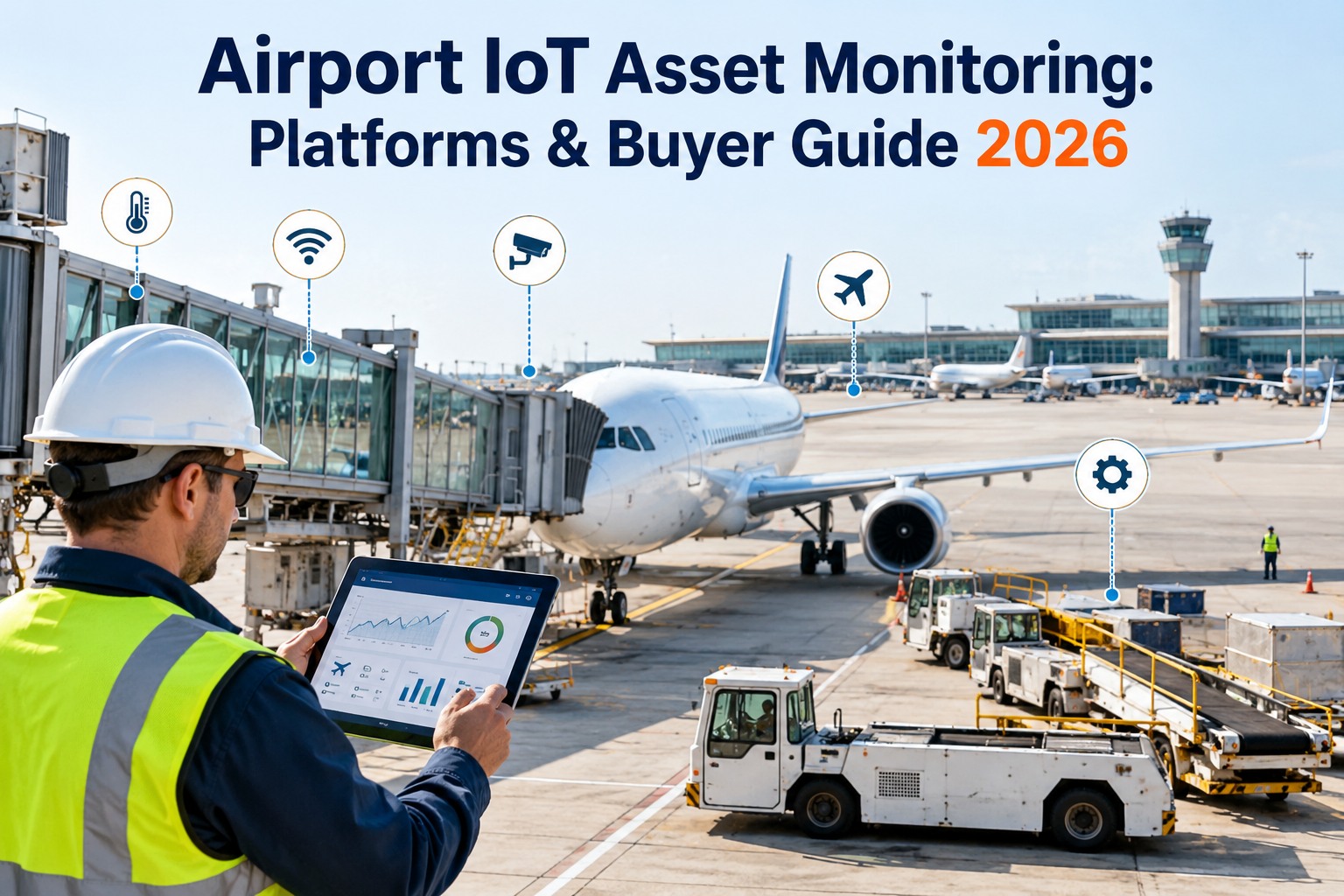
Airport IoT Asset Monitoring: Platforms & Buyer Guide 2026

By Willam Jerry on October 3, 2026

best-airport-iot-asset-monitoring-platform-2026-guide

Sensors are cheap now. What airports struggle with is everything after the sensor: getting data from airside and terminal assets into one platform, turning an alert into a work order, and proving what the program is worth. This 2026 buyer guide breaks down the airport IoT stack, the platform types you will compare, realistic cost components and the questions to ask every vendor — and shows how OXMAINT AI, the AI-powered CMMS, connects monitoring to maintenance action.

Airport IoT · Asset Monitoring · Buyer Guide 2026

Airport IoT Asset Monitoring: Platforms & Buyer Guide 2026

An alert nobody turns into a work order is just another notification. OXMAINT AI, the AI-powered CMMS, connects inspections, defects, work orders and preventive or predictive maintenance in one platform, so monitoring data leads to action on the right asset.

1Sensor reading or inspectionCondition data from monitored assets
→
2Issue or defectAlert logged against the asset record
→
3Work orderAssigned to a technician with history
→
4PM & predictive planOutcomes tune future schedules

The result: better asset visibility and a faster path from alert to work order.

The 4-Layer Airport IoT Stack

Every platform you evaluate is a combination of four layers. Weakness in any one shows up later as missed alerts, manual re-keying or cost surprises. Book a demo to see all four layers connected in OXMAINT AI.

4
CMMS & work managementWork orders, asset history, PM plans, technician mobile app
3
Platform & analyticsBaselines, thresholds, anomaly detection, alert rules, dashboards
2
Gateways & connectivityLoRaWAN, cellular, Wi-Fi or BLE; buffering, security, protocol translation
1
Sensors on assetsVibration, temperature, current, runtime on baggage systems, HVAC, pumps, boarding bridges

Four Platform Types You'll Compare

Sensor-vendor platform
Best for: quick start on one asset class
Tight hardware-software fit. Watch for lock-in and limited work-order workflow.
General IoT cloud platform
Best for: custom builds with IT teams
Flexible and scalable. Maintenance workflows usually need extra integration work.
CMMS-native IoT
Best for: turning alerts into maintenance action
Alerts land next to asset history, PMs and work orders. Confirm the sensor types and protocols you need.
BMS / SCADA based
Best for: building and plant systems
Strong on control data. Often weaker on maintenance history and cross-asset analytics.

What to Weigh When Scoring Vendors

There is no universal weighting, so adjust to your airport. This is a sensible starting point for most operators.

CMMS integration & auto work orders
25%
Open APIs, hardware-agnostic
20%
Alert quality (thresholds, trends)
15%
Coverage airside & in terminals
15%
Security & data governance
12%
Total cost & support
13%

Cost Components to Budget For

Published 2026 benchmarks put hardware at the cheaper end of the bill. Integration and setup usually matter more. Start free and map your critical assets in OXMAINT AI.

$40–100
vibration sensor, per node
$500–1,500
gateway, covering roughly 50–100 nodes
$2–5
cloud platform, per node per month
$5,000–20,000
integration and setup
$2,000–5,000
training

Source: 2026 industrial bearing-sensor buyer benchmarks. Airport-specific costs vary with ruggedised hardware, airside certification, coverage area and security requirements. Get written quotes.

Which Connectivity Fits Which Airport Zone?

OptionStrengthsTrade-offsTypical zone
LoRaWAN Long range, strong building penetration, low-power sensors Low bandwidth; not for high-rate data Airside, remote assets, terminals
Cellular No gateway to install; carrier-managed Subscription cost per device Mobile or isolated assets
Wi-Fi / wired High bandwidth, existing infrastructure Power needs, coverage gaps Terminals, plant rooms
BLE tags Very low-cost tracking Short range Tools, carts, proximity sensing

The Best Sensor Is Useless Without a Work Order Behind It.

See how a threshold alert becomes an assigned job with full asset history, in one platform.

A Pilot Roadmap That Limits Risk

Step 1
Rank assetsPick the 5–10 whose failure hurts most
Step 2
Pilot sensorsOne zone, one gateway, clear baselines
Step 3
Wire the workflowAlert rules, work orders, technician routing
Step 4
Review and scaleCheck alert quality, then extend coverage

10 Questions to Ask Every Vendor

1Do alerts create work orders automatically?
2Is the platform hardware-agnostic?
3Which protocols are supported?
4How are false alarms reduced?
5What happens when connectivity drops?
6How is data encrypted and governed?
7Is there an open API?
8What is the all-in cost per asset?
9Who handles setup and training?
10Can we run a time-boxed pilot?

Frequently Asked Questions

What should an airport IoT monitoring platform include?
Sensors, gateways, an analytics layer with alert rules, and integration into the CMMS so alerts become work orders. Book a demo to see this in OXMAINT AI.
How much does airport IoT cost?
Hardware is a small part. Budget for gateways, platform subscriptions, integration and training, then validate with written quotes for your site.
Do I need to replace existing sensors or BMS?
Not necessarily. Prefer platforms that integrate with existing systems through open APIs and standard protocols. Start free in OXMAINT AI.
Where should an airport start?
With a handful of high-impact assets, a time-boxed pilot and a clear alert-to-work-order workflow.

Make Every Alert Lead to Action.

Connect monitoring to inspections, work orders and preventive plans in the OXMAINT AI maintenance management software, and run a pilot on the assets that matter most.
Share This Story, Choose Your Platform!