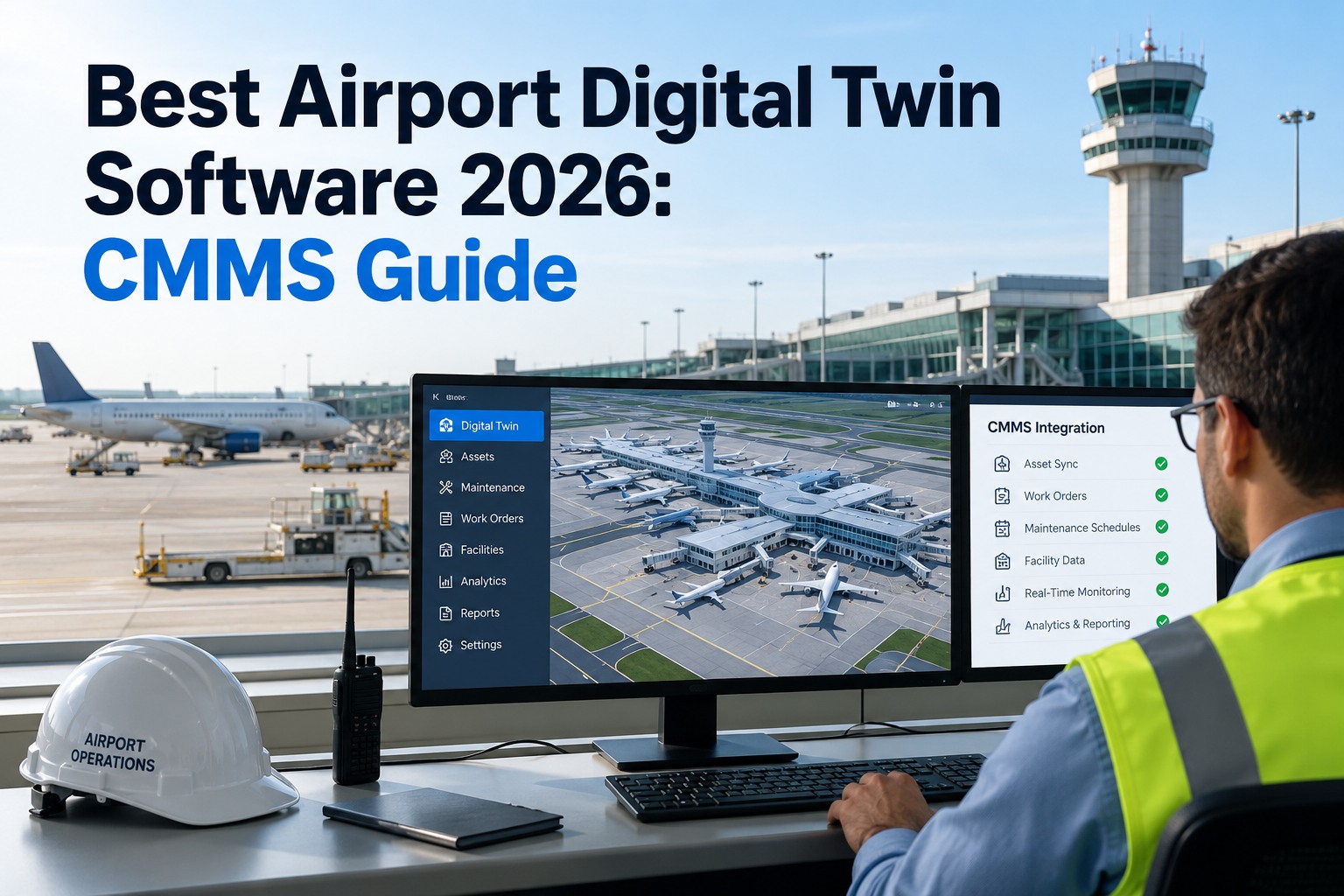
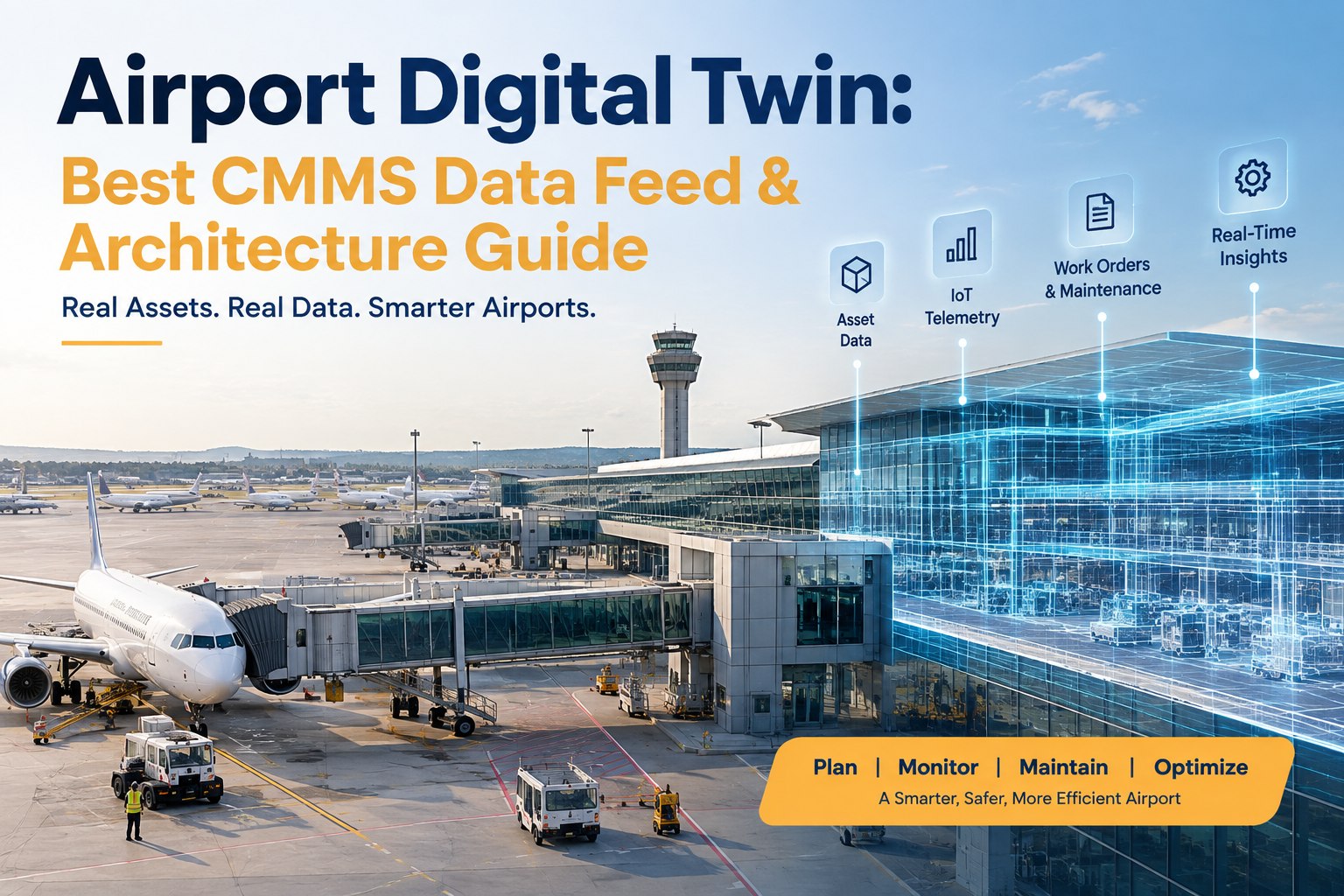
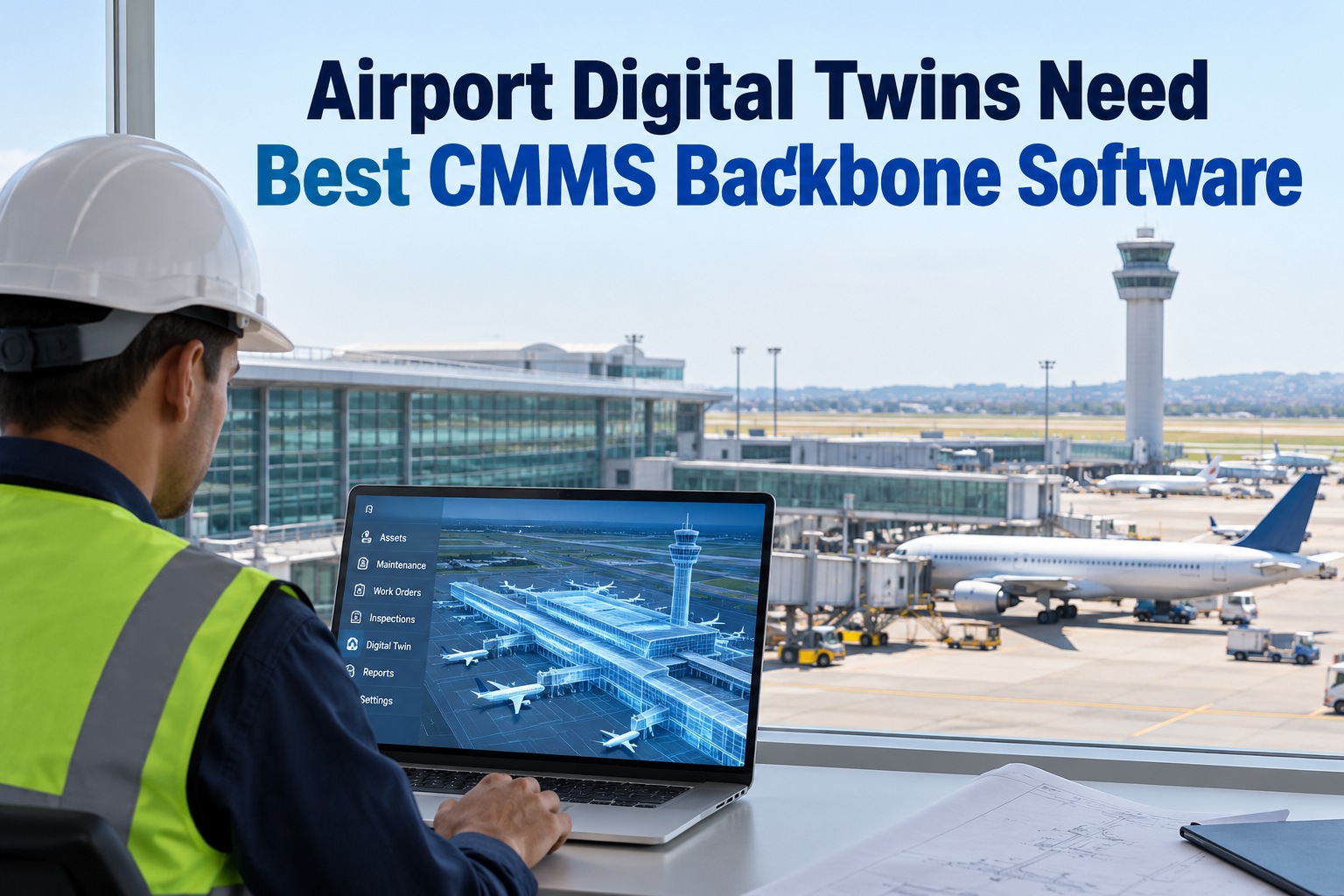
"Digital twin" is the most oversold phrase in airport technology — and underneath the hype sits a real, unglamorous truth: a twin is only as good as the maintenance data feeding it, and most airport asset registers are quietly wrong. The register starts clean, then a ground-power unit gets swapped between terminals with no record update, a contractor swaps ten fixtures for LEDs and the old asset numbers persist, and within a year the "real-time replica" is modeling a facility that no longer exists. That's why the best airport digital twin software in 2026 isn't judged on 3D graphics — it's judged on how tightly it's wired to a live CMMS. This guide covers the honest state of practice, a maturity ladder to place your airport on, and how OxMaint's maintenance management software supplies the operational layer a twin needs.
Aviation · Digital Twin · CMMS Integration · Buyer's Guide 2026
Best Airport Digital Twin Software 2026: CMMS Guide
A digital twin without a CMMS is a model without a mission. Here's the practical state of practice, the maturity ladder that tells you what to build next, and how to evaluate maintenance-linked twins.
15–25%
maintenance-spend savings independent analysis attributes to airport twins
37%
of airports lack integration between BIM, CMMS & operational systems
17 of 31
large-hub airports still in twin pilot or planning stages, early 2026
10,000+
discrete assets a large hub must keep current for a twin to be true
The State of Practice, Honestly
The financial case is settled; the deployment gap is not. A handful of large hubs — DFW, ATL, LAX — run operational twins, while most remain in pilots, and the ACRP is studying the topic directly under a funded research project. The lesson from the airports that made it work is consistent: they didn't start with a rendering, they started with structured maintenance data. Schiphol connected 80,000+ sensors on top of an integrated data environment; Heathrow manages full asset lifecycle across its estate. Every one of them rests on an accurate, current asset register — the precondition that quietly sinks the rest. Sign up free and OxMaint keeps that register live as the operation changes.
The register erodes
It starts accurate, then field reality drifts it out of date — swapped units, un-updated records, renovation ghosts. A twin on a wrong register models a fiction.
Rich history beats sensors alone
Twins built on real maintenance history outperform those relying on telemetry only. Structured CMMS data is foundational, not optional.
Integration is the gap
More than a third of airports can't connect BIM, CMMS and ops systems — so cascading dependencies go unseen until they cascade.
The Digital Twin Maturity Ladder
A twin isn't a switch you flip — it's four rungs you climb, and skipping one is why pilots stall. Each rung adds capability only if the one below it is solid, and the CMMS is the foundation the whole ladder stands on. Find your airport on this ladder before you evaluate any platform. Book a demo to see where OxMaint puts you today.
Rung 4
Autonomous Optimization
Twin simulates scenarios and optimizes capital, gate and lifecycle decisions on live asset-health profiles. Expands across domains and stakeholders.
Rung 3
Predictive & Simulating
Predictive algorithms and failure simulation run on the twin; scenario planning tests "what breaks if" before it breaks.
Rung 2
Live & Connected
IoT telemetry streams in; sensor thresholds auto-generate work orders. The twin now reflects real-time state, not last month's.
Rung 1 · Foundation
Structured Asset Register + CMMS
Accurate hierarchy, maintenance history, PM and inspection records in a live CMMS. Every rung above depends on this staying true.
A Digital Twin Without a CMMS Is a Model Without a Mission.
Twins predict; they don't act. The CMMS is the operational layer that turns a twin's insight into a dispatched work order, a staged part, a closed loop. OxMaint provides that layer — structured asset hierarchy, PM automation, mobile execution and an open API that accepts sensor and twin alerts and converts them into work orders in under 60 seconds.
The 2026 Evaluation Scorecard
Score any twin platform on the seven capabilities that decide whether it becomes an operating tool or an expensive rendering. The distinguishing test in 2026 is depth of CMMS integration — a twin that can't write a work order is a dashboard. Sign up free to score OxMaint against your own criteria.
01
Live CMMS Write-Back
Twin insight becomes a real, dispatched work order — not just a flashing alert on a screen.
Must-have
02
Register Sync & Drift Control
Keeps the asset hierarchy current as units move and change — the precondition everything else rests on.
Must-have
03
Open API & Standard Protocols
Connects BIM, BMS, SCADA and ERP via OPC-UA, MQTT, BACnet and REST — integrates, doesn't replace.
Must-have
04
Maintenance-History Ingestion
Uses structured repair history, not sensor data alone — the input that makes predictions actually accurate.
Must-have
05
Failure & Dependency Simulation
Models cascades — a cooling failure that hits IT in four hours — before they happen.
High-value
06
Phased Deployment Path
Starts on one asset category and expands — value at each stage, not a two-year big-bang bet.
High-value
07
Decision-Grade Reporting
Turns twin + maintenance data into OTP, ASQ and capital decisions leadership can act on.
High-value
Where to Start: Pick the Category That Bleeds the Most
The airports that succeed don't twin everything at once — they start with the single asset category whose failures cost the most, prove value, then expand. A pilot on one category commonly runs $50K–$200K depending on existing sensors, and airports already on a structured CMMS cut that by skipping the data-reconstruction step. Book a demo to scope your highest-cost category first.
Baggage Handling
Conveyor drives, diverters, sorters — vibration and current signatures appear weeks ahead. High disruption when it stops.
Jet Bridges
Direct gate-turnaround and OTP impact; a stuck bridge delays a departure and cascades through the schedule.
Terminal HVAC
Comfort and cascade risk — a cooling fault can reach IT and passenger experience within hours if unseen.
Vertical Transport & GSE
Escalators, walkways, ground equipment — high unit counts, visible to passengers, measurable ASQ effect.
Rendering-Only Twin vs. CMMS-Integrated Twin with OxMaint
The market's dividing line in 2026 isn't 2D vs 3D — it's whether the twin closes the loop to execution. Here's what separates a viewer from an operating system. Start free and build the foundation rung this week.
Why OxMaint Earns the Pick for 2026
OxMaint is the operating layer a twin needs — the foundation rung and the write-back engine in one system, so twin insight becomes maintenance action instead of a slide. Here's the concrete mapping to the scorecard. Book a demo to see it on your estate.
Asset Hierarchy Mapped to Reality
Structured registers that mirror the real operation — the accurate foundation a twin's every layer depends on.
Sub-60-Second Work Orders
An open API accepts threshold and twin alerts and returns fully structured work orders with asset context, history and parts.
PM & Inspection Automation
Calendar, runtime, cycle and condition-based scheduling that keeps the maintenance history a twin learns from rich and current.
Mobile Technician Execution
Field crews close the loop on a phone — so the register updates as work happens and never drifts into fiction.
IoT & Enterprise Integration
Standard-protocol connections to sensors and to BIM, BMS, SCADA and ERP — a unified view without ripping anything out.
Decision-Grade Reporting
Maintenance data turned into the OTP, ASQ and capital-planning numbers leadership actually decides on.
Use this guide plus OxMaint to build the foundation a twin stands on, climb the maturity ladder rung by rung, and turn maintenance data into decisions that cut unplanned downtime as operations scale. Try OxMaint free or book a demo to see it on your airport.
"
We spent a year and a serious budget on a beautiful 3D twin, and it sat unused because it was built on an asset register that was wrong the day we finished it — units had moved, records were stale, and nobody trusted what it showed. We rebuilt from the bottom: OxMaint as the live register and CMMS first, then wired the sensor feeds and the twin on top. The difference is that now an alert becomes a work order automatically, the register stays true because technicians close jobs on mobile, and the simulations are believable because they run on real maintenance history. The twin finally does something. We started with baggage handling and expanded from there.
Head of Infrastructure & Asset Management · Large Hub Airport
Frequently Asked Questions
What makes airport digital twin software "best" in 2026?
Depth of CMMS integration — a twin that writes real work orders, keeps the asset register current, ingests maintenance history, and connects to BIM/BMS/SCADA via open protocols. Rendering quality is secondary to closing the loop to action.
Do I need to replace my existing systems to deploy a twin?
No. Twins integrate with CMMS, BMS, SCADA and ERP through APIs and standard protocols, creating a unified view without disrupting current workflows. The starting point is BIM/CAD plus your asset register and history.
Why is the CMMS the foundation rather than the sensors?
Twins built on structured maintenance history outperform those on telemetry alone, and every twin layer depends on an accurate, current register. Without a live CMMS keeping that true, the twin models a facility that no longer exists.
Where should an airport start?
With the asset category whose failures cost the most — often baggage handling or jet bridges. Prove value on one category, then expand. Airports already on a structured CMMS cut pilot cost by skipping data reconstruction.
How does OxMaint fit a digital twin program?
It's the operational layer — the live register and the engine that turns twin insight into dispatched work orders in under 60 seconds.
Sign up free to build the foundation rung.
Build the Foundation. Then the Twin Means Something.
OxMaint gives an airport digital twin what it can't work without — a live asset register, rich maintenance history, and the write-back engine that turns prediction into a dispatched work order. Start at the foundation rung and climb from there. Start free — no credit card, unlimited users, forever. Or Schedule a demo.