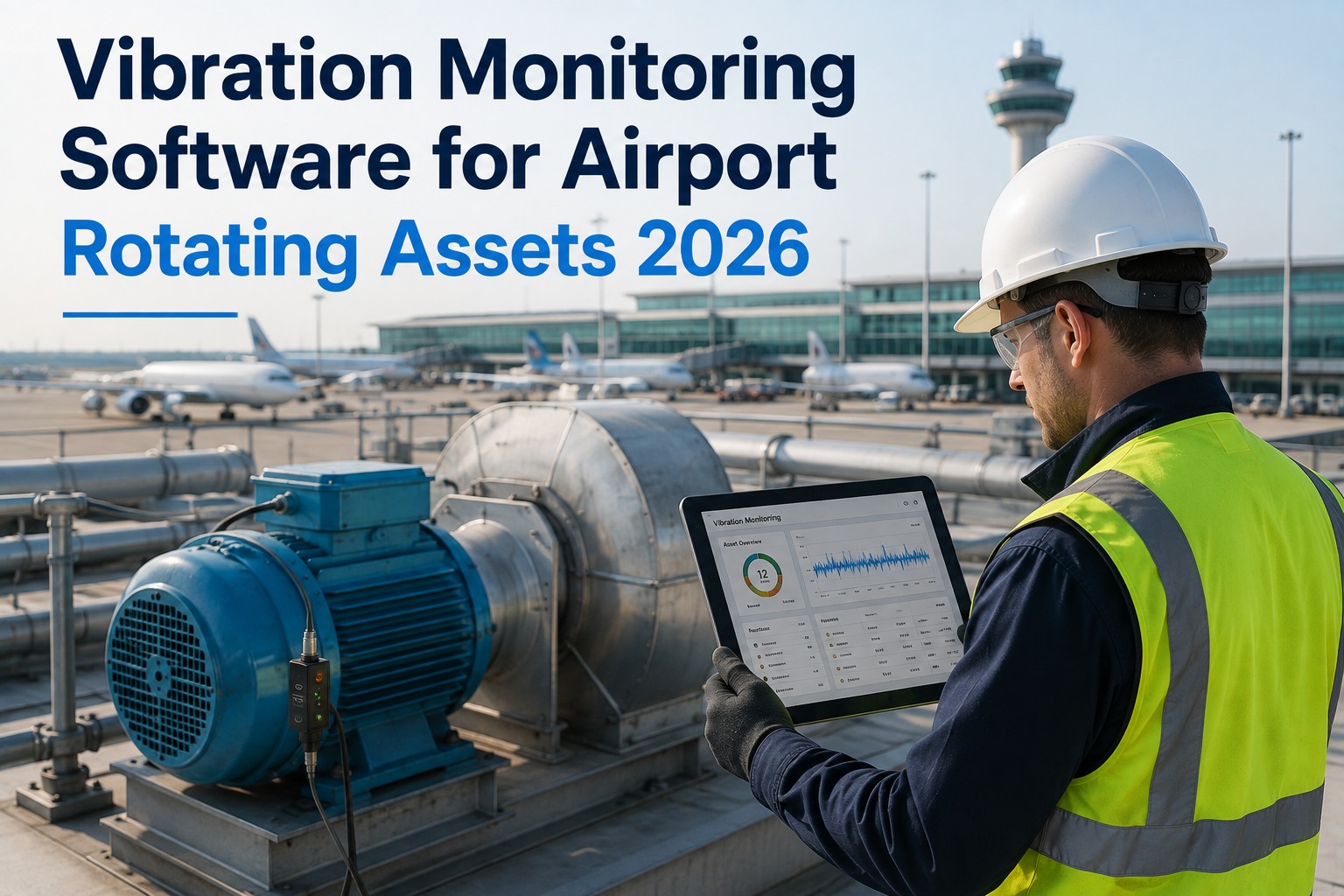
Every rotating machine at an airport is broadcasting its own health, continuously, in a language most maintenance programs never learn to read: vibration. A chiller compressor, a chilled-water pump, an AHU fan, a baggage conveyor motor, an escalator drive — each has a healthy vibration signature, and each starts to change that signature the moment a bearing, a coupling, or a balance condition begins to degrade. Bearing defects alone cause 51% of all rotating-equipment failures, and vibration monitoring catches them 2 to 8 weeks before the machine seizes — the difference between a planned overnight bearing swap and an emergency that costs nearly five times as much and shuts a gate or a bag belt at peak. But the signal only pays back if three things talk to each other: the IoT sensors that capture it, the condition-based logic that interprets it, and the CMMS that turns an alert into a tracked work order closed by a named technician. This guide covers vibration monitoring for airport rotating assets in 2026: which assets to watch, what the vibration actually reveals, the measurement discipline behind it, and how a CMMS turns every reading into defensible maintenance action. Book a free vibration-program review for your airport.
Every Rotating Machine Is Broadcasting Its Own Health
Vibration reveals a failing bearing weeks out — but only if the sensor, the logic, and the CMMS all talk.
51%
Of rotating-equipment failures caused by bearing defects — the top mode
2–8 wks
Advance warning vibration gives before catastrophic bearing collapse
4.8x
Cost of emergency bearing replacement vs a planned intervention
30–50%
Reduction in emergency repair cost from structured vibration monitoring
The Rotating Assets Worth Monitoring
An airport runs thousands of assets, but vibration monitoring pays back on the rotating machines whose failure stops an operation. These are the ones to instrument first — high utilization, high consequence, and a clear vibration signature to read.
Chiller Compressors
The heart of terminal cooling. Bearing and rotor faults here threaten the whole HVAC plant — a prime target for permanently mounted continuous monitoring.
Chilled & Condenser Water Pumps
Bearing wear, cavitation, and misalignment are classic vibration finds. Pumps are high-count and failure-prone — ideal for trended monitoring.
AHU & Cooling-Tower Fans
Blade fouling shows as rising 1× imbalance over weeks. Weekly measurement captures the trend long before the fan reaches a critical severity zone.
Baggage Conveyor Motors
A seized motor or gearbox at peak delays hundreds of bags. Motor and gearbox vibration flags the fault weeks ahead of a peak-hour stoppage.
Escalator & Elevator Drives
Drive-motor and gearbox degradation creates passenger-facing breakdowns and accessibility issues. Vibration catches the mechanism decline early.
GSE & Ground Equipment
Tugs, belt loaders, and ground power units have engines, pumps, and drives that vibration monitoring keeps off the critical failure list at the gate.
What the Vibration Actually Reveals
The power of vibration analysis is specificity — it doesn't just say "something's wrong," it names the fault. Each defect produces a distinct signature in the frequency spectrum, so the repair is targeted, not a blind teardown. These are the four the spectrum reads most clearly.
1× RPM
Imbalance
A single dominant peak at running speed. On fans it's often blade fouling or dirt build-up — the amplitude rises gradually over weeks as the condition worsens.
2× RPM
Misalignment
A peak at twice running speed, typically with high axial vibration and sidebands. Points to coupling or shaft misalignment — a leading cause of premature bearing wear.
Harmonics
Mechanical Looseness
Multiple harmonics of running speed — 3×, 4×, and beyond. Indicates loose mounts, worn fits, or structural slack that amplifies every other fault present.
BPFO / BPFI / BSF / FTF
Bearing Defects
Non-synchronous peaks at the four bearing defect frequencies pinpoint outer race, inner race, ball, or cage damage — the single largest failure mode, caught early by envelope analysis.
Scope Your Vibration Program in 30 Minutes
Working session with our aviation team — bring your rotating-asset list. We'll pick continuous vs route-based monitoring per asset, set ISO severity thresholds, and show how OxMaint turns a vibration alert into a tracked work order closed by a named technician.
The Measurement Discipline · How It's Actually Read
Vibration monitoring is only as good as its method. A reliable program layers three measurements — an overall severity number, a diagnostic spectrum, and an early-warning envelope — and judges each against both a threshold and a trend.
Overall RMS Velocity
The severity number
Overall velocity in mm/s, captured 10–1000 Hz per ISO 10816/20816 and classified into severity zones A through D. It's the primary trigger — alert levels prompt investigation, alarm levels prompt urgent action.
FFT Spectrum
The diagnosis
When overall levels rise, a Fast Fourier Transform decomposes the signal into its frequencies, exposing the peaks — 1×, 2×, harmonics, bearing frequencies — that name the specific fault and its severity.
Envelope / High-Frequency
The early warning
Envelope detection in the 2–5 kHz band catches the impacting of an early bearing defect before overall velocity even rises — the earliest possible signal, weeks ahead of the trend.
The discipline that separates a real program from noise: judge every reading by threshold and trend together. A point at 3.8 mm/s rising 0.4 mm/s per week is more urgent than one sitting stable at 5.0 mm/s for six months. Rate-of-change is often the earlier alarm.
Continuous vs Route-Based · Match the Method to the Asset
Not every asset needs a permanent sensor. The right coverage model depends on criticality — the trick is spending continuous monitoring where a failure stops the operation, and using efficient route collection everywhere else.
Continuous · Critical Assets
Permanently mounted IoT sensors, always streaming
For chiller compressors and lead pumps a failure can't wait on
Catches sudden-onset faults between manual rounds
Feeds automatic alerts straight to the CMMS
Route-Based · Important Assets
Monthly handheld collection on a scheduled route
For the larger population of fans, minor pumps, drives
Trends readings per point, per asset over time
Cost-efficient coverage without a sensor on every machine
How OxMaint Turns Vibration Data Into Action
OxMaint is where the IoT signal becomes maintenance action — vibration, thermal, ultrasound, and BMS data all flowing into structured work orders with technician response tracked to close, from one dashboard on desktop or mobile. This is the third piece that makes the sensor investment pay back.
Ingest
Sensor & Route Data
Stream continuous IoT vibration data and capture handheld route readings against each asset and measurement point — RPM and location stored with every sample.
Threshold
ISO Zones & Rate Rules
Apply ISO 10816/20816 severity zones plus rate-of-change rules, so both an absolute level and a fast-rising trend can raise an alert or an alarm.
Diagnose
Spectrum & History
Store full FFT spectrum and waveform per point so the fault frequency — imbalance, misalignment, looseness, or bearing defect — is on the work order, not guessed.
Trigger
Alert to Work Order
An alarm auto-generates a prioritized work order with asset history and the diagnostic attached — mobile-first, with offline mode and QR asset tags on the floor.
Track
Response to Close
Every alert is tracked from dispatch to a named technician's sign-off — closing the loop that turns a signal into a documented, accountable repair.
Prove
ROI & Reliability Reporting
Dashboards tie each sensor and alert to avoided downtime and cost — giving leadership defensible ROI on every sensor, with SAP and Maximo overlay.
Turn Every Vibration Signal Into Defensible Action
Catch bearing faults weeks early, plan the repair, and prove the return on every sensor. See how OxMaint connects vibration, IoT, and the CMMS into one accountable workflow across your airport's rotating assets. Free forever plan available.
Frequently Asked Questions
What is vibration monitoring for airport rotating assets?
It's a condition-based maintenance technique that measures and interprets the mechanical vibration of rotating equipment — chiller compressors, pumps, fans, baggage conveyor motors, escalator and elevator drives, and ground support equipment — to detect developing faults weeks before they cause a failure. A healthy machine produces a predictable vibration signature; as bearings, couplings, or balance conditions degrade, the amplitude rises and new frequency components appear. By trending overall vibration and analyzing the frequency spectrum, technicians identify exactly which fault is developing and how severe it is, so the repair is planned into a low-traffic window instead of happening as a peak-hour emergency. It's the most actionable predictive technique for the rotating machines that keep a terminal and airfield running.
Book a program review.
What faults can vibration analysis detect?
The main ones are imbalance, misalignment, mechanical looseness, and bearing defects — each with a distinct signature in the frequency spectrum. Imbalance shows as a dominant peak at 1× running speed; misalignment as a peak at 2× running speed, often with high axial vibration and sidebands; looseness as multiple harmonics (3×, 4×, and beyond); and bearing defects as non-synchronous peaks at the four characteristic bearing frequencies — BPFO for the outer race, BPFI for the inner race, BSF for the balls, and FTF for the cage. Vibration also reveals resonance, gear-mesh problems, and pump cavitation. Because each fault has its own fingerprint, analysis enables targeted repair — replacing the right bearing or correcting the alignment — rather than a blind teardown. Bearing defects are the single largest failure mode, causing 51% of rotating-equipment failures.
Sign up free to start trending.
What is ISO 10816 and how are thresholds set?
ISO 10816 — and its successor ISO 20816 — is the international standard for evaluating machine vibration by measurements on non-rotating parts, such as bearing housings. It defines severity zones, commonly labeled A (newly commissioned, good) through D (unacceptable, damage likely), based on overall RMS velocity in mm/s, with different limits by machine class and power. A monitoring program sets alert thresholds that trigger investigation and higher alarm thresholds that trigger urgent action, using these zones as the baseline. The critical refinement is to apply both an absolute threshold and a rate-of-change rule simultaneously: a reading rising quickly week over week can be more urgent than a higher but stable one. Over-sensitive thresholds create nuisance alerts; overly lenient ones let faults progress — so tuning them per asset class matters.
Should sensors be permanent or is a monthly route enough?
It depends on the asset's criticality, and a good program uses both. Critical assets — a chiller compressor or a lead pump whose failure would stop cooling or an operation — warrant permanently mounted IoT sensors that stream continuously, catching sudden-onset faults that could develop between manual rounds and feeding automatic alerts to the CMMS. Important but less critical assets — the larger population of fans, secondary pumps, and drives — are well served by monthly handheld route collection, which trends each measurement point over time at a fraction of the sensor cost. The art is matching spend to consequence: continuous coverage where a failure is operationally intolerable, efficient route-based collection everywhere else. A CMMS holds both data streams in the same asset history for consistent trending.
How does OxMaint turn vibration data into maintenance action?
OxMaint is the layer where the IoT signal becomes accountable work. It ingests both continuous sensor streams and handheld route readings against each asset and measurement point with RPM and location stored, applies ISO 10816/20816 severity zones together with rate-of-change rules to raise alerts and alarms, and stores full FFT spectrum and waveform so the specific fault frequency travels with the work order rather than being guessed later. An alarm auto-generates a prioritized, mobile-first work order with asset history and the diagnostic attached, and every alert is tracked from dispatch to a named technician's sign-off — closing the loop between signal and repair. Reliability dashboards then tie each sensor and alert to avoided downtime and cost, giving leadership defensible ROI, with SAP and Maximo overlay. A free forever plan is available to start.