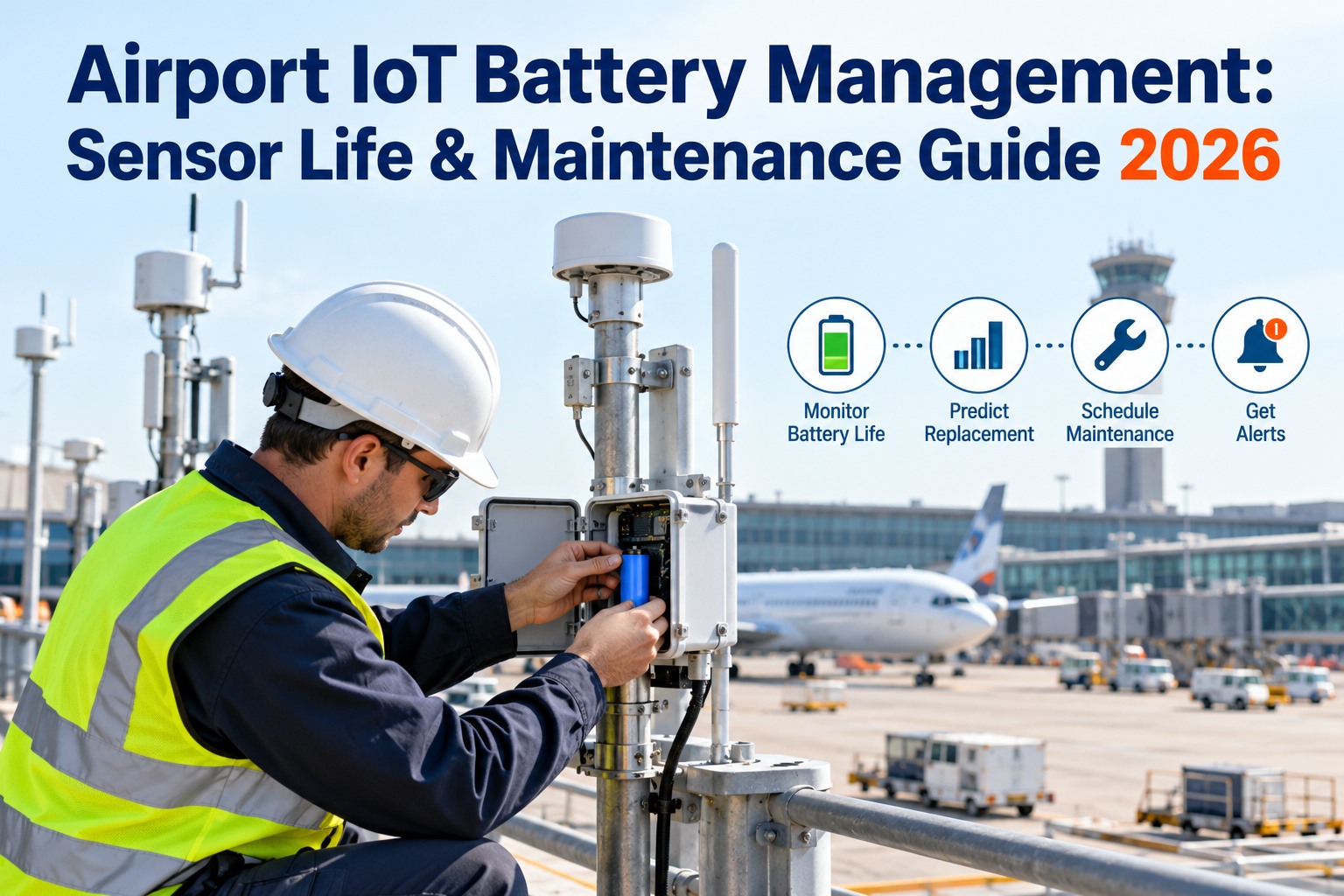
A wireless sensor that dies quietly is worse than no sensor: the asset it watched is now unmonitored, and nobody knows. Across an airport with hundreds of battery-powered sensors on baggage systems, pumps, HVAC and airside equipment, battery life is not a spec-sheet number — it is a maintenance program. This guide shows what drains IoT batteries, how to forecast replacements, and how OXMAINT AI, the AI-powered CMMS, turns battery data into scheduled, trackable work.
Airport IoT Battery Management: Sensor Life & Maintenance Guide.
Sensor batteries fail on their own schedule, not yours. OXMAINT AI, the AI-powered CMMS, connects battery checks, low-battery issues, replacement work orders and preventive plans in one platform, so every sensor is treated like the asset it is.
The result: better visibility of sensor health and replacements scheduled before coverage is lost.
Battery Life Is a Configuration Outcome, Not a Spec
A vendor's "up to 10 years" is achievable under ideal conditions, but the same hardware can land far lower in the field. Three things decide the result: how often it transmits, how hard each transmission works, and the temperature it lives in. Book a demo to see sensors managed as assets in OXMAINT AI.
Dots show relative impact for typical LoRaWAN-type sensors. Actual impact depends on your devices and network. Test in your own environment.
Same Sensor, Three Airport Conditions
Illustrative only. Bars show relative expected life, not measured values.
A Battery Health Board You Can Run Weekly
Most sensors report battery level or voltage with each reading. Turn it into three simple states, with thresholds you set to match your battery type and lead times. Start free and set up sensor assets in OXMAINT AI.
Thresholds are examples. Set them per battery chemistry, device and criticality.
Forecast Replacements in Four Moves
Replacement Is an Infrastructure Cost. Plan It Like One.
Access permits, escorts, ladders and technician time add up when sensors fail one by one. Batch what you can see coming.
Duty-Cycle Levers and Their Trade-Offs
| Lever | Effect on battery | Trade-off |
|---|---|---|
| Slow the reporting interval | Large gain | Slower detection of change |
| Add or reposition gateways | Lets devices use lower airtime | Extra hardware and install effort |
| Enable adaptive data rate | Matches power to signal strength | Works best on stationary sensors |
| Event-based reporting | Sends data only on change | Needs well-tuned thresholds |
| Size battery for cold extremes | Protects real-world life | Larger or costlier cells |
Frequently Asked Questions
Keep Every Sensor Online, and Every Replacement Planned.
Manage sensor assets, battery checks, work orders and preventive plans in the OXMAINT AI maintenance management software.