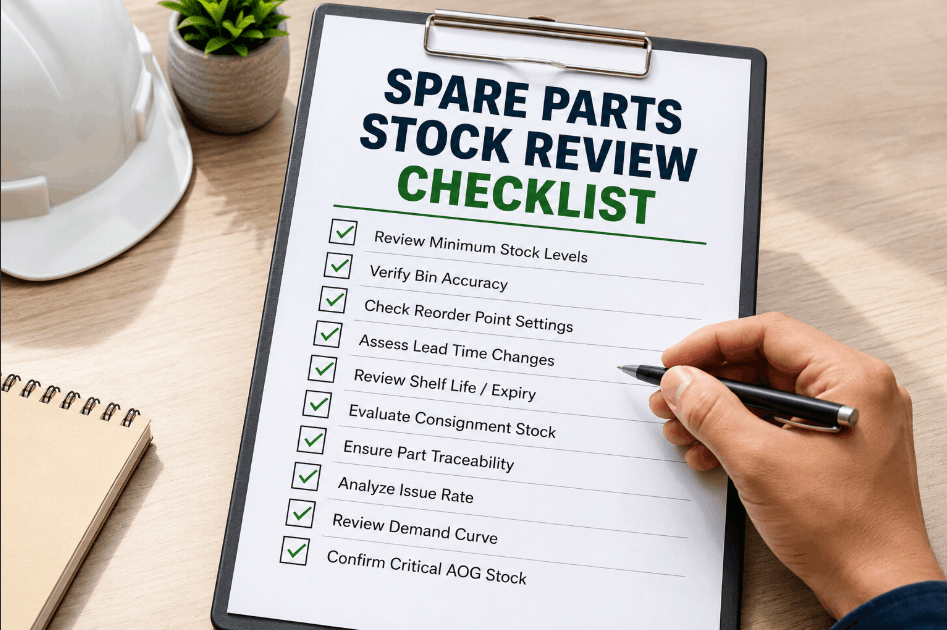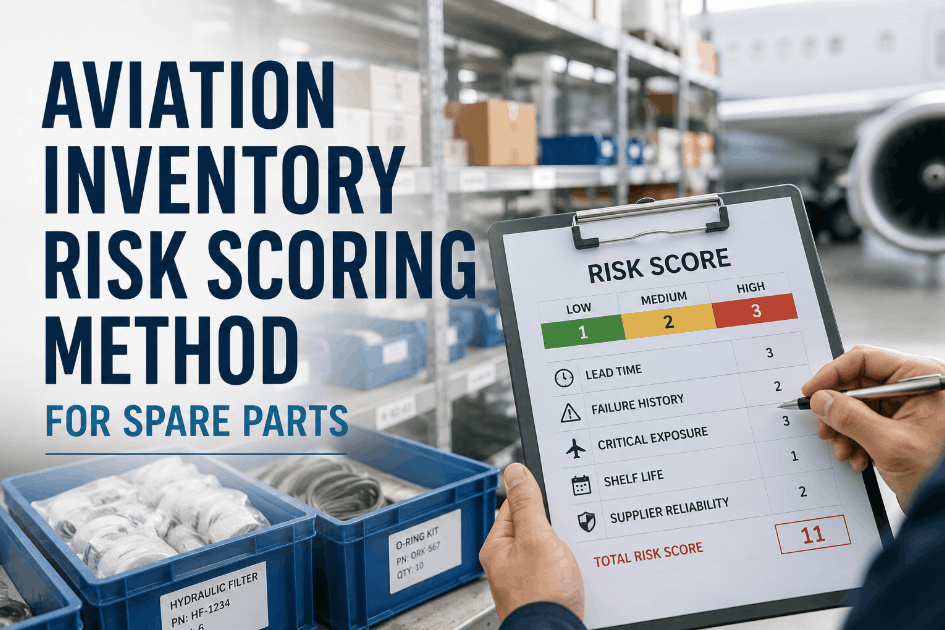
Aviation inventory risk scoring is the operational discipline that moves spare parts management from bin-level intuition to data-driven stocking decisions that account for lead time exposure, failure history, shelf life constraints, and the service continuity consequence of each part being unavailable when a repair cannot wait. Without a structured risk scoring method integrated into your CMMS, critical parts go understocked while low-consequence consumables absorb budget — and the imbalance only reveals itself when an aircraft-on-ground event traces back to a part that should have been on the shelf. Sign Up Free on Oxmaint to build a spare parts risk scoring model, prioritize stocking decisions by part criticality, track demand curves, and prevent the shortages that delay repairs and erode service readiness across your aviation maintenance operation.
Why Aviation Spare Parts Require Risk Scoring — Not Just Reorder Points
Standard reorder point logic treats all parts equally — restocking when a bin drops below a threshold without accounting for the consequence of a stockout, the length of the procurement cycle, or the failure frequency pattern of the assets the part supports. In aviation maintenance, the asymmetry between a routine consumable stockout and a critical component shortage is not marginal — it is the difference between a scheduled task delay and a grounded aircraft. Book a Demo to see how Oxmaint applies risk-based criticality scoring to aviation spare parts inventory — prioritizing stocking investment toward the parts whose absence causes the greatest delay, the longest lead time exposure, and the highest service continuity risk across your repair operation.
The Four Inventory Risk Gaps That Cause Aviation Parts Shortages
Sign Up Free on Oxmaint to close all four aviation inventory risk gaps with structured criticality scoring, lead time tracking, demand curve analysis, and shelf life management built into your CMMS work order and procurement workflow.
Most aviation stores systems carry part numbers, quantities, and reorder points without a criticality classification that reflects the consequence of a stockout. Without criticality scoring, procurement budget and safety stock investment are distributed evenly across parts that have radically different service impact profiles.
Reorder points set without lead time data create stockout exposure windows that are invisible until a technician reaches for a part that should have been ordered weeks earlier. For aviation components with 12–20 week procurement cycles, static reorder points built on historical usage alone are systematically insufficient.
Parts that appear in failure records at accelerating frequency are often still stocked at the same quantity as when they rarely failed. Without connecting asset failure history to stocking decisions, demand increases driven by aging fleet components are absorbed as stockouts rather than anticipated through proactive inventory adjustment.
Aviation parts with shelf life expiry, airworthiness certificate requirements, and lot traceability obligations require active management to remain usable and compliant. Without shelf life tracking integrated into the CMMS, expired or non-traceable parts consume stocking space and create compliance exposure when issued to a repair job.
Aviation Spare Parts Risk Scoring Matrix by Part Category
Book a Demo to see how Oxmaint applies category-specific risk scores to your aviation spare parts portfolio — prioritizing stocking investment toward the parts with the highest lead time exposure, failure frequency, and service continuity consequence across your maintenance and repair operation.
| Part Category | Criticality Factor | Lead Time Risk | Shelf Life Constraint | Oxmaint Inventory Action |
|---|---|---|---|---|
| Life-Limited Aircraft Components | AOG exposure / regulatory | High — 16–24 week procurement | Cycle count / calendar expiry | Criticality score + lead time reorder WO |
| Rotable and Repairable Spares | Repair cycle length / exchange pool | Medium-High — repair turnaround | Overhaul interval tracking | Exchange pool tracking + MTBR demand model |
| Consumable Fasteners and Seals | Task volume / issue rate | Low-Medium — standard supply | Shelf life by material type | Demand curve WO + shelf life expiry alert |
| Ground Support Equipment Parts | Turnaround support continuity | Medium — regional supplier | Varies by component | Failure history WO + stock rotation log |
| Avionics and Electrical Components | OEM sole-source / ESD sensitivity | Very High — OEM lead time | ESD and temperature storage | Sole-source flag + consignment agreement track |
Implementing Aviation Inventory Risk Scoring in Oxmaint
Assign Criticality Scores to All Parts Based on Failure Consequence and Lead Time
Oxmaint part records support criticality classification combining failure consequence, asset dependency, procurement lead time, and availability of alternative sourcing — generating a risk score per part that drives stocking priority, safety stock investment, and procurement cycle parameters across the entire aviation stores catalog.
Integrate Lead Time Data into Reorder Point Calculations
Oxmaint inventory settings allow reorder points to be configured with supplier lead time as an active variable — automatically adjusting the trigger quantity for high-lead-time parts to ensure procurement is initiated before the stockout window opens, not after the demand event exposes the gap.
Connect Asset Failure History to Demand Curve Analysis
Oxmaint links work order failure records to parts issued in each repair — generating demand curves per part that reflect actual asset failure frequency rather than historical issue averages alone. Accelerating demand curves on aging fleet components trigger stocking adjustments before the next stockout event rather than after it.
Track Shelf Life, Traceability, and Lot Compliance per Part Record
Oxmaint inventory records capture expiry dates, airworthiness documentation status, and lot traceability per stock item — alerting stores teams to approaching expiry, flagging non-traceable items before issue, and maintaining the compliance documentation that aviation regulatory audits require at part level.
Report Inventory Risk Exposure and Stocking Gaps to Procurement and Operations Leadership
Oxmaint reporting surfaces the parts with the highest combined risk score, longest lead time, and lowest current stock coverage — giving procurement teams a prioritized shortage risk list that directs purchasing decisions toward the parts most likely to cause repair delays before the stockout event occurs.
Aviation Inventory Risk Scoring KPIs for MRO and Stores Operations
Measures the percentage of high-criticality part requests fulfilled from on-hand stock without expedite sourcing. Rates below 95% on critical parts confirm that stocking levels are insufficient to absorb demand at current failure frequency — requiring immediate review of safety stock parameters.
Tracks stockout events segmented by part risk score category. Any stockout on a critical-scored part represents a risk scoring or stocking policy failure. Stockouts on lower-score parts are monitored for demand trend shifts that may require recategorization.
Measures the proportion of part purchases requiring expedite routing and premium cost due to unplanned stockout. A declining expedite rate confirms that risk scoring and lead time integration are enabling proactive reorder before demand events expose stocking gaps.
Tracks the value of parts that expire before issue as a percentage of total inventory value. High expiry rates indicate over-stocking of shelf-life-sensitive parts without demand curve alignment — consuming budget that should be allocated toward higher-criticality shortage risk coverage.
Measures the percentage of parts issued to work orders that carry complete traceability documentation at point of issue. Non-traceable parts issued to aircraft maintenance create regulatory non-compliance exposure and potential airworthiness documentation gaps during audit or incident review.
Measures the percentage of active stock items that carry a complete criticality risk score. Unscored parts cannot be prioritized in stocking decisions — making coverage a prerequisite for the risk-based inventory management discipline to deliver its shortage reduction value.