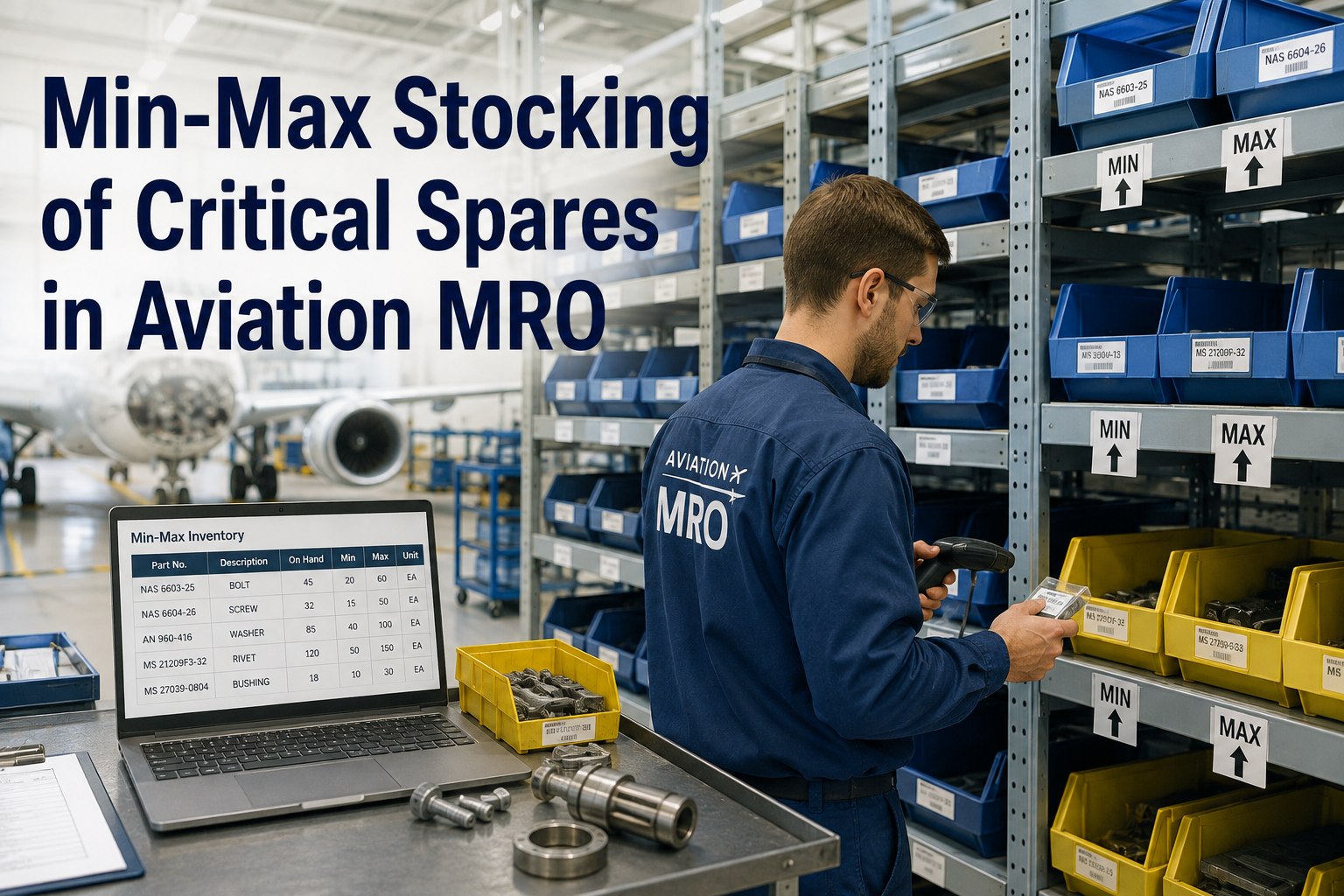
Min-max stocking of critical spares in aviation MRO is the discipline of setting a minimum reorder point and a maximum stock ceiling for high-value aircraft parts so a component is available the moment a check or AOG event demands it — without freezing millions in idle inventory. Get the minimum wrong and you ground aircraft at $10,000–$150,000 per hour of downtime; get the maximum wrong and 20–30% of your spares budget sits on shelves gathering dust and obsolescence. This guide walks procurement and logistics managers through criticality scoring, service-level targets, safety stock calculation, review cycles, and how to keep aviation critical spares policies aligned with real fleet consumption. If you want these policies automated instead of managed in spreadsheets, Start Free Trial and see how OxMaint recalculates min-max levels from live work-order data.
How much should you stock of a part that fails twice a decade — but costs $150K an hour when you don't have it?
That is the min-max question every aviation MRO answers daily. Stock everything and carrying costs eat 18–25% of inventory value per year. Stock nothing and a single AOG event wipes out a quarter's savings. The answer is a disciplined, data-driven min-max stocking policy for critical spares.
What is min-max stocking for aviation critical spares?
Min-max stocking is a replenishment policy with two triggers: when on-hand stock of a critical spare drops to the minimum (reorder point), you buy or repair up to the maximum (ceiling). In aviation MRO, where a single rotable can cost $5K–$500K and lead times run 30–365 days, these two numbers decide fleet availability.
The Minimum (Reorder Point)
Min = expected demand during lead time + safety stock. If a hydraulic pump fails on average once per 90 days across your fleet and the OEM lead time is 120 days, your minimum must cover at least 1.3 expected failures plus a buffer. Set it to zero and every failure becomes an AOG or a cannibalization event.
The Maximum (Stock Ceiling)
Max = min + economic order quantity, capped by shelf life, storage cost and obsolescence risk. For parts with 24-month cure dates or life-limited components, the max prevents overbuying stock that expires on the shelf. Industry benchmark: carrying cost runs 18–25% of part value per year, so every unit above the true max is a slow financial leak.
Worked example: an MRO supporting 40 narrow-body aircraft stocks a $28,000 avionics LRU. Demand history shows 6 removals/year, OEM repair turnaround is 75 days. Expected lead-time demand ≈ 1.25 units. At a 95% service level, safety stock ≈ 1 unit. Min = 2, Max = 3. That single policy protects availability while capping exposure at $84K instead of the $196K a "keep 7 just in case" habit would tie up.
How to score which aircraft critical spares deserve shelf space
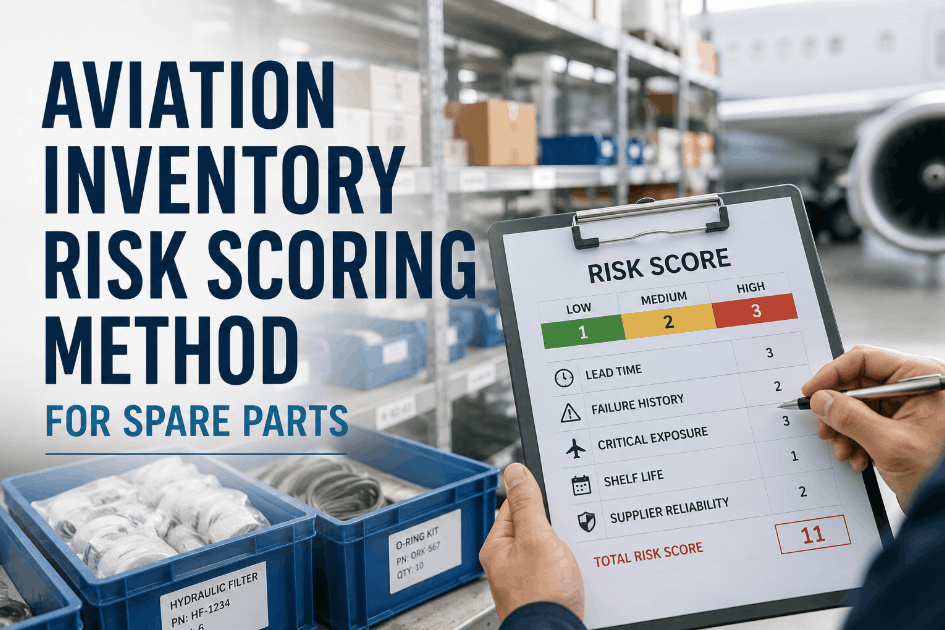
Not every part earns a min-max policy. Roughly 10–15% of SKUs in a typical MRO storeroom are truly critical — but they drive 80%+ of AOG risk. Score every candidate part on four axes, 1–5 each, and only parts above a threshold (commonly 14 of 20) get guaranteed stocking.
Operational Impact
Does a missing part ground the aircraft (no-go per MEL/CDL), delay a check, or just inconvenience the crew? A no-go item scores 5; a cabin trim part scores 1.
Failure Predictability
Wear-out parts with clean Weibull curves (tires, brakes, filters) are forecastable. Random-failure electronics are not — unpredictable demand pushes the score up because you cannot schedule around it.
Supply Lead Time & Volatility
A part with a stable 14-day lead time scores low. A part with a 180–365 day OEM lead time, single-source supply, or allocation risk scores 5 — the supply chain itself is the hazard.
Cost of Not Having It
Combine AOG exposure ($10K–$150K/hour), expedite freight premiums (often 3–10x standard), lease penalties and contract SLAs. A $4K part that triggers a $200K delay is a critical spare, full stop.
Safety stock and service-level targets for MRO critical inventory
Service level is the probability you can fill a demand from shelf stock. Aviation MROs typically target 90–95% for critical spares, 97–99% for no-go AOG items, and 80–85% for low-criticality parts. Each point of service level costs money — moving from 95% to 99% can double safety stock on slow movers.
For slow-moving aviation critical spares (fewer than ~4 demands/year), Poisson-based models outperform normal-distribution math — a 95% service level on a part demanded twice a year often still means stocking just 1–2 units, but the right model tells you which. This is exactly the calculation OxMaint automates per SKU from your own consumption history.
Recommended min-max stocking levels by criticality tier
A tiered policy keeps aviation spares stocking levels defensible in front of finance and auditors. Below is a proven starting framework — tune the numbers to your fleet size, utilization and route structure.
| Tier | Part Type | Service Level | Min Logic | Review Cycle |
|---|---|---|---|---|
| A — AOG / No-Go | Rotables, LRUs, engine/APU line items | 97–99% | Lead-time demand + Poisson safety stock | Monthly |
| B — Check-Critical | Hydraulics, actuators, avionics | 90–95% | Normal-dist. SS, Z = 1.28–1.65 | Quarterly |
| C — Scheduled Consumables | Brakes, tires, filters, seals | 85–90% | Forecast-driven, tied to check calendar | Quarterly |
| D — Low Criticality | Hardware, cabin, non-MEL items | 80–85% | Simple min-max or order-on-demand | Semi-annual |
Governance rule that separates mature MROs from reactive ones: min-max values are recalculated on a fixed review cycle — monthly for Tier A, quarterly for B/C — and every override is logged with a reason. Policies that drift silently are how storerooms end up with $2M of stock and daily AOGs at the same time.
What disciplined critical spares stocking is worth
MROs that replace gut-feel stocking with calculated min-max policies consistently report the same four outcomes — usually within two review cycles (6 months).
How OxMaint automates min-max stocking of critical spares
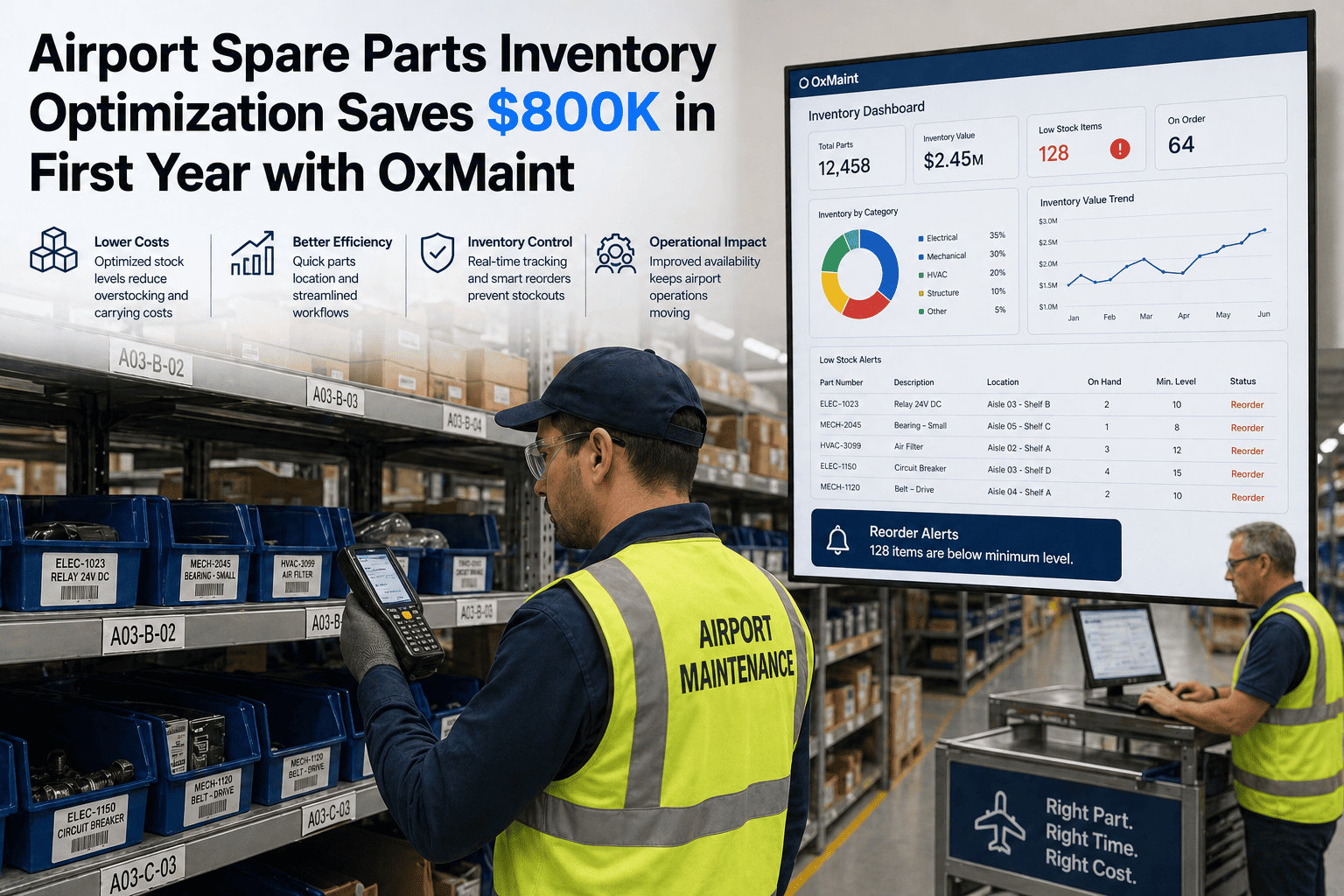
Spreadsheets cannot recalculate 5,000 reorder points every month. OxMaint's AI-powered CMMS/EAM ties your spare-parts inventory directly to work orders and asset history, so aviation min-max stocking levels follow real consumption — not last year's guess.
Dynamic Min-Max Recalculation
OxMaint computes reorder points and safety stock per SKU from live usage, lead times and your service-level targets — and flags policies that drift. Outcome: 15–30% lower carrying cost with fill rates above 95%.
Criticality-Linked Inventory
Parts inherit criticality from the assets they serve, so a no-go LRU automatically gets Tier-A stocking rules and monthly review. Outcome: AOG expedites cut 40–60%, with every policy auditable for ISO 55000-aligned governance.
Auto-Reorder & Purchase Workflows
When stock hits the minimum, OxMaint raises a purchase requisition with the calculated order quantity — no planner babysitting bins. Outcome: zero stockouts from missed reorder triggers and hours of manual checking eliminated weekly.
Consumption Analytics by Fleet & Tail
Dashboards show demand by aircraft, check type and station, exposing phantom demand and shelf-life risk before parts expire. Outcome: obsolescence write-offs shrink and stocking follows the fleet plan, not habit.
See your real reorder points in 30 minutes
Book a demo and we'll walk through your critical spares list, show the min-max OxMaint calculates from your data, and quantify the inventory you can release.
Min-max stocking of aviation critical spares — common questions
What is min-max stocking in aviation MRO?
Min-max stocking is an inventory policy where a spare part is reordered when on-hand quantity falls to a calculated minimum (reorder point) and replenished up to a maximum ceiling. In aviation MRO it is the standard method for controlling critical spares — balancing aircraft availability against the 18–25% annual cost of carrying inventory.
How do you calculate safety stock for critical aircraft spares?
For regular movers: Safety Stock = Z × σ of demand during lead time, where Z reflects your service-level target (1.65 for 95%, 2.33 for 99%). For slow movers under ~4 demands per year — most aviation critical spares — Poisson-based models are more accurate. Start Free Trial and OxMaint runs the right model per SKU automatically from your consumption history.
What service level should MRO critical inventory target?
Target 97–99% for AOG/no-go rotables, 90–95% for check-critical parts, and 80–85% for low-criticality items. Each additional service-level point raises safety stock cost, so a single blanket target across all parts almost always means overstocking cheap parts and understocking the ones that ground aircraft.
How often should min-max levels be reviewed?
Monthly for Tier-A critical spares, quarterly for Tier B/C, and semi-annually for low-criticality stock — plus an immediate recalculation whenever fleet size, utilization, routes or OEM lead times change. A Book a Demo session shows how OxMaint schedules and automates these review cycles with full audit history.
Why do MROs overstock critical spares even with min-max policies?
Three causes: min-max values set once and never recalculated, demand estimates based on fear instead of consumption data, and no cap for shelf-life or obsolescence. The fix is governance — automated recalculation from real work-order usage, tiered service levels, and logged overrides — which is precisely what a CMMS-driven inventory module enforces.
Stop guessing your critical spares stocking levels
OxMaint turns your work-order history into calculated min-max policies, automated reorders and audit-ready inventory governance — so parts are on the shelf when the aircraft needs them, and cash isn't trapped when it doesn't.
Free 14-day trial · No credit card · Set up in days, not months