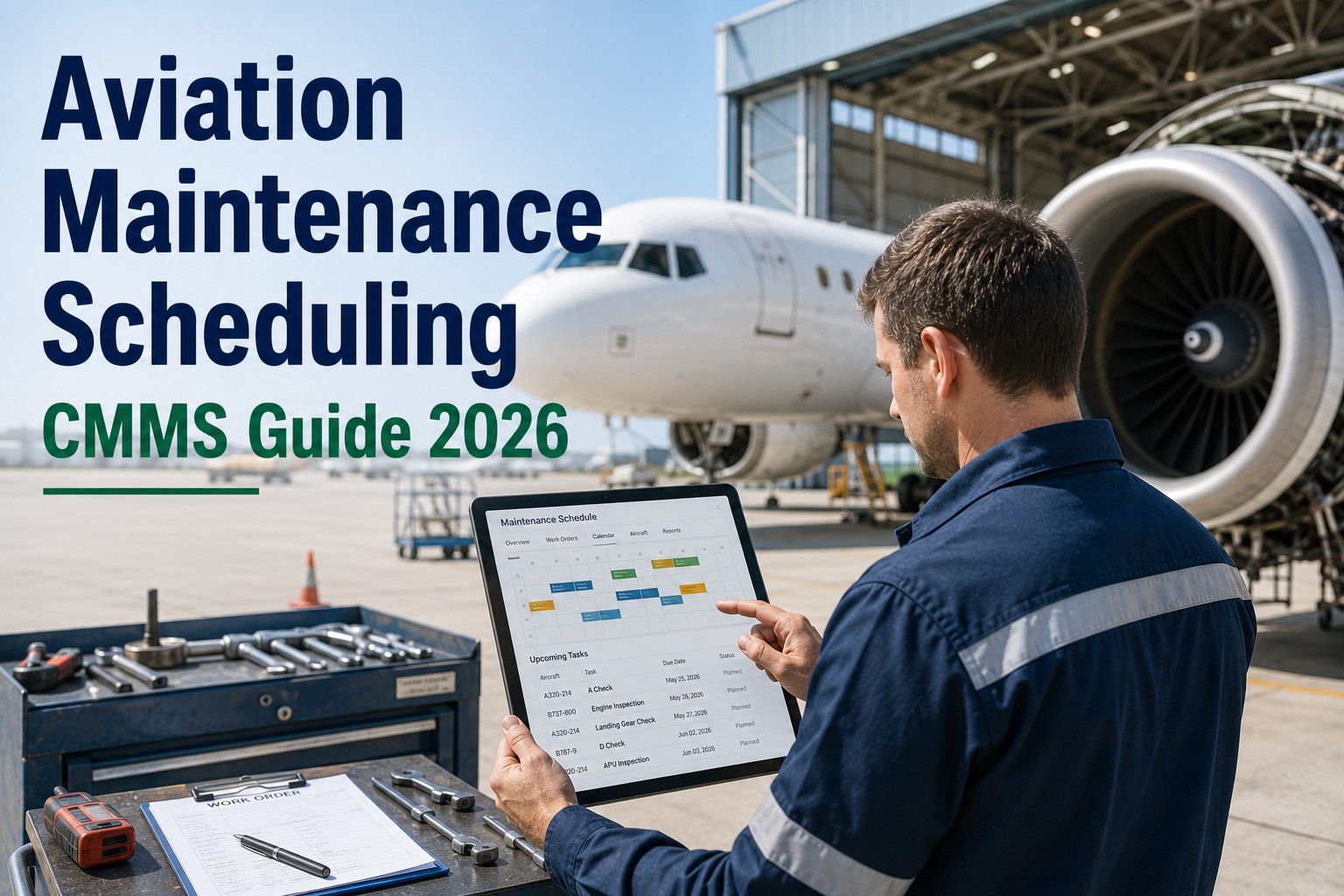
Aviation maintenance scheduling is where hangar productivity is either created or lost — and airlines with mature scheduling routinely beat industry turnaround time (TAT) by 20–30%. This 2026 guide to aviation maintenance scheduling in a CMMS covers due-list forecasting, resource-constrained scheduling, ground time optimization, and workforce planning for maintenance and reliability teams. If your team is still managing aircraft checks on spreadsheets, you are likely leaking billable flight hours and risking airworthiness deadline slips. You can Start Free Trial of OxMaint today to see how AI-driven scheduling transforms these workflows.
AVIATION SCHEDULING GUIDE 2026
Are you still losing billable flight hours to static maintenance schedules?
Aircraft scheduling guide for 2026: Replace reactive spreadsheets with intelligent CMMS aviation scheduling that automatically generates pre-loaded work orders from PM intervals, inspection thresholds, and condition-based triggers.
THE COST OF REACTIVE SCHEDULING
Why aviation PM scheduling fails on spreadsheets in 2026
A typical narrow-body aircraft generates 40–60 scheduled maintenance tasks per month. Tracking these across a fleet of 50 aircraft using Excel creates a 2,500-row matrix that breaks the moment a flight delays or a technician calls in sick.
Airlines with mature CMMS scheduling beat average turnaround times by optimizing ground time and resource allocation.
A single missed airworthiness deadline or unscheduled AOG event costs thousands per hour in lost revenue and repositioning.
Reactive scheduling ignores inventory lead times, causing parts stockouts that extend ground time by days.
"
A 180-aircraft fleet spending $42M annually on maintenance can leak over $8M in unnecessary ground time and expedited parts costs simply by relying on static scheduling that ignores real-time asset conditions.
SCHEDULING ARCHITECTURE
How to build a CMMS aviation scheduling system that hits airworthiness deadlines
Effective aircraft maintenance scheduling requires four trigger mechanisms working in unison. A modern CMMS schedule for aviation automatically converts these triggers into pre-loaded work orders without manual data entry.
| Trigger Type | Scheduling Mechanism | Example Threshold | CMMS Action |
|---|---|---|---|
| Flying Hours | PM Interval | Every 500 FH | Auto-generate work order 50 FH before due |
| Cycles | Countdown Trigger | Every 1,000 landing cycles | Pre-load inspection task card to due-list |
| Calendar Days | Date-based Deadline | 30 / 90 / 365 days | Alert reliability team 14 days prior |
| Condition-Based | Predictive AI Threshold | Vibration > 0.45 IPS | Dynamically insert work order into next ground slot |
Due-List Forecasting Formula
Next Due Date = Current Date + (Threshold Remaining / Average Daily Utilization)
OxMaint recalculates this daily for every asset, automatically flagging tasks that will breach compliance within your configurable alert window (default: 14 days).
GROUND TIME OPTIMIZATION
Resource-constrained scheduling for maximum hangar throughput
Ground time optimization means packing the maximum airworthiness-mandated work into the minimum aircraft downtime. This requires a CMMS that understands technician availability, bay constraints, and parts inventory simultaneously.
Demand Forecasting
System pulls all PM intervals, inspection thresholds, and condition-based triggers for the next 90 days, generating a due-list forecast that maps exactly what work is coming and when.
Constraint Mapping
Algorithm checks technician certifications, shift coverage, hangar bay availability, and required ground support equipment against the forecasted workload.
Work Order Pre-Loading
System automatically creates pre-loaded work orders with task cards, parts kits, and assigned technicians — eliminating 4–6 hours of manual planning per check.
Dynamic Re-sequencing
When a flight delays or an unscheduled defect arises, the CMMS re-optimizes the entire schedule in seconds, shifting tasks to the next available ground window without missing compliance deadlines.
HOW OXMAINT HELPS
OxMaint: The AI-powered CMMS for aviation maintenance scheduling
OxMaint replaces reactive spreadsheet management with an intelligent EAM platform built for maintenance and reliability teams. Here is how our aviation scheduling CMMS capabilities map directly to your hangar's biggest bottlenecks.
Automated Due-List Forecasting
AI models your fleet's flying hours, cycles, and calendar deadlines to auto-generate pre-loaded work orders before compliance windows close.
Outcome: Eliminate 100% of missed airworthiness deadlines and cut manual planning time by 80%.
Predictive Maintenance Triggers
Condition-based monitoring uses vibration, temperature, and oil analysis data to predict failures and dynamically insert tasks into the schedule.
Outcome: Cut unplanned AOG events by 30–50% by catching defects during scheduled ground time.
Resource-Constrained Scheduling
Optimizer balances technician certifications, shift availability, hangar bay slots, and parts inventory to pack maximum work into minimum ground time.
Outcome: Improve hangar throughput by 20–30% and reduce average TAT across all check types.
Maintenance Analytics Dashboard
Real-time KPI tracking for schedule compliance, MTBF, wrench time, and parts consumption — ready for FAA, EASA, and ISO 55000 audit pulls.
Outcome: Achieve 100% audit-readiness and identify scheduling gaps before they cost flight hours.
REAL-WORLD SCENARIO
Aviation scheduling 2026: A worked example
Consider a regional carrier operating 45 aircraft with an average of 2,400 flying hours per aircraft annually. Their maintenance team manages 1,200+ scheduled tasks per quarter using legacy scheduling software and shared spreadsheets.
- Average C-check TAT: 21 days
- Missed compliance deadlines: 4 per quarter
- Manual planning hours: 120 hrs/week
- Unscheduled AOG events: 11 per month
- Parts stockouts during checks: 18%
- Average C-check TAT: 15 days (−28%)
- Missed compliance deadlines: 0 per quarter
- Manual planning hours: 24 hrs/week (−80%)
- Unscheduled AOG events: 5 per month (−55%)
- Parts stockouts during checks: 3%
Annual savings for this 45-aircraft fleet: $3.2M in recovered ground time, reduced AOG costs, and eliminated expedited parts shipping — paying back the OxMaint subscription in under 60 days.
WORKFORCE PLANNING
Aligning technician capacity with maintenance schedule demands
Workforce planning is the missing link in most aviation PM scheduling strategies. A CMMS schedule for aviation is only as good as the hands available to execute it.
Certification Tracking
System maps each work order's required certifications (e.g., A&P, avionics, NDT Level II) against active technician credentials, preventing task assignment to unqualified staff.
Shift Optimization
Optimizer staggers shifts to align peak technician availability with high-density maintenance windows, maximizing wrench time during overnight C-checks.
Skill Gap Forecasting
AI analyzes upcoming task types against current workforce capabilities, flagging skill gaps 60–90 days in advance so training can be scheduled before it bottlenecks the hangar.
Contractor Integration
When internal capacity is exceeded, the system automatically identifies tasks suitable for outsourced MRO partners and generates scope-of-work packages.
See OxMaint schedule your fleet in real time
Stop leaking flight hours to static spreadsheets. Book a 30-minute demo and watch our AI auto-generate pre-loaded work orders from your actual PM intervals and inspection thresholds.
FAQ
Aviation maintenance scheduling CMMS: Frequently asked questions
What is aviation maintenance scheduling in a CMMS?
Aviation maintenance scheduling in a CMMS is the automated process of generating, sequencing, and tracking work orders based on flying hours, cycles, calendar deadlines, and condition-based triggers. Unlike spreadsheets, a CMMS like OxMaint dynamically re-sequences tasks when flights delay or resources change, ensuring airworthiness compliance while minimizing ground time.
How does CMMS aviation scheduling improve turnaround time?
CMMS aviation scheduling improves TAT by 20–30% through resource-constrained optimization — automatically matching technician certifications, hangar bay availability, and parts inventory to scheduled tasks. This eliminates the manual planning bottlenecks that typically extend ground time. You can Book a Demo to see live TAT optimization on your fleet data.
What PM intervals should aviation maintenance scheduling include?
Aviation PM scheduling should include flying-hour intervals (e.g., every 500 FH), cycle-based triggers (e.g., every 1,000 landings), calendar deadlines (30/90/365 days), and condition-based thresholds from predictive analytics. A robust CMMS schedule for aviation combines all four trigger types and auto-generates pre-loaded work orders before each threshold is reached.
How long does it take to switch from spreadsheets to OxMaint CMMS?
Most aviation maintenance teams are fully operational on OxMaint within 2–4 weeks. The platform imports existing asset registers, PM intervals, and parts inventory via CSV or API integration, and the AI immediately begins generating due-list forecasts and pre-loaded work orders from your first data load.
Does OxMaint support FAA and EASA compliance reporting?
Yes. OxMaint maintains a full audit trail for every work order, inspection, and parts replacement, with timestamped technician sign-offs and digital task card completion. The analytics dashboard exports compliance reports formatted for FAA Part 145, EASA Part-145, and ISO 55000 audits, ensuring 100% audit-readiness at any time.
READY TO OPTIMIZE?
Transform your aviation maintenance scheduling in 2026
Join the airlines beating industry TAT by 30%. Let OxMaint AI auto-generate your pre-loaded work orders, optimize your hangar throughput, and eliminate missed airworthiness deadlines.
Free 14-day trial · No credit card