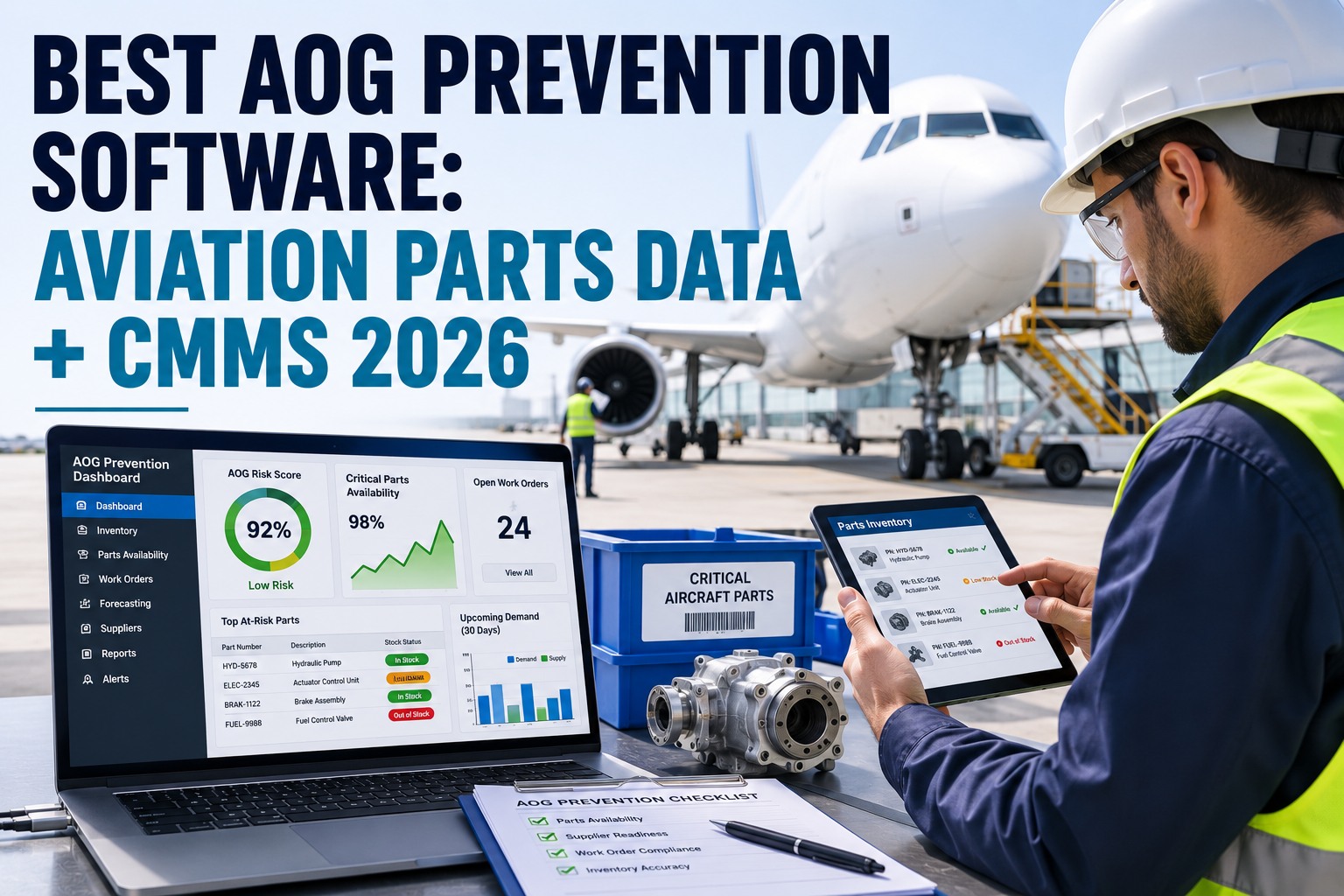
Every part on a certificated aircraft falls into one of three categories, and getting that classification wrong is where audits go sideways. A rotable that's tracked like a consumable loses its individual life record. A life-limited part with a gap in its history — one missing installation date, one untranslated overseas record — doesn't just get flagged, it gets retired early, regardless of how much service life physically remains. This guide covers how rotable, repairable and consumable parts actually need to be tracked, what an LLP counter is measuring, and what a traceability audit trail needs to hold up under an EASA or FAA review.
Aviation Parts Tracking · Rotable · Repairable · Consumable · 2026
One Missing Record Shouldn't Ground an Aircraft
A rotable pulled for overhaul, a life-limited part approaching its cycle limit, a batch of consumables nearing shelf-life expiry — each needs a different tracking rule, and a gap in any of them turns a routine audit into a grounded aircraft. OXMAINT AI tracks every part by its actual classification: serial-controlled history for rotables, LLP counters against cycles and hours, and batch traceability for consumables — with the Form 1 / 8130-3 chain attached at every step.
3 classes
rotable, repairable & consumable — each governed by a different tracking rule
Form 1 / 8130-3
the release document required at every return from a Part-145 or FAA repair station
Back-to-birth
the unbroken record every life-limited part must carry from manufacture forward
145.A.42 / §145.211
the EASA & FAA rules requiring full traceability on every installed part
Three Classifications, Three Tracking Rules
Misclassifying a part isn't a paperwork nuance — it changes what documentation is required, whether a life record gets kept, and whether an audit finding is waiting downstream. Start free and classify your inventory correctly from day one.
What an LLP Counter Is Actually Measuring
A life-limited part isn't retired because it's old — it's retired because it has accumulated a defined amount of stress, measured one of three ways, and the counter has to be exact. Book a demo to see LLP counters trended against your fleet's actual utilization.
🔄
Cycles
Takeoff-and-landing cycles — the standard for engine discs and many rotating components.
⏱️
Hours
Accumulated flight hours — used for components whose fatigue tracks with time in operation.
📅
Calendar Time
Fixed shelf or service life regardless of usage — common for seals, batteries and pyrotechnics.
The Back-to-Birth Chain — What Can't Have a Gap
Every stage a life-limited part passes through has to leave a documented trace. Break the chain at any single point, and the part's remaining life can no longer be verified — which regulators treat as grounds for early retirement, not a paperwork inconvenience to fix later.
🏭
Manufacture
Original Form 1/8130-3 issued at production.
→
✈️
Install
Logged against tail number, with cycle/hour baseline recorded.
→
🔧
Remove & Overhaul
Removal reason logged; new release tag issued from the repair station.
→
🔁
Reinstall
Accumulated life carries forward, unbroken, to the next installation.
Every Part, Tracked the Way Its Classification Requires
OXMAINT AI keeps serial-controlled history for rotables, LLP counters ticking against cycles and hours, and batch traceability for consumables — with every Form 1/8130-3 captured at receipt, so a full traceability package is a query, not a week of digging through paper tags.
Receiving: The Gate Every Part Has to Pass Through
No part should reach "available" status without clearing this check — it's the point where a traceability gap either gets caught or gets buried in inventory. Sign up free and enforce this as a hard gate on receipt.
✓
Form 1 / 8130-3 verified — issuing organization approval and signature checked, not just presence confirmed.
✓
Part number & serial number matched against the documentation, not just the shipment label.
✓
Shelf-life items checked and dated — expiry calculated from manufacture or cure date at receipt.
✓
LLP accumulated life confirmed against the previous operator's or lessor's movement history sheet.
✓
Consumable batch linked to CoC so any work order using that batch traces back to its certificate.
✓
Discrepancies rectified before "available" — a part doesn't enter serviceable stock with an open question.
Frequently Asked Questions
What's the difference between a rotable and a repairable part?
In practice the terms overlap — both describe serialized components that are repaired or overhauled rather than discarded. "Repairable" is sometimes used more specifically for parts that can be economically repaired versus rotables generally, but both require individual serial tracking and a Form 1/8130-3 at each return from a repair station.
What happens if an LLP's back-to-birth record has a gap?
A gap in the documented history typically means the part's remaining life can no longer be verified, which generally requires premature retirement of the part — regardless of how much physical service life it may actually have left. This is why every installation, removal and overhaul event needs to be logged without exception.
Do consumable parts need any traceability at all?
Yes, though less than rotables — consumables are tracked by part number and batch/lot rather than individual serial number, linked to a certificate of conformance, and (for shelf-life items) tracked to an expiry date. They don't carry an individual life record the way a serialized rotable does.
Can OXMAINT AI manage kanban-style replenishment for consumables alongside serial tracking for rotables?
Yes — consumables with high, predictable usage can be managed with min/max or kanban-style reorder triggers, while rotables and LLPs are tracked individually by serial number with their own life records, all within the same parts inventory system.
How is an LLP's remaining life actually calculated?
Remaining life is the part's regulator- or manufacturer-set limit (in cycles, hours, or calendar time) minus its accumulated life to date, drawn from the unbroken back-to-birth record of installations, removals and logged utilization across every operator and aircraft it has served on.
Track Every Part the Way Its Classification Actually Requires.
Serial-controlled rotables, LLP counters against cycles and hours, batch-traceable consumables — all with Form 1/8130-3 captured at receipt, so your next traceability package is a query, not a scramble.