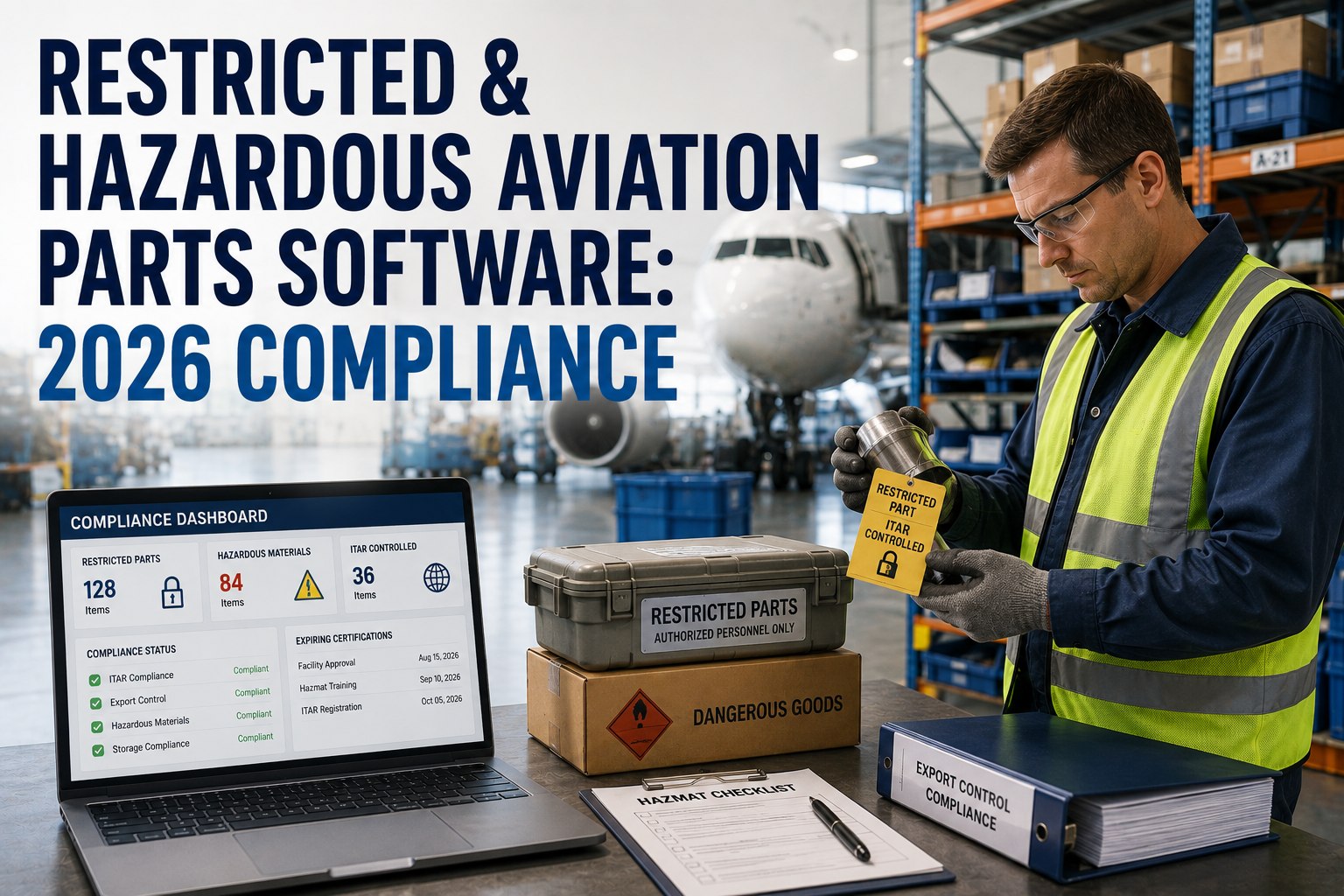
Restricted and hazardous aviation parts sit at the intersection of three overlapping compliance regimes — export control (ITAR + EAR), dangerous goods transport (IATA DGR + 49 CFR), and airport-side restricted-part accountability — and getting any one wrong exposes the airport, the MRO, and the parts custodian simultaneously. More than 1.25 million dangerous goods shipments move by air each year, roughly 70% of DG non-compliance incidents stem from incorrect classification rather than packing failure, and the 2026 IATA DGR 67th Edition (effective January 1, 2026) makes lithium battery state-of-charge limits mandatory rather than recommended UN 3480 lithium ion batteries shipped alone must now transport at ≤30% design capacity or ≤25% indicated. On the export-control side, ITAR-listed avionics and EAR-controlled hardware demand ECCN classification, end-use screening, and chain-of-custody records that a generic parts inventory system simply can't produce. The regulator's question is always the same: show me the record. Book a Demo to see OxMaint's restricted-parts module — UN code, ECCN, SoC limits, UN 38.3 test summary, and full chain of custody, one filter click each.
Aviation · Restricted & Hazardous Parts · CMMS 2026
Restricted & Hazardous Aviation Parts Software: 2026 Compliance
Manage restricted, hazardous, and export-controlled aviation parts with the best 2026 CMMS — one platform tracking EAR, ITAR, IATA DGR, and 49 CFR compliance across every hazmat SKU, lithium battery, and controlled part.
1.25M+
Dangerous goods shipments moved by air each year worldwide (IATA)
~70%
DG non-compliance incidents traced to incorrect classification, not packing failure
Jan 1, 2026
IATA DGR 67th Edition effective — lithium SoC limits now mandatory
3 Regimes
Export control (ITAR/EAR) + Dangerous goods (DGR/49 CFR) + Airport restricted parts
The 3 Overlapping Regimes — Where Compliance Actually Lives
Most parts compliance failures happen because teams treat these as three separate systems — export control in one binder, hazmat in another, airport restricted-parts in a spreadsheet — when the same physical part often falls under all three. Below is the stack that shows where each regime governs, and where they overlap. Start a free OxMaint workspace and register your first restricted part against all three regimes in a single record — the aviation library includes ECCN + UN code + SoC fields on the parts template out of the box.
ITAR
International Traffic in Arms Regulations
U.S. Department of State · 22 CFR 120–130
Defense articles + technical data on the U.S. Munitions List (USML). Categories VIII (aircraft/associated equipment) + XV (spacecraft) capture most aviation-related items. Requires DDTC registration + license.
EAR
Export Administration Regulations
U.S. Department of Commerce · 15 CFR 730–774
Dual-use items on the Commerce Control List (CCL). Every controlled item has an ECCN classification. End-use, end-user, and destination screening required per BIS lists (Entity List, Denied Persons).
DGR
Dangerous Goods Regulations
IATA DGR 67th Edition · ICAO Technical Instructions · 49 CFR
Air transport of hazmat: 9 hazard classes, UN codes, packing groups, Shipper's Declaration for Dangerous Goods (SDDG), operator variations, state variations (Thailand, France, UK notable for 2026).
RESTRICTED
Airport Restricted Parts & TSA Chain of Custody
TSA + Part 139 tenant coordination
Physical accountability on the airfield: controlled tools, security-sensitive items, restricted-area storage, chain-of-custody records surviving shift changes and multi-vendor handoffs.
The 9 IATA DGR Hazard Classes — Airport & Aviation Examples
Every hazmat SKU on the airfield belongs to one of nine IATA DGR classes. Airport operations touch most of them regularly — hydraulic fluids (Class 3), cleaning solvents (Class 3 or 8), oxygen generators (Class 5.1), fire suppression canisters (Class 2), and lithium-powered avionics (Class 9). Below is the coverage grid. Book a live demo to see the DGR classification workflow demonstrated against your airport's specific hazmat inventory — an OxMaint specialist walks classification + packing group logic on your actual SKU list during the call.
Lithium Batteries — The 2026 State-of-Charge Rules Every Airport Must Enforce
The IATA DGR 67th Edition (effective January 1, 2026) makes state-of-charge limits mandatory for lithium ion batteries shipped by air — previously these were recommendations. Airports and their MRO partners now enforce a hard SoC ceiling at packaging, and OxMaint captures the reading against every shipment. Sign up free and every lithium battery record in OxMaint gets its own SoC-check field, UN 38.3 test-summary attachment, and 2026-effective mandatory-limit enforcement.
2026 IATA DGR · LITHIUM BATTERY SoC LIMITS · MANDATORY JAN 1
UN 3480
Lithium Ion Batteries · Shipped Alone
≤ 30% design capacity
or ≤ 25% indicated
Standalone lithium ion cells/batteries shipped as cargo. Prior recommendation now mandatory.
UN 3090
Lithium Metal Batteries · Shipped Alone
Prohibited on US
passenger aircraft
US-specific: primary lithium metal batteries banned from passenger-carrying aircraft under 49 CFR.
UN 3481
Lithium Ion Batteries · Contained In / Packed With Equipment
≤ 30% / ≤ 25%
if standalone thresholds apply
Batteries installed in devices (avionics, portable test equipment). Adequate instruction under DGR 1.6 required.
UN 3556
Lithium Ion Battery-Powered Vehicles
≤ 30% design capacity
when battery > 100 Wh
Airside electric GSE, battery-powered tugs, mobile equipment. 2026 SoC limit applies to any Wh > 100.
All lithium/sodium batteries manufactured after 30 June 2003 require a UN 38.3 test summary to be made available — OxMaint accepts direct attachment or QR-code linkage to the manufacturer's digital summary.
70% of DG Failures Are Classification, Not Packing.
You can't pack your way out of the wrong UN code. OxMaint enforces classification at part-record creation — UN code, hazard class, packing group, ECCN, SoC limits — so downstream shipping, storage, and shift handovers all inherit the correct treatment automatically.
The Restricted Part Record — 12 Fields OxMaint Captures Per SKU
A restricted or hazardous aviation part demands more than a stock number. Below is the record schema OxMaint enforces at part-record creation — every field mandatory for its regime. The record shape below is the actual OxMaint template for a restricted / hazmat SKU. Schedule a walkthrough to see the record schema applied to your specific aviation parts catalog — an OxMaint specialist configures the classification workflow against your MRO's actual SKU list during the call.
RESTRICTED / HAZARDOUS PART RECORD · OxMAINT SCHEMA
SKU-RH-000247
Description
Human-readable part name
UN Code · IATA Class
e.g. UN 3480 · Class 9
Packing Group
I / II / III
USML Category (if ITAR)
e.g. VIII(h) · XV(a)
SoC Limit (Li batteries)
≤ 30% design / ≤ 25% ind.
UN 38.3 Test Summary
PDF attach / QR link
Storage Zone
Restricted-access location
Chain of Custody
Every touch e-signed
Expiry / Shelf Life
Auto-alert at 30 days
SDDG Required?
Yes / No · triggers form
Fields marked in amber are regime-mandatory — OxMaint refuses to save the record until they are populated. No workaround, no override, no unclassified restricted part reaching the airside.
Spreadsheet Inventory vs. OxMaint Restricted-Parts Module
Spreadsheet-based hazmat and ITAR inventory is the single biggest source of the classification errors that produce 70% of DG failures. Below is what changes when the same parts list moves into OxMaint's restricted-parts module. Start free and import your existing hazmat catalog via CSV in your first week — OxMaint validates classification fields on import and flags SKUs missing required regime attributes.
"
Our previous system for restricted parts was a hazmat spreadsheet, an ITAR spreadsheet, and a security-sensitive spreadsheet — none of them talked to each other, and the same physical part often lived on all three with slightly different classifications. When the FAA and Commerce Department showed up in the same quarter, we spent two weeks reconciling records. In OxMaint, every restricted or hazardous part is one record with UN code, ECCN, USML category, SoC limit, and chain of custody all populated at creation. The 2026 SoC rules landed in January — we updated our mandatory-field configuration in an afternoon. Zero shipping rejections since.
Head of MRO Supply Chain · Regional Aviation Maintenance Provider · 3 hangars · Mid-Atlantic USA
Frequently Asked Questions
What's the difference between ITAR and EAR?
ITAR (International Traffic in Arms Regulations, 22 CFR 120–130) is administered by the U.S. Department of State's DDTC and covers defense articles + technical data on the U.S. Munitions List. EAR (Export Administration Regulations, 15 CFR 730–774) is administered by Commerce's BIS and covers dual-use items on the Commerce Control List with ECCN classifications. Some aviation items fall under one, some under the other, and a few migrate between them following export-control reform.
What are the 2026 lithium battery SoC limits I need to enforce?
Starting January 1, 2026, UN 3480 lithium ion batteries shipped alone must be transported at ≤30% of rated design capacity or ≤25% indicated battery capacity. UN 3556 lithium ion battery-powered vehicles with battery capacity greater than 100 Wh follow the same limit. These are mandatory requirements — no longer recommendations.
Start free on OxMaint to enforce SoC checks as a mandatory field on every lithium battery shipment.
Why are so many DG failures classification errors rather than packing errors?
Approximately 70% of DG non-compliance traces to incorrect classification — wrong UN code, wrong packing group, wrong hazard class. You cannot pack your way out of a wrong classification because every downstream requirement (packing group, labeling, SDDG, operator variation, state variation) flows from the classification. OxMaint enforces classification at part-record creation so downstream processes inherit correct treatment automatically.
What's a UN 38.3 test summary and why does OxMaint capture it?
The UN 38.3 test summary is required for every lithium and sodium ion battery manufactured after 30 June 2003, per Subsection 38.3 of the UN Manual of Tests and Criteria. The regulatory obligation is to make it available (paper or digital, including QR code). OxMaint attaches the summary PDF or QR link directly to the part record so it's producible on demand for any regulator, MRO customer, or carrier acceptance check.
Does OxMaint handle the Shipper's Declaration for Dangerous Goods (SDDG)?
Yes. OxMaint auto-generates the SDDG from the part record and destination — pre-populated with correct classification, UN code, packing group, quantity, and any applicable state/operator variations for 2026 (Thailand, France, UK have notable variations). The completed form is timestamped and retained against the shipment record.
Book a demo to see SDDG generation live against a sample shipment.
Can OxMaint enforce restricted-area access for security-sensitive parts?
Yes. Restricted parts are tagged to specific storage zones with access enforced by role. Every check-out and check-in requires an e-signature, and chain of custody is unalterable — a critical requirement for TSA-coordinated restricted-area accountability and for MROs handling security-sensitive items across shift changes.
Does OxMaint replace our export-control screening tools?
OxMaint holds the ECCN classification and USML category as fields on the part record, but integrates with rather than replaces dedicated export-control screening tools (Entity List, Denied Persons, sanctioned countries). The parts record is where classification lives; the screening tool remains the source of truth for end-user + destination checks.
Start a free workspace to test the integration approach with your existing export-control stack.
One Record Per Part. Three Regimes Enforced. Zero Reconciliation Weeks.
OxMaint's restricted-parts module holds ITAR + EAR + IATA DGR + airport chain-of-custody as fields on a single part record — with mandatory classification, 2026 SoC enforcement, UN 38.3 attachment, and one-click regulator export. The audit trail assembles itself as work happens, not the week before the inspector arrives.