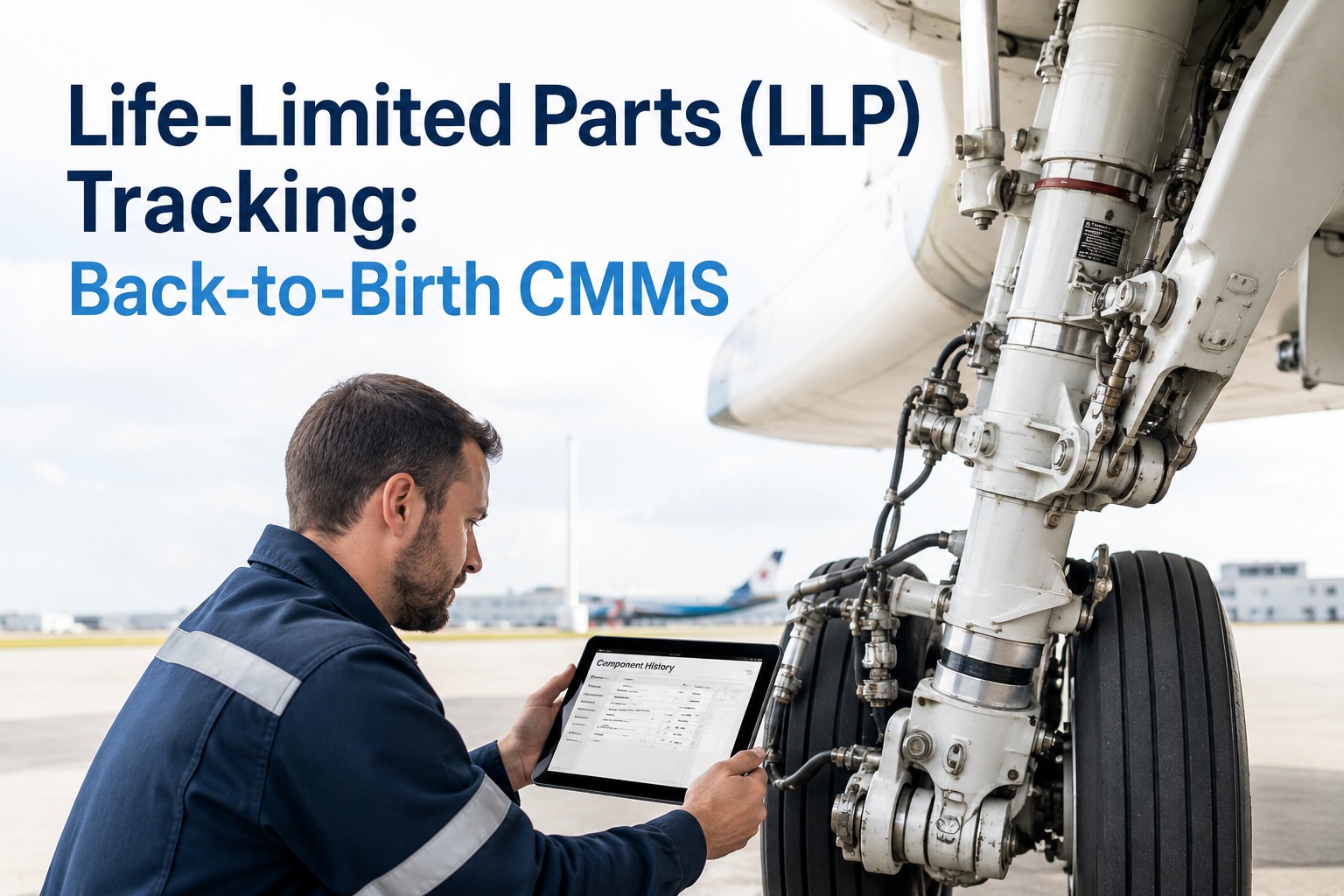
A turbine disc is not just a part — it is a document trail with a metal core. From the moment it leaves the OEM with its birth certificate, every hour it flies, every engine it is fitted to, and every shop it passes through must be recorded in an unbroken chain. Break that chain — lose the paperwork for one installation, one owner, one overhaul — and the rule is unforgiving: with no traceability, the part must be treated as having zero life remaining, no matter how many cycles it actually has left. A disc worth a quarter of a million dollars becomes scrap, not because it is worn, but because its history cannot be proven. This is the discipline of life-limited-part tracking: a serial-number ledger, maintained back to birth, that says exactly how much life every critical component has left and proves it to any auditor or lessor. This guide covers how LLP tracking works and how a CMMS keeps the chain intact. Start a free Oxmaint trial to track every LLP by serial number with back-to-birth records, or book a demo to see remaining-life tracking and traceability gap detection live.
Aviation · Continuing Airworthiness · Component Traceability
Life-Limited Parts (LLP) Tracking & Back-to-Birth Records
Back-to-birth records, remaining life by hours, cycles, and calendar, and serial-number traceability — how operators, MROs, and lessors track every life-limited component from manufacture to retirement and prove an unbroken chain on demand.
-
Zero
life a part is credited with when its traceability chain is broken
-
Mandatory
the replacement limit on an LLP — zero tolerance for exceedance
-
Life + 90d
records retained past a part's remaining life under FAA rules
-
EOL
at end of life an LLP is permanently scrapped, never overhauled back
What Makes a Part Life-Limited
The Parts You Cannot Overhaul Back to Life
A life-limited part carries a mandatory replacement limit set in the type design — not a recommendation. When it reaches that limit, it must come off and be permanently removed from the supply chain. This is what separates an LLP from a hard-time part, and why its records matter more than almost anything else on the aircraft.
-
Life-Limited Part
Turbine and compressor discs, fan blades, shafts, certain structural parts. Mandatory cycle or hour limit. At end of life it is scrapped — never restored to service. Traceability must be unbroken back to birth.
-
Hard-Time Part
Landing gear assemblies and similar. Reach a limit, then are overhauled, tested, and returned to service. Reusable — though a gear can be both hard-time and carry life-limited sub-components.
Common LLPs are the parts whose failure is catastrophic: engine discs, fan blades, high-pressure turbine blades, and shafts. There is no inspection that buys them extra life — only the counter and the record.
The Unbroken Chain
One Part, Cradle to Retirement
Back-to-birth means exactly that: a continuous, certified record from the day the part was made to the day it is scrapped. Every link must connect to the next, with the right paperwork at each handoff. Follow a single disc through its life — and see where the chain can break.
-
Birth
8130-3 / EASA Form 1 The OEM issues the part with a serial number and its birth certificate — the production conformance document that starts the chain and can never be reissued. -
Installation
Install record + times Fitted to an engine or aircraft by an approved organization. Total time on the aircraft at install and the part's own accumulated time are logged. -
Service & Accrual
Certified hours on wing Every flight adds hours and cycles. The certified record of time-on-wing is the core of continuing-airworthiness proof. -
Removal & Transfer
Movement history sheet Removed "part life" and moved to another engine, sold, or stored. The history sheet must travel with the part — the most common place the chain breaks. -
Retirement
Disposition record At its mandatory limit the part is permanently removed and mutilated so it can never re-enter service. The retirement record closes the chain and proves the limit was never exceeded.
The Unforgiving Rule
No Traceability Means No Life
This is the principle that makes records worth more than the metal. If the chain is broken — a missing Form 1, an unexplained gap between removal and reinstallation, an overhaul with no reference — the part cannot be trusted, and the safe assumption is zero life remaining.
- 1 A record goes missing One installation period has no certified time log, or a part changes hands without its movement history sheet following it.
- 2 Remaining life cannot be proven The accumulated cycles for that gap are unknown. There is no way to certify how much of the mandatory limit is actually left.
- 3 The part is treated as zero life A component with real cycles left is grounded or scrapped — a six-figure disc written off over a paperwork gap, not a mechanical one.
- ✓ A digital ledger prevents the gap Each serialized part carries a perpetual, connected history — every install, removal, and Form 1 linked, with gaps flagged before they become a write-off.
What the Record Must Prove
Remaining Life, on Three Counters
Regulators require the record to show current status and remaining life against every applicable limit. Many LLPs carry more than one, and the part retires at whichever is reached first. These are the data points the chain has to carry for every serialized part.
| Data Point | What It Records |
|---|---|
| Time Since New (TSN) | Total flight hours accumulated since manufacture |
| Cycles Since New (CSN) | Total flight cycles since manufacture — often the governing limit |
| Calendar age | Elapsed time from manufacture, where a calendar limit applies |
| Remaining life | Limit minus accumulation, calculated per counter |
| Installation history | Every aircraft or engine the part has been fitted to, with times |
| Birth & release refs | Original 8130-3 / Form 1 and each subsequent release document |
Under FAA §43.10 and §91.417, the record must show time in service, install date, aircraft time at install, and time since new or overhaul; EASA M.A.305 requires accumulated time, cycles, and remaining life to the limit. Book a demo to see TSN, CSN, and remaining life tracked on every serialized LLP.
Records Are the Asset
On a Leased Aircraft, the Paperwork Is Worth as Much as the Part
With most of the world's commercial fleet now leased, the lessor's business is preserving asset value — and an aircraft with poor technical records loses value even when it is fully airworthy. Lease agreements routinely demand back-to-birth and back-to-overhaul traceability and a contractually agreed amount of life remaining on every LLP at return. A structured digital record turns a lease return, a pre-buy, or an audit from weeks of paper archaeology into a package generated on demand — and protects the residual value of the whole aircraft.
Oxmaint for LLP Tracking
How Oxmaint Keeps the Chain Intact
-
Serial-Number Ledger
A Perpetual History Per Part
Every serialized LLP carries a continuous record — manufacture date, birth certificate reference, and a chronological ledger of every installation, removal, overhaul, and release since new.
-
Remaining Life
TSN, CSN & Calendar, Live
Time and cycles since new tracked against each mandatory limit, updated automatically from flight data, with remaining life displayed per counter and a removal forecast per part.
-
Gap Detection
Broken Chains Flagged Early
The system evaluates each part for chain completeness — a removal-to-install gap without a Form 1, or a claimed overhaul with no reference — and flags it for investigation before it becomes a write-off.
-
Document Linking
Every 8130-3 and Form 1 Attached
Birth certificates and each subsequent release document linked directly to the part's history — so the certified evidence lives with the record, not in a separate filing cabinet.
-
Removal Alerts
Planned, Never Overrun
Configurable alerts at 10% and 5% remaining on any counter give enough lead time to plan removal into a shop visit — and enforce the zero-tolerance limit that an LLP can never exceed.
-
Traceability Export
Back-to-Birth Package on Demand
A complete, indexed back-to-birth dossier for any part or aircraft, generated in minutes — the traceability record a pre-buy, lease return, or authority audit requires, with zero gaps.
Frequently Asked
LLP & Back-to-Birth Questions
What happens if an LLP's traceability chain is broken?
If back-to-birth traceability cannot be established — a missing release document, an unexplained gap in the history — the part must be treated as having zero life remaining. A component with real cycles left can be forced into early retirement or scrapped purely because its history cannot be proven, which is why the record is often worth as much as the part itself. Sign up for Oxmaint to keep every LLP's chain connected and gap-free.
What documents make up a back-to-birth record?
The chain starts with the birth certificate — the OEM production conformance document, FAA 8130-3, or EASA Form 1. It then includes a record of every operator and MRO the part passed through, a certified record of the hours and cycles it accumulated on wing, and a non-incident/non-accident statement. Each installation, removal, and overhaul must have its own certified release linking to the next.
How is a life-limited part different from a hard-time part?
A life-limited part has a mandatory replacement limit and must be permanently removed from service at end of life — it can never be overhauled back into use. A hard-time part reaches a limit and is then overhauled, tested, and returned to service. A landing gear can be both: a hard-time assembly that also contains life-limited sub-components. Book a demo to see LLP and hard-time components tracked distinctly.
How long must LLP records be retained?
Under FAA rules, life-limited-part records are retained for the remaining life of the part plus a period after permanent removal. EASA requires records for critical components to be kept for extended periods. Best practice is to retain the full history for the entire life of the part plus a safety margin — because the moment a record is lost, the part's provable life resets to zero. Sign up for Oxmaint to retain every LLP record for the life of the part and beyond.
Birth · Track · Prove
The Cycles Are in the Metal. The Life Is in the Record.
A life-limited part is only worth its remaining life if that life can be proven — and one lost document turns a valuable component into scrap. Oxmaint gives operators, MROs, and lessors one platform to track every LLP by serial number, maintain an unbroken back-to-birth chain, calculate remaining life on every counter, flag traceability gaps early, and produce a complete traceability package on demand.