In 2023, thousands of aircraft engine parts entered the global fleet with forged certificates from a distributor that turned out to be selling paperwork as much as hardware. The AOG Technics scandal was the wake-up call the industry had been putting off: a part's airworthiness is only as trustworthy as its paper trail, and paper can be faked, lost, or quietly "improved." Blockchain answers that specific problem — a tamper-evident, shared record that makes a part's back-to-birth history verifiable instead of merely claimed. But here's the honest part most vendor decks skip: blockchain by itself is a filing cabinet, not a maintenance program. It proves a part is genuine; your CMMS is where that verified part becomes an installed, life-limited, work-ordered asset. This 2026 guide compares the real blockchain traceability landscape, what actually separates a usable platform from a pilot, and where OxMaint's maintenance management software turns verified provenance into operational control.
Aviation · Parts Traceability · Blockchain × CMMS · Buyer's Guide 2026
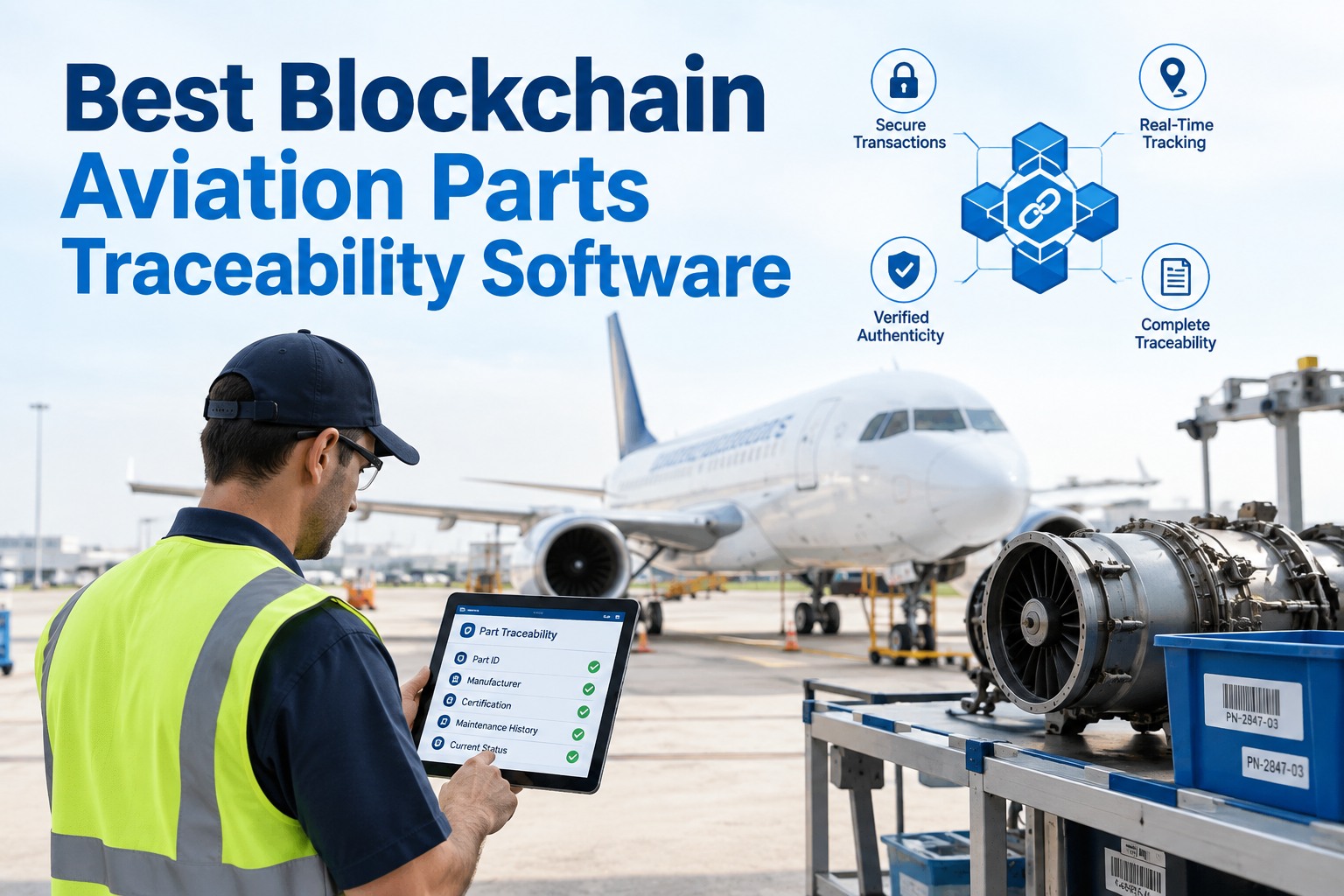
Best Blockchain Aviation Parts Traceability Software
Blockchain verifies a part is genuine. A CMMS makes it operational. The best 2026 setups pair a narrow-use traceability ledger with the maintenance system that turns a verified part into a tracked, life-limited asset.
$765B
global aircraft-parts market — engines ~47% of MRO spend
5–20%
MRO cost reduction analysts attribute to blockchain traceability
4 gaps
transition points where a part "goes dark" in its lifecycle
Permissioned
aviation uses private, access-controlled chains — not public crypto
Where Parts Go Dark — The Problem Blockchain Targets
Part traceability doesn't fail because the process is missing — it fails at four specific handoffs where visibility drops and the paper trail can be broken or faked. These are the gaps a traceability ledger is built to close. Sign up free and OxMaint anchors each part to its asset record so the history survives every handoff.
Gap 1
Distribution → Installation
A part leaves the OEM with a certificate; by install, that cert can be substituted or forged. The AOG Technics gap.
Gap 2
Aircraft → Aircraft Transfer
When a component moves airframes, its accumulated life and history often don't move with it cleanly.
Gap 3
Into & Out of Repair
A shop visit can update the part without a verifiable link back to its origin record — the chain of custody thins.
Gap 4
Lease Return / Resale
Residual value and airworthiness both hinge on provable back-to-birth history — exactly where records are weakest.
The Digital Pedigree: Blockchain Is One Layer of Four
No single technology solves traceability — the credible approach stacks four layers into what the industry calls a part's "digital pedigree." Blockchain is the trust layer; it's worthless without the identity, data, and operational layers around it. This is why a blockchain-only pitch should raise an eyebrow. Book a demo to see the operational layer on your fleet.
Layer 4 · Operational
The CMMS — where a verified part becomes an installed asset with PM, life limits and work orders. Where provenance becomes action.
Layer 3 · Trust
Blockchain — makes the back-to-birth record tamper-evident and shareable across OEM, MRO, airline and lessor.
Layer 2 · Data
Spec 2000 / standardized records — the common format so records mean the same thing to every party.
Layer 1 · Identity
Serialized part marking (DPP, laser-etch, RFID) — the physical anchor tying the atom to the record.
The Real Landscape — Narrow-Use, Consortium-Led
Be clear-eyed about maturity: aviation blockchain is real but narrow, advancing through consortia and point solutions rather than one universal ledger. Here's the honest map of who's doing what, and what it means for a buyer in 2026. Sign up free and start with the operational layer you control today.
Consortium Ledgers
Industry alliances (e.g. SITA's MRO Blockchain Alliance with airlines, HAECO, lessors and Ramco) building shared track-and-trace. Powerful — but value depends on everyone joining.
Marketplace Provenance
Parts e-commerce with blockchain-backed certificates (e.g. Honeywell GoDirect Trade) proving a listing's pedigree. Strong for buying; scoped to the marketplace.
Point Platforms
Focused vendors (e.g. Block Aero, SkyThread) offering Spec 2000-compatible ledgers and back-to-birth tracking. Nimble, narrow, interoperability-dependent.
The CMMS Layer
Where any of the above becomes operational — the verified part installed, tracked and maintained. The layer you can deploy now, without waiting for industry consensus.
A Ledger Nobody Else Joined Is Just an Expensive Database.
Blockchain's value is network-dependent: it only works when OEMs, MROs, airlines and lessors adopt the same standards — and full FAA/EASA recognition of digital traceability as legally valid is still maturing. That's the risk in a blockchain-first strategy. The de-risking move is to get your own house in order first: a clean, serialized, life-limit-tracked asset register in a CMMS that can ingest a blockchain record whenever the network arrives. OxMaint is that ready operational layer.
The 2026 Evaluation Scorecard
Score any traceability platform on the seven capabilities that decide whether it becomes an operating tool or a stranded pilot. The distinguishing test in 2026 is whether provenance connects to execution — a ledger that can't drive a work order is a museum of certificates. Book a demo to score OxMaint against your own criteria.
01
Permissioned Architecture
Private, access-controlled chain with clear on-chain vs off-chain data rules — not a public crypto ledger.
Must-have
02
Spec 2000 / Standard Data
Records in the industry format so they interoperate with other systems and parties, not a walled garden.
Must-have
03
CMMS / ERP Integration
Writes provenance into the maintenance system so a verified part becomes a tracked, life-limited asset.
Must-have
04
Back-to-Birth Continuity
Unbroken life-consumed record that survives every transfer, repair and lease return.
Must-have
05
Serialized Part Identity
A physical anchor — laser-etch, RFID, digital product passport — tying the record to the actual component.
High-value
06
Smart-Contract Compliance
Automated checks that flag a non-conforming or out-of-cert part before it's installed.
High-value
07
Regulator-Ready Records
Audit trails structured for the day FAA/EASA formally accept digital traceability as compliance evidence.
High-value
Blockchain-Only vs. Blockchain + OxMaint CMMS
The dividing line in 2026 isn't which ledger — it's whether provenance ever reaches the technician and the work order. Here's what a verification layer alone leaves on the table, and what the operational layer adds. Start free and build the operational layer this week.
Why OxMaint Is the Layer to Start With
You can't control when the industry agrees on one ledger — but you can control your own asset register today. OxMaint is the operational layer a traceability strategy needs first and integrates with later, so verified provenance becomes installed, tracked, maintained reality. Here's the mapping. Book a demo to see it on your fleet.
Serialized Asset Register
Every component tracked by serial with back-to-birth life history — the operational home a blockchain record plugs into.
Life-Limit & Cycle Tracking
Hours, cycles and calendar limits per part, with retirement alerts — turning a static provenance record into active control.
Install-Time Verification
A part with incomplete or non-conforming records can be flagged before it's installed against an asset — the AOG Technics check.
Open API for Ledger Feeds
Ingests provenance from blockchain and Spec 2000 sources, so the CMMS is ready when your network partners come online.
Mobile Technician Execution
Scan, verify and install at the aircraft — the point where provenance either reaches the job or doesn't.
Audit & Lease-Return Records
Provenance plus maintenance history in one exportable record — for regulators, auditors and residual-value defense.
Use this guide plus OxMaint to close the traceability gaps you can close now — a clean, serialized, life-tracked asset register ready to ingest blockchain provenance as the industry network matures — so parts integrity is operational, not aspirational. Try OxMaint free or book a demo to see it on your operation.
"
After the counterfeit-parts scandal, leadership wanted "blockchain traceability" yesterday — but every platform we looked at only delivered value if our OEMs, MROs and lessors all joined the same network, and that consensus isn't here yet. What we could do immediately was fix our own side. We rebuilt our component register in OxMaint: every part serialized, back-to-birth life tracked, and a check that flags any part with incomplete records before it's installed. When a blockchain feed does mature, the API is ready to ingest it. In the meantime we already caught two parts with gaps in their paper trail that would have gone straight onto an aircraft. The ledger is the future; the operational layer is what protected us now.
Director of Materials & Component Management · Airline MRO
Frequently Asked Questions
Does aviation blockchain use public chains like Bitcoin?
No. Aviation uses permissioned, access-controlled chains, and a part's digital ID is a non-transferable audit trail — it tracks use and custody, not tradable ownership. Public-chain crypto models don't fit the sector's privacy and compliance needs.
Is blockchain parts traceability mature enough to rely on in 2026?
It's real but narrow — advancing through consortia and point platforms rather than one universal ledger. Value depends on network adoption, and regulators are still formalizing digital traceability as compliance evidence, so most deployments are scoped, not fleet-wide.
Why pair blockchain with a CMMS instead of using it alone?
Blockchain proves a part is genuine; it doesn't install it, track its life limits, or drive a work order. The CMMS is the operational layer that turns verified provenance into a maintained, life-tracked asset — the part of the stack you control today.
What should I do now if the industry network isn't ready?
Get your own register clean: serialized parts, back-to-birth life tracking, and install-time verification in a CMMS with an open API. That closes the gaps you control and leaves you ready to ingest a blockchain feed when partners come online.
How does OxMaint fit a traceability program?
It's the operational layer — the serialized, life-limited asset register that a blockchain record plugs into, with install-time checks and audit-ready export.
Sign up free to build it.
Verify the Part. Then Actually Manage It.
Blockchain makes a part's history tamper-evident; OxMaint makes that verified part an installed, life-tracked, work-ordered asset — with install-time checks and an API ready for the ledger networks as they mature. Build the operational layer you control now. Start free — no credit card, unlimited users, forever. Or book a demo.