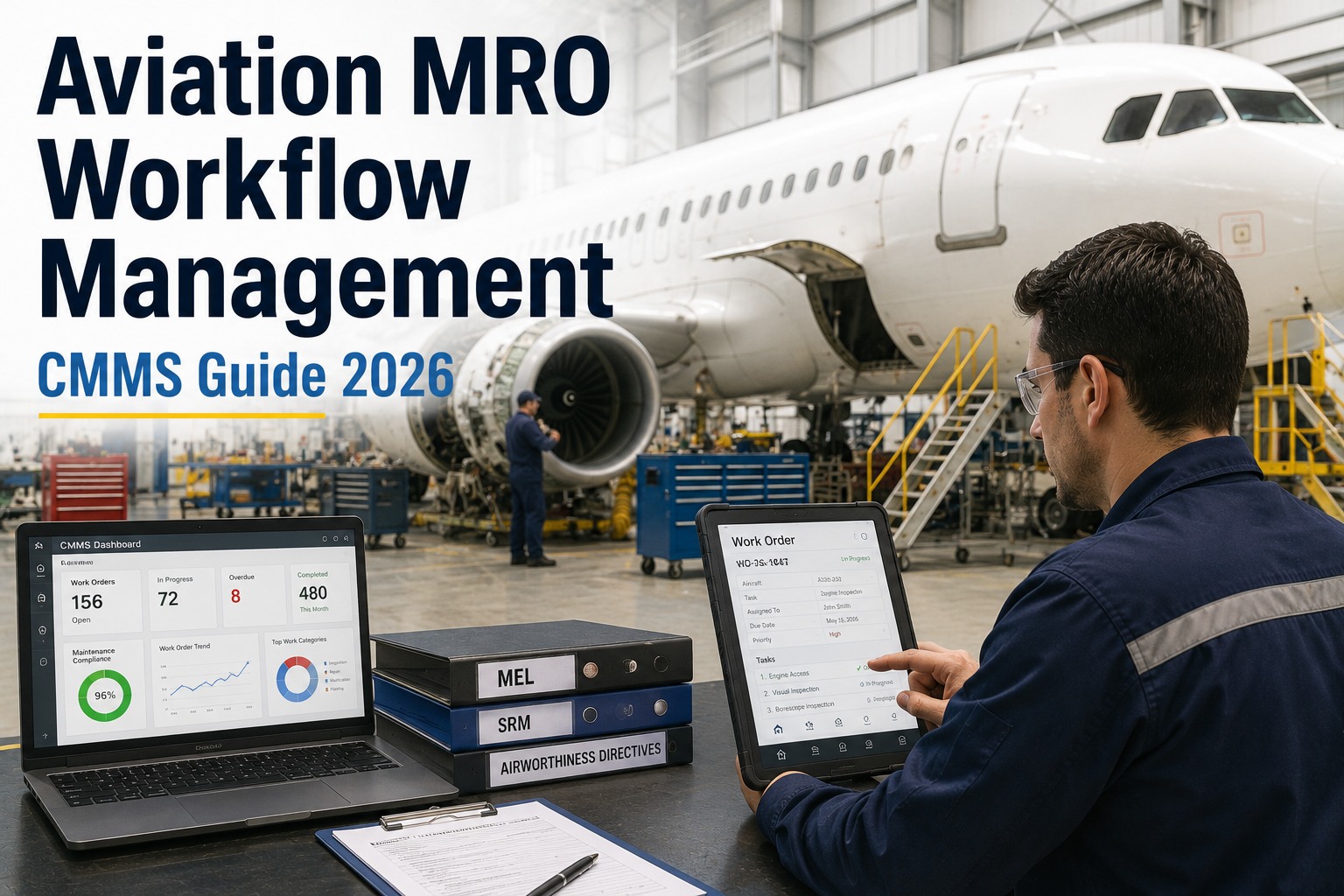
Aviation maintenance never sleeps. A single grounded aircraft costs carriers between $10,000 and $150,000 per hour in lost revenue, and the majority of those groundings trace back not to catastrophic failures—but to preventable paperwork gaps, missed work order handoffs, and fragmented MRO tracking. The gap between world-class aviation maintenance and average performance isn't skill—it's system. If your technicians are still chasing paper work cards, hunting for part histories, or re-entering data across disconnected platforms, the inefficiency compounds silently until it becomes a safety risk. Want to close that gap today? Start a free trial for 30 days and see what modern aviation work order management actually looks like in practice.
AVIATION CMMS INTELLIGENCE
Aviation Work Order Management: Complete CMMS Guide for MRO Efficiency
From work card creation to sign-off — eliminate delays, errors, and compliance gaps across your entire MRO operation.
68%
of MRO delays caused by paperwork bottlenecks
4.8x
higher cost for reactive vs. planned maintenance
$150K
per hour cost of AOG events for wide-body aircraft
35%
technician time lost to non-wrench activities
FOUNDATION
What Is Aviation Work Order Management?
Aviation work order management is the structured process of creating, assigning, executing, tracking, and closing maintenance tasks on aircraft and ground support equipment — from routine line checks to heavy C and D checks. It is the operational backbone of every MRO facility and airline maintenance department.
In practice, a work order is more than a task assignment. It is a living document that carries the full context of a maintenance event: the asset, the defect, the required skill level, the parts needed, the regulatory reference, the technician sign-off, and the audit trail. When this process runs cleanly, aircraft turn around faster, regulators are satisfied, and safety is never compromised. When it breaks down — through paper-based systems, siloed software, or poor data hygiene — the consequences range from costly delays to fleet-wide AOG events. Book a demo to explore how Oxmaint brings this clarity to your MRO operation.
Work Order
A formal instruction to perform a defined maintenance task on a specific asset, traceable from origin to closure.
Work Card
A detailed task instruction card linked to an AMM or SRM reference, issued as part of a work package.
MRO
Maintenance, Repair and Overhaul — the full spectrum of activities that keep aircraft airworthy and compliant.
CMMS
Computerised Maintenance Management System — the software platform that orchestrates all of the above with precision and audit-readiness.
FRAMEWORK
The Aviation Work Order Lifecycle — 8 Critical Stages
Every aviation work order, whether it's a scheduled A check or an unscheduled engine borescope, moves through eight distinct lifecycle stages. Failure at any stage degrades efficiency, compliance, or safety. Understanding each stage is the first step toward optimising your MRO workflow.
01
Identification & Initiation
Triggered by scheduled maintenance intervals, pilot defect reports (PDR), or engineering orders. The defect or task is logged with asset, symptom, and urgency classification.
02
Planning & Scoping
The work package is built: AMM references selected, tooling confirmed, parts sourced, skill levels and estimated man-hours assigned, and access requirements noted.
03
Approval & Release
Engineering or maintenance control reviews and signs off the work package before release to the hangar floor. Regulatory requirements and MEL/CDL checks are verified at this stage.
04
Scheduling & Dispatch
Work orders are assigned to technicians or teams based on skill, availability, and hangar slot. CMMS scheduling logic prevents conflicts and balances workloads across shifts.
05
Execution & Real-Time Tracking
Technicians execute tasks against work cards. Digital CMMS captures real-time progress, parts consumed, time logged, and any findings that trigger additional work orders.
06
Inspection & Quality Control
Required Inspection Items (RIIs) are signed off by independent inspectors. Non-conformances are flagged, dispositioned, and linked to the original work order for full traceability.
07
Certification & Sign-Off
Licensed Aircraft Maintenance Engineers (LAMEs/LAEs) certify task completion. Digital signatures with timestamp, licence reference, and authorisation scope create an auditable record.
08
Closure & Data Capture
The work order closes, feeding actual vs. planned hours, parts usage, and findings back into the asset history. This data drives future scheduling accuracy and CapEx forecasting.
PAIN POINTS
Where Aviation MRO Operations Break Down
The same problems appear in MRO facilities from Dallas to Dubai. They're not caused by bad technicians — they're caused by systems that weren't built for the complexity of modern aviation maintenance. These are the four most damaging failure points, and they compound each other in real operations. A free 30-day trial shows exactly where your current workflow is losing time and money.
CRITICAL
Paper Work Cards & Manual Sign-Offs
35% of technician time lost to paperwork
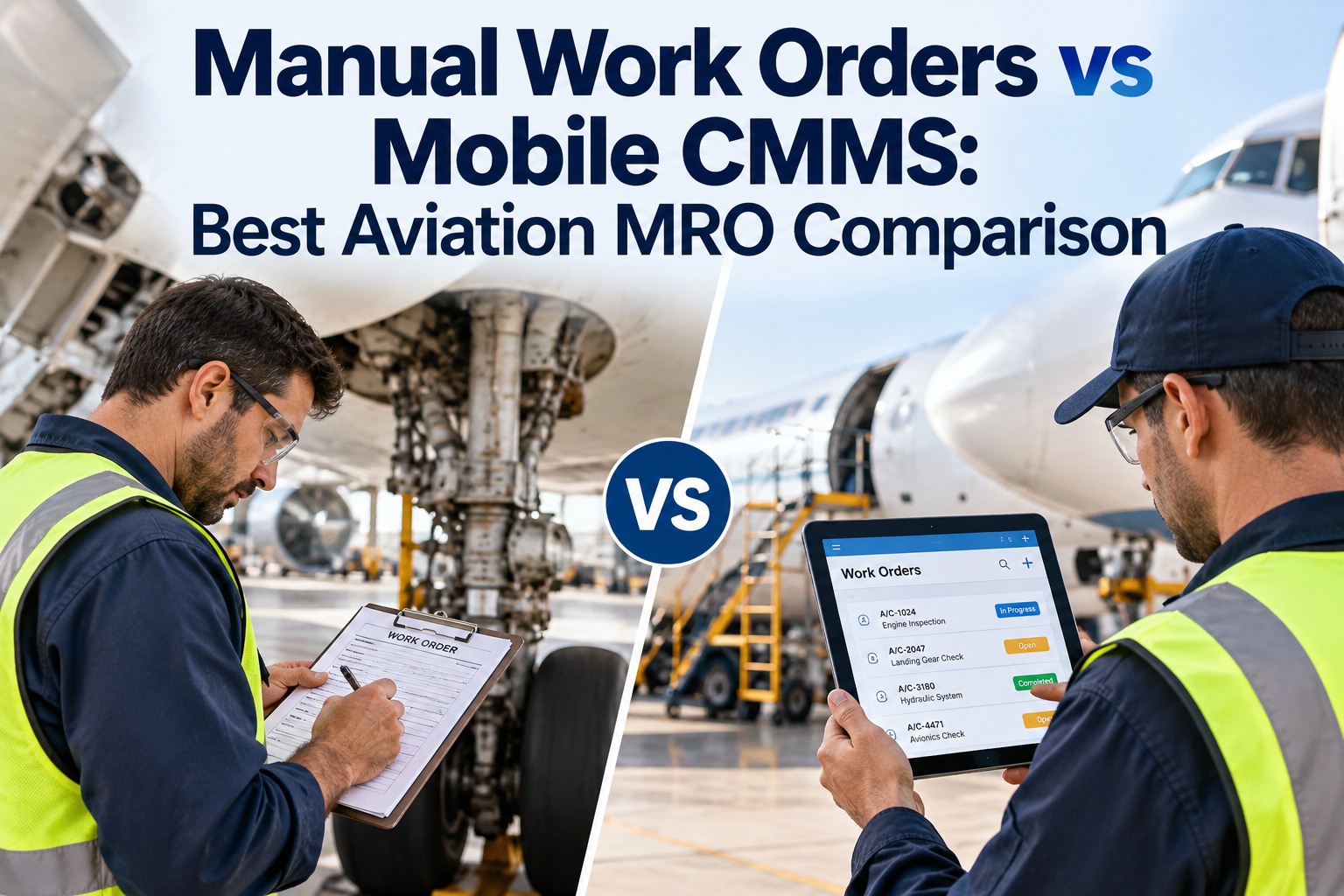
Physical work cards get lost, misread, or filed incorrectly. Manual data re-entry creates transcription errors that propagate into maintenance records and compliance reports. In a Part 145 audit, gaps in paper trails become findings.
HIGH IMPACT
No Real-Time Visibility Across Shifts
2.3 hours average delay at shift handover
When the outgoing shift has no structured way to communicate in-progress work order status, the incoming team spends the first hours of every shift reconstructing context. Aircraft sit idle while technicians hunt for information that should be instantly accessible.
HIGH IMPACT
Parts Availability Disconnected from Work Orders
23% of work stoppages due to missing parts
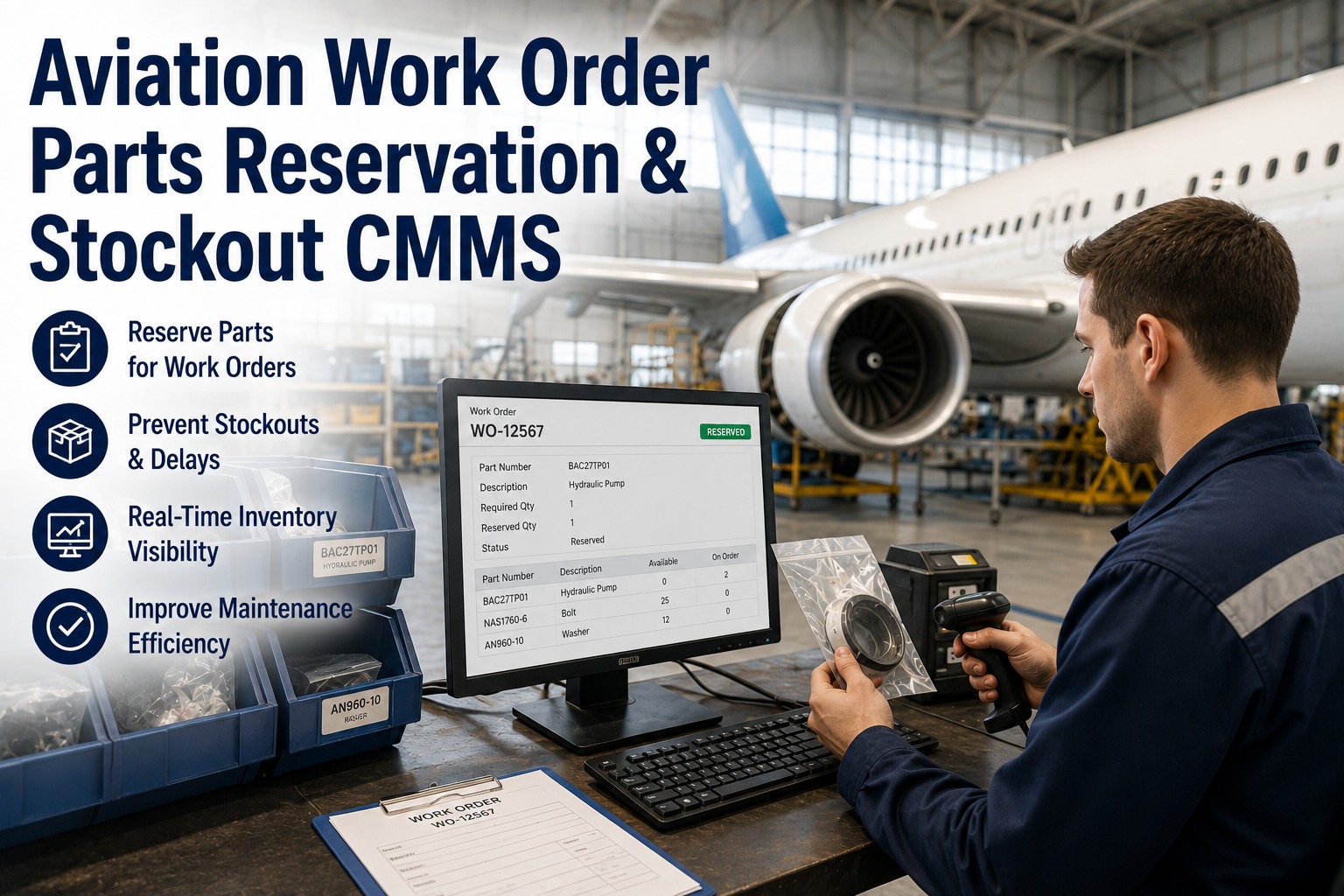
When inventory management and work order management operate in separate systems, technicians open aircraft panels only to discover required parts haven't been ordered. The resulting AOG delay is entirely avoidable with integrated CMMS-to-inventory workflows.
SYSTEMIC
Unplanned Work Cascades Without Data
Up to 40% of heavy check man-hours unplanned
Findings during maintenance expand scope. Without a system that tracks findings, disposition decisions, and related work order generation in real time, production planning becomes guesswork — and TAT creep becomes the norm.
OXMAINT CMMS FOR AVIATION
Your MRO operation runs on data. Make sure it's the right data.
Oxmaint connects work order management, asset history, parts inventory, and compliance documentation in one platform — built for the complexity aviation demands.
OXMAINT SOLUTION
How Oxmaint Transforms Aviation Work Order Management
Oxmaint is built for operations where getting maintenance wrong has consequences measured in lives and millions of dollars. The platform replaces fragmented, paper-dependent workflows with a unified digital backbone that covers every stage of the aviation work order lifecycle — and connects maintenance execution to asset condition, parts inventory, and compliance reporting.
DIGITAL WORK CARDS
Mobile-First Work Card Execution
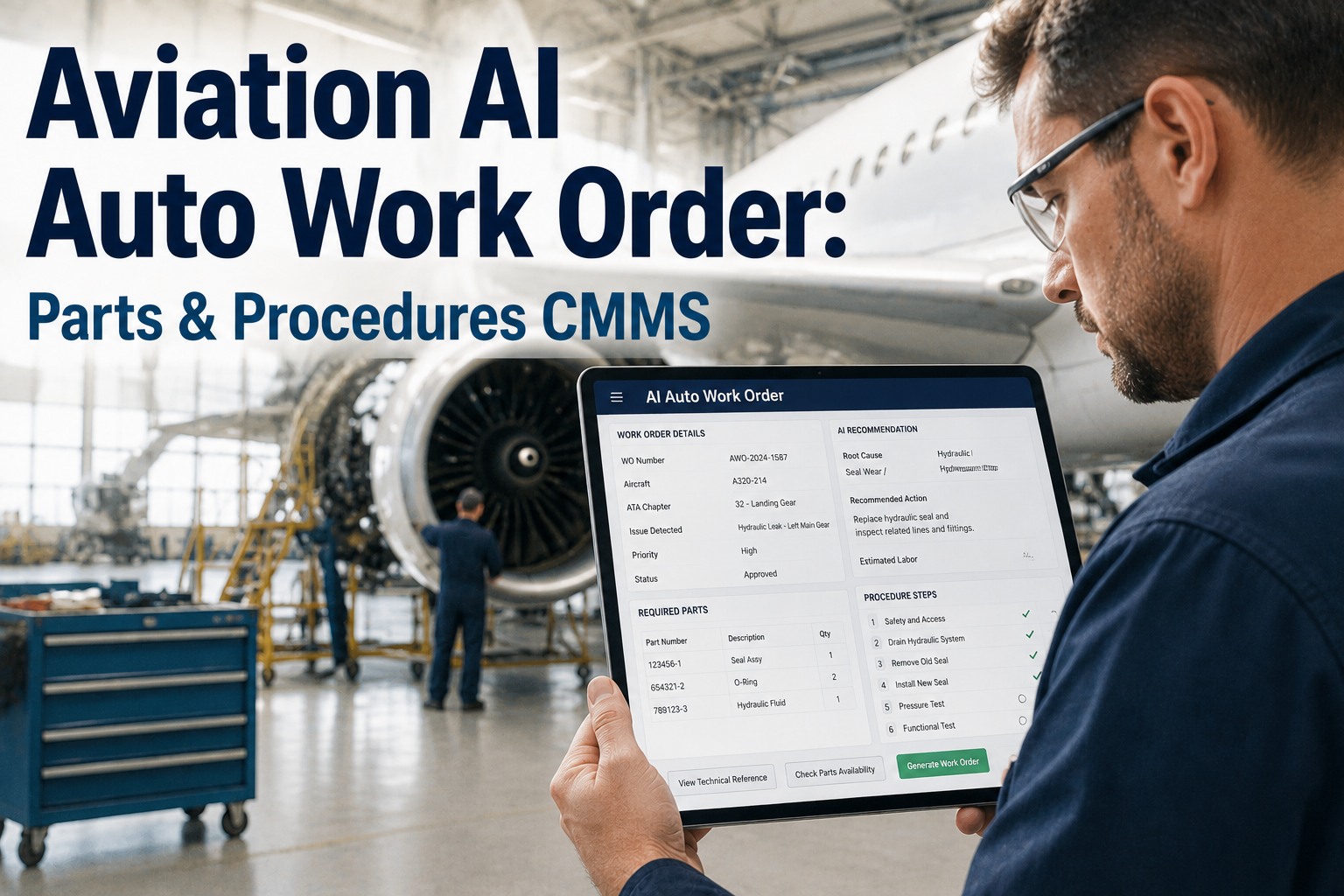
Technicians receive, execute, and sign off work cards on mobile devices. AMM references, tooling lists, and part requirements are embedded directly in the task — no paper, no hunting through manuals.
SCHEDULING ENGINE
Intelligent Maintenance Scheduling
Schedule work orders against flight programme data, hangar slot availability, and technician skill matrices simultaneously. Production planning runs on facts, not assumptions.
REAL-TIME TRACKING
Live Work Order Status Dashboards
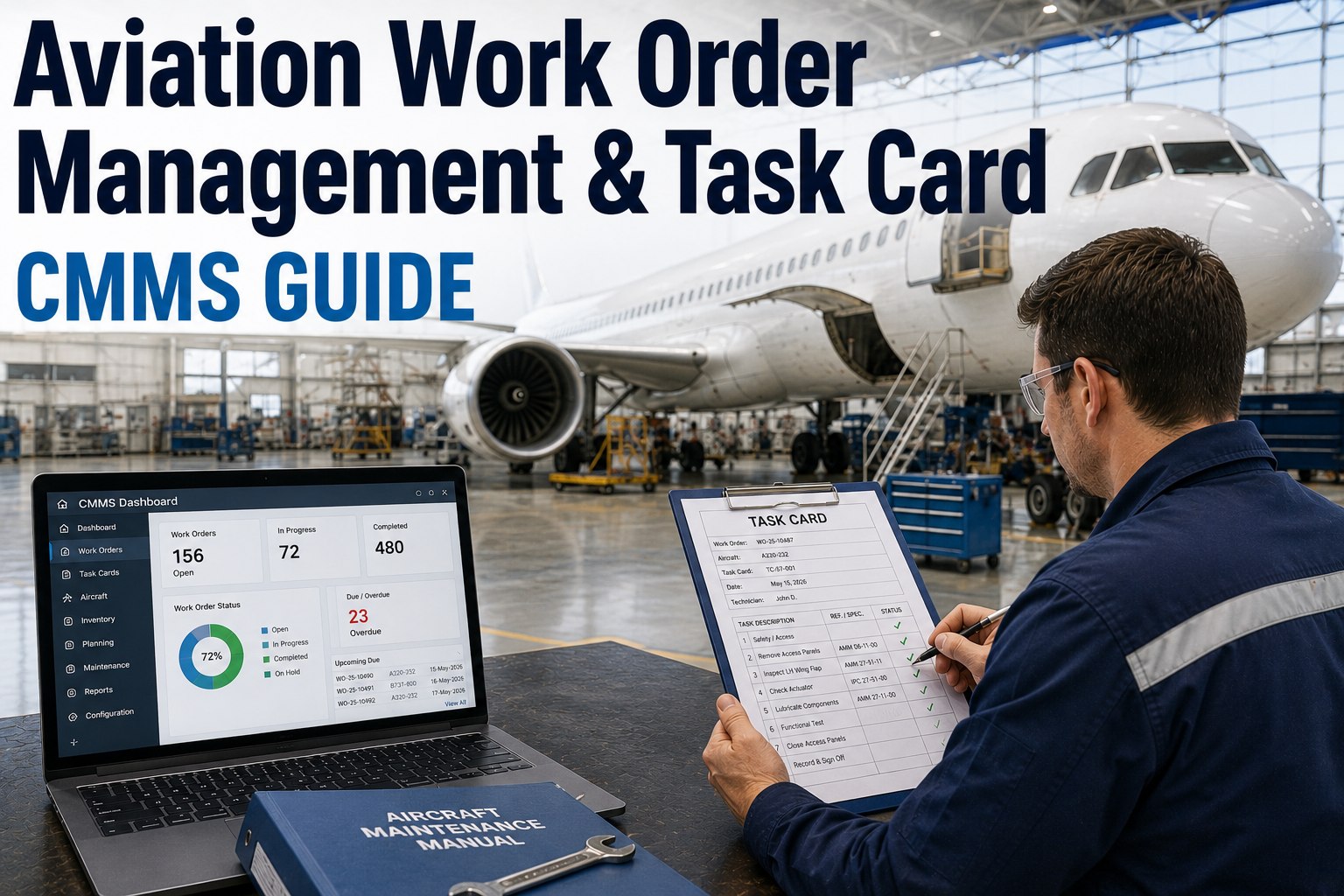
Production control sees every open work order, its completion percentage, and any blockers — in real time. Shift handovers take minutes, not hours, because everything is visible and documented.
COMPLIANCE BUILT-IN
Audit-Ready Documentation Automatically
Digital signatures with timestamp, licence number, and authorisation scope are captured at task completion. Regulatory audits become a report export, not a file room excavation.
PARTS INTEGRATION
Work Order-Driven Parts Reservation
Parts requirements flow automatically from work order creation into MRO inventory. Technicians see parts status before opening an aircraft panel. AOG events from missing parts drop sharply.
FINDINGS MANAGEMENT
Unplanned Work Captured and Controlled
When technicians find additional defects, new work orders are generated, linked to the parent work package, and routed for engineering disposition — all within the same system, maintaining full traceability.
ASSET LIFECYCLE
Full Component History at Every Work Order
Every work order links to a complete asset hierarchy — from fleet level down to individual component. Maintenance history, condition scoring, and remaining useful life inform every task decision.
MULTI-SITE CAPABLE
Portfolio-Wide Visibility for MRO Networks
For operators and MROs with multiple line stations or maintenance bases, Oxmaint consolidates work order status, KPIs, and compliance data across every location into a single management view.
COMPARISON
Reactive MRO vs. CMMS-Driven MRO: The Real Difference
The financial and operational gap between reactive and planned aviation maintenance is not marginal — it's structural. These numbers represent real industry benchmarks, and they explain why world-class MRO operations are accelerating their investment in digital work order management. Book a demo to see Oxmaint's impact modelled against your current KPIs.
| Metric |
Reactive / Paper-Based MRO |
CMMS-Driven Planned MRO |
| Work Order Turnaround |
Unpredictable — days to weeks for complex tasks |
Predictable TAT within 15% of planned estimate |
| Maintenance Cost per Event |
4.8x higher than planned equivalent |
Controlled cost with accurate pre-event scoping |
| Technician Productive Time |
65% — 35% lost to admin and information hunting |
85%+ — tasks, references, and parts pre-loaded |
| Regulatory Audit Readiness |
Days of preparation; gaps frequently found |
Continuous; reports generated in minutes |
| Unplanned AOG Events |
Frequent; fleet reliability under constant pressure |
Reduced 20-35% through predictive scheduling |
| Shift Handover Quality |
Verbal briefings; critical context regularly lost |
Digital handover; full work order status captured |
| Parts AOG from Stock-Outs |
23% of work stoppages due to parts unavailability |
Parts reserved at work order creation; stock-outs minimised |
| Data Quality for Planning |
Poor; planning based on estimates and experience |
High; actual hours and parts feed future planning accuracy |
ROI & RESULTS
The Numbers Behind CMMS-Driven MRO Efficiency
These statistics represent verified industry benchmarks from aviation MRO operations that have transitioned to digital work order management. They represent the business case — and the safety case — for modernising your maintenance workflow.
25%
Reduction in Overall Maintenance Costs
MROs implementing digital CMMS platforms consistently report 20-30% cost reduction within 18 months of deployment.
40%
Faster Work Order Closure
Digital work cards, pre-loaded references, and parts confirmation cut administrative time from every task — closing work orders up to 40% faster.
30%
Fewer Unplanned AOG Events
Predictive maintenance scheduling and condition-based work order triggers reduce unplanned groundings by 20-35% across fleet operations.
98%
Audit Pass Rate on First Submission
Operations with digital sign-off and auto-generated compliance documentation report near-perfect audit pass rates — versus 76% for paper-based systems.
KEY CONCEPTS
Aviation Work Order Management: Core Frameworks You Need to Know
Understanding these four frameworks is essential for anyone modernising their MRO operation. They represent the structural logic that separates world-class aviation maintenance from average — and they're the building blocks that Oxmaint's CMMS is designed around. Ready to see them working in your environment? Start a free trial for 30 days with no commitment and full platform access.
The industry-standard methodology for developing aircraft maintenance programmes. MSG-3 logic determines which maintenance tasks are performed based on failure mode consequence analysis — not arbitrary time intervals. A CMMS that supports MSG-3 task structures ensures your work orders align with the maintenance programme intent, not just its schedule.
RCM drives maintenance task selection based on functional failure analysis. In practice, this means your CMMS work order triggers should reflect real asset condition and failure probability — not calendar elapsed time. Oxmaint's condition scoring and production-based triggers implement RCM principles at the operational level, reducing unnecessary tasks while catching real risks early.
TAT is the primary commercial performance metric for MRO facilities. Every minute of unnecessary delay in work order processing, parts confirmation, or sign-off is a direct hit to TAT — and revenue. Digital CMMS eliminates the administrative drag that accounts for the majority of TAT creep in manual systems, typically recovering 15-25% of total check duration.
The MPD is the OEM-published master reference for all scheduled maintenance requirements on a given aircraft type. Effective work order management requires that every scheduled task traces back to an MPD reference — and that your CMMS maintains this linkage automatically, preventing compliance gaps when MPD revisions are issued.
FAQ
Aviation Work Order Management: Your Questions Answered
What makes aviation work order management different from standard industrial CMMS?
Aviation maintenance operates under strict regulatory frameworks — FAA Part 145, EASA Part 145, CASR Part 145 — that require every maintenance task to be traceable from initiation through certification. Work orders must carry regulatory references, technician licence authorisation data, and independent inspection records. A standard industrial CMMS may handle scheduling and work order tracking, but it lacks the compliance architecture that aviation requires. Oxmaint is built to accommodate this depth of documentation without making it burdensome for the technician executing the task.
How does a CMMS reduce AOG events in line maintenance operations?
AOG events in line maintenance most commonly stem from three sources: parts not available when needed, repeat defects that weren't properly resolved at previous maintenance events, and deferred defects that expired without action. A CMMS addresses all three simultaneously. Work order-driven parts reservation ensures components are available before the aircraft arrives. Complete defect histories prevent repeat defect cycles. And approaching deferral deadlines trigger automated alerts, ensuring MEL items are addressed before they become AOG events. Operators using digital work order management report 25-35% reductions in preventable AOG groundings within the first year.
Can Oxmaint integrate with existing MRO ERP systems and technical records platforms?
Yes. Oxmaint is designed for integration into existing MRO technology stacks. The platform connects via API to technical records systems, ERP platforms, parts procurement systems, and engineering order management tools. This means you gain the operational visibility and mobile work card execution of a modern CMMS without requiring a full system replacement. Data flows bidirectionally — work order completion feeds technical records, and parts availability feeds work order planning — eliminating the duplicate data entry that costs MRO operations hours per shift.
How quickly can an MRO facility get Oxmaint deployed and producing results?
Oxmaint is built for rapid deployment — a deliberate design choice. Most line maintenance operations are live within two to four weeks, with hangar maintenance and heavy check environments typically up and running within six to eight weeks. There are no heavy implementation fees or lengthy professional services engagements. The platform's asset hierarchy — Portfolio, Property, System, Asset, Component — maps cleanly to standard aircraft and ground equipment structures, reducing configuration time significantly. Early results, including faster work order closure and improved shift handovers, are typically visible within the first month of operation.
STREAMLINE YOUR AVIATION WORK ORDERS WITH OXMAINT CMMS
Every grounded aircraft is a decision waiting to be made. Make it faster.
Aviation maintenance teams using Oxmaint close work orders 40% faster, pass regulatory audits on first submission, and reduce unplanned AOG events by up to 30%. The platform deploys in weeks, not months — and the first 30 days are free. See how Oxmaint's work order management transforms your MRO operation — start a free trial or book a demo with our team today.