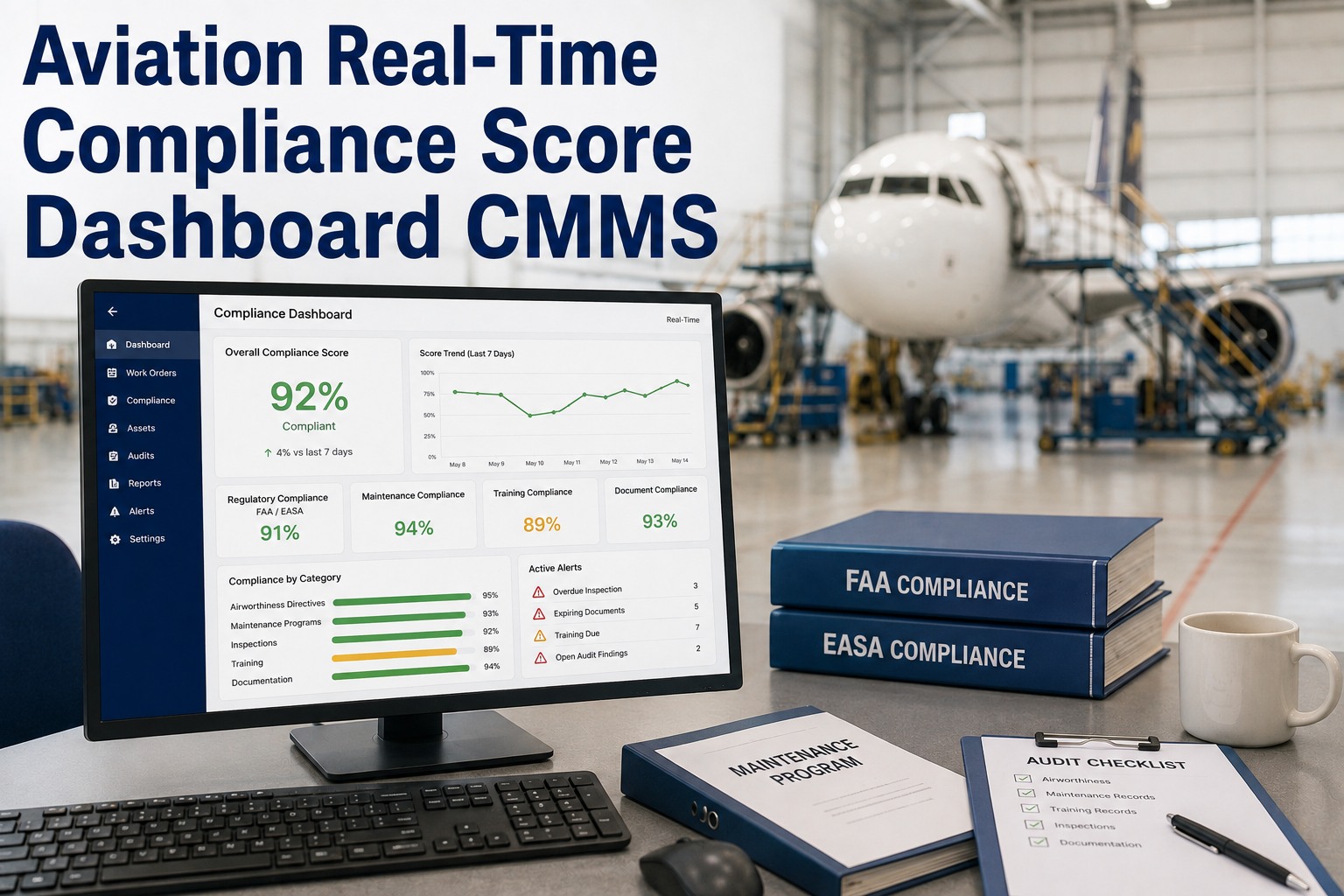
Aviation maintenance leaders operating without a real-time KPI dashboard are navigating a fleet blindfolded. When dispatch reliability dips, MTBUR degrades, or AOG hours spike, the difference between a two-hour recovery and a 48-hour operational crisis is often a single metric visible on the right screen at the right moment. OxMaint's aviation maintenance KPI dashboard gives COOs and VP Maintenance Analytics a live executive view — from fleet-wide dispatch reliability down to individual tail number performance — without waiting for Monday morning reports. Sign Up Free and connect your MRO data to a pre-built aviation analytics layer in hours, not months.
Live Aviation KPI Dashboards for MRO Leaders
OxMaint delivers pre-built executive dashboards for MTBUR, TAT, dispatch reliability, CPFH, and AOG hours — drill from board view to tail number in seconds.
Why Aviation Maintenance KPI Dashboards Are Mission-Critical in 2026
The Intelligence Gap Costing MRO Operations Millions Per Year
43%
of unplanned AOG events are preceded by degraded MTBUR trends visible 72+ hours before failure
$180K
average cost per AOG hour across narrowbody commercial operations including crew, pax, and slot recovery
2.8×
faster TAT variance detection for MRO shops with real-time dashboard monitoring vs weekly report cycles
67%
of MRO directors report their current reporting cycle is too slow to prevent performance slippage in-period
Core Aviation Maintenance KPIs: What the Dashboard Tracks
From Fleet-Level Reliability to Component-Level Drill-Down
| KPI |
What It Measures |
OxMaint Dashboard View |
Executive Action Signal |
| Dispatch Reliability |
On-time departure rate excluding mx delays |
Fleet trend + tail-level breakdown |
Route or tail with consistent degradation |
| MTBUR |
Mean Time Between Unscheduled Removals |
Component family ranking + threshold alert |
Components trending below reliability spec |
| TAT (Turnaround Time) |
Actual vs planned maintenance cycle time |
Shop-level heatmap + variance histogram |
Shops exceeding benchmark TAT consistently |
| AOG Hours |
Aircraft-on-ground time due to unresolved defects |
Real-time AOG ticker + root cause log |
AOG duration trends and repeat defect patterns |
| CPFH |
Cost Per Flight Hour — total mx spend normalized |
Fleet average vs tail-level cost outliers |
Tails with escalating CPFH vs peer group |
| Schedule Completion Rate |
PM and check completion vs plan |
Check type completion % + overdue queue |
Deferred checks approaching regulatory limits |
| Deferred Defect Count |
Open MEL/CDL items across fleet |
Aging deferred defect matrix by tail |
Items approaching MEL expiry requiring escalation |
OxMaint Dashboard Architecture: From Executive View to Tail Number
How MRO Intelligence Flows Across Three Levels of Detail
Board Level
Fleet Reliability Scorecard
COO-ready summary of dispatch reliability, AOG status, fleet MTBUR, and CPFH against benchmark targets — updated live, not at week-end close.
Operations Level
Station and Shop Performance
TAT variance by station, schedule completion by check type, and technician productivity metrics surfaced for VP Maintenance review without manual data pulls.
Asset Level
Tail Number Drill-Down
Click any fleet KPI to isolate individual aircraft — full maintenance history, open work orders, deferred defects, and CPFH trend in a single tail-level view.
Component Level
MTBUR by Component Family
Rank component reliability across the fleet. Identify which APU, avionics, or hydraulic components are generating disproportionate unscheduled removal events.
Threshold Alerts
Proactive KPI Breach Notifications
Set reliability thresholds once. OxMaint alerts VP Maintenance when dispatch reliability, TAT, or MTBUR crosses defined boundaries — before the board meeting, not after.
Reporting
Audit-Ready MRO Exports
Generate structured PDF and CSV KPI reports for CAMO submissions, insurance reviews, and airline customer SLA reporting — without manual assembly or spreadsheet reconciliation.
When Static Reports Fail: The Real Cost of Lagging MRO Analytics
Four Operational Scenarios Where Real-Time KPI Visibility Changes the Outcome
01
Dispatch Reliability Slippage Before It Becomes a Penalty Event
When dispatch reliability drifts from 99.2% to 97.8% over three weeks, a live dashboard flags the trend in day four. A weekly report surfaces it in week three — after the airline customer has already logged a contractual performance notice.
02
AOG Recovery Coordination Across Stations
An AOG event at an outstation requires the COO to understand part availability, technician assignment, and estimated recovery time simultaneously. OxMaint's live AOG tracker consolidates all three inputs in one view — eliminating the phone-chain coordination loop.
03
TAT Overrun Detection Before Customer SLA Breach
A C-check running 14 hours over planned TAT is invisible in daily shift logs but immediately visible in a real-time TAT heatmap. OxMaint flags the variance so resource reallocation decisions happen during the check — not after the delivery delay.
04
CPFH Outlier Identification Before Fleet Budget Overrun
One tail running 23% above fleet-average CPFH represents material budget exposure at scale. OxMaint's cost analytics surface CPFH outliers by tail and maintenance category — giving VP Maintenance the data to justify targeted intervention or early retirement analysis.
Connect Your MRO Data to Live Aviation KPI Dashboards
Pre-built dashboards for dispatch reliability, MTBUR, TAT, AOG hours and CPFH — drill from fleet scorecard to tail number without a BI team or custom build.
Aviation Maintenance KPI Dashboard ROI: What MRO Leaders Measure
Benchmark Outcomes from Real-Time MRO Analytics Deployments
Performance Improvements Reported by MRO Operations Using Live KPI Dashboards
Improvement in Dispatch Reliability (Real-Time Trend Monitoring vs Weekly Reports)
Reduction in AOG Duration (Live Coordination vs Phone-Chain Recovery)
TAT Variance Reduction (Real-Time Heatmap vs End-of-Check Review)
CPFH Reduction (Outlier Tail Intervention Before Quarterly Review)
Schedule Completion Rate Increase (Proactive Alert vs Passive Reporting)
Choosing an Aviation Maintenance Analytics Platform: Evaluation Criteria
What Separates an MRO KPI Dashboard from a Genuine Decision-Support Platform
Pre-Built Aviation KPIs
Verify the platform ships with MTBUR, dispatch reliability, TAT, AOG, CPFH, and deferred defect tracking out of the box — not as custom configuration projects requiring BI resources.
Drill-Down Capability
Fleet-level KPIs are only useful if a single click surfaces the tail, component, or station driving the variance. Confirm drill-down depth reaches asset and component level without exporting to Excel.
Real-Time Data Refresh
Dashboards refreshing every 24 hours are reports with a better UI. Confirm live or near-live data refresh rates for AOG status, open work orders, and dispatch reliability — delays cost operations money.
MRO System Integration
A dashboard isolated from your CAMO, ERP, and parts management system creates a parallel data entry burden. Evaluate pre-built connectors and API availability before assuming integration is simple.
Threshold and Escalation Alerts
Passive dashboards require someone to be watching. Confirm the platform delivers proactive alerts when KPIs breach defined thresholds — pushing intelligence to the VP Maintenance inbox, not waiting for login.
Compliance-Ready Reporting
Regulatory and airline customer reporting requires structured, timestamped maintenance records. Confirm the platform generates audit-ready exports without manual data assembly or version control risks.
Aviation maintenance operations investing in real-time KPI dashboards consistently outperform peers relying on weekly report cycles for reliability, cost, and TAT management. The operational intelligence gap between a live dashboard and a lagging report is measured in AOG hours, penalty clauses, and CPFH budget overruns. Sign Up Free to connect your fleet data to OxMaint's pre-built MRO analytics layer. For multi-fleet or CAMO-integrated deployments, Book a Demo to walk through the dashboard configuration and integration requirements with the OxMaint aviation team directly. MRO leaders who have already made the transition — Sign Up Free and see how live KPI visibility changes operational decision speed from the first login.
Frequently Asked Questions
What aviation maintenance KPIs does OxMaint's dashboard track out of the box?
OxMaint ships pre-built dashboards for dispatch reliability, MTBUR, turnaround time (TAT), AOG hours, cost per flight hour (CPFH), schedule completion rate, and deferred defect count — no custom BI configuration required. Book a Demo to see the full aviation KPI library.
Can the dashboard drill down from fleet-level KPIs to individual tail numbers?
Yes — OxMaint supports drill-down from fleet scorecard to tail number to component level in a single click. COOs can navigate from board-level dispatch reliability to the specific aircraft and defect driving underperformance without exporting data.
How does OxMaint integrate with existing CAMO and MRO management systems?
OxMaint connects via API and pre-built connectors to CAMO platforms, ERP systems, and parts management tools. Data flows into the KPI layer without duplicate entry. Integration scope is reviewed during the Book a Demo session for enterprise deployments.
Does OxMaint send alerts when aviation KPIs breach defined thresholds?
Yes — VP Maintenance and COO users set KPI thresholds once. OxMaint delivers proactive alerts when dispatch reliability, MTBUR, or TAT breach defined limits — pushing intelligence to decision-makers rather than waiting for dashboard login.
Can OxMaint generate compliance-ready maintenance reports for airline customers and regulators?
OxMaint generates structured PDF and CSV maintenance records for CAMO submissions, airline customer SLA reviews, and regulatory audits. Reports are timestamped and export-ready without manual assembly. Sign Up Free to test reporting against your own data.
Is OxMaint suitable for multi-fleet or multi-operator MRO environments?
Yes — OxMaint supports multi-fleet hierarchies with operator-level, fleet-type-level, and tail-level access controls. Operations directors monitoring multiple customer fleets see consolidated and segmented views without data cross-contamination.
Ready to Move Your Aviation Maintenance Analytics to Real-Time?
OxMaint's pre-built MRO KPI dashboards give COOs and VP Maintenance the live visibility into dispatch reliability, MTBUR, TAT, AOG hours, and CPFH needed to act before performance slippage becomes a cost event.