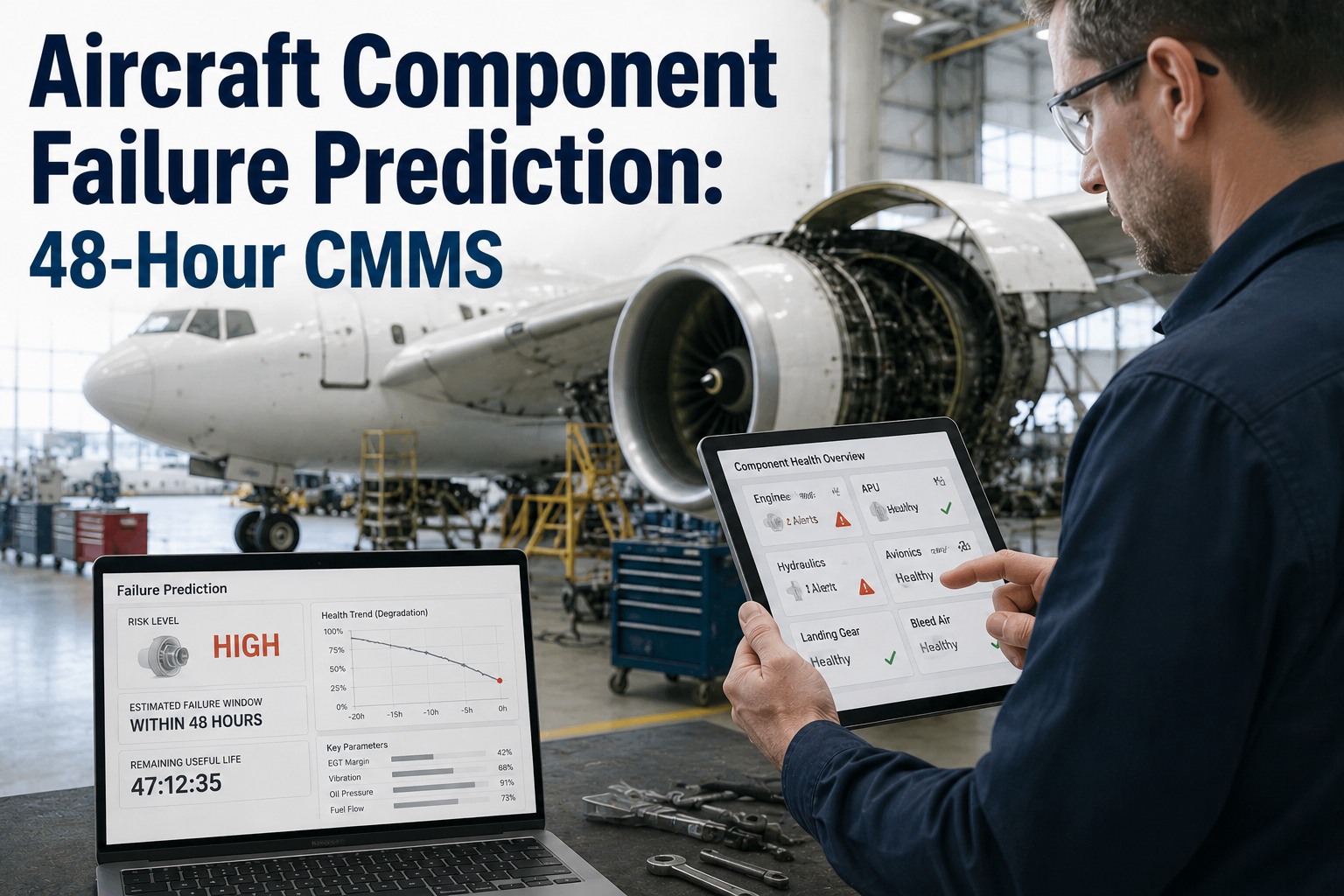
Every commercial aircraft generates terabytes of operational data per month — ACARS streams, FDM exceedances, oil-debris monitors, vibration sensors, engine performance trends, ECAM messages — yet most operators still discover component failures only after they happen. The cost of that gap is brutal: a 1–2 hour AOG situation can cost an airline $10,000 to $20,000, and severe AOG events on widebody routes can hit $150,000 per hour according to Boeing estimates. Engine shop turnaround time on new-generation engines is now over 150% higher than pre-pandemic, with the aviation predictive maintenance market projected to grow from $4.2 billion in 2024 to $9.5 billion by 2034 — reflecting proven ROI across the industry. Predictive maintenance software solves the data-rich-but-warning-poor problem. Machine-learning models trained on millions of flight hours of historical component behavior identify failure signatures 200–400 flight hours before unscheduled removal probability spikes — early enough to schedule the work, source the part, and avoid the AOG entirely. Start a free trial and feed sample sensor data into the OxMaint predictive engine, or book a demo and we will model your fleet's reliability curve.
projected aviation predictive maintenance market size by 2034, up from $4.2B in 2024 — proven industry ROI
20%+
CAGR for aviation AI as airports and airlines recognize predictive maintenance benefits
150%
increase in new-generation engine shop turnaround time vs. pre-pandemic — much of it preventable
14
average AOG events per US commercial aircraft per year — predictive models can avoid most of them
What Is Aviation Predictive Maintenance Software?
Aviation predictive maintenance software uses machine learning, sensor data and historical reliability records to forecast when a specific component is likely to fail — before it actually does. The system ingests data from ACARS, FDM, engine health monitors, oil-debris sensors, vibration probes, brake-wear indicators, ECAM/EICAS messages and pilot reports. Algorithms compare live signal patterns to known failure signatures and output a remaining useful life estimate per serialized component.
For airlines, this turns unscheduled removals into scheduled removals — meaning the work happens during planned downtime, with the right part already on the shelf and the right technician already assigned. The economic case is direct: avoid one widebody AOG event and the predictive platform pays for itself many times over. Start a free trial and run sample sensor data through the model, or book a demo and walk through a real engine reliability case.
Data Sources Feeding the Predictive Engine
01
ACARS Data Streams
Engine performance, fuel flow, takeoff temperature trends and ECAM messages streamed from every flight leg into the predictive model.
02
Flight Data Monitoring
FDM exceedance events, hard landings, gear cycles and high-load events feed structural and component fatigue models per tail.
03
Oil & Vibration Sensors
Oil-debris monitors and vibration probes track bearing health, gear-train wear, and rotating-component degradation across the engine and APU.
04
Brake & Tire Telemetry
Brake-wear pin readings and tire-pressure sensor data forecast next removal — eliminating ramp delays from last-minute brake or wheel swaps.
05
Historical Removal Records
Every prior unscheduled removal feeds the model. Failure signatures, leading indicators and time-to-failure curves built per component family.
06
Pilot Defect Reports
PIREP and tech-log defects pattern-matched against historical reports to detect recurring or evolving issues before they escalate.
Why Reactive Maintenance Is Becoming Financially Unviable
$150K/Hour AOG Exposure
Boeing estimates severe AOG situations can hit $150,000 per hour. Without predictive lead time, the first signal of failure is the aircraft already grounded — and the meter already running.
Engine Shop Bottleneck
Engine shop TAT up 150% on new-generation engines. Every unplanned removal joins the back of a long queue, extending grounding by weeks instead of days.
Parts Inventory Misalignment
No predictive forecast means parts inventory is sized for worst-case rather than demand. Stockouts on critical rotables drive emergency sourcing at 3–5x list price.
Dispatch Reliability Hit
Unscheduled removals cascade across the network. One AOG at 6am can cancel four flights, displacing hundreds of passengers and triggering EU261 or DOT compensation.
Every prevented unscheduled removal can save more than a year of subscription cost in a single AOG avoided.
How OxMaint Predicts Component Failure Before It Happens
OxMaint's predictive maintenance engine combines fleet sensor data, OEM reliability curves, and the operator's own historical removal records to score every monitored component for failure probability over the next 50, 100, 200 and 400 flight hours. The output is delivered into the same work-order and planning workflows the maintenance team already uses — meaning predictions become work orders, parts orders and slot bookings without re-keying. Book a demo and we will walk through a live engine reliability scenario.
Multi-Source Data Ingestion
ACARS, FDM, oil-debris, vibration, brake-wear and ECAM data ingested via secure API. Pilot reports and historical removal records merged into a single per-component reliability timeline.
Component-Level Health Score
Every monitored part — engine modules, APUs, landing gear, generators, packs, hydraulic pumps — carries a live health score and projected remaining useful life updated after each flight leg.
Failure Signature Library
Machine-learning models trained against thousands of historical failure events recognize early signatures specific to fleet type, component family and operating environment.
Work-Order Auto-Trigger
When a component health score crosses operator-defined thresholds, a planning work order opens automatically with proposed removal date, parts kit and labor estimate — ready for review.
Reliability Program Feedback
Predictive accuracy tracked event-by-event. Models tune to your operating environment over time — narrower confidence intervals and longer prediction lead times.
Parts & Slot Forecasting
12-month forward forecast of predicted removals feeds parts inventory planning and hangar slot booking. Emergency-spend events reduced by 50–70% on instrumented fleets.
Reactive Removal vs. Predictive Removal — Side by Side
Dimension
Reactive Unscheduled Removal
Predictive Scheduled Removal
First warning
Component failure in flight or pre-flight
200–400 flight hours before failure probability spike
Aircraft status
AOG, often at a remote station
Available — work scheduled into planned downtime
Parts sourcing
Emergency, 3–5x list price, possible AOG charter freight
Routine procurement, list price, scheduled freight
Labor cost
Overtime AOG team, $5K–$25K labor premium
Standard shift, planned crew
Revenue impact
$10K–$80K per hour grounded — cascading cancellations
Zero — aircraft already out of service for planned visit
Passenger impact
Rebookings, EU261 / DOT compensation, hotel costs
None — no schedule disruption
Shop slot availability
Back of the queue, weeks of additional grounding
Pre-booked, slot reserved at planning time
Reliability KPI
Dispatch reliability degraded
Dispatch reliability protected — typically 99%+
ROI of Aviation Predictive Maintenance
35%
reduction in unscheduled component removals reported across fleets running predictive analytics on sensor data
200–400
flight hours of warning lead time on monitored components — enough to schedule the work and source the part
99%+
dispatch reliability achievable when reactive failures are replaced by predictive scheduled removals
50–70%
reduction in emergency parts spend when planning is driven by predicted demand instead of reactive shortage
Frequently Asked Questions
What aircraft sensor and operational data does OxMaint need to make predictions?
OxMaint ingests ACARS engine and performance data, FDM exceedance events, oil-debris monitor outputs, vibration sensor readings, brake-wear indicators, ECAM/EICAS messages, and pilot defect reports. The platform also leverages historical removal and reliability data from your maintenance records to refine model accuracy over time. Operators with limited sensor coverage still get value from FDM and historical-reliability-based models on day one.
How accurate are the predictions, and how is accuracy measured?
OxMaint tracks every prediction against the actual outcome — confirmed failures, scheduled removals, and false positives — to publish a live accuracy score per component family. Models tune to each operator's environment over time. Typical mature deployments achieve 200–400 flight hour lead time on monitored rotables with confidence intervals tight enough to support planning decisions.
Does predictive maintenance replace the OEM Maintenance Planning Document or condition-based intervals?
No. Predictive maintenance supplements the regulator-approved maintenance program — it does not replace it. ADs, MPD tasks and operator-imposed reliability tasks continue to drive scheduled work. Predictive alerts surface inside that framework as supporting evidence to escalate, defer or accelerate tasks within the approved program structure.
Can OxMaint predictive maintenance work for smaller fleets and operators?
Yes. The predictive engine combines your fleet's data with fleet-wide reliability data from OEM models, regulator-published reliability information and aggregated benchmarks. Smaller fleets benefit immediately from the cross-fleet learning even before generating their own large historical dataset. The system scales from a few tails to several hundred.
Stop Discovering Failures the Hard Way
Predict Component Failures 200–400 Flight Hours in Advance
OxMaint turns aircraft sensor data — ACARS, FDM, oil-debris, vibration, ECAM — into early failure warnings that auto-generate planning work orders. Cut unscheduled removals 35%, eliminate preventable AOG events, and protect dispatch reliability above 99%. Used by operations teams managing 10,000+ assets. Live in 6–12 weeks.