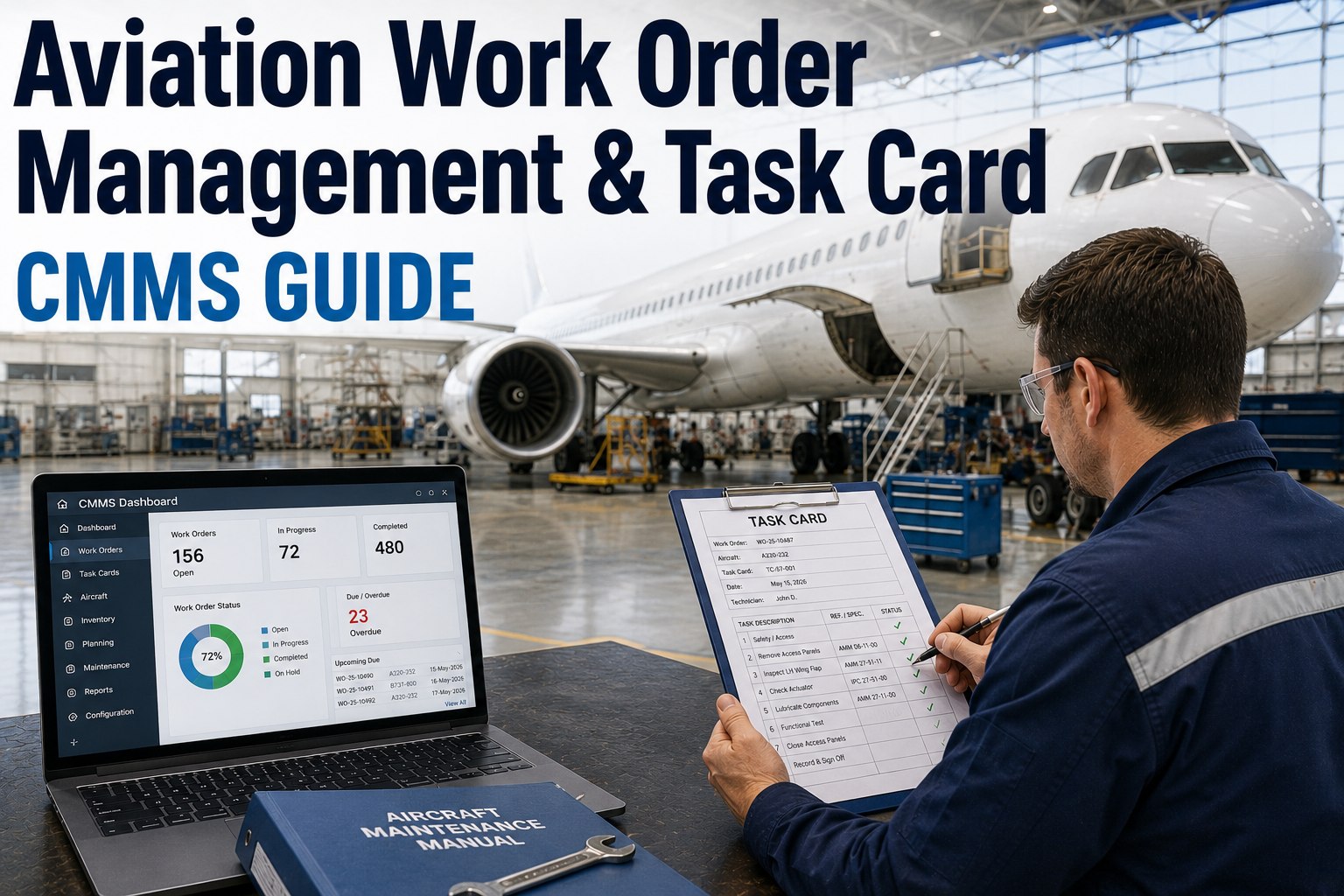
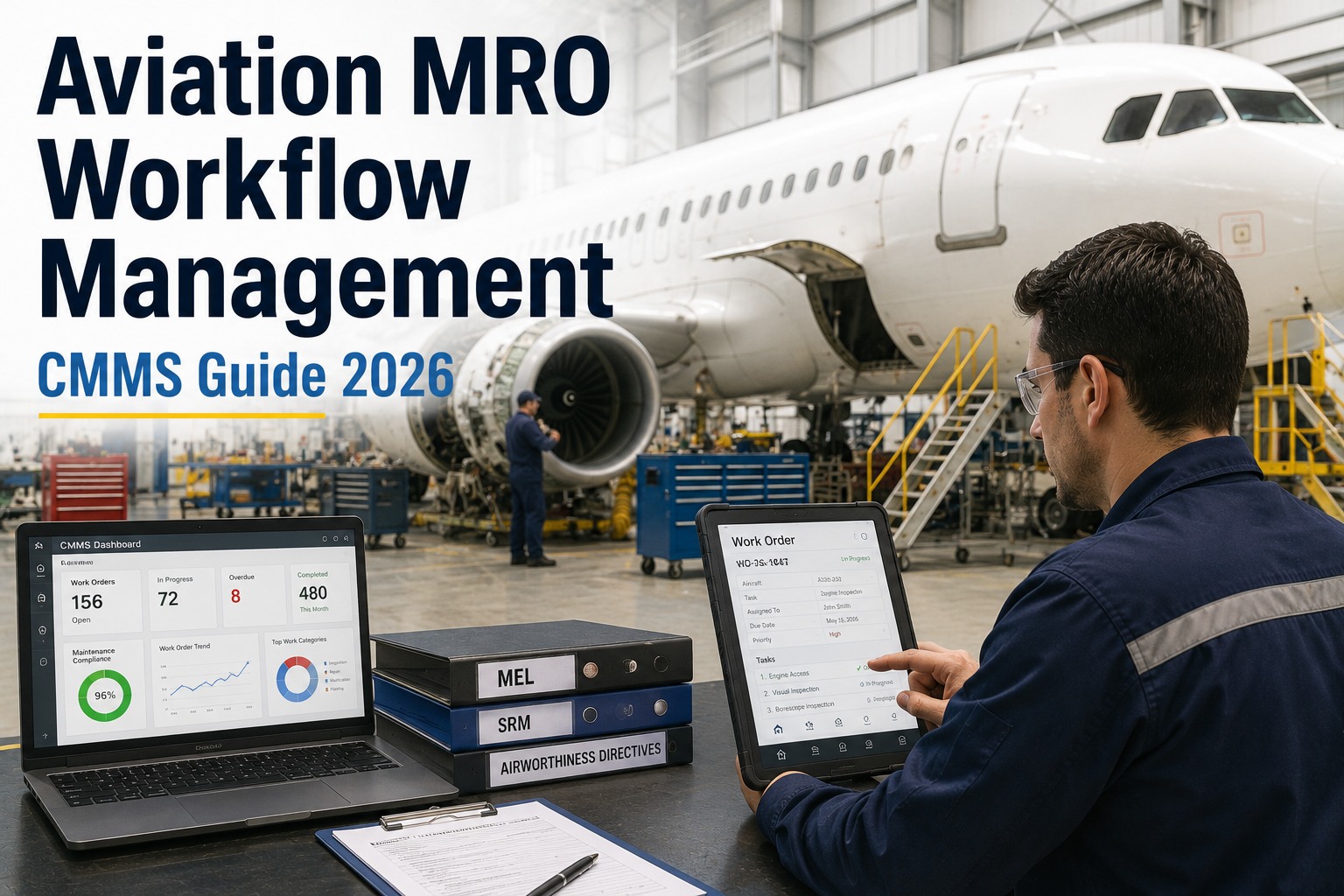
Aviation maintenance has no tolerance for administrative failure. A work order sitting unsigned in a paper pile, a task card mis-sequenced on a clipboard, or an authorization stuck in a physical routing queue — none of these stay paperwork problems for long. They become compliance gaps, audit findings, and in the worst cases, airworthiness events. Across MRO hangars globally, work order management remains the single most labor-intensive, error-prone, and audit-exposed function in the entire maintenance operation. Planners build task packages by hand. Technicians queue for authorizations that haven't cleared. Supervisors close shifts with no real view of what is genuinely complete and what is still open. Oxmaint's CMMS is built to close every one of these gaps — digitizing, automating, and audit-proofing the complete work order lifecycle from task trigger to final sign-off. Want to see how a connected CMMS transforms your daily maintenance execution? Start a free trial and run your first digital work order within the hour, or book a demo and let us map your current workflow against what a modern platform delivers.
72%
of MRO facilities still rely on paper-based or hybrid work order systems — creating audit exposure on every shift
4.8x
higher cost of reactive versus planned maintenance — every missed PM work order compounds this multiplier
34%
of aviation maintenance delays traced to work order documentation errors or incomplete authorization sign-offs
60%
faster work order cycle time for MROs that deploy digital CMMS versus paper-based manual workflows
Your work orders deserve better than clipboards and spreadsheets.
Oxmaint's aviation CMMS gives your team a single connected platform for creating, authorizing, executing, and closing work orders — with full audit-ready documentation from task open to final sign-off. No lengthy implementation. No heavy onboarding. Live within the week.
What Is Aviation Work Order Management?
A work order in aviation maintenance is not optional paperwork — it is the legal authorization, execution record, and airworthiness certificate for every task performed on an aircraft. Aviation work order management is the end-to-end discipline of creating, planning, scheduling, executing, inspecting, and closing these documents within a controlled, fully traceable system. Managed manually, the process is a serial bottleneck: one planner, one printer, one physical authorization chain, one filing cabinet. Managed through a connected CMMS, it becomes a parallel, real-time workflow where planners, technicians, inspectors, and supervisors all operate from the same live data — simultaneously, without waiting for each other. The difference between these two approaches is measurable in labor productivity, audit outcomes, and the unplanned aircraft-on-ground events that no airline customer tolerates. If your operation is currently running work orders outside a CMMS, the cost of that decision is accumulating on every shift. Ready to see the alternative in action? Start a free trial and benchmark your current process against a fully digital workflow, or book a demo with the Oxmaint team to walk the full platform.
The Aviation Work Order Lifecycle — 6 Critical Stages
01
Task Initiation
Triggered by a scheduled PM interval, inspection finding, pilot defect report, or unscheduled fault. In Oxmaint, triggers auto-generate work orders linked directly to the asset record — no manual creation required for recurring tasks.
02
Planning and Task Packaging
Task cards, required parts, tooling references, AMM linkage, and certification requirements are assembled into a complete task package. Oxmaint checks parts inventory and tooling availability before the package leaves planning — eliminating mid-task suspensions.
03
Authorization and Assignment
Work orders require supervisor authorization before execution begins. Oxmaint routes approvals digitally — supervisors sign off via mobile from anywhere on the hangar floor. Authorization wait time drops from an average 47 minutes to under 4 minutes.
04
Execution and Progress Tracking
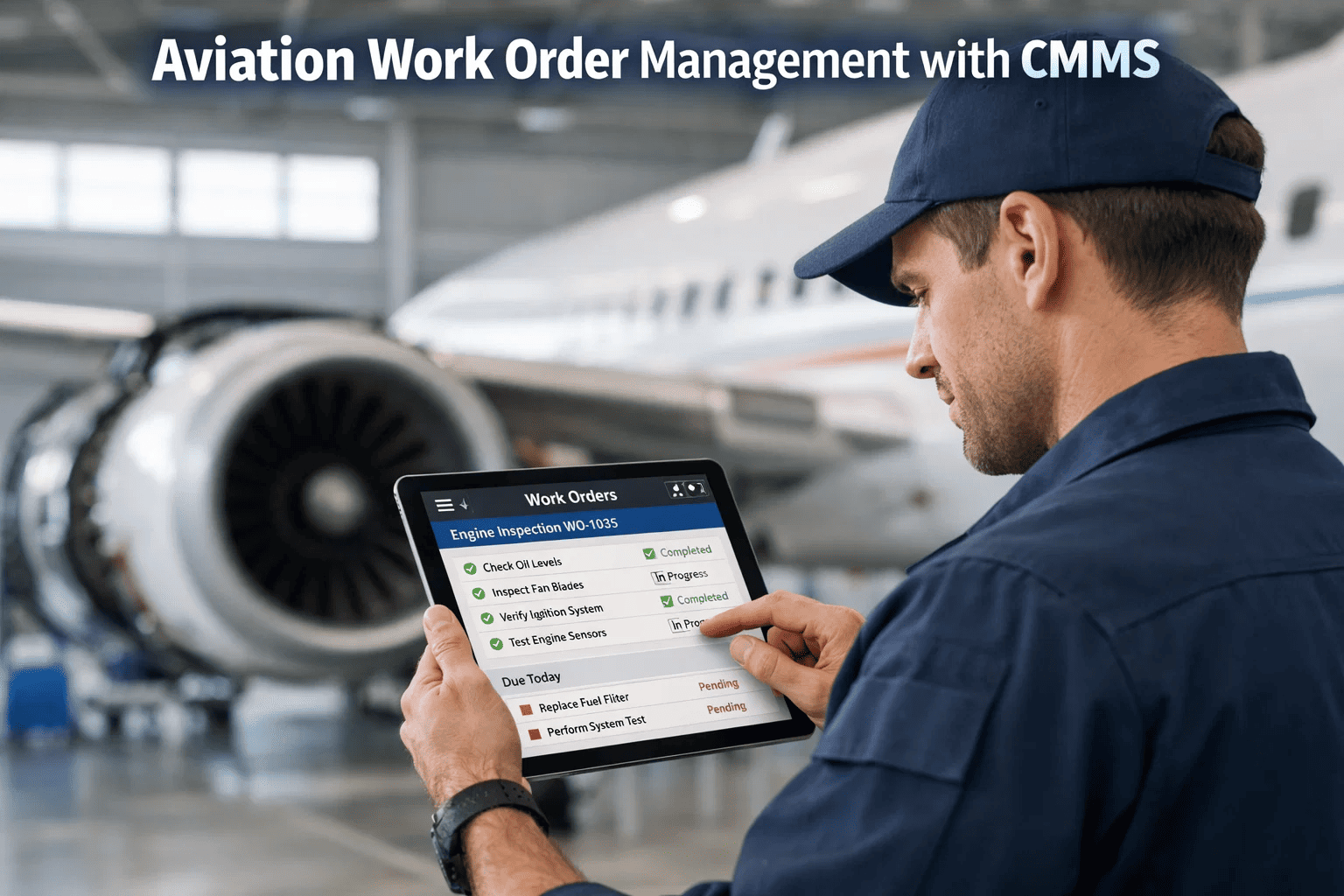
Technicians complete tasks, log time, record parts used, and capture observations directly on mobile. Supervisors see real-time task completion status across the entire hangar — without walking the floor to chase updates.
05
Inspection and Quality Sign-Off
Inspection tasks are built into the same work order. Certifying staff apply digital signatures that are timestamped, identity-verified, and audit-compliant with FAA Part 145, EASA Part 145, and CASA CASR Part 145 requirements.
06
Closure and Records Archiving
Closed work orders become permanent, searchable maintenance records. Full task history, technician logs, part usage, and sign-offs are retained in the asset record — instantly accessible during any CAA audit, with zero physical archive required.
The Real Cost of Poor Work Order Management
Work order failures do not announce themselves as system failures. They surface as single-incident audit observations that compound into pattern findings. An observation becomes a corrective action. A corrective action becomes a repeat finding. A repeat finding becomes an enforcement action. Trace the root cause back on almost any documentation-related enforcement, and it points to a work order process built on manual coordination, paper records, and individual memory rather than a connected system. These are the four failure modes that cost MROs the most per year.
01
Lost and Incomplete Documentation
Paper work orders are misfiled, damaged, or lost. Industry data shows 29% of MRO audit findings trace to missing or incomplete work order records. Every lost document is an airworthiness liability waiting to surface at the worst possible moment — during an unannounced audit or an AOG event.
02
Authorization Queue Bottlenecks
Manual authorization chains mean technicians wait for supervisors who are occupied in other bays, in meetings, or off-site. Average authorization wait time in paper-based shops is 47 minutes per work order. At 20 open work orders per shift, that is 15+ lost productive labor hours — every day.
03
Zero Real-Time Shift Visibility
Without a connected system, shift supervisors have no live view of task completion status across the hangar. They find out a critical task is blocked when a technician physically walks over — typically 2 to 3 hours into the delay. By that point, the TAT impact is already locked in.
04
Mid-Task Parts and Tooling Mismatches
Work orders issued without checking parts availability or tooling status force mid-task suspensions. Each suspension adds an average 3.5 hours to total task completion time and creates open-work-order exposure for every hour the aircraft sits in an incomplete maintenance state.
How Oxmaint Solves Aviation Work Order Management
Oxmaint is not a generic maintenance ticketing tool adapted for aviation. It is designed around the specific workflow, compliance, and documentation requirements of Part 145 and Part M operations — with the capability to serve line maintenance, heavy MRO, component shops, and fleet operators from a single unified platform. Every feature in the work order module targets a specific operational failure mode. The result is a measurable reduction in labor waste, documentation risk, and audit exposure from the first week of deployment. Want to see this applied to your specific operation? Start a free trial and see the difference in your first shift, or book a demo for a live walkthrough of the full work order module.
Automation
Auto-Generated Work Orders
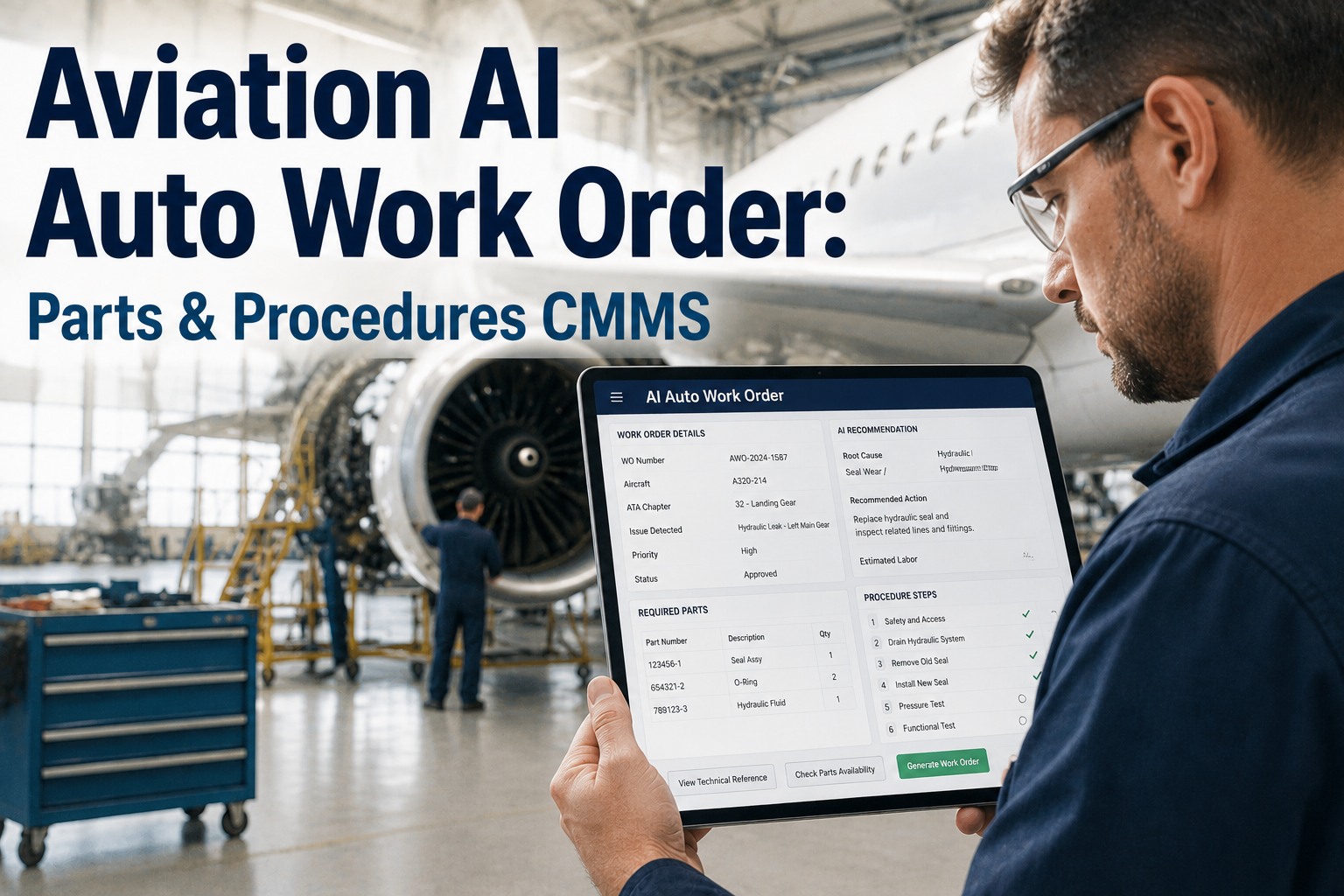
PM intervals, inspection thresholds, and condition-based triggers automatically create work orders — linked to the correct asset, pre-loaded with the right task cards, before the planner touches the keyboard. Scheduled maintenance no longer requires manual initiation.
Authorization
Digital Approval Routing
Mobile authorization ends the physical queue. Supervisors and certifying staff approve work orders from anywhere on the hangar floor. Average authorization time drops from 47 minutes to under 4 minutes per work order — per every authorization in the chain.
Execution
Mobile Task Completion
Technicians log time, parts, findings, and sign-offs on mobile — no paper task cards, no end-of-shift batch data entry. Every action is timestamped and attributed to the individual performing it, in real time, from wherever the work is being done.
Visibility
Live Work Order Dashboard
Supervisors see every open work order, current task completion percentage, blocked status, and estimated completion time — on one screen, without walking the floor. Delays surface in minutes, not hours, giving supervisors time to act before TAT is impacted.
Compliance
Audit-Ready Digital Records
Every closed work order carries a full, searchable audit trail: who performed each task, what parts were used, when sign-offs occurred, and which certifying authority approved release. CAA auditors get instant access — no physical archive retrieval required.
Inventory
Integrated Parts Checking
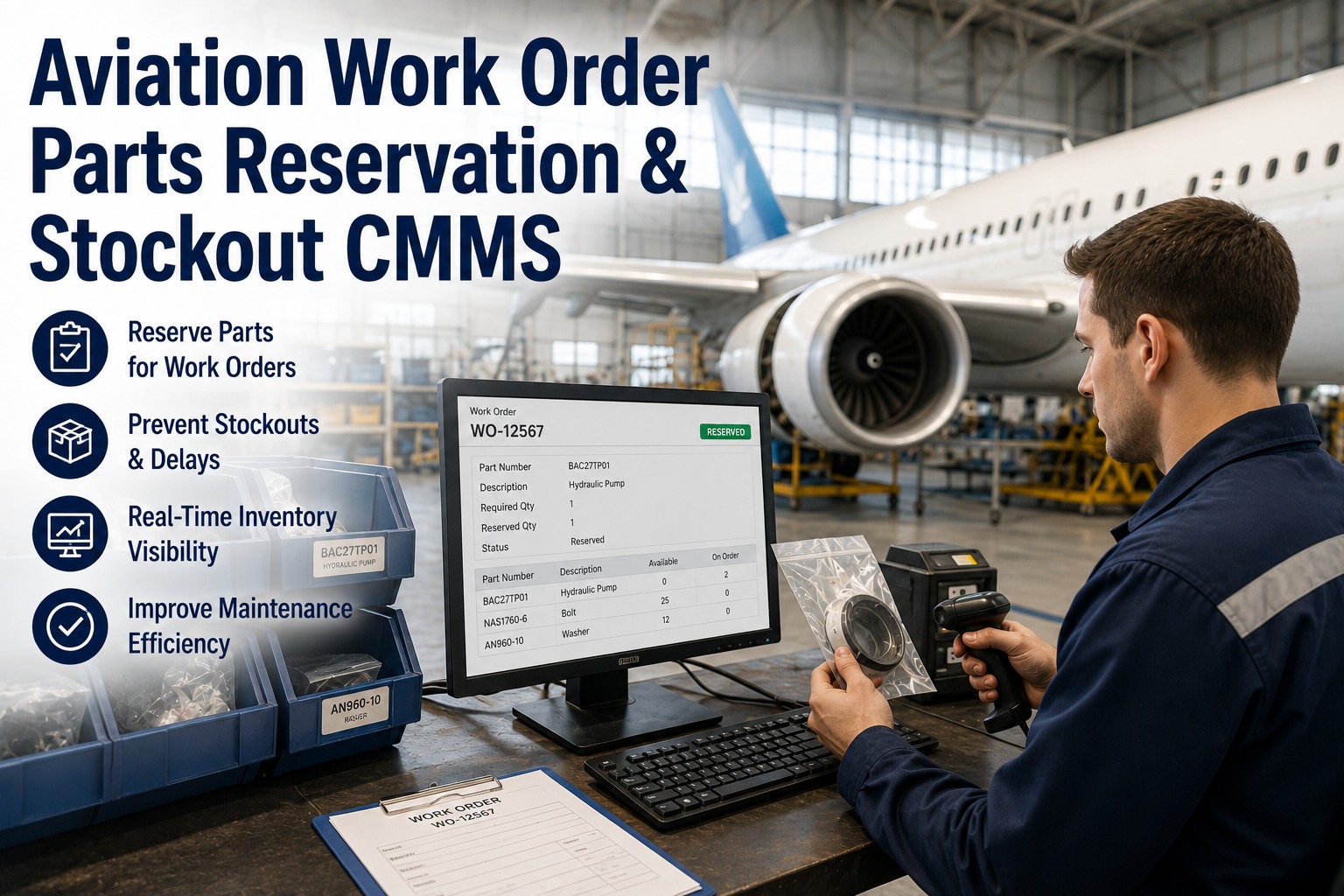
Work orders verify parts availability at the planning stage. If a required component is not in stock, a procurement request is triggered automatically — before the technician is assigned. Mid-task suspensions from missing parts become a solvable exception, not a daily reality.
Intelligence
Work Order Analytics Engine
Track mean time to complete by work order type, identify recurring bottlenecks, measure technician productivity, and monitor rework rates across your operation. Data that was previously locked in paper records becomes a continuous improvement engine.
Multi-Site
Portfolio-Wide Work Order View
For operators managing multiple MRO stations or line maintenance bases, Oxmaint consolidates all open work orders across all sites into a single portfolio-level view — with site-level and aircraft-level drill-down available on demand for any VP of Operations or Director of Maintenance.
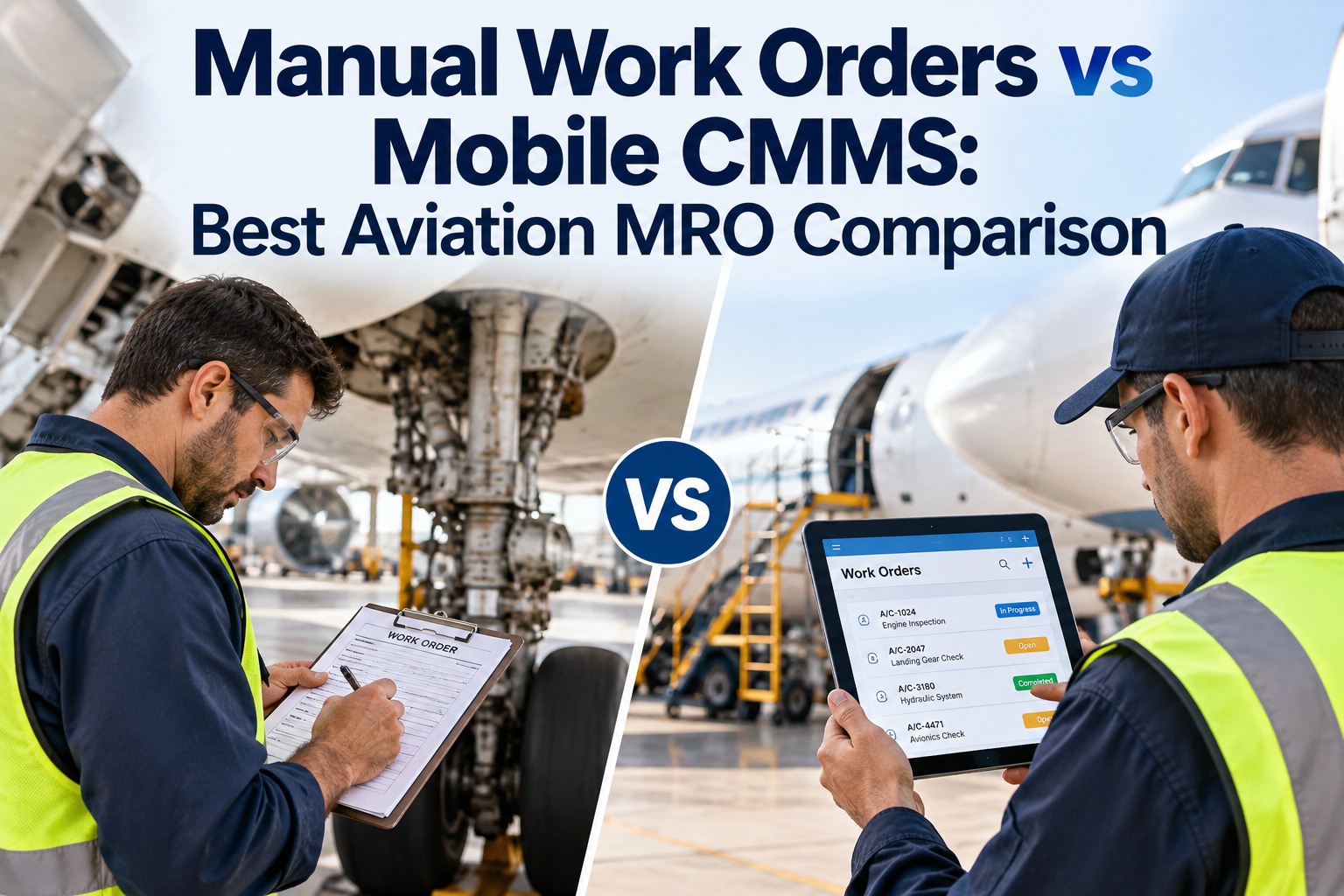
Paper-Based vs. Digital CMMS: Work Order Management Compared
The operational gap between paper-based and CMMS-driven work order management is structural, not incremental. The table below quantifies the difference across the dimensions that matter most to maintenance managers, operations directors, and CAA auditors — with specific figures from operations that have made the transition.
The ROI of Digital Work Order Management
The return on CMMS investment in aviation work order management is documented in maintenance cost reduction, audit outcome improvement, and aircraft-on-ground prevention — across commercial, business aviation, and MRO operations. These figures reflect industry-measured outcomes from operations that have transitioned from manual to digital work order management on a connected CMMS platform.
60%
Faster Work Order Cycle Time
From task creation to final sign-off. Digital routing, mobile execution, and instant authorization eliminate every serial wait state in the process.
29%
Fewer Audit Findings
CMMS operations report significantly fewer documentation-related audit observations — driven by structured task closure requirements that enforce completeness before sign-off.
18%
Drop in Maintenance Labor Cost
Recovered directly from eliminated authorization wait time, reduced rework cycles, and faster task package preparation across all work order types and check levels.
4.8x
Reactive vs. Planned Cost Ratio
Every unplanned work order costs 4.8x more than a scheduled one. CMMS-driven PM scheduling and auto-triggered work orders directly compress this cost multiplier.
Frequently Asked Questions
What types of aviation work orders does Oxmaint support?
Oxmaint supports the complete range of aviation work order types — scheduled preventive maintenance orders triggered by calendar interval, flight hours, or landing cycles; unscheduled corrective maintenance orders from pilot defect reports or MEL items; inspection work orders for A through D checks; component shop work orders for off-aircraft maintenance tasks; and modification work orders for engineering orders and STC implementations. Each work order type carries its own authorization routing, task card structure, and documentation requirements. All work orders link to the relevant asset record in Oxmaint's asset hierarchy — so every technician begins a task with complete context: previous maintenance history, open defects, current component status, and applicable AMM references, without having to pull a separate record.
How does Oxmaint handle regulatory compliance for aviation work order documentation?
Oxmaint's work order documentation framework is built to meet the requirements of the major civil aviation authorities. For FAA Part 145 operations, work orders include maintenance release statements, certifying technician credential linkage, and AMO authorization documentation. For EASA Part 145 operations, the platform supports CRS issuance from within the work order closure workflow. Digital signatures are timestamped and identity-verified. The full audit trail — from work order creation through every status change, authorization, task completion, and final sign-off — is retained in a searchable format that can be exported directly for any CAA audit. Record retention is configurable by jurisdiction, with a minimum 10-year retention period supported as standard for all closed work orders and associated documentation.
Can Oxmaint integrate with existing MRO systems like ERP, parts management, or aircraft tracking platforms?
Yes. Oxmaint is built with an open API architecture designed for integration across the MRO technology stack. Common integration points for aviation operations include ERP systems such as SAP and Oracle for financial cost coding and purchase order generation from work order parts requests; parts management and inventory platforms for real-time stock availability checks at work order planning stage; aircraft tracking systems for live flight hour and cycle data that automatically drive PM work order generation without manual entry; and document management systems for AMM, IPC, and SRM reference linkage directly within task cards. Oxmaint also supports SPEC 2000 data exchange for cross-organization maintenance record portability. Standard integrations are typically live within 2 to 4 weeks of deployment — not months.
How quickly can our MRO get live with Oxmaint's work order management module?
Most aviation operations are generating live digital work orders within their first week on Oxmaint. The platform is designed for fast deployment — there is no multi-month implementation project, no heavy data migration requirement, and no dedicated consulting engagement needed to go live. During onboarding, Oxmaint configures the asset hierarchy, imports existing maintenance schedules, and maps work order types to your current authorization and routing structure. Technicians learn mobile task completion in a single 45-minute session — the interface is designed for hangar floor use, not back-office administrators. Planners and supervisors have full access to the work order dashboard within 48 hours of account setup. For operations starting with a trial, the first live digital work order is typically running within 90 minutes of logging in for the first time.
Stop Managing Work Orders. Start Controlling Them.
Oxmaint's aviation CMMS gives your maintenance operation a fully digital work order system — from auto-triggered task creation through mobile execution, digital sign-off, and searchable audit-ready record archiving. No clipboards. No lost paperwork. No authorization queues. Just controlled, compliant, measurable maintenance execution across every aircraft, every site, and every shift.