Baggage handling systems move over 5 billion pieces of luggage annually across the world's airports, and a single conveyor jam or sorter failure can cascade into hundreds of missed connections, delayed flights, and millions in operational losses within hours. The question is no longer whether your system will fail — it is whether you will know before it does.
Stop Reacting to Failures.
Start Preventing Them.
AI-driven predictive maintenance is transforming airport baggage operations. Here is how leading facilities are cutting downtime, reducing costs, and eliminating delays before passengers ever notice a problem.
Your baggage system runs 24/7. Your maintenance program should too. Start a free trial and automate your entire BHS maintenance schedule in days — or book a demo to see it live.
What Is Baggage Handling System Maintenance?
A Baggage Handling System (BHS) is a network of conveyors, sorters, early baggage storage (EBS) units, tub return systems, and screening integrations that move checked luggage from check-in counters through security screening to the correct departure gate — and from arrival belts to the baggage claim carousel. Modern BHS infrastructure at major airports spans tens of kilometers of conveyor belt and processes thousands of bags per hour.
BHS maintenance is the structured, scheduled program of inspections, lubrication, component replacement, calibration, and software updates that keeps every element of that network operating at specification. Without it, friction escalates on conveyor drives, sorter diverters mis-align, scanner feeds jam, and the entire flow collapses — usually at the worst possible time: peak departure windows.
Modern BHS maintenance is no longer just wrench-turning on conveyor rollers. It integrates IoT sensor data, CMMS-driven work orders, and AI-generated failure predictions to shift operations from reactive firefighting to precision-timed interventions. If your team is still managing BHS maintenance on paper logs or spreadsheets, start a free trial with Oxmaint and see what a purpose-built CMMS changes for airport operations.
- Check-in conveyor feeders
- Linear induction motor (LIM) sorters
- Tilt-tray and cross-belt sorters
- Early Baggage Storage (EBS) systems
- Make-up units and claim carousels
- Inline screening / HBS integrations
- Baggage reconciliation (BRS) software
- SCADA and PLC control layers
The BHS Maintenance Framework: Four Layers
A modern BHS maintenance program operates across four interconnected layers. Weakness in any single layer creates vulnerabilities that compound into system-wide failures. Each layer requires dedicated maintenance protocols, asset records, and scheduling logic inside your CMMS.
Mechanical Layer
Conveyor belts, rollers, drive motors, gearboxes, chains, and structural supports. Failure here creates immediate, visible stops. Lubrication schedules, belt tension checks, and roller replacement intervals are the core tasks.
Electrical & Control Layer
PLCs, variable frequency drives (VFDs), sensors, photoelectric detectors, e-stops, and wiring. Intermittent faults here cause erratic system behavior. Panel inspections, VFD health checks, and sensor testing prevent cascading shutdowns.
Software & SCADA Layer
Baggage control system software, SCADA interfaces, barcode / RFID readers, and network infrastructure. Software bugs, outdated firmware, and network latency translate directly into misrouted bags and sort errors.
Security Screening Layer
Inline HBS CT scanners, explosive detection systems (EDS), and integration with the BRS. TSA / airport authority regulations mandate strict calibration and performance verification schedules that must be documented and audit-ready.
The Real Cost of BHS Downtime: Problems Maintenance Teams Face
Airport operations teams are not dealing with abstract risk. These are the concrete, daily problems that accumulate into major incidents when BHS maintenance is not structured and proactive.
No Visibility Into Component Wear
Teams discover worn rollers, stretched belts, and failing motors only after they stop. Without continuous condition monitoring, the first symptom of a problem is the failure itself — at 06:00 on a peak departure day.
Fragmented Maintenance Records
Work history scattered across paper logs, email chains, and multiple contractor spreadsheets means no one has the full picture. When a sorter fails, technicians spend 20–30 minutes just reconstructing what was last done to it.
Reactive Maintenance Culture
Budget pressure keeps teams reactive. Preventive tasks get deferred until something breaks. Emergency repairs cost 4.8x more than planned work, and the airport pays both in direct repair cost and airline delay penalties.
Compliance Documentation Gaps
TSA, ECAC, and airport authority audits require granular maintenance records for screening integrations, EDS units, and safety systems. Manual documentation leaves facilities perpetually at risk of regulatory citations and failed audits.
Spare Parts Stockout Delays
Critical components — VFDs, sorter diverters, scanner assemblies — have lead times measured in weeks. Without inventory visibility linked to maintenance schedules, teams routinely discover missing parts after a failure begins.
Multi-Contractor Coordination Chaos
BHS maintenance involves OEM technicians, airport in-house teams, and third-party contractors working across different zones. Without unified work order management, tasks fall through gaps or get duplicated, creating both cost waste and safety risk.
How Oxmaint Transforms BHS Maintenance Operations
Oxmaint is built for complex, multi-system asset environments — exactly the kind of infrastructure airport BHS represents. Here is how the platform addresses every layer of BHS maintenance.
Complete BHS Asset Hierarchy
Register every conveyor section, sorter, motor, VFD, scanner, and sensor in a structured hierarchy — Terminal > Concourse > System > Asset > Component. Full service history, condition scores, and remaining useful life estimates per asset, not just per system.
IoT and SCADA Integration
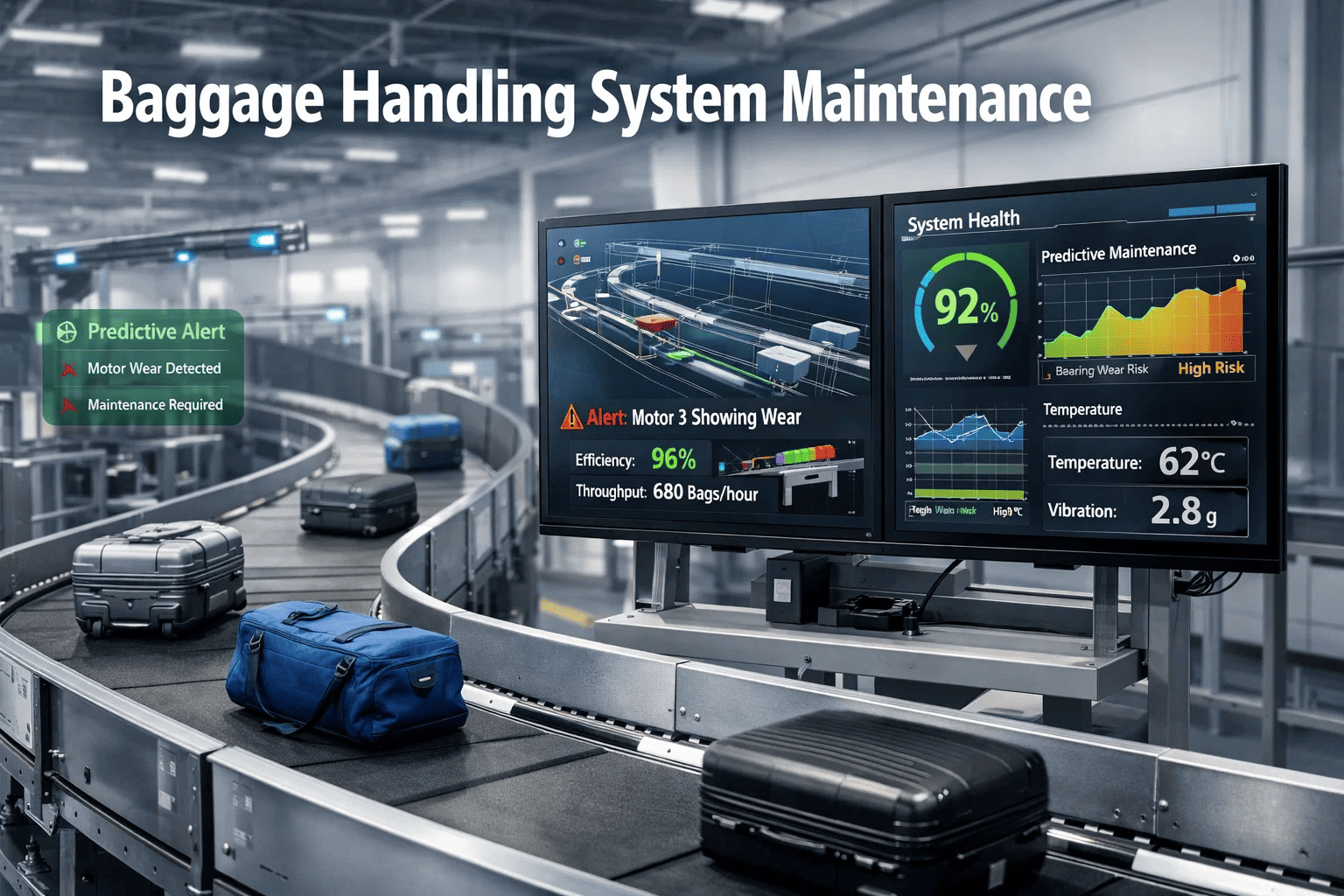
Connect vibration sensors, thermal cameras, and SCADA outputs directly into Oxmaint. When motor vibration crosses a defined threshold, the system auto-generates a work order and alerts the on-duty technician — before the bearing fails and the conveyor stops.
Production-Based PM Triggers
Schedule maintenance not just by calendar date but by operating hours, belt meters, cycle counts, and bag throughput. A sorter diverter rated for 500,000 actuations gets its work order automatically at 450,000 — whether that takes 3 months or 8.
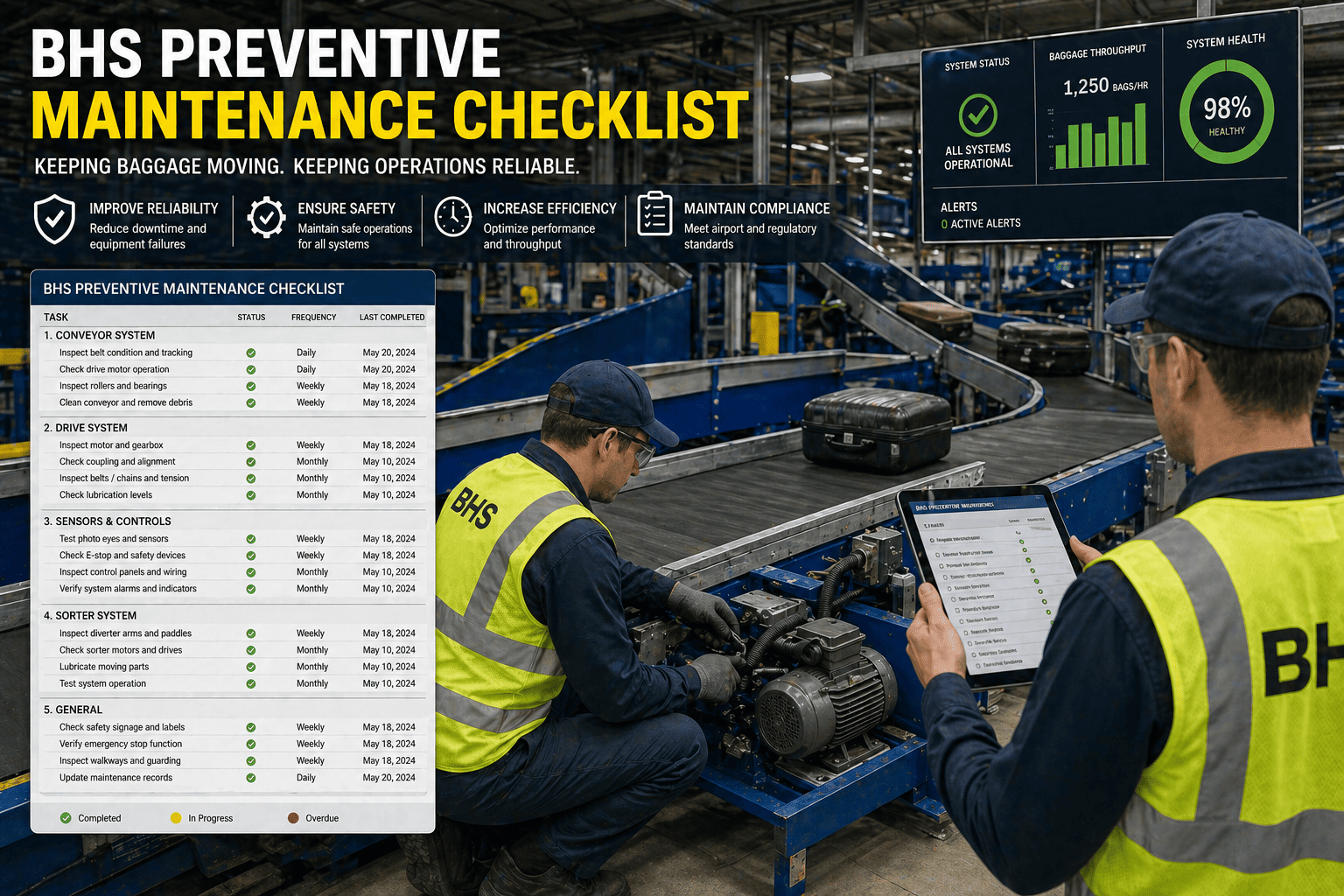
Digital Checklists for Technicians
Technicians use mobile-first inspection forms that walk through every check point — belt tension, roller spin, photo capture, sensor reading, torque values. No paper, no transcription errors, and every result timestamped and attached to the asset record automatically.
Audit-Ready Documentation
Every completed work order generates a signed, timestamped compliance record. EDS calibration logs, screening integration tests, and safety system certifications are stored, retrievable in seconds, and formatted for TSA, ECAC, and airport authority review.
Spare Parts Linked to Assets
Every asset record connects to its required spares. Oxmaint tracks inventory levels, triggers reorder alerts at minimum stock thresholds, and links parts consumption to work orders — so you know what you have, what you used, and what you need to order before it matters.
CapEx Forecasting for BHS
Rolling 5–10 year capital expenditure models built on actual asset condition data. When a conveyor drive reaches end-of-life condition, finance sees it in the CapEx forecast 18 months before you need to replace it — with supporting asset history as justification.
Portfolio-Level Visibility
For airport operators and concession management groups operating across multiple terminals or airports, Oxmaint consolidates every asset, work order, and KPI into a single dashboard. Benchmark performance across sites and identify systemic maintenance patterns.
The airports winning on operational reliability are not the ones with the newest equipment — they are the ones with the best-maintained equipment. Start a free trial today and configure your first BHS asset hierarchy in under an hour, or book a demo to walk through the platform with an implementation specialist.
Reactive vs. Predictive BHS Maintenance: The Real Difference
The gap between reactive and predictive maintenance is not philosophical — it is financial and operational. Every column below represents a decision your organization is making right now, whether you have made it explicitly or not.
| Operational Area | Reactive Maintenance | Predictive Maintenance with Oxmaint |
|---|---|---|
| Failure Detection | Discovered when system stops | Detected 2–6 weeks before failure via sensor alerts |
| Repair Cost | 4.8x emergency repair premium | Planned work at standard labor rates |
| Downtime Duration | Avg. 47+ minutes per incident | Maintenance windows scheduled during off-peak hours |
| Spare Parts | Emergency sourcing, high cost, long wait | Pre-stocked based on PM schedules and asset condition |
| Compliance Records | Paper logs, manually assembled for audits | Auto-generated, digital, timestamped, ready instantly |
| Technician Dispatching | Reactive calls, often pulling from other tasks | Scheduled work orders with skill matching and time allocation |
| CapEx Planning | Budget surprises, crisis-mode replacement requests | 5–10 year rolling forecasts built on asset condition data |
| System Availability | Below 97%, driven by unplanned events | 99.7%+ availability target achievable with structured PM |
If your current BHS maintenance program looks more like the left column than the right, the gap is not a technology problem — it is a system problem. Start a free trial and close it, or book a demo with our airport operations team today.
What Structured BHS Maintenance Actually Delivers
These are the measurable operational and financial outcomes facilities achieve when they move from reactive to CMMS-driven preventive maintenance programs.
Your BHS Cannot Afford Another Unplanned Failure
Flights do not wait. Passengers do not wait. Every hour of baggage system downtime costs your airport in delay penalties, mishandled bag claims, and airline relationship damage. Oxmaint gives your maintenance team the tools to prevent failures before they happen — with automated PM scheduling, real-time asset monitoring, and instant compliance documentation.
Join operations teams at airports across the USA, UK, UAE, Australia, and Germany who are running tighter, smarter, and more reliable baggage systems with Oxmaint as their maintenance backbone.
Frequently Asked Questions
How often should airport baggage conveyor belts be inspected and maintained?
Conveyor belt systems require daily visual inspections during shift handovers, weekly lubrication of drive chains and bearings, monthly belt tension and alignment checks, and quarterly full mechanical inspections including motor current draw analysis. High-throughput systems processing over 5,000 bags per day may require tighter intervals. A CMMS like Oxmaint tracks cumulative operating hours and bag throughput to trigger maintenance automatically based on actual usage — not just calendar dates — ensuring no inspection is missed regardless of operational intensity.
What is the biggest driver of unplanned BHS downtime and how is it prevented?
Bearing failure in conveyor drive motors accounts for approximately 31% of all unplanned BHS stoppages. Bearings degrade gradually, generating distinctive vibration signatures weeks before mechanical failure. IoT vibration sensors mounted on drive assemblies and integrated with a CMMS can detect these signatures and auto-generate maintenance work orders before the bearing fails. This is the single highest-ROI predictive maintenance intervention in a BHS environment, typically preventing 40–50% of the most disruptive failure events that occur during peak operational hours.
Can a CMMS integrate with existing airport BHS control systems and SCADA?
Yes. Modern CMMS platforms including Oxmaint support IoT and SCADA integration to receive real-time operational data from existing BHS control infrastructure. This includes alarm feeds, cycle counts, throughput metrics, and equipment status signals from PLCs and SCADA supervisory layers. Integration allows Oxmaint to generate maintenance triggers based on actual system performance data rather than estimated intervals, and to correlate SCADA alarm history with asset maintenance records for root cause analysis. Implementation does not require replacing your existing BHS control architecture.
What compliance documentation does a BHS maintenance program need to produce?
BHS maintenance programs at airports must maintain documentation for TSA-mandated EDS and inline HBS screening system maintenance and calibration, airport authority equipment certification requirements, manufacturer warranty compliance records, safety system test logs including e-stop function verification, and in ECAC-compliant airports, additional explosive detection standard documentation. During TSA or airport authority audits, facilities must produce maintenance logs, calibration certificates, technician qualifications, and corrective action records. Oxmaint generates all of these as audit-ready digital reports, eliminating the risk of documentation gaps that lead to regulatory citations and operational holds.