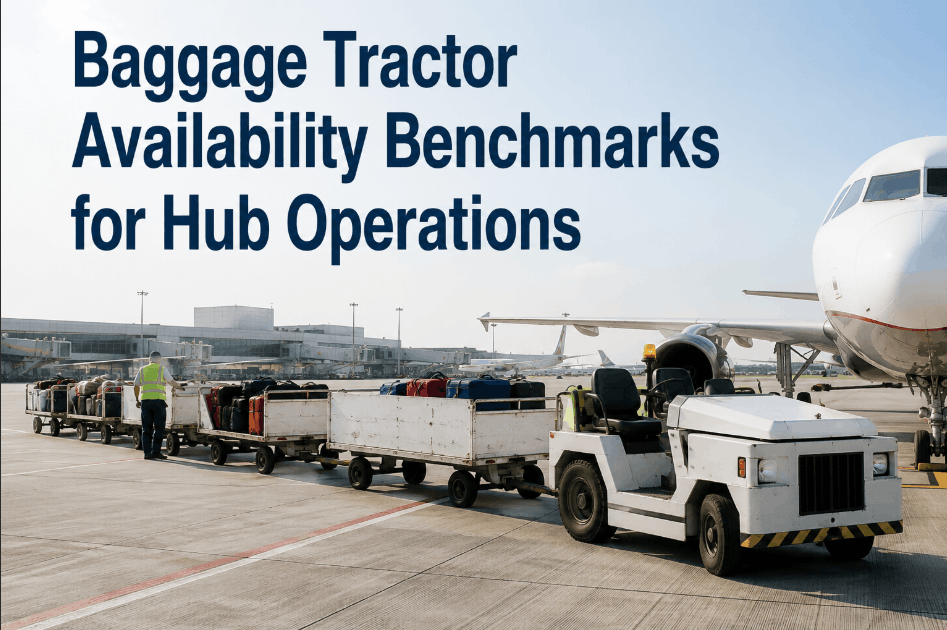
Baggage tractor availability is one of the most measurable levers hub ground handling managers have to improve stand turnaround performance. When tractor fleets fall below serviceability thresholds during peak bank periods, the consequences chain quickly — delayed baggage loading, missed departure slots, apron congestion from aircraft holding at stands. Yet most hub operations still benchmark tractor uptime informally, relying on shift supervisor judgment rather than structured asset reliability data. Oxmaint's CMMS platform gives ground handling teams a live equipment register with work order history, PM compliance tracking, and out-of-the-box availability KPIs that surface tractor serviceability gaps before they show up as flight delays. Hub managers can Sign Up Free and begin building their baggage tractor maintenance history from the next shift without any infrastructure project. For multi-airline or multi-terminal hub operations, Book a Demo to see how cross-fleet availability benchmarking works inside a single operations view.
Oxmaint connects tractor work order history to asset registers and PM schedules — giving hub ground handling teams the availability benchmarks they need to keep passenger flow moving through peak departure banks.
6 Baggage Tractor Availability Factors Hub Operations Teams Must Measure
Tractor availability at hub level is not a single number — it is a composite of fleet size, rotation balance, repair turnaround speed, and PM compliance across multiple asset classes. Oxmaint connects each of these dimensions to individual asset records so hub managers can Sign Up Free and access structured availability analytics from their first full maintenance cycle.
The percentage of baggage tractors available for dispatch at stand assignment windows — the foundational metric that determines whether hub baggage operations can meet scheduled aircraft turnaround commitments.
Available tractors relative to simultaneous stand assignments during peak bank periods — exposing allocation gaps where tractor shortfalls create queuing delays and baggage loading compression.
Hours from breakdown report to tractor return to active service — a cycle time that directly determines how quickly a serviceability dip is recovered and whether backup assets are needed to cover the gap.
Distribution of operating cycle hours across same-class tractor assets — identifying overloaded units approaching failure while underutilised assets sit idle, masking the true fleet wear profile.
Scheduled preventive maintenance completion rate for conventional and towbarless tractor fleets — the leading indicator that predicts whether unplanned breakdown rates will rise or fall over the next operating quarter.
Tracking towbar serviceability alongside tractor availability — since a serviceable tractor paired with a failed towbar or coupling delivers the same stand delay as a full tractor breakdown.
Baggage Tractor Availability KPIs: What Hub Ground Handling Managers Should Track
Hub ground handling operations that benchmark tractor uptime against structured KPIs consistently outperform those that rely on supervisor judgment. Oxmaint's asset analytics layer connects work order history to fleet availability metrics that are ready to use from day one. Ground handling directors should Book a Demo to review the complete availability KPI library before selecting a CMMS platform.
| KPI | What It Measures | Decision It Supports | Review Frequency | Priority |
|---|---|---|---|---|
| Fleet Serviceability Rate | % tractors available at peak dispatch windows | Fleet size adequacy review | Weekly | Critical |
| MTBF by Tractor Class | Mean time between failures per asset class | PM interval calibration | Monthly | Critical |
| Repair Cycle Time | Breakdown to return-to-service duration | Workshop capacity and parts stocking | Weekly | Critical |
| Stand Assignment Gap Events | Instances where tractor unavailability delays stand coverage | Peak period contingency planning | Monthly | Important |
| PM Compliance Rate | Scheduled PMs completed on time vs overdue | Maintenance program adherence review | Monthly | Important |
| Rotation Balance Index | Cycle hour spread across same-class assets | Dispatch rotation optimisation | Quarterly | Important |
| Deferred Work Order Backlog | Count and age of open maintenance tasks | Risk prioritisation | Weekly | Routine |
| Towbar Serviceability Rate | % towbars available and certified for use | Coupling equipment procurement | Monthly | Routine |
How Oxmaint Delivers Baggage Tractor Availability Benchmarks Without Manual Data Collection
The barrier to structured availability benchmarking at most hub operations is not lack of data — it is the absence of a system that captures work order events against individual assets in real time. Oxmaint closes this gap at shift speed. Hub teams can Sign Up Free and start logging tractor work orders against registered assets from day one — with availability dashboards populating automatically as data accumulates.
- Each baggage tractor registered as a named asset with class, location, and cycle data
- Mobile work order creation at point of breakdown — no office return required
- PM schedules linked to cycle counters for tractor-class-appropriate intervals
- Availability KPIs updated in real time as work orders are opened and closed
- Repeat failure flags triggered when same fault recurs within a configurable window
- Stand assignment integration for linking tractor availability to departure performance
- No asset register? Tractor fleet onboarding completes in hours, not weeks
- Shift log-based tracking? Real-time mobile work orders replace paper records
- Multi-terminal complexity? Single availability view across all hub zones
- No BI team? Out-of-the-box tractor uptime KPIs need zero configuration
- Deferred maintenance risk? Open backlog aging visible to all operations managers
- Audit documentation? Every repair timestamped and attributed by technician
Baggage Tractor Availability Investment vs Delay Reduction Value Model
Per-user pricing with no hardware overhead. Baggage tractor availability analytics go live within the first maintenance cycle — no BI tooling or system integration required.
Hub operations relying on manual shift records spend 15–30 hours weekly reconstructing availability data — a task Oxmaint's automated work order capture eliminates entirely.
Tractor shortfalls during peak banks create departure delays that carry airline penalty and handling contract exposure — costs that structured availability benchmarking and PM compliance directly reduce.
Cycle-based PM scheduling driven by actual tractor utilisation data reduces unplanned breakdown rates — improving fleet serviceability at the exact windows where availability matters most.
Identifying rotation imbalances early extends asset life across the tractor fleet — reducing capital replacement frequency and preventing concentration of wear on a subset of high-cycle units.
Structured availability data gives hub managers the evidence to justify fleet renewal, staffing additions, or PM program investment to airline clients and airport authority stakeholders.
Why Hub Ground Handling Teams Choose Oxmaint for Baggage Tractor Availability Benchmarking
Oxmaint is a maintenance execution platform with asset intelligence built into every workflow — not a standalone equipment register. For hub ground handling, that means availability data generated at the point of breakdown and PM, not assembled manually after the fact. Operations managers can Book a Demo to see how tractor availability analytics connect to stand assignment performance in one operational view.
Technicians log tractor breakdowns and close work orders from the apron via mobile — building availability history without shift-end data consolidation or office returns.
PM intervals tied to actual operating cycle counters — keeping maintenance frequency matched to real tractor wear rates rather than calendar assumptions.
MTBF, serviceability rate, repair cycle time, and PM compliance visible without custom report configuration — ready from the first maintenance cycle after onboarding.
Compare tractor availability across all hub terminal zones and airline handling areas — enabling fleet resource decisions based on where serviceability gaps are actually occurring.
Automatic flags when the same fault recurs on the same tractor within a configurable window — identifying chronic assets before their repeat failures begin impacting stand assignment coverage.
Every tractor repair, inspection, and PM timestamped and user-attributed — supporting airline ground handling contract audits, airport authority reviews, and safety compliance documentation.
Oxmaint gives hub ground handling teams asset-level work order capture, cycle-based PM scheduling, and out-of-the-box tractor availability benchmarks — no manual shift logs, no spreadsheets, no blind spots at peak departure banks.
Baggage Tractor Availability Benchmarking — Questions Hub Ground Handling Managers Ask
Oxmaint logs every tractor work order against a registered asset — building the work order history that drives availability KPIs like MTBF, serviceability rate, and repair cycle time automatically without manual data assembly.
Yes. Oxmaint's multi-site hierarchy supports separate views for each terminal zone within a single hub account — enabling cross-area availability benchmarking and fleet resource allocation decisions.
Yes. PM triggers can be linked to cycle counters — keeping maintenance intervals matched to actual baggage tractor utilisation rates rather than assumptions that may not reflect hub operating patterns.
Fleet registration and first work order flow typically completes within 24–48 hours. Structured availability benchmarks emerge after 4–6 weeks of consistent work order capture across the tractor fleet.
Yes. Asset-level failure history and repeat breakdown flags surface the specific tractor units whose reliability is most impacting fleet serviceability and stand assignment coverage at peak windows.
Yes. Towbars and ground coupling equipment can be registered as separate assets with their own work order history — giving ground handling managers a complete picture of all components that affect tractor dispatch readiness.
Oxmaint gives hub ground handling teams mobile work order capture, asset-level availability analytics, and cycle-based PM scheduling — no manual consolidation, no spreadsheets, no blind spots on stand assignment readiness.