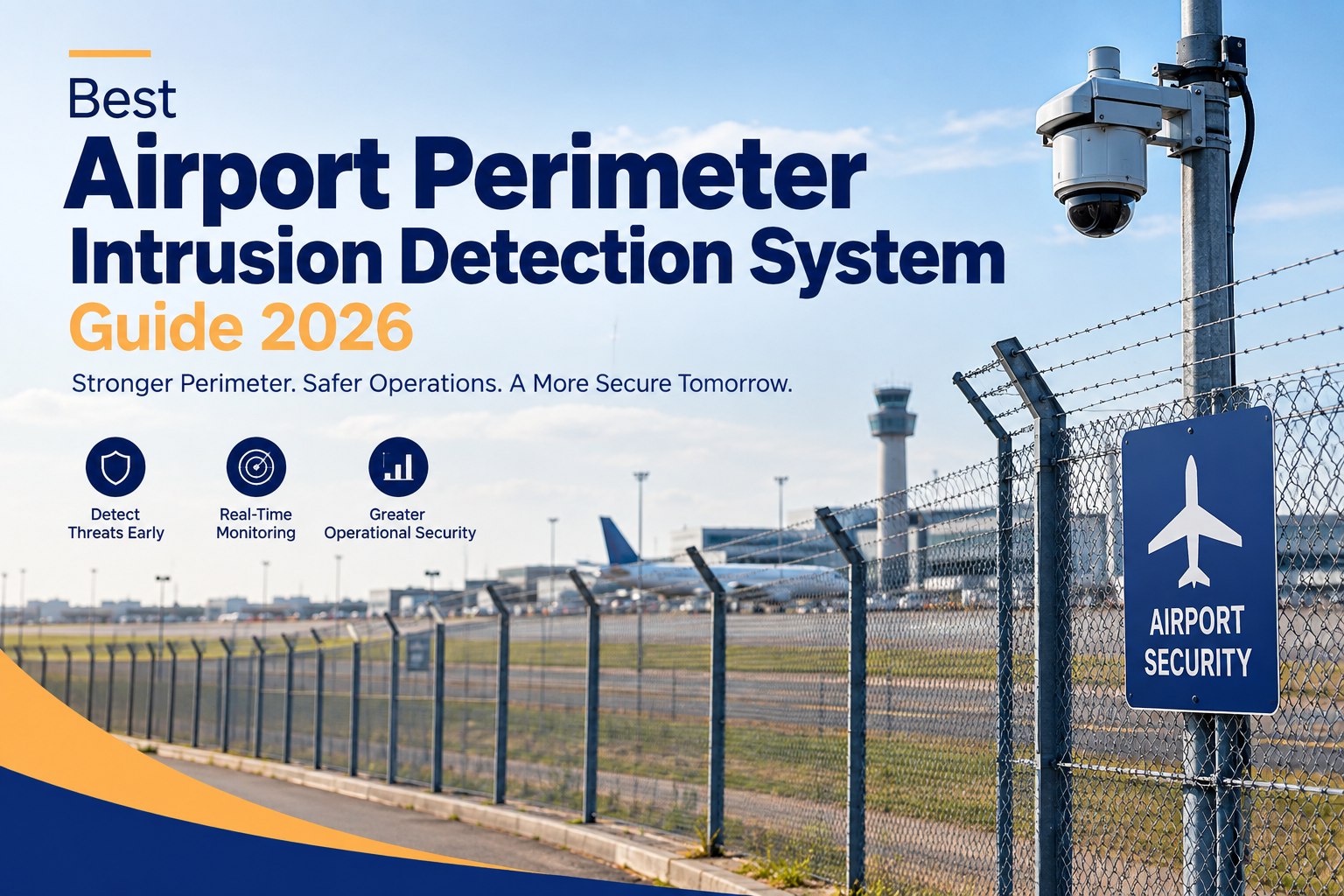
Best Airport Perimeter Intrusion Detection System Guide 2026

By William Jerry on September 17, 2026

best-airport-perimeter-intrusion-detection-system-2026

An airport perimeter is a 20–40 km fence line packed with fiber-optic cable, radar heads, thermal cameras, buried seismic sensors and access gates — hundreds of physical assets, each one a maintenance job waiting to happen. When a sensor drifts, a camera fogs, or a radar unit loses calibration, your perimeter intrusion detection system (PIDS) has a blind spot — and the intruder walks through it. That's why choosing a PIDS in 2026 isn't just a sensor decision; it's a decision about the maintenance management software that keeps every sensor healthy, every alarm tracked, and every response auditable. According to market research, the airport PIDS segment reached USD 6.4B in 2024 and is on track for USD 11.9B by 2033. This guide compares the sensor technologies and top vendors — and shows why OXMAINT AI is the CMMS software airport security teams use to run the response and maintenance loop behind the detection layer.

Aviation Security · PIDS Buyer's Guide · Sensor Fusion · 2026

Best Airport Perimeter Intrusion Detection System Guide 2026

A PIDS is only as good as the maintenance behind it — one drifted sensor, one uncalibrated radar, one unrepaired fence panel and you have a blind spot. OXMAINT AI, an AI-powered CMMS, connects the full workflow in one platform: inspection or alarm → defect logged → work order routed → PM & predictive alerts scheduled, so every sensor stays healthy and every issue closes on record.

$6.4B → $11.9B
airport PIDS market 2024 → 2033 at 8.1% CAGR
15.5%
CAGR of the broader PIDS market to 2030
52.8%
share of PIDS spend held by sensor hardware
20–40 km
typical hub-airport perimeter length to cover

The Threat Picture — Why Airports Are Buying PIDS Now

Airport perimeters used to be a chain-link fence and a patrol vehicle. Post-2023 runway-incursion scrutiny changed that: the FAA's Runway Incursion Mitigation program tracks locations averaging one or more incursions per year across 520+ towered airports, and India's Ministry of Civil Aviation mandated PIDS at all major airports in 2024 after multiple runway breaches. Miami International Airport deployed fiber-optic + radar + laser-wall barriers in October 2024. The threat has moved from casual trespass to drone incursions, coordinated intrusions and vehicle-borne breaches — and every one of those threats generates alarms, patrol dispatches and sensor-maintenance work that OXMAINT AI maintenance management software captures in one system of record. Start free and log every alarm as a tracked incident in OXMAINT AI.

Fence Cut & Climb
Classical intrusion — a cut chain-link, a scaled fence at night. Detected by fiber-optic vibration; repaired via OXMAINT AI work order.
Vehicle Ram-Raid
A vehicle driven through a gate or fence at speed. Detected by seismic cable and radar; gate-repair task fires in OXMAINT AI on impact.
Drone / UAS Incursion
Low-altitude drone over airside. RF + radar detect; OXMAINT AI logs the incident, dispatches response & tracks C-UAS sensor health.
Runway Incursion (Ped)
A person crossing airside. Ground radar + thermal detect; OXMAINT AI creates the patrol task and holds the audit chain of custody.

The 5 Sensor Technologies — And the Maintenance Load Each One Carries

No single sensor covers every intrusion vector — but every sensor also carries its own calibration schedule, failure mode and spare-part list. OXMAINT AI maintenance management software runs the PM cadence for all five simultaneously, so no sensor goes blind while another is watching. Book a demo to see the multi-sensor PM cadence in OXMAINT AI.

01
Fiber-Optic Fence Sensor
Fiber cable woven into the fence detects vibration signatures across tens of kilometres. Immune to electromagnetic interference, but tension & controller health need scheduled checks.
OXMAINT AI: quarterly zone-walk PMs & controller diagnostics
Weakness: doesn't classify — cut vs. wind vs. animal
02
Microwave / Radar
Volumetric detection between transmitter–receiver pairs, or ground-based radar tracking movement across open airside. Long-range, multi-target, all-weather.
OXMAINT AI: alignment PMs, runtime-triggered service intervals
Weakness: wildlife & blowing debris trip false alarms without AI
03
Infrared / Thermal Video
Thermal cameras with AI classify humans vs. animals vs. vehicles in darkness & fog — the visual verification layer for every other sensor.
OXMAINT AI: lens cleaning cadence, firmware PMs, dead-pixel checks
Weakness: dense fog & heavy rain still degrade range
04
Buried Seismic Cable
A cable buried along the perimeter detects footsteps & digging. Covert (an intruder can't see it), unaffected by weather above ground.
OXMAINT AI: seasonal recalibration PMs by soil zone
Weakness: soil type & frost line change calibration
05
AI Video Analytics + LiDAR
The fusion & classification layer — combines every other sensor's raw signal, classifies threat type, and cuts false alarms by an order of magnitude vs. rule-based analytics.
OXMAINT AI: model-update logs, edge-compute health tracking
Weakness: model quality varies wildly by vendor

The Sensor-Fusion Coverage Map

No serious 2026 airport RFP asks for a single sensor. Each layer catches what the next one misses — and the fusion controller stops a fiber-optic vibration from being an alarm and turns it into a classified, verified incident. OXMAINT AI maintenance management software sits behind all of it, keeping every layer maintained and every classified alarm turned into a routed work order. Sign up free and route every classified alarm into an OXMAINT AI work order.

Threat Type
Fiber-Optic
Radar
Thermal
Seismic
AI Video
Fence cut / climb
Primary
Partial
Verify
Classify
Vehicle ram-raid
Partial
Primary
Verify
Primary
Classify
Drone / UAS
Primary
Partial
Partial
Pedestrian airside
Primary
Primary
Primary
Classify
Digging / tunnel
Primary
Wildlife (nuisance)
False +
False +
Filter
False +
Filter

Every Alarm Needs an Owner, a Response Time and an Audit Trail — That's What OXMAINT AI Delivers.

A PIDS that fires 400 alarms a night isn't a security system — it's noise. The sensor's fusion controller filters alarms to real events; OXMAINT AI maintenance management software turns each real event into a tracked patrol dispatch, an auto-generated work order for damaged fence panels or drifted sensors, and a closed incident with response-time evidence. Without that CMMS loop, a Category B runway incursion has no chain of custody for the post-incident review. OXMAINT AI is the software that closes the loop — every PIDS alarm becomes a routed work order with photo capture, technician assignment and closure timestamp.

Top Airport PIDS Vendors — Feature Scorecard

The vendor short-list for a mid-to-large airport in 2026 has narrowed to a handful of names combining sensor hardware, fusion analytics and integration with existing VMS/access-control stacks. OXMAINT AI is vendor-agnostic — it works as the maintenance management & response layer behind any of these detection platforms. Book a demo to see OXMAINT AI wired to your PIDS.

Vendor / Platform
Fiber-Optic
Radar
Thermal / AI
VMS Integration
Airport Track Record
Honeywell Vindicator
Pro-Watch native
Very strong
Senstar (fiber & taut-wire)
✓ Class-leading
Partner
Open API
Strong
Southwest Microwave
✓ INTREPID
Partner
Open
Strong
FLIR / Teledyne
✓ Ground radar
✓ Thermal leader
Open
Very strong
Axis + Genetec
Radar addon
✓ AI analytics
Genetec-native
Strong VMS
Fotech / Luna Optasense
✓ DAS long-range
Partner
Open
Growing

Note: this is a directional feature-fit view, not a formal ranking — every airport should validate on-site with pilot deployments. OXMAINT AI maintenance management software integrates with all six vendors through their open APIs.

The 6 RFP Criteria That Separate Winners From Losers

Sensor specs are table stakes. The dimensions that decide which system performs at year three, not month three, are these six — and the last two, where OXMAINT AI does the heavy lifting, are the ones cheap RFPs skip. Sign up free and track sensor-uptime SLAs in OXMAINT AI.

18%
False-Alarm Rate (FAR)
Measured per km per 24h under real weather. Below 1 nuisance alarm / km / day is a modern benchmark.
17%
Probability of Detection
Verified against walk-test, run-test, roll-test & crawl-test at multiple points — OXMAINT AI schedules the test cadence.
17%
Sensor Fusion Depth
How many sensor types the fusion controller natively correlates — not "supports", but actually classifies together.
16%
Open API & VMS Fit
Native integration with your VMS (Genetec / Milestone / Pro-Watch) & the ability to push events to OXMAINT AI.
16%
Response-Loop Integration
Does an alarm auto-create a patrol task & sensor-repair work order in OXMAINT AI? Or does it stop at the operator screen?
16%
Total Cost of Ownership
Sensor life, calibration frequency, spares stocking, licence renewals — all tracked in OXMAINT AI over a 10-year horizon.

The Alarm-to-Closure Workflow OXMAINT AI Runs

This is where most PIDS deployments break — not at the sensor, but at the workflow after the alarm. A modern airport response loop is six steps, and each step needs an owner, a timer and a system of record. OXMAINT AI maintenance management software owns steps 3 through 6 — turning the operator's decision into tracked, evidence-backed work. Book a demo to see the six-step loop live in OXMAINT AI.

1
Sensor triggers
Fiber-optic vibration + radar track + thermal signature fuse into a single classified event.
2
Operator verifies
SOC operator views the auto-tagged camera pop-up, confirms real intrusion vs. nuisance.
3
OXMAINT AI dispatches
The CMMS auto-creates a patrol task, assigns nearest responder, starts response-time clock.
4
Field evidence logged
Responder logs findings, photos & fence/sensor damage into the OXMAINT AI mobile app.
5
Repair WO fires
Damaged sensor or fence panel auto-generates a maintenance work order in OXMAINT AI with priority & parts.
6
Incident closed
Full chain of custody archived in OXMAINT AI — alarm, verify, dispatch, arrive, repair, root-cause.

The ROI Math — What OXMAINT AI Adds to a Fusion PIDS

The business case for a modern PIDS isn't preventing one catastrophic breach — it's cutting the daily cost of false alarms, patrol miles, and unrepaired-sensor blind spots that pile up over a year. Here's the annualized picture for a 25 km mid-hub perimeter — legacy fence-only vs. sensor fusion wired into OXMAINT AI maintenance management software. Sign up free and run this analysis on your fence line with OXMAINT AI.

False alarms / day
Legacy fence-only
~400 / day
Fusion + OXMAINT AI
~20 / day
Avg. verify time / alarm
Legacy
~90 sec
Fusion + OXMAINT AI
~15 sec (auto-pop)
Patrol miles / month
Legacy
~4,800 mi
Directed by OXMAINT AI
~1,700 mi
Sensor mean-time-to-repair
Legacy (email chain)
~7 days
OXMAINT AI tracked WO
~36 hrs

What OXMAINT AI Maintenance Management Software Gives an Airport Security Team

OXMAINT AI isn't a PIDS sensor vendor — it's the CMMS software that keeps every sensor healthy and turns your Honeywell, Senstar, FLIR or Southwest Microwave detection into tracked, closed, audit-ready work. Here's what airport security & facilities teams get. Book a demo to see OXMAINT AI wired to your VMS.

Alarm-to-Work-Order Bridge
PIDS/VMS events push into OXMAINT AI via open API — every classified alarm becomes a routed task with a response-time clock.
Sensor-Health PM Cadence
OXMAINT AI puts every fiber run, radar unit & thermal camera on a scheduled calibration & test-target inspection — before it goes blind.
Mobile Field Evidence Capture
Patrol responders log photos, fence-damage notes & GPS-tagged findings on the OXMAINT AI mobile app — no radio-only trail.
Response-Time SLAs
Every alarm class has a response-time target; OXMAINT AI tracks p50/p95 by zone, shift & responder automatically.
Audit-Ready Chain of Custody
Alarm → verify → dispatch → arrive → resolve → close, each timestamped in OXMAINT AI, ready for regulator review.
Vendor-Agnostic Integration
OXMAINT AI works with Honeywell, Senstar, Southwest Microwave, FLIR, Axis, Genetec & Milestone — no OEM lock-in.
"

We had one of the top-name fiber-optic systems on the fence, and it was firing four hundred alarms a shift. The operator was tuning them out — which is exactly how a real intrusion gets missed. We added AI classification on top and dropped that to twenty, but the bigger unlock was wiring the classified alarms into OXMAINT AI. Now every real event has a patrol task with a start time, an arrive time, a close time and photo evidence in one record. When a sensor goes offline OXMAINT AI creates the repair work order within the hour, not the next patrol cycle. The post-incident review that used to take two days of pulling emails is one export from OXMAINT AI.

Head of Airside Security · International Hub Airport

Frequently Asked Questions

Which PIDS sensor technology is best for an airport perimeter?
None on its own — the 2026 standard is sensor fusion. Fiber-optic for long fence lines, radar for open airside & drones, thermal for verification, seismic for covert detection, and AI video analytics for classification. OXMAINT AI maintenance management software runs the PM cadence for all five layers and turns their alarms into tracked work orders.
How much does an airport PIDS cost?
Budgets vary widely by perimeter length & sensor mix, but a hub airport project typically spans millions in capex across sensors, controllers, integration & VMS work — plus recurring analytics licences. OXMAINT AI helps stretch that capex further by pushing sensor life, tracking calibration & cutting repair MTTR.
Where does OXMAINT AI maintenance management software fit into airport perimeter security?
A PIDS detects & classifies; OXMAINT AI runs the response, repair & PM loop behind it. Each classified alarm becomes a routed patrol task, field evidence captures on mobile, work orders auto-create for damaged sensors & fence panels, and incidents close with full chain of custody — the audit trail regulators need.
Is one PIDS vendor clearly better than the others?
No — the "best" system is the one whose sensor mix & VMS integration fit your fence line, weather profile & existing security stack. OXMAINT AI is vendor-agnostic and works as the maintenance & response layer behind Vindicator, Senstar, Southwest Microwave, FLIR or Axis-Genetec.
How fast can OXMAINT AI be wired into an existing PIDS deployment?
Most airports go live in a few weeks — import your asset list (sensors, cameras, gates, fence zones) into OXMAINT AI, wire the VMS event stream via open API, and start generating tracked patrol tasks & PM work orders on classified alarms from day one.

Detection Without OXMAINT AI Is Just Noise.

Pick the right sensor-fusion stack for your fence line — then wire it into OXMAINT AI maintenance management software so every classified alarm becomes a tracked patrol task, every drifted sensor becomes a work order, and every incident closes with an audit-ready chain of custody.

Share This Story, Choose Your Platform!