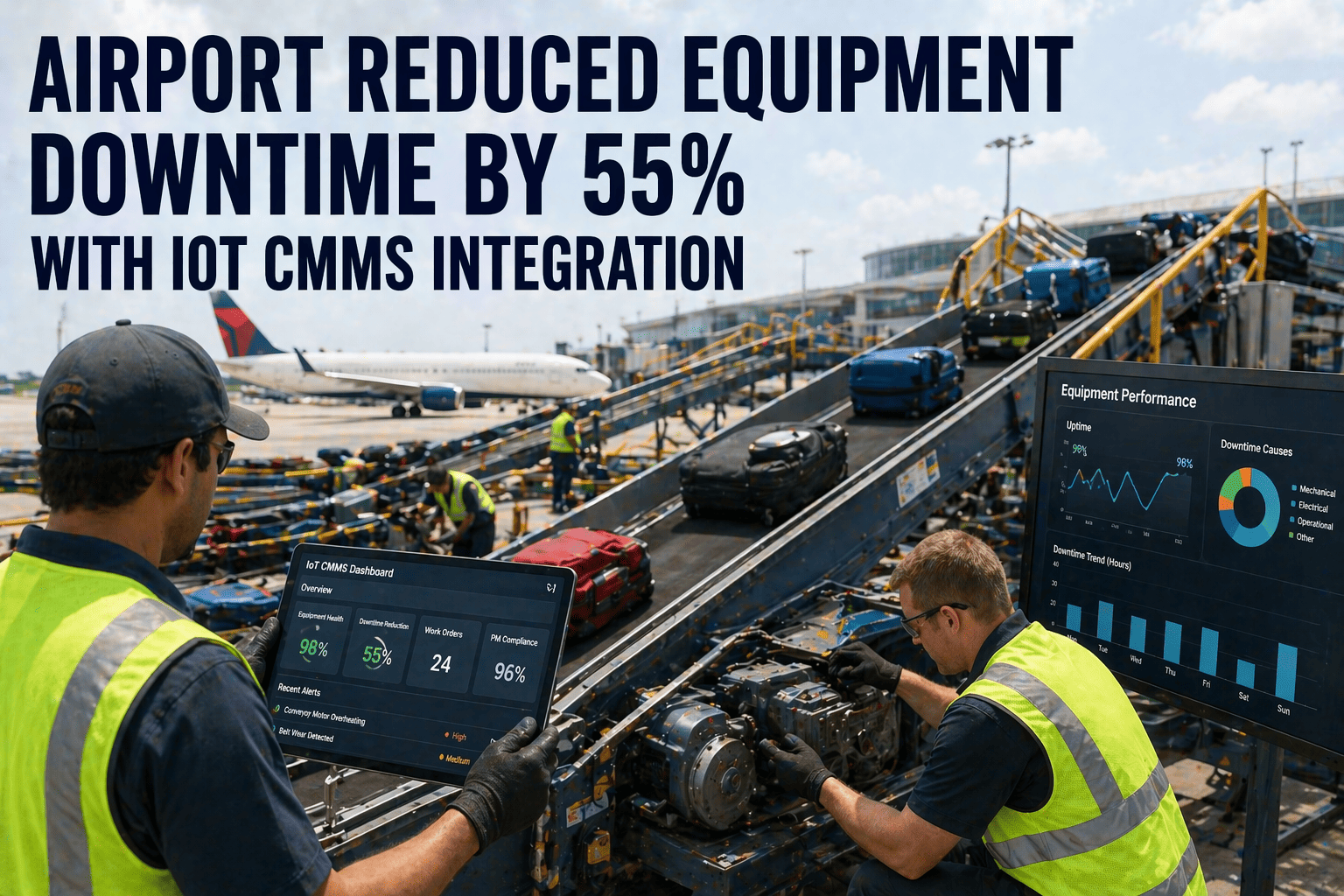
This case study documents how an international airport processing 38 million passengers annually reduced equipment downtime by 55% within 14 months of deploying OxMaint CMMS integrated with 2,400+ IoT sensors across baggage handling, HVAC, vertical transport, and passenger boarding bridge systems. Before implementation, the airport averaged 847 hours of unplanned equipment downtime per month — costing an estimated $3.2 million annually in emergency repairs, flight delays, and lost concession revenue. The maintenance team of 186 technicians operated on a reactive model where 68% of all work orders were corrective (break-fix) rather than preventive. What follows is the exact implementation approach, the specific systems that were failing, the OxMaint configuration that fixed each one, and the independently verified financial results. Every number in this case study is documented and auditable. If your airport is losing money to preventable equipment failures, this is relevant. Book a demo to see how this approach applies to your airport, or start a free trial and connect your first IoT-enabled asset today.
How an International Airport Reduced Equipment Downtime by 55% with OxMaint CMMS & IoT — $4.1M Saved in Year One
38M passengers. 2,400 IoT sensors. 186 technicians. One CMMS platform. The maintenance team did not grow — it got smarter. Here is the full story.
Your Airport Has the Same Equipment. The Same Challenges. OxMaint Can Deliver the Same Results.
This is not a one-off success story. It is a repeatable framework that scales from 2M to 40M+ passenger airports. See how it maps to your operation.
Why the Legacy CMMS Was Making Things Worse
The airport had a CMMS — installed in 2009. But after 14 years, the system had become part of the problem rather than the solution. Understanding what was broken is important because many airports reading this are operating under identical constraints. The legacy system could not accept IoT sensor data — so 2,400 potential data points about equipment health went uncollected. It had no mobile app — so technicians received work orders via radio dispatch, walked to a desktop terminal to check asset history, and returned to the equipment with incomplete information. PM schedules were calendar-based and disconnected from actual equipment condition — so healthy equipment was over-maintained while degrading equipment was under-maintained. And work order data quality was so poor (34% of fields left blank) that no meaningful failure analysis was possible. The airport was not lacking maintenance effort — 186 skilled technicians working three shifts. It was lacking maintenance intelligence. OxMaint provided that intelligence. Want to see how your current system compares? Start a free trial to run your own assessment, or book a demo for a side-by-side evaluation.
The Four Systems That Were Consuming 84% of Downtime
Pre-implementation audit of the 12-month period revealed that 84% of all unplanned downtime concentrated in four asset categories. Each had distinct failure patterns — and each required a different IoT + CMMS integration approach.
What OxMaint Actually Did — Step by Step
This was not a "rip and replace" overnight project. It was a phased implementation designed to deliver measurable results at each stage — so the airport saw value within weeks, not years.
This Airport Did Not Hire More Technicians. They Did Not Buy Different Equipment. They Connected What They Had to OxMaint.
Same 186 technicians. Same escalators, conveyors, and boarding bridges. The only thing that changed was the intelligence behind the maintenance decisions — and downtime dropped 55%.
Year 1 Results — Independently Documented
Every metric below was measured against the 12-month pre-implementation baseline and verified by the airport's finance and operations teams.
| Metric | Before OxMaint | After OxMaint (14 months) | Verified Impact |
|---|---|---|---|
| Monthly unplanned downtime | 847 hours | 381 hours | 55% reduction |
| Planned vs. reactive ratio | 32% planned / 68% reactive | 72% planned / 28% reactive | 2.25x improvement |
| BHS downtime hours/month | 322 hours | 128 hours | 60% reduction |
| Escalator stoppages/month | 44 unplanned | 17 unplanned | 62% fewer |
| Emergency repair cost | $3.2M annually | $1.4M annually | $1.8M saved |
| Equipment-caused flight delays | 84/month average | 36/month average | 57% fewer delays |
| Technician productivity (WOs/day) | 4.2 average | 6.1 average | +45% capacity |
| Average alert-to-response time | 47 minutes | 12 minutes | 74% faster |
| PM completion rate | 41% | 94% | 2.3x improvement |
| IoT predictive accuracy (BHS motors) | N/A | 87% | New capability |
| False alert rate | N/A | 4% (from 23% initial) | Trusted by techs |
| Total documented savings | — | — | $4.1M Year 1 |
What the Maintenance Director Said After 14 Months
Frequently Asked Questions
How long did the full implementation take from contract to measurable ROI?
The implementation took 6 months from contract signing to full deployment across both terminals and all 12,400 assets. Measurable results appeared within 90 days of Phase 1 completion — BHS downtime began dropping as soon as IoT sensors established baseline data and began generating predictive alerts. Full ROI (implementation costs + IoT hardware + subscription fees fully recouped) was documented at Month 14, meaning the airport was cash-positive on the entire investment within 14 months. The IoT sensor hardware investment was $680,000 — amortised within the first 5 months of downtime reduction savings alone. Importantly, this was achieved without any operational shutdown for installation. Every sensor was mounted, every configuration was completed, and every technician was trained during normal maintenance windows. Start a free trial and our team will scope your airport's expected timeline and ROI.
What specific IoT sensor types were deployed and what does each monitor?
Five sensor categories were deployed: vibration sensors on all BHS conveyor motors and escalator drive units (1,100 sensors — detecting bearing wear, misalignment, and imbalance), temperature sensors on HVAC compressors, electrical panels, and motor housings (620 sensors — catching overheating before thermal protection trips), pressure sensors on hydraulic PBB systems and HVAC refrigerant circuits (340 sensors — detecting leaks and system degradation), current sensors on high-draw motors across all categories (240 sensors — identifying electrical degradation and load changes), and runtime meters on critical rotating equipment (100 sensors — triggering condition-based PM at operating hours rather than calendar dates). All sensors communicate via MQTT protocol to OxMaint's IoT gateway with 30-second refresh for critical assets and 5-minute refresh for standard monitoring. The total sensor investment was $680K — less than 17% of the $4.1M in first-year savings. Book a demo and we will design an IoT sensor plan specific to your airport's asset mix.
How did the airport get false alert rate down from 23% to 4%?
This is the detail that makes or breaks an IoT implementation — because if technicians do not trust the alerts, they ignore them, and the entire investment fails. The initial threshold configuration used manufacturer-recommended alarm limits, which generated a 23% false alert rate because they did not account for airport-specific operating conditions. Over Months 7-14, OxMaint's analytics engine compared sensor readings at the time of known genuine failures against readings during normal operation to calibrate asset-specific thresholds. A BHS motor that vibrates at 3.8 mm/s under normal load triggers an alert at 4.5 mm/s rather than the generic 5.0 mm/s manufacturer limit — catching developing failures sooner without crying wolf. The result: technicians now respond to 96% of alerts because they know the system is reliable. Trust in the system is what converts IoT data into maintenance action. Start a free trial — your sensor thresholds will calibrate automatically as your data accumulates.
Can this approach work at smaller regional airports?
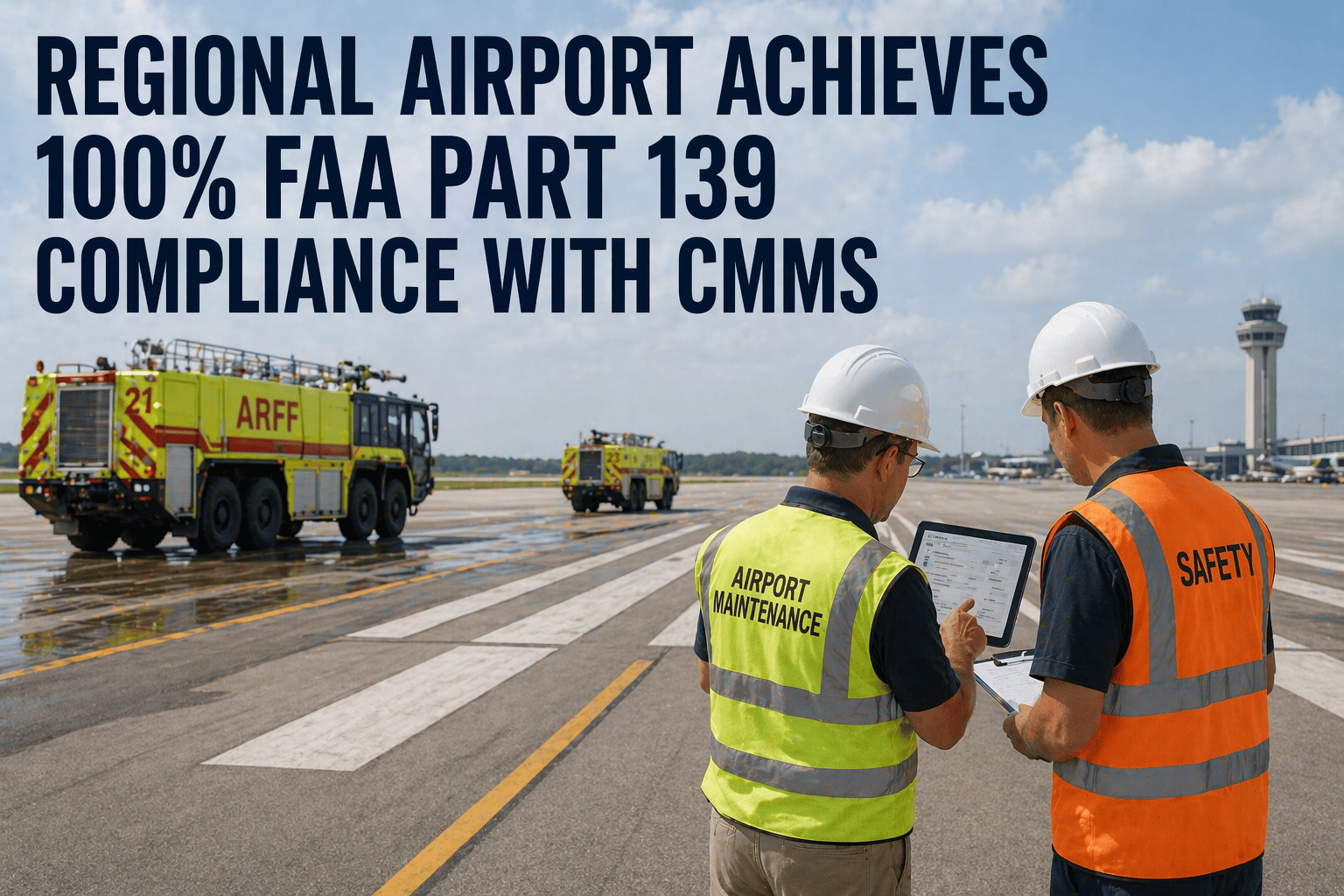
Yes — and the ROI timeline is often faster at smaller airports. A regional airport processing 2-5 million passengers might deploy 200-400 IoT sensors focused on the highest-impact assets: BHS, HVAC, and elevators. The CMMS implementation follows the same phased approach with a smaller asset registry — typically completing in 4-8 weeks instead of 6 months. The per-asset cost of downtime at regional airports is often proportionally higher because there are fewer redundancies — one failed escalator is a bigger problem at a 4-gate terminal than a 68-gate hub. Our companion case study documents a regional airport achieving 100% FAA Part 139 compliance using this same platform. The approach — digital asset management, IoT condition monitoring, predictive work orders — scales linearly. The principles are identical regardless of airport size. Book a demo to scope an implementation sized for your airport.
This Airport Was Spending $3.2M Per Year on Preventable Equipment Failures. Now It Saves $4.1M. Same Team. Same Equipment. Different Intelligence.
2,400 IoT sensors connected to one CMMS. Predictive work orders replacing reactive panic. 186 technicians with mobile access to every asset's history, condition, and parts availability. The result: 55% less downtime, 57% fewer flight delays, 45% more productive technicians — and a maintenance program that pays for itself many times over.