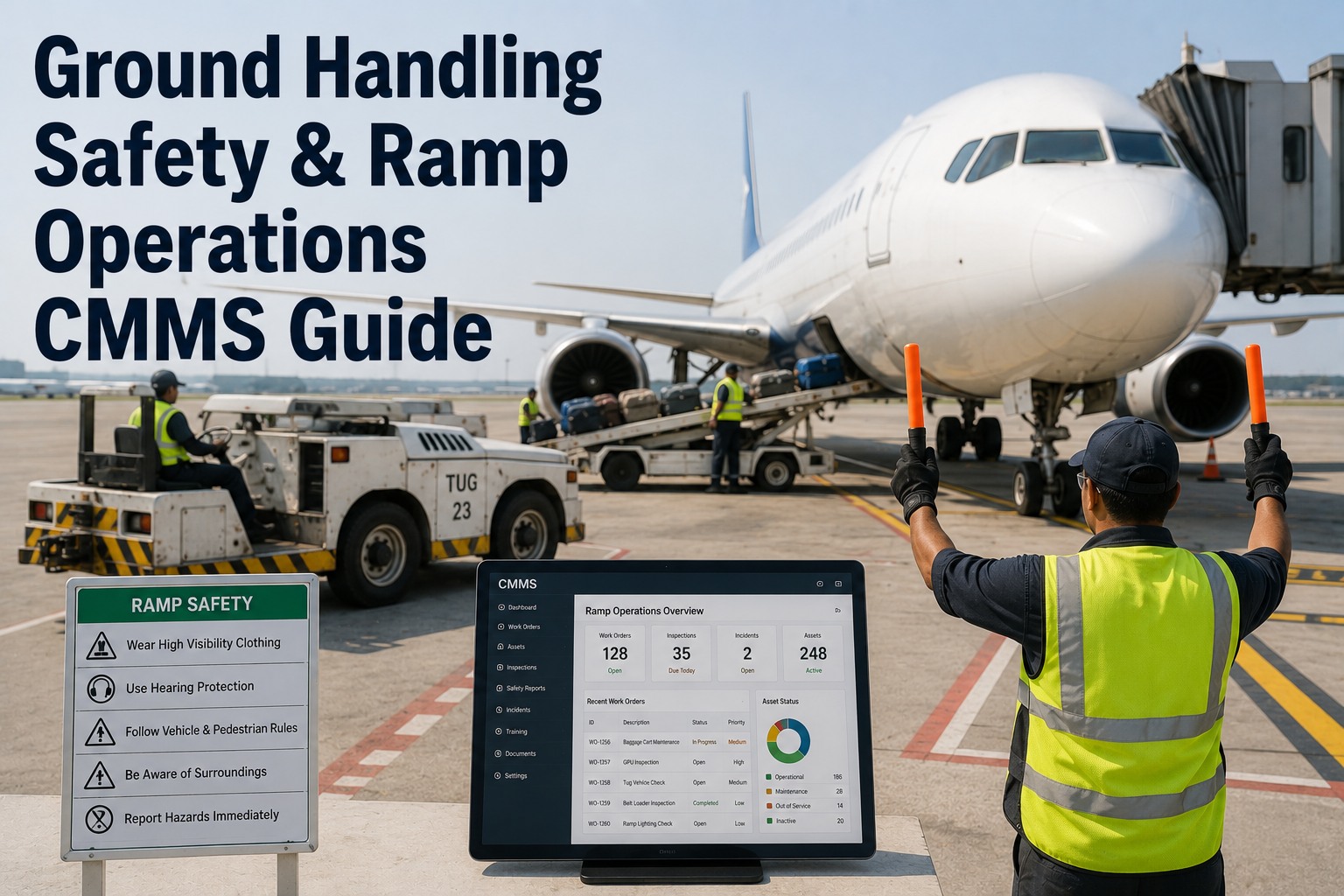
Ground handling causes more damage to aircraft than any other operational activity on the apron — and most of those incidents trace back to ramp equipment condition, undocumented inspections, or procedural gaps. A disciplined Computerized Maintenance Management System closes those gaps by structuring GSE inspection routes, driver certification tracking, jet blast hazard zones, and ramp incident reporting into one auditable record. Safety managers using these practices routinely cut ramp damage cost by 20–40% within the first year. You can Start Free Trial today to see exactly how the workflow feels inside a real ramp operations CMMS.
Where ramp damage actually starts — and how CMMS stops it
A single baggage-tow tractor costs roughly $45,000 to replace; the aircraft skin panel it dents can run $250,000+. Most of that damage is preventable when inspection routes, operator certs, and equipment condition live in one connected system.
GSE Inspection Routes
Daily walkaround checklists digitized per asset type — belt loaders, tugs, pushbacks, GPUs, passenger steps. QR-coded at each unit so operators complete forms on the ramp; overdue inspections auto-escalate to the shift supervisor.
Driver Certification Tracking
Each operator's training records, license class, and recertification date are bound to the equipment they're cleared to operate. The CMMS blocks dispatch when a cert is within 30 days of expiry and flags the trainer automatically.
Ramp Incident Reporting
Damage reports captured in under 90 seconds — photo, GPS location on stand, asset ID, weather, shift. Severity auto-routes to the safety officer; root-cause analysis closes the loop with corrective actions and due dates.
Hazard Zone Compliance
Jet blast and engine ingestion zones defined per aircraft type and stand. Pre-position checklists verify GSE placement before arrival; violations trigger retraining events tied to the responsible operator.
Tiered ramp safety checklist inside a CMMS
Tiered by frequency — daily, weekly, monthly — so nothing slips between shifts. Each item below becomes a mandatory CMMS task with photo evidence and a sign-off signature.
Pre-shift ramp & GSE checks
- FOD sweep of stand, service road, and equipment parking
- Tire pressure, fluid leaks, brake function on every dispatched GSE
- Jet blast barriers positioned and locked
- Chocks, cones, and ground power cables staged at stand
Equipment & compliance audits
- Hydraulic hose and fitting inspection on high-cycle units
- Driver license and airside driving permit verification
- Review of near-miss reports from the past 7 days
- Calibration of GPU output voltage and frequency
Safety system & KPI review
- Ramp damage rate per 1,000 turns — trend vs. prior month
- Overdue inspection count and mean time to close
- Corrective actions from open incident investigations
- Fuel spill kit inventory and expiry audit
Hazard zone reference — jet blast, ingestion, and GSE placement
Jet blast from a departing narrow-body can exceed 56 km/h at 60 meters — enough to flip an unsecured baggage cart. These reference values should be encoded as CMMS geofence rules and pre-arrival checks.
| Hazard Zone | Reference Distance | Risk if Violated | CMMS Control |
|---|---|---|---|
| Jet blast — idle thrust | 15 m behind engine | Loose FOD propelled, light GSE displaced | Pre-departure GSE clearing checklist |
| Jet blast — takeoff thrust | 60 m behind engine | Severe — cart overturn, personnel injury | Geofenced no-go zone, auto-alert to ramp lead |
| Engine ingestion | 3 m intake, 1.5 m radius | Fatal — personnel or equipment sucked into intake | Engine shutdown confirmation before approach |
| Propeller / rotor arc | 5 m clearance circle | Severe laceration, equipment strike | Cones placed at arc boundary, photo evidence |
| GSE parking — no-park zone | 2 m from fuselage | Aircraft skin dent, door damage | Positioning check per stand drawing |
A 24-stand operation: what disciplined CMMS practice is worth
Consider a regional handler running 24 stands, 180 GSE units, and 140 certified drivers. They average 11 ramp-damage incidents per year at an average $28,000 repair and delay cost — roughly $308,000 in annual damage spend.
The 55% incident reduction is conservative — it assumes only inspection-route compliance and cert tracking come online in year one. Most handlers see the steepest drop in the first 90 days once overdue GSE inspections surface and the undocumented units are pulled from dispatch. At $168,000 in annual savings against a CMMS subscription of roughly $12,000–$18,000, payback lands inside the first 6 weeks of live use.
How ramp safety teams stand up CMMS in 90 days
A disciplined rollout avoids the spreadsheet-and-clipboard patchwork most handlers live with. Each month has a single objective and a measurable exit criterion.
Asset & operator registry
Load all 180 GSE units with serial number, manufacture date, hour meter, and current inspection status. Import driver roster with license class, cert expiry, and assigned equipment codes.
EXIT: 100% asset & operator records liveInspection routes & checklists
Build daily, weekly, and monthly checklists per GSE type. QR-code each unit. Pilot on 3 stands for 2 weeks, then expand to all 24. Train shift leads on escalation paths.
EXIT: 95% daily checklists completed on-timeIncident reporting & KPI dashboard
Launch the 90-second incident report form with photo and GPS capture. Stand up the monthly KPI dashboard: damage rate per 1,000 turns, overdue inspections, mean time to close.
EXIT: First KPI review with safety committeeClipboard-based ramp safety vs. CMMS-driven ramp safety
The difference is not just digitization — it's that every record becomes searchable, time-stamped, and accountable. Here's what changes when a handler moves from paper to a structured ramp safety CMMS.
- Inspection forms filed in a cabinet; 15–20% lost or unsigned
- Driver cert expiry discovered after an incident, not before
- Incident reports take 3–5 days to reach the safety officer
- No trend data — same FOD hotspots recur every quarter
- Auditors find gaps; corrective actions tracked on whiteboards
- 100% of inspections time-stamped with photo evidence
- Cert expiry auto-blocks dispatch 30 days before due date
- Incident report lands in safety inbox in under 5 minutes
- FOD hotspot heat map updated from GPS-tagged reports
- Auditor-ready export in one click; corrective actions tracked to closure
Stop paying for preventable ramp damage.
Put inspection routes, driver certs, and incident reporting in one auditable system — and see your first KPI dashboard within 30 days.
Ground handling safety & CMMS — what teams ask first
How does a CMMS actually reduce ramp damage incidents?
It surfaces overdue GSE inspections and expired driver certifications before they cause an incident, not after. When a tug with worn brakes is flagged for inspection it stays out of dispatch; when a driver's airside permit is 30 days from expiry the system schedules recertification automatically. Most handlers see a 30–55% drop in preventable damage within the first year of disciplined use.
Can we migrate from paper checklists without disrupting the ramp?
Yes — the standard rollout pilots digital checklists on 2–3 stands for two weeks while the rest of the operation continues on paper. Once shift leads are comfortable, the system expands to all stands. Most teams complete full migration inside 30 days. To see the exact onboarding path, Book a Demo and we'll walk through your stand count and GSE mix.
What KPIs should a ramp safety CMMS track monthly?
At minimum: ramp damage incidents per 1,000 turns, overdue inspection count, mean time to close corrective actions, driver certification compliance rate, and FOD recurrence by stand. These five give the safety committee a complete picture of where risk is concentrated and whether the interventions from last month are working.
Does the system handle jet blast and engine ingestion zone compliance?
Yes. Hazard zones per aircraft type and stand are encoded as geofenced rules and pre-arrival checklists. Operators confirm GSE placement with a photo before the aircraft arrives; violations auto-alert the ramp lead and trigger a retraining event tied to the responsible operator's record.
How long does it take to see a return on the CMMS investment?
For a mid-size handler running 20+ stands, payback typically lands inside 6–8 weeks once daily inspection routes and cert tracking go live. The savings come from prevented damage — one avoided narrow-body skin-panel repair covers roughly a year of CMMS subscription. You can Start Free Trial and run the numbers against your own incident history.
Your ramp safety program, auditable in one click.
Join the handlers who cut preventable ramp damage by 30–55% in year one — with inspection routes, driver cert tracking, and incident reporting built for the apron.
Free 14-day trial · No credit card