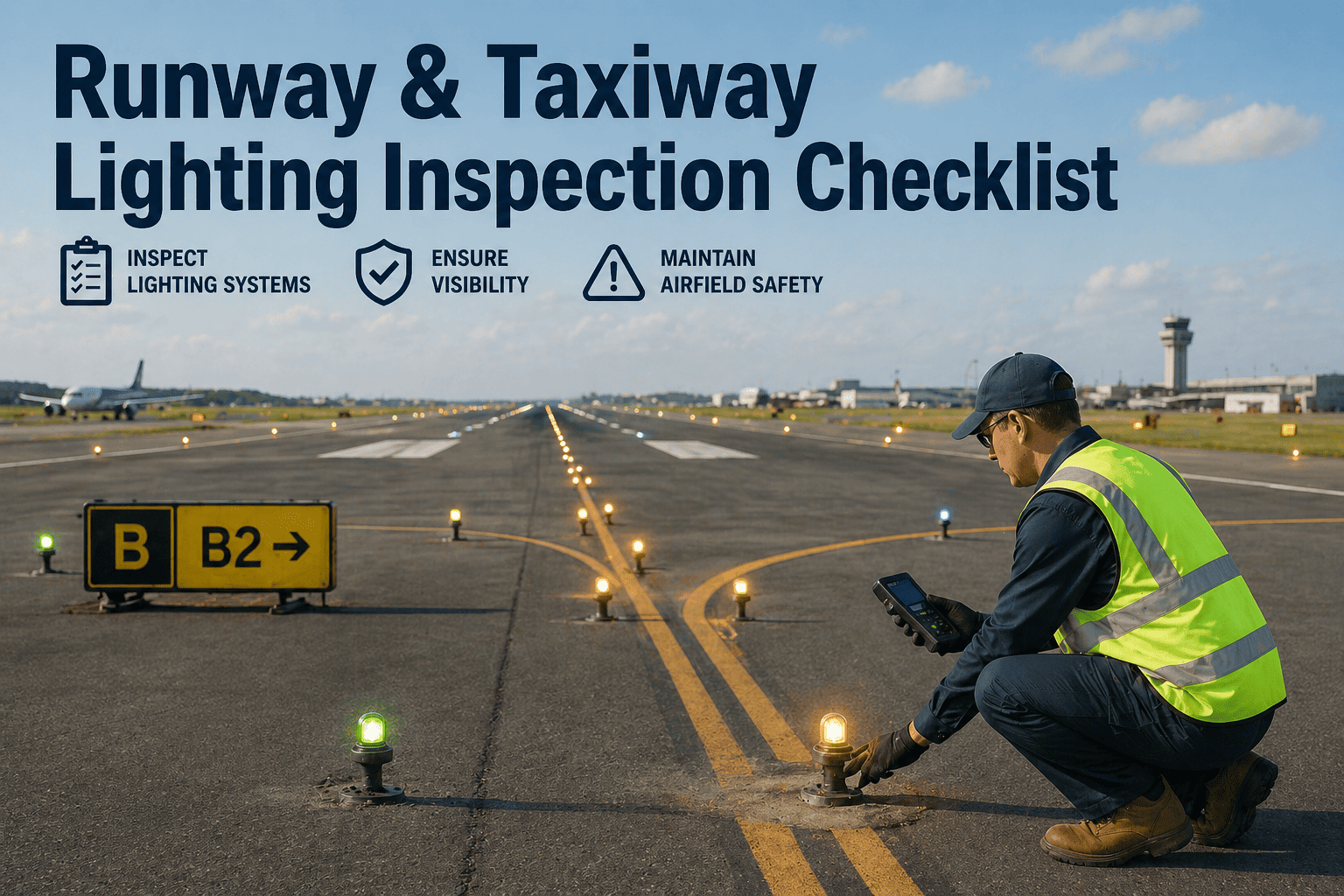
Runway edge lights and PAPI units are the two most inspection-intensive visual aid systems on any airfield, and a single uncorrected outage can trigger a NOTAM that strips a runway of instrument approach minima or, in busy towered environments, halts night operations entirely. FAA AC 150/5340-26 and ICAO Annex 14 Volume I both demand structured, recurring verification of these assets — photometric output, beam elevation, circuit integrity, lamp health — which means maintenance teams must run a defensible, auditable inspection program rather than reacting lamp-by-lamp. This guide breaks down what a 2026-grade CMMS-based lighting inspection program looks like for edge and approach systems, including photometric thresholds, PAPI angle verification tolerances, and the failure-cost math that justifies investing in a digital program. If your team is ready to migrate from spreadsheets to a structured, auditable CMMS workflow, you can Start Free Trial and configure the runway lighting inspection modules in under an hour.
AIRFIELD LIGHTING INSPECTION · 2026
Is one unlogged PAPI lamp worth a missed approach at minimums?
A single white/red transition error on a PAPI unit can push a Category I approach below authorized minima, forcing go-arounds that cost carriers $4,000–$12,000 in fuel, crew time and slot disruption. A CMMS-driven inspection program catches angle drift, lamp outage and circuit degradation before they reach the cockpit.
REGULATORY DRIVERS
Why edge lighting and PAPI inspection is non-negotiable in 2026
FAA AC 150/5340-26C and ICAO Annex 14 define mandatory inspection intervals for airfield lighting. The cost gap between a structured, CMMS-tracked program and a reactive one is measured in six-figure NOTAM exposure per runway per year.
On a typical CAT I airfield operating 16–18 hours daily, a structured inspection program logs between 240 and 360 discrete lighting checks per runway annually — covering edge lights, threshold lights, runway end identifier lights, approach lights and PAPI units. Each check produces evidence the FAA, ICAO auditors and airline safety teams will request: photometric readings, CCR current levels, lamp serial numbers, technician identity, timestamp and weather conditions. Without a CMMS to structure this evidence, the inspection paper trail becomes the single biggest liability during a Part 139 annual certification review.
CHECKLIST PROGRAM
The runway lighting inspection checklist — tier by tier
A defensible program splits inspections into daily, monthly and quarterly tiers. Each tier maps directly to FAA and ICAO language so an auditor can trace any log entry back to a regulatory citation.
- Visual scan of all edge lights for outages during evening civil twilight
- PAPI color transition check from the designated observation point
- Confirm CCR output current matches last calibrated step setting
- Log any NOTAM-issued lighting discrepancies with time and technician ID
- Lamp replacement sweep on any unit with >2 aged lamps since last cycle
- Approach light bar — verify all fixtures aligned within ±0.5° of runway centerline
- Inspect fixture bases, frangible couplings and isolated transformer connections
- Test series circuit insulation resistance; record megger values in CMMS
- Photometric survey of PAPI units using calibrated lux meter at design eye position
- Beam elevation verification with theodolite or electronic inclinometer
- CCR step calibration audit against manufacturer tolerance tables
- Approach light photometric spot-check at 10% sample of fixtures
PAPI ANGLE VERIFICATION
Calibrating PAPI beam elevation — tolerances and technique
PAPI is the system most prone to silent failure: a beam can drift half a degree without triggering any alarm, yet raise decision height by 50 feet. The quarterly angle check is the single highest-value inspection your team performs.
PAPI angle tolerance envelope (ICAO Annex 14)
θmeasured = θsetting ± 0.25°
Where θsetting is the commissioned approach angle, typically 3.00° for most CAT I runways. Any deviation outside ±0.25° requires NOTAM action and recalibration within 24 hours.
Transition zone — color change boundary
ΔHtransition ≤ 0.05°
The pink transition band between red and white must occupy less than 0.05° of vertical angle. Wider bands indicate lamp misalignment, contaminated filters or failing optical assemblies.
| PAPI defect | Detection method | Tolerance | CMMS action |
|---|---|---|---|
| Beam elevation drift | Theodolite / inclinometer at design eye position | ±0.25° of commissioned angle | Auto-generate recalibration work order |
| Lamp outage (single unit) | Visual color-transition scan, daily | 0 outages permitted on active PAPI | Trigger lamp-replace WO within 4 hours |
| Pink transition widening | Photometric survey with lux meter | ≤0.05° vertical band | Schedule optical assembly inspection |
| CCR current deviation | Monthly ammeter reading at vault | ±2% of rated series current | Escalate to electrical maintenance lead |
| Fixture tilt post-mow | Quarterly alignment sweep | ±0.5° from runway centerline | Realign fixture; log root cause |
CMMS WORKFLOW
From daily scan to closed work order — the inspection lifecycle
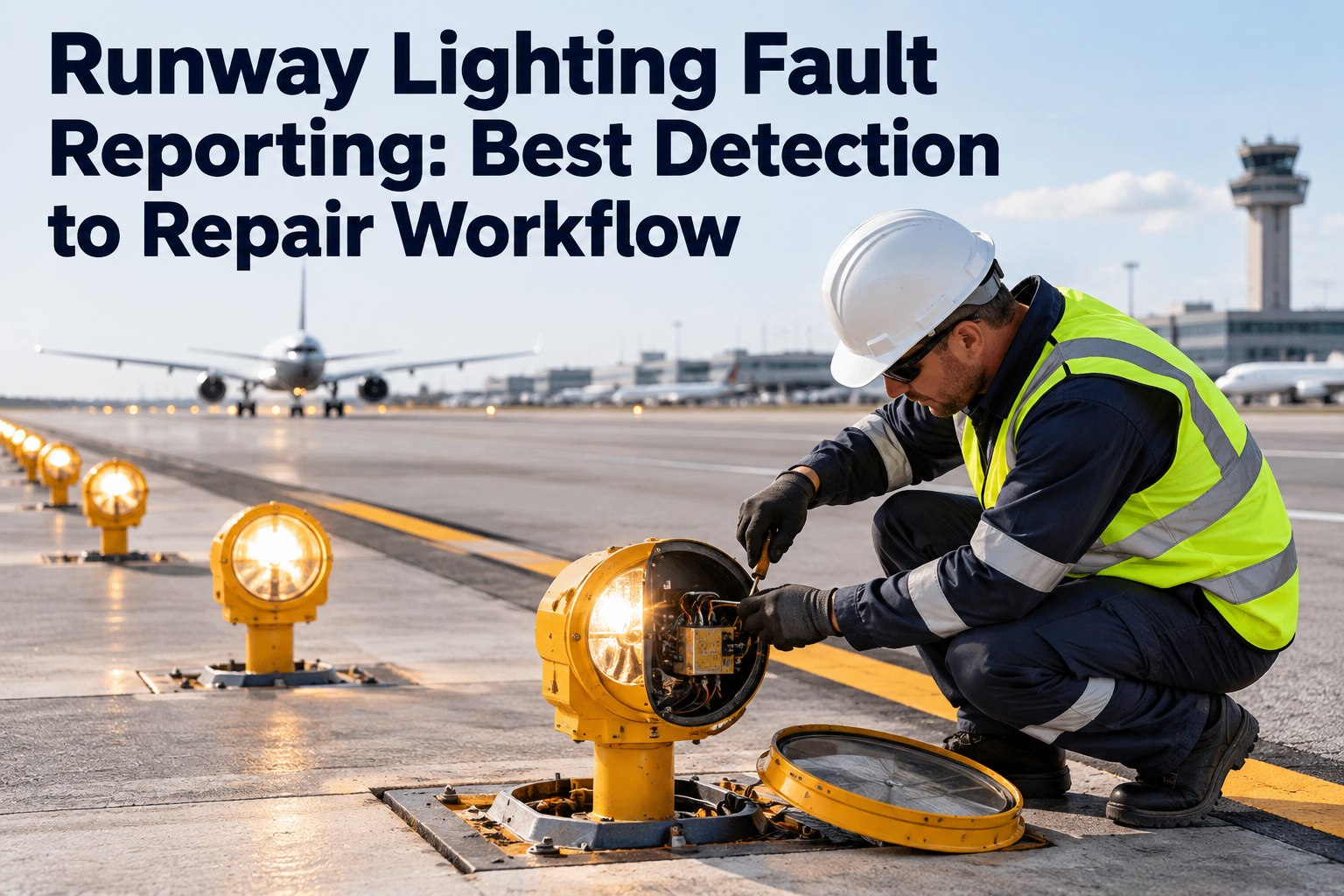
A 2026-grade CMMS compresses the time from defect detection to verified closure. Here is the typical lifecycle for a PAPI lamp outage detected during a daily evening scan.
T+0 min · Field detection
Technician on twilight scan observes a missing white segment on PAPI unit 3. Mobile CMMS app logs the defect with GPS coordinates, photo attachment and timestamp.
T+5 min · NOTAM decision
CMMS evaluates the defect against the runway's operational category. If the outage reduces PAPI below 3 functional units, the system auto-drafts a NOTAM recommendation to ATC and the operations supervisor.
T+20 min · Work order dispatch
A lamp-replacement work order is generated, pre-stocked with the correct lamp SKU, isolation transformer ID and torque spec. The on-call electrician receives it via mobile push notification.
T+90 min · Repair and verify
Lamp replaced, fixture re-sealed, color transition re-checked from observation point. CMMS requires photo evidence and a second-technician sign-off before allowing work order closure.
T+95 min · NOTAM cancellation
Closure triggers auto-notification to ATC and operations. The full chain — detection, NOTAM, dispatch, repair, verification, cancellation — is archived as a single audit-ready record.
REAL-WORLD IMPACT
The cost of not running a structured program
A regional airport operating two runways with 280 edge lights and 8 PAPI units typically spends $42K–$68K annually on reactive lighting maintenance. Structuring the same program in a CMMS reduces that spend by 30–40% and, more importantly, cuts NOTAM exposure from an average of 14 days per year to under 4.
NOTAM days reduced
14 → 4
A Midwest regional airport cut lighting-related NOTAM days from 14 to 4 in year one after migrating to a CMMS-driven daily scan with auto-dispatch.
Annual maintenance savings
$18K
Bulk lamp purchasing, scheduled CCR calibration and eliminated emergency callouts saved a 280-fixture program $18,200 in direct labor and parts within 12 months.
Audit preparation time
85%
Part 139 annual recertification prep dropped from 40 staff-hours to under 6, because every inspection record was already structured, timestamped and exportable from the CMMS.
"
Before the CMMS, our PAPI logs lived in three-ring binders that nobody wanted to touch during an audit. Now a FAA inspector can pull any photometric reading from any quarter in under thirty seconds — and our NOTAM exposure has dropped to single digits per year.
— Maintenance Supervisor, Category I regional airport, 2025 program review
Turn every lighting check into audit-ready evidence
Configure daily scans, quarterly PAPI surveys and CCR calibration cycles in a CMMS built for Part 139 and ICAO Annex 14 airfield compliance.
FREQUENTLY ASKED
Runway lighting and PAPI inspection — answered
How often must PAPI units be photometrically inspected under FAA guidance?
FAA AC 150/5340-26C requires a photometric and beam-elevation check of every PAPI unit at least quarterly, with daily visual color-transition scans in between. Airports operating under Part 139 must retain every reading — lux value, beam angle, technician identity, timestamp — for the full certification cycle. A CMMS automates this retention and flags any unit approaching tolerance drift. You can Start Free Trial to configure the quarterly PAPI survey template in minutes.
What is the acceptable tolerance for PAPI beam elevation error?
ICAO Annex 14 specifies a maximum permissible deviation of ±0.25° from the commissioned approach angle, typically 3.00°. Anything outside that envelope requires a NOTAM raising approach minima until recalibration. The pink transition band between red and white must occupy less than 0.05° of vertical angle — wider bands indicate optical contamination or lamp tilt that warrants immediate inspection.
How does a CMMS handle lamp replacement scheduling for edge lighting?
Rather than replacing lamps reactively one outage at a time, a CMMS tracks lamp hours, failure rates and batch serial numbers across each series circuit. When a circuit exceeds a configurable threshold — typically 5% outages within a 30-day window — the system generates a bulk replacement work order, pre-stocked with the correct SKU and torque specifications. This cuts lamp cost per fixture by 20–30% through bulk purchasing and eliminates repeat truck rolls.
Can a CMMS auto-generate NOTAMs when a lighting defect is detected?
A well-configured CMMS evaluates any logged defect against the runway's operational category and auto-drafts a NOTAM recommendation when the failure reduces the system below authorized minimums — for example, a PAPI with fewer than 3 functional units. The draft routes to the operations supervisor for approval and transmission to ATC, and the full chain from detection to NOTAM cancellation is archived as a single audit record. To see this workflow live, Book a Demo.
What records does a Part 139 auditor expect to see for runway lighting?
Inspectors look for a continuous, timestamped log of daily scans, monthly circuit tests, quarterly photometric surveys, CCR calibration records, lamp replacement histories and NOTAM chains. Each entry must tie to a technician identity, a weather condition note and a regulatory citation. A CMMS structures this evidence at the point of capture, so an auditor can export a full year of records for any runway in under five minutes rather than reconstructing it from paper binders.
Build your 2026 runway lighting inspection program today
Deploy daily scans, quarterly PAPI surveys, CCR calibration cycles and auto-NOTAM workflows in a CMMS engineered for Part 139 and ICAO Annex 14 compliance.
Free 14-day trial · No credit card