Aviation maintenance has always been a discipline where human judgment sits at the center of every safety-critical decision. The rapid integration of AI-driven diagnostics, predictive maintenance alerts, and automated work order prioritization is introducing a new class of risk that most MRO quality programs have not yet designed controls for — the risk of the human operator over-trusting the machine. Automation bias, alert fatigue, skill erosion, and decision fatigue are not theoretical concerns from academic papers. They are documented failure modes occurring right now in AI-augmented maintenance environments across every major aviation market, and they can reach airworthy aircraft before any existing quality gate is positioned to catch them. FAA human factors research consistently finds that over 80 percent of aviation maintenance errors carry a human factors element — and that proportion does not decline when AI tools are introduced. It shifts into new failure modes that traditional oversight systems were never calibrated to detect. Managing human factors in AI-driven maintenance is not an HR program or a training initiative. It is a structural airworthiness responsibility. Want to see how Oxmaint integrates human factors safeguards directly into the AI maintenance workflow? Start a free 30-day trial today or book a session with our aviation operations team to see the cognitive load monitoring and override analytics modules working on real MRO data.
Human Factors in AI-Driven Aviation Maintenance: Preventing Automation Risks Before They Reach the Hangar Floor
AI tools in MRO are accelerating maintenance decisions — but without structured human factors management, they are also accelerating a category of error that paper-based quality systems were never built to catch.
Build an AI-Augmented Maintenance Program That Keeps Human Judgment — and Human Safety — at the Center
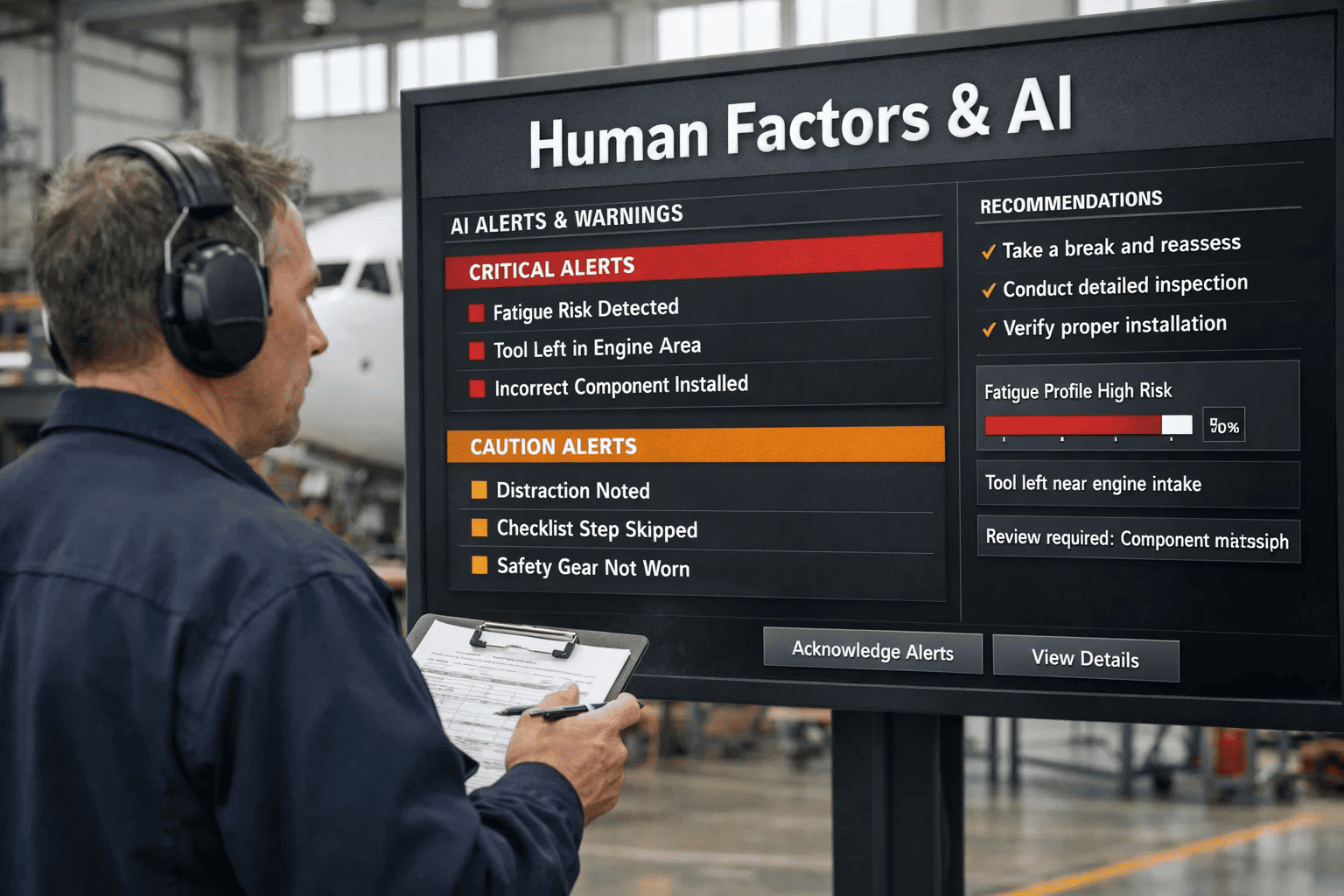
Oxmaint's Human Factors Analytics module tracks override patterns, alert acknowledgment behavior, cognitive load indicators, and shift-based decision volume across your maintenance teams — surfacing automation risk before it reaches a sign-off event and inserting structured confirmation gates exactly where behavioral data shows they are needed most.
What Are Human Factors in AI-Driven Aviation Maintenance?
Human factors in aviation maintenance is the study of how human capabilities, limitations, and behavioral patterns interact with tasks, tools, and environments to influence safety outcomes. In AI-driven maintenance, this discipline takes on a new and more complex dimension — because technicians are no longer working only with checklists and documentation. They are working with machine recommendations, probabilistic alerts, and automated prioritization that feels authoritative even when it carries significant uncertainty or a non-trivial error margin.
The fundamental risk is not that AI maintenance tools make mistakes. Every technology makes mistakes. The fundamental risk is that technicians and supervisors stop independently evaluating those mistakes — deferring to system outputs because overriding a machine recommendation feels uncomfortable, demands justification, or simply requires more cognitive effort than accepting it. This is automation bias, and it is now the fastest-growing documented human factors risk category in MRO environments across all major aviation markets.
Well-designed AI maintenance platforms account for this risk at the workflow architecture level — building in mandatory verification steps, transparent confidence scoring, cognitive load monitoring, and behavioral override tracking that keeps human judgment active rather than sidelined. The goal is not to remove AI from the decision pathway. The goal is to ensure AI recommendations remain a tool that technicians use critically, not a ruling that technicians accept reflexively. See how Oxmaint manages the human-AI interface across your maintenance operation — start a free 30-day trial to explore the human factors dashboard on your real data or book a live session with our aviation human factors team and walk through the override analytics module.
6 Documented Human Factors Risks in AI-Augmented Aviation MRO
Each risk category below represents a documented failure mode in AI-assisted maintenance environments — identified through FAA human factors research, EASA safety analysis, and peer-reviewed aviation maintenance human performance studies published between 2019 and 2025. Understanding how Oxmaint addresses each one is straightforward — start a free trial and see the human factors controls working live in the platform or book a demo and walk through each module with our aviation team on your operational setup.
4 Ways Current MRO Platforms Amplify Human Factors Risk Instead of Managing It
The majority of AI maintenance tools deployed in aviation today were designed to maximize predictive accuracy and workflow throughput — not to manage the human behavioral effects those tools create in the technicians who use them every shift.
How Oxmaint Builds Human Factors Management Into the AI Maintenance Workflow
Oxmaint's Human Factors Analytics module monitors behavioral signals across the maintenance workflow — override frequencies, alert acknowledgment patterns, decision timing, and shift-based cognitive load indicators — surfacing automation risk before it reaches a sign-off event and inserting structured confirmation gates exactly where the behavioral data shows they are needed. See what that visibility looks like on your operation — start a free 30-day trial with Oxmaint today or book a live demo and walk through the override analytics, alert tiering, and cognitive load dashboard with our aviation team.
Unmanaged AI Integration vs Oxmaint Human-Factors-Aware Platform
The difference is not in AI capability itself — it is in whether the platform was designed to manage the human behavioral effects that AI generates in the maintenance teams using it.
| Human Factors Area | Unmanaged AI Integration | Oxmaint Human-Factors-Aware Platform |
|---|---|---|
| Automation Bias Detection | No override tracking — bias accumulates invisibly over months without supervisor visibility | Override patterns tracked per technician with supervisor alerts when behavior exceeds safe thresholds |
| Alert Volume Management | All alerts routed to technician in real time — volume drives fatigue and systematic dismissal behavior | Intelligent tiering routes alerts by confidence and urgency — technician receives only actionable, specific notifications |
| AI Recommendation Transparency | Recommendations presented without confidence scores — technicians cannot assess AI reliability per task | Every recommendation includes confidence score, data quality indicator, and model uncertainty range |
| Cognitive Load Monitoring | No real-time visibility into technician cognitive state — supervisors unable to identify fatigue risk | Live cognitive load dashboard per technician enables proactive reallocation before error probability peaks |
| Sign-Off Verification Gates | AI acceptance substitutes for independent technician verification on safety-critical task closures | Mandatory human confirmation gates on high-risk tasks — not bypassable through AI acceptance alone |
| Skill Maintenance Scheduling | No manual skill workflow — AI handles all diagnostics, progressively degrading technician proficiency | Scheduled manual verification tasks maintain proficiency across all AI-assisted skill areas per technician |
| Mode Clarity | Technician unclear on current system mode during task handoffs — mode confusion precursors unaddressed | Persistent, unambiguous mode indicators on every task screen — technician always knows their current responsibility |
| Regulatory Documentation | No human factors behavioral data captured — cannot demonstrate proactive HF management during audits | Full behavioral dataset exportable for regulatory audits and SMS reporting across all major authority frameworks |
ROI of Structured Human Factors Management in AI-Augmented MRO Operations
Quantified outcomes that accountable managers, directors of quality, and VP-level operations leaders use to build the internal business case for human factors management investment in AI-assisted maintenance programs.
Frequently Asked Questions
What is automation bias and why is it a specific safety risk in AI-assisted aviation maintenance? +
Automation bias is the tendency to over-rely on automated system outputs — accepting machine recommendations without independent verification, even when other cues indicate those recommendations may be incorrect. In aviation maintenance, this manifests when a technician accepts an AI-generated inspection pass or work order closure because the system flagged it as complete, without independently confirming their own physical inspection findings. The risk is acute because the consequences of a missed defect are not a downstream quality problem. They are an airworthiness event. Automation bias develops progressively: technicians working with high-accuracy AI systems experience fewer errors when following the AI recommendation, which reinforces deference behavior even in the minority of cases where the AI is wrong. Without structured behavioral monitoring and override tracking in the platform, this bias accumulates invisibly — reaching dangerous levels before any quality gate catches it. Want to understand how Oxmaint tracks and manages automation bias in your team's workflow? Start a free trial and explore the override analytics and human factors dashboard today or book a live demo with our aviation human factors specialists to walk through the behavioral monitoring module on your real operational data.
How does Oxmaint prevent alert fatigue in high-volume AI maintenance environments? +
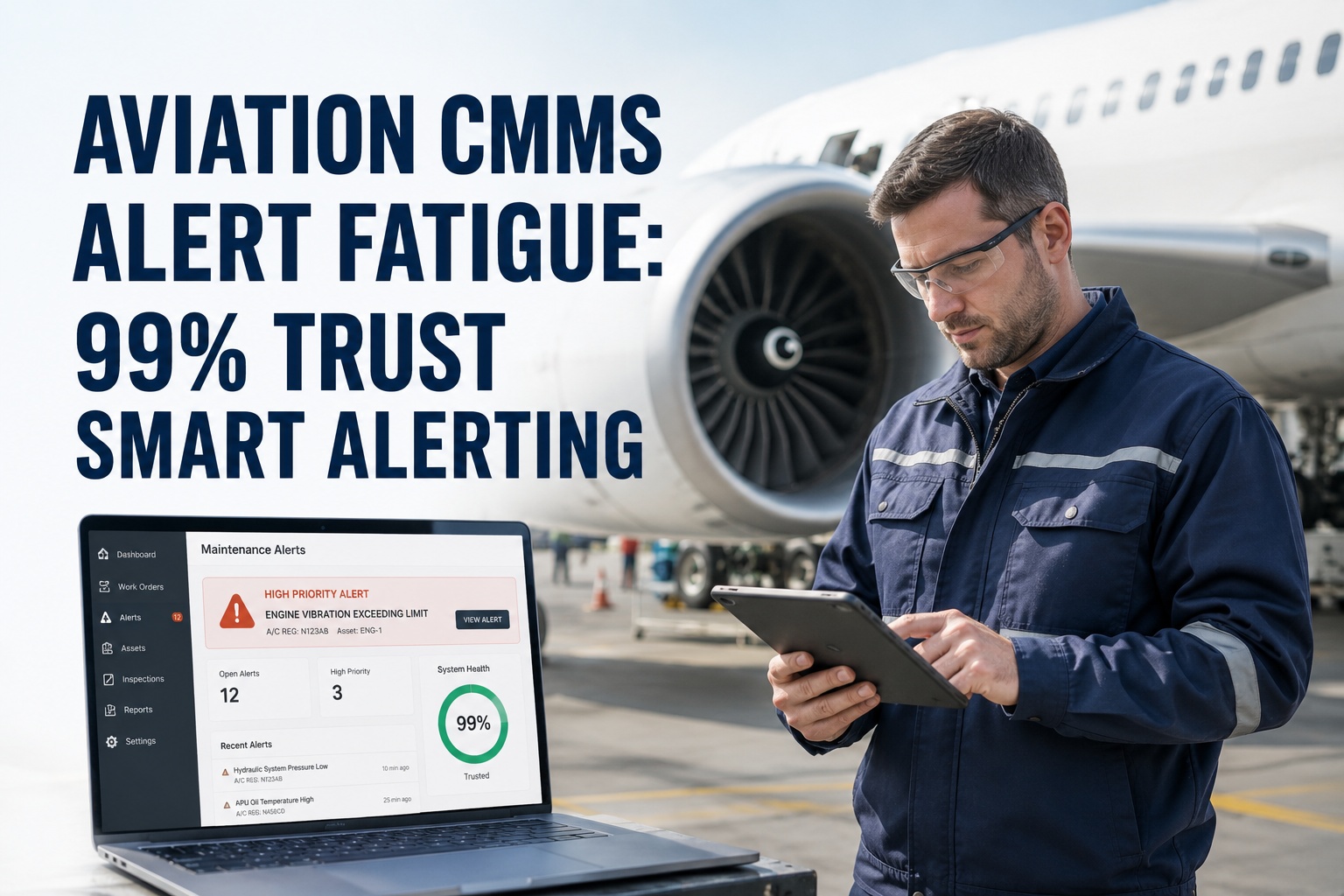
Oxmaint addresses alert fatigue through intelligent alert classification rather than simply reducing overall notification volume. Each AI-generated alert is assessed for confidence score, task urgency, operational context, and potential consequence severity before routing to the technician interface. High-confidence, high-urgency alerts reach the technician immediately and prominently. Low-confidence or low-urgency alerts are batched into a reviewed queue, routed to supervisor oversight, or held pending additional data confirmation — preventing the high-volume, low-specificity stream that drives systematic dismissal behavior. The platform also monitors each technician's alert acknowledgment patterns over time: sudden increases in rapid acknowledgment without corresponding task action are flagged as potential alert fatigue indicators, triggering a supervisor review prompt before the behavior becomes entrenched.
How does Oxmaint support technician skill maintenance alongside AI-assisted workflows? +
Oxmaint's workflow engine includes a dedicated skill maintenance scheduling module that integrates manual inspection and diagnostic tasks directly into the standard work order queue — ensuring technicians perform hands-on, AI-unassisted tasks across critical skill areas at defined intervals configured by the quality management team. Skill maintenance tasks are explicitly distinguished in the technician interface: they require independent findings documentation before any AI recommendation is displayed, preserving the independent assessment habit even in environments where AI assistance is the daily operational norm. Completion rates for scheduled skill maintenance tasks are tracked per technician and surfaced in competency records accessible to supervisors, training coordinators, and quality managers.
What regulatory frameworks currently address human factors in AI-assisted aviation maintenance? +
Regulatory guidance on human factors in AI-assisted aviation maintenance is actively evolving across all major authorities. The FAA's Advisory Circular AC 120-72B on Maintenance Human Factors Programs provides the foundational framework for US operations, requiring approved maintenance organizations to address human performance factors in their quality systems — an obligation that extends to AI tool deployments as those tools become integrated into regulated workflows. EASA's NPA 2023-11 on AI in aviation safety has proposed specific requirements for AI system transparency and human oversight in safety-critical applications, with formal rulemaking anticipated by 2026. The UK CAA and CASA in Australia have both issued safety notices highlighting automation complacency and over-reliance as emerging SMS risks requiring proactive management. Oxmaint's human factors documentation module generates audit-ready behavioral data reports that map directly to human performance program documentation requirements under each of these regulatory frameworks.
Keep Human Judgment Sharp — Even as AI Takes on More of the Workflow
Every AI tool you deploy changes how your maintenance teams think, decide, and verify. Oxmaint's Human Factors Analytics module builds the behavioral monitoring, alert management, and cognitive load visibility your quality program needs to ensure AI augments human judgment rather than replacing it.
Trusted by aviation MRO operations across the USA, UK, Australia, UAE, Canada, and Germany. No lengthy implementation. Human factors monitoring active from day one of onboarding.