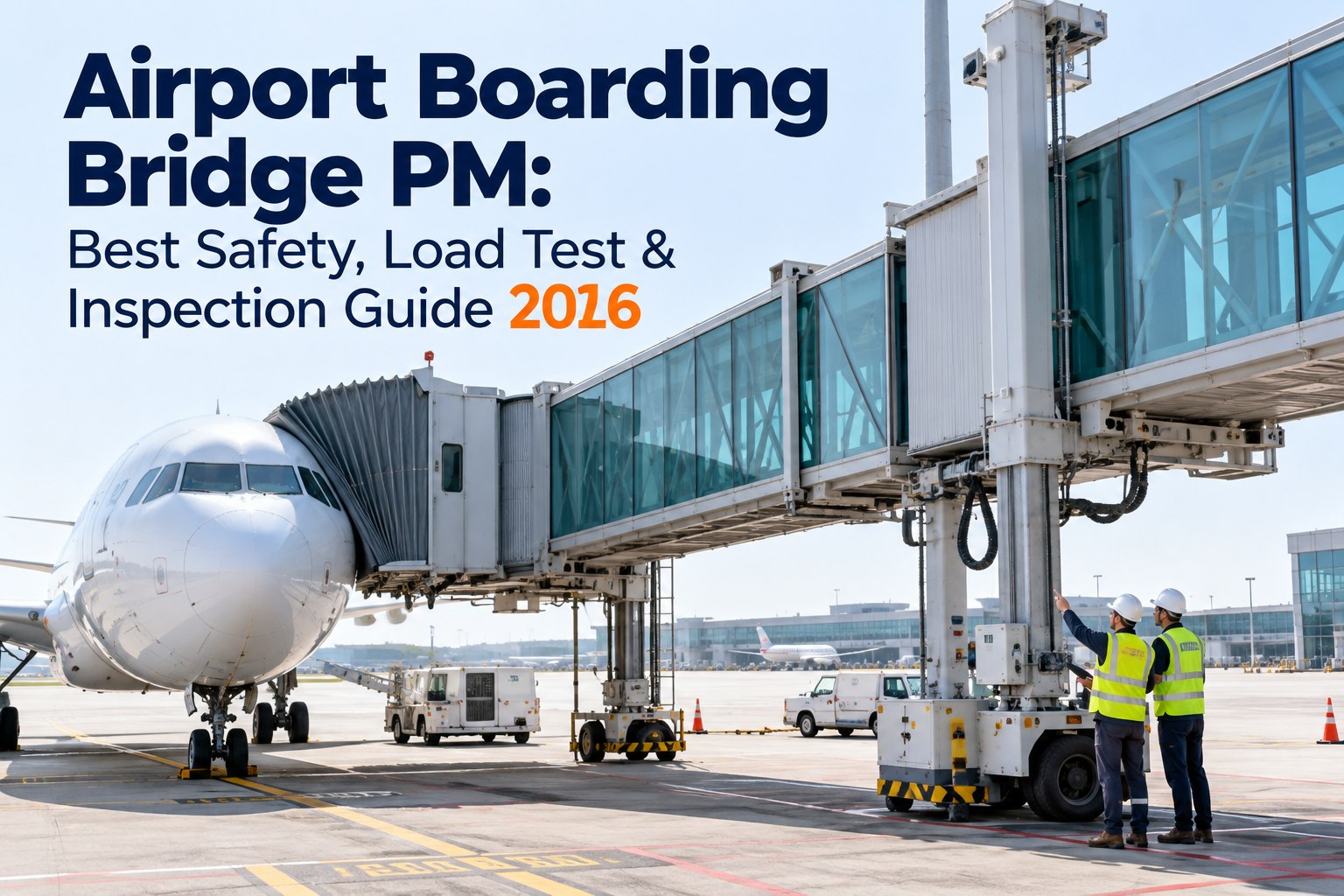
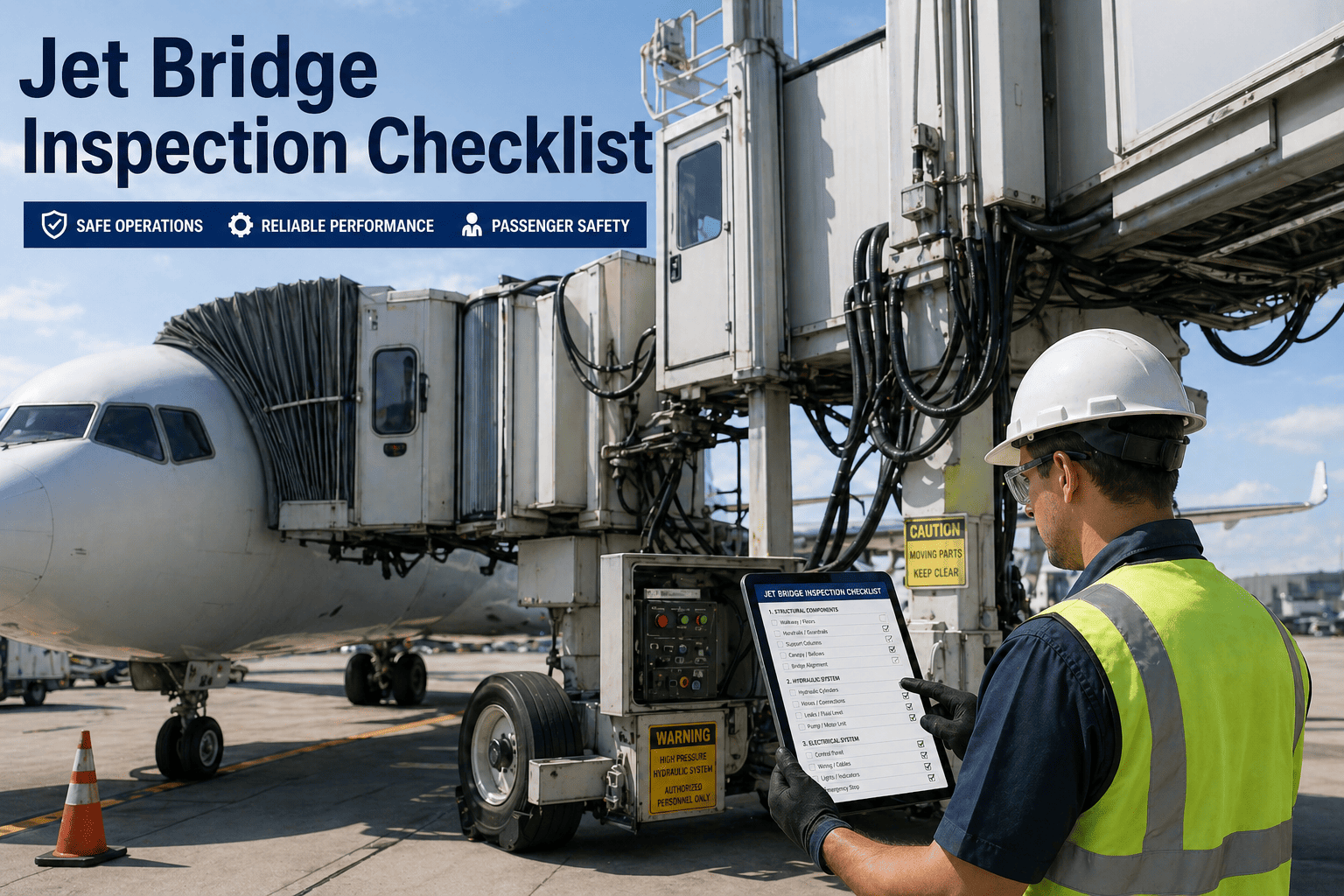
A single jet bridge can handle 200–400 docking cycles daily, accelerating structural fatigue, wheel carriage wear and seal degradation. Missing load tests or overdue inspections can sideline a bridge and cost $12,000–$25,000 per gate per day. A tiered PM program targets six key subsystems — hydraulic, drive, structural, electrical/controls, canopy and safety — to catch early warning signs. OXMAINT AI keeps every inspection, maintenance task and bridge record audit-ready.
Airport Ground Support · Passenger Boarding Bridges · PM & Load Testing · 2026
Airport Boarding Bridge PM: Best Safety, Load Test & Inspection Guide
A gate agreement doesn't get suspended over a bridge that failed — it gets suspended over a load test nobody can produce. OXMAINT AI connects the full inspection workflow: daily walkarounds, monthly functional tests, annual load testing and 5-year structural surveys all log against the specific bridge, any deviation becomes a tracked work order, and the complete cycle-based history stays retrievable the moment an airline or inspector asks for it.
Tiered Inspection Logged
→
Deviation Flagged
→
Work Order Created
→
Load Test & NDT History Tracked
200–400
docking cycles per day on a typical jet bridge, accelerating wear and fatigue
$12K–$25K/day
revenue lost per gate when a bridge is sidelined by a missing or failed inspection
92%
of jet bridge failures trace back to just six inspectable subsystems
4 Tiers
daily, monthly, annual and 5-year inspection frequencies in a complete PBB program
The Four-Tier PBB Inspection Framework
Collapsing every check into one annual event consistently misses early degradation in high-cycle components like drive wheels and hydraulic seals. Each tier targets a different failure mode. Sign up free and build this exact framework for your bridge fleet.
Tier 1 · Daily
Operator Walk-Around
5–10 minutes per bridge, before first docking
Drive wheel condition and tire pressure
Hydraulic fluid level check
Canopy seal and bumper condition
Lighting and emergency stop function
Tier 2 · Monthly
Functional Inspection
45–90 minutes, full operational cycle test
Full extend/retract cycle timing
Hydraulic pressure and seal integrity
Drive motor current draw measurement
Safety interlock and sensor calibration
Tier 3 · Annual
Comprehensive Audit
4–8 hours, specialist-level teardown
Structural weld and bolt inspection
Electrical panel and wiring audit
NFPA 415 compliance verification
Foundation and column load test
Tier 4 · Every 5 Years
NDT & Structural Survey
1–2 days, specialist contractor
Ultrasonic thickness measurement
Corrosion depth mapping
Seismic anchor bolt evaluation
Remaining useful life assessment
Six Subsystems Behind 92% of Jet Bridge Failures
Hydraulic System
Cylinder seal integrity, fluid level and contamination, pressure testing against OEM specs.
Drive System
Drive wheel tread depth — replace at 50% wear — plus bearing condition and travel motor lubrication.
Structural
Column pivot pins, torque arms, steel structure corrosion at gate apron connections.
Electrical & Controls
PLC docking logic, proximity sensor alignment, auto-leveler height sensors and bumper sensitivity.
Canopy & Weatherproofing
Bellows and weather seal condition — a torn membrane means water ingress and a slip hazard.
Safety & Emergency
E-stop circuits, door interlocks, proximity sensors preventing aircraft contact, emergency lighting.
Critical Safety Response Thresholds
A handful of numbers define whether a bridge's safety systems are actually protecting an aircraft and its passengers — these are the ones every inspection should verify against spec, not just confirm "operational."
<0.3 sec
E-Stop Response
Emergency stop buttons must cut drive power in under 0.3 seconds — verified, not assumed.
<0.5 sec
Auto-Leveler Response
Auto-leveler limit switches must respond within 0.5 seconds to keep the walkway level as the aircraft settles.
50% Wear
Drive Wheel Replacement
Drive wheel tread depth gets replaced at the 50% wear threshold — not run to failure.
90 Days / 500 Cycles
Drive Lubrication Interval
Drive wheels and travel motors lubricate on whichever comes first — time or cycle count.
An Annual Inspection Alone Misses What Happens Between January and December.
OXMAINT AI schedules all four tiers automatically — daily walkarounds, monthly functionals, annual load tests and 5-year NDT surveys — with digital checklists and timestamped records for every bridge.
From Walkaround to Closed Work Order
1
Inspection performed
Daily, monthly, annual or 5-year check completed at the appropriate tier.
→
2
Logged to the bridge
Entry timestamped against the specific bridge and gate, not a general log.
→
3
Deviation flagged
A worn wheel, slow auto-leveler response or seal failure surfaces against that record.
→
4
Work order created
A corrective work order routes to maintenance, with the deviation and bridge history attached.
→
5
Record retained
Closure evidence links back to the finding, retrievable by bridge and date when an airline asks.
Clipboard Logs vs. Digital Tiered PM in OXMAINT AI
Clipboard & Single Annual Event
Daily walkarounds recorded on paper, easy to skip or lose
Monthly functional tests often merged into the annual audit
Load test and NDT records filed separately, hard to produce together
Wheel wear and seal degradation caught only at the annual teardown
Digital Four-Tier PM in OXMAINT AI
Daily checklist pushed automatically to a technician's mobile device
Monthly functional tests run and recorded on their own schedule
Load test, NDT and annual audit history all in one bridge record
Wear and degradation caught at the tier designed to catch it
What OXMAINT AI Gives Airport Ground Support Teams
Four-Tier PM Scheduling
Daily, monthly, annual and 5-year inspections scheduled automatically per bridge, with digital checklists pushed to mobile.
Load Test & NDT Tracking
Annual load test and 5-year structural survey records stay attached to the bridge, retrievable together for any review.
Deviation-to-Work-Order Linking
A worn wheel, slow response time or seal failure becomes a tracked work order automatically, with the finding attached.
Cycle & Time-Based Triggers
Lubrication and wear-part tasks trigger on cycle count or elapsed time, whichever comes first — not a fixed calendar date alone.
Photo-Documented Findings
Every inspection tier supports photo capture, so a canopy tear or corrosion finding has visual evidence attached.
Exportable Records by Bridge
Pull a specific bridge's full daily, monthly, annual and 5-year history in minutes when an airline requests it.
"
We used to fold everything into one big annual event, and it meant we were essentially finding out about drive wheel wear once a year whether it needed attention or not. Since splitting inspections into the four tiers in OXMAINT AI, the daily walkaround catches obvious issues immediately, and the monthly functional test has caught auto-leveler response drift twice now before it became a finding at the annual audit. When an airline asked for two years of load test records on one gate last quarter, it was a five-minute export.
Ground Support Equipment Manager · International Airport
Frequently Asked Questions
How often does a passenger boarding bridge need a load test?
Structural load testing is typically part of the annual comprehensive audit, verifying the foundation and column can safely bear the rated load. A separate, more extensive structural survey using non-destructive testing is commonly performed every five years to assess long-term fatigue and corrosion.
Why does a single annual inspection miss so many jet bridge failures?
High-cycle components like drive wheels, hydraulic seals and auto-leveler sensors degrade continuously between annual events. A four-tier schedule catches that gradual wear at the daily, weekly and monthly checkpoints, rather than only discovering it once a year during the comprehensive teardown.
What happens when a daily walkaround finds a defect?
The finding logs against the specific bridge and creates a work order automatically, with the defect details and bridge history attached, so the operator's daily check connects directly to the maintenance team's response rather than sitting on a separate paper form.
How does OXMAINT AI help when an airline requests PBB maintenance records before a gate use agreement?
Every tier's inspection history — daily, monthly, annual load test and 5-year NDT survey — is stored against the specific bridge and exportable by date range, so a records request can be answered in minutes rather than assembling files from multiple logs and locations.
Inspect the Right Tier, at the Right Frequency, Every Time.
Daily walkarounds, monthly functionals, annual load tests and 5-year structural surveys — all scheduled, tracked and retrievable by bridge. That's the PM program OXMAINT AI runs.